01. Quick Answer
AI can push natural gas prices both higher and lower, depending on whether power demand or system efficiency wins first
NYMEX natural gas futures settled at about $3.04/MMBtu on May 18, 2026 on the Yahoo Finance chart API, NG=F 1-month daily data, while EIA's official monthly Henry Hub benchmark averaged $2.77/MMBtu in April 2026 according to the EIA, Short-Term Energy Outlook: Natural gas, May 12, 2026. That split matters. Futures reflect the market's latest expectations and risk premium, while the Henry Hub cash benchmark is the cleaner official anchor for medium-term scenario work.
The IEA, Energy and AI: Energy supply for AI says natural gas and coal together are expected to meet more than 40% of additional data-center electricity demand until 2030, while the IEA, Energy and AI: Energy demand from AI says data centers still account for less than 10% of total global electricity-demand growth over that period. Those two ideas are not contradictory. They mean AI is meaningful for marginal power demand, but not automatically dominant for the entire gas market.
| Category | Evidence-based read | Implication |
|---|---|---|
| Bullish AI channel | Data centers can increase electricity demand and support gas-fired generation. | AI can raise gas demand in regions that need fast firm power. |
| Bearish AI channel | AI can also improve drilling, trading, forecasting, and grid efficiency. | Higher supply efficiency and lower energy intensity can offset part of the demand impulse. |
| Most likely outcome | The evidence is mixed rather than one-directional. | AI should be treated as a scenario amplifier, not a standalone forecast. |
| Investor implication | Watch power contracts, grid bottlenecks, and gas-fired buildouts more than generic AI headlines. | Transmission from AI to gas price is indirect and region-specific. |
02. Historical Context
Natural gas has always repriced when a new demand source arrives, but the size of that repricing depends on infrastructure
Historically, natural gas has not moved simply because a new narrative emerges. It moves when that narrative becomes physical: more pipeline flows, more export trains, more power demand, or lower storage. AI should be analyzed the same way. The right question is not whether AI is important. It is whether AI changes the physical gas balance enough to matter.
Over the last decade, the same benchmark has traded from a 10-year low near $1.43/MMBtu in June 2020 to a 10-year high near $10.03/MMBtu in August 2022 based on the Yahoo Finance chart API, NG=F 10-year monthly data. That range is why any serious natural gas forecast needs regimes and probabilities, not a single heroic target. The transition from a regional shale market to a global LNG-linked market is a good example. Prices did not structurally change because people talked about LNG. They changed because export capacity and utilization rose. The same logic applies to AI.
| Marker | Approximate level | Interpretation |
|---|---|---|
| June 2020 low | $1.43/MMBtu | Pandemic-era demand destruction and oversupply showed how quickly gas can break when storage and weather turn against bulls. |
| August 2022 high | $10.03/MMBtu | The European energy crisis and LNG-linked scarcity proved that U.S. gas is no longer insulated from global stress. |
| March 2024 low close | $1.76/MMBtu | Warm weather, strong output, and ample inventories can still push the market back toward sub-$2 conditions. |
| January 2026 spike | $7.83 intramonth high | Short-term squeezes remain possible when winter weather, storage withdrawals, and export utilization line up. |
| May 18, 2026 close | $3.04/MMBtu | The latest tape sits near the middle of the long-run range, which is why scenarios matter more than momentum extrapolation. |
03. AI Channels
How AI could influence natural gas prices
1. AI raises power demand in gas-heavy regions
The EIA press release, strongest four-year growth in U.S. electricity demand since 2000, fueled by data centers, January 13, 2026 projects strong U.S. electricity-demand growth driven by data centers, and the IEA, Energy and AI: Energy supply for AI says natural gas is one of the major fuels likely to meet incremental load through 2030. In constrained grids, gas can be the fastest dispatchable answer, which is the cleanest bullish AI-to-gas transmission channel.
2. AI can strengthen basis differentials and local price sensitivity
If data-center growth clusters in specific power markets, it can make regional gas and power fundamentals tighter even when national averages look comfortable. That means AI may matter first through localized basis and power pricing before it fully changes Henry Hub itself.
3. AI can improve supply productivity
On the bearish side, AI can help producers optimize drilling, completions, maintenance, and logistics. If productivity improves meaningfully, the supply curve can shift lower and offset part of the demand impulse.
4. AI can improve grid and demand efficiency
The IEA, Energy and AI: Energy demand from AI and IEA, Energy and AI: Energy supply for AI both emphasize that AI also improves system optimization. Better forecasting, more efficient cooling, smarter dispatch, and faster industrial optimization can reduce how much incremental gas is actually required.
5. AI can affect macro growth and therefore broader gas demand
If AI eventually boosts productivity across the economy, that could support industrial activity and energy demand more broadly. But the IMF, World Economic Outlook, April 2026 and World Bank, Commodity Markets Outlook, April 2026 suggest today's macro environment is still fragile, so this channel is more speculative than the power-demand channel.
| Driver | What the latest evidence suggests | Why it matters for price |
|---|---|---|
| LNG exports | EIA expects U.S. LNG exports to rise from 15.1 Bcf/d in 2025 to 17.0 in 2026 and 18.2 in 2027. | Higher export capacity links Henry Hub more tightly to global gas balances. |
| Associated gas | May 2026 STEO assumes more oil-linked gas output from the Permian than earlier forecasts did. | If oil stays firm, gas supply can grow even without a gas-drilling boom. |
| Storage | EIA estimated March-end inventories at 1,908 Bcf, around 4% above the five-year average. | Storage direction affects whether winter risk premium can stick. |
| Global LNG security | IEA says Middle East disruption has delayed the LNG easing wave by at least two years. | International tightness can still pull U.S. gas prices higher through arbitrage and export utilization. |
| Power demand and AI | EIA and IEA both point to data centers as a meaningful electricity-demand driver through 2027 and beyond. | Natural gas remains one of the fastest scalable firm-power options in many U.S. regions. |
04. Institutional Forecasts and Analyst Views
The institutional message is that AI matters, but mostly through power-system bottlenecks and marginal fuel choice
The strongest official AI-to-gas evidence comes from the EIA press release, strongest four-year growth in U.S. electricity demand since 2000, fueled by data centers, January 13, 2026, the EIA, Domestic and international demand drive natural gas production growth, April 8, 2026, and the IEA, Energy and AI: Energy supply for AI. Together they show a common theme: electricity demand is rising, data centers are part of that story, and natural gas remains one of the fuels most capable of meeting fast-growing firm-load needs.
But there is an important nuance. The IEA, Energy and AI: Energy demand from AI says data-center growth still accounts for less than 10% of global electricity-demand growth through 2030. That means AI alone probably does not justify a standalone structural gas supercycle. Instead, AI changes the probability distribution by increasing the odds of tighter power-sector demand in already-constrained markets.
| Source | Signal | Interpretation |
|---|---|---|
| EIA press release on data centers | Strongest four-year U.S. electricity-demand growth since 2000. | AI-related load is already affecting official demand projections. |
| EIA AEO 2026 growth article | High power-demand case explicitly includes data centers. | Long-run planning now treats data centers as a real variable. |
| IEA Energy and AI | Gas and coal can supply over 40% of added data-center demand to 2030. | Gas is a major marginal beneficiary where firm power is needed quickly. |
| IEA Energy demand from AI | Data-center load remains a minority of global power-demand growth. | AI is important, but not all-powerful. |
| Counterpoint | AI can also improve efficiency and productivity. | The net price effect is conditional, not automatic. |
05. Bull, Bear, and Base Case
How AI changes the probability distribution for natural gas
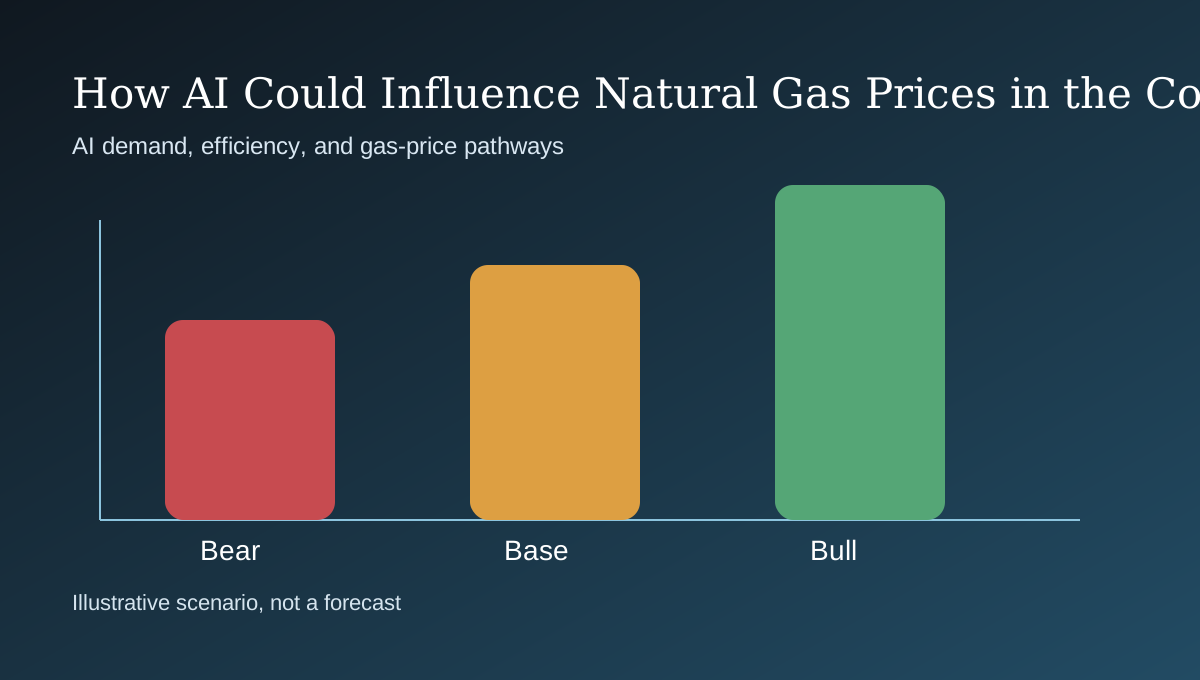
The framework below does not assume AI determines gas prices by itself. Instead, it asks whether AI amplifies an already-tight market, leaves the market roughly unchanged, or offsets demand by boosting productivity and efficiency.
| Scenario | Price effect range | Conditions | Probability |
|---|---|---|---|
| Bearish AI effect | -$0.25 to -$1.00/MMBtu versus non-AI path | Efficiency gains, better forecasting, faster supply response, and more non-gas power additions. | 25% |
| Base AI effect | Flat to +$0.75/MMBtu | AI raises power demand, but supply and efficiency absorb much of it. | 45% |
| Bullish AI effect | +$1.00 to +$2.50/MMBtu | Data-center power demand arrives faster than grids and non-gas supply can adapt. | 30% |
| Direction | Probability | Comment |
|---|---|---|
| Probability AI pushes prices higher | 45% | The power-demand channel is real, especially in constrained regions. |
| Probability AI pushes prices lower | 20% | This requires productivity and efficiency gains to dominate demand growth. |
| Probability AI has only a limited net effect | 35% | Still plausible because AI is one factor inside a larger gas market. |
| Investor type | Prudent approach | Main watchpoints |
|---|---|---|
| Investor already in profit | Hold a core view only if AI is one part of a broader LNG or power-demand thesis, not the entire thesis. | Watch actual utility and power-market evidence, not just AI hype. |
| Investor currently at a loss | Reassess whether the original thesis depended on a direct AI link that has not yet materialized. | AI can be a long lead-time theme. |
| Investor with no position | Wait for confirmation through gas-fired project announcements, utility filings, or sustained demand data. | The narrative can run ahead of fundamentals. |
| Trader | Trade around catalysts such as utility deals, grid bottlenecks, and basis moves, while using tight risk controls. | AI headlines can move sentiment faster than balances. |
| Long-term investor | Use AI as a scenario modifier, not a sole reason to build a large natural gas position. | The transmission path is indirect. |
| Risk-hedging investor | Hedge only after defining whether the risk is power scarcity, inflation, or fuel cost pass-through. | AI-related energy exposure can be expressed in several ways. |
| Invalidation trigger | Why it matters | Effect on thesis |
|---|---|---|
| Data-center load growth slows materially | Would weaken the core demand channel. | Bullish AI effect would shrink. |
| Gas-fired power loses share to faster non-gas solutions | Would reduce gas as the marginal balancing fuel. | Base and bull AI scenarios move lower. |
| AI-driven supply productivity jumps quickly | Would lower the marginal cost of gas production. | Bearish AI effect gains weight. |
AI can influence natural gas prices, but the direction is not predetermined. Available data suggests AI is more likely to increase volatility and tighten some regional balances than to guarantee a national price surge by itself. Disclaimer: This article is for informational and research purposes only and is not personalized financial advice.
06. FAQ
Frequently asked questions
Will AI definitely make natural gas more expensive?
No. AI can increase power demand, but it can also improve efficiency and supply productivity.
Why does AI matter more for regional gas markets first?
Because data-center projects concentrate geographically, and local power and pipeline bottlenecks show up before broad national averages move.
What is the strongest bullish AI channel for gas?
The strongest bullish channel is more gas-fired generation in regions that need fast, dispatchable power for data centers.
What evidence should investors watch?
Watch utility plans, gas-fired capacity additions, data-center power contracts, LNG utilization, and regional basis behavior rather than generic AI headlines.
References
Sources
- Yahoo Finance chart API, NG=F 10-year monthly data
- Yahoo Finance chart API, NG=F 1-month daily data
- EIA press release, strongest four-year growth in U.S. electricity demand since 2000, fueled by data centers, January 13, 2026
- EIA, Domestic and international demand drive natural gas production growth, April 8, 2026
- EIA, Short-Term Energy Outlook: Natural gas, May 12, 2026
- IEA, Energy and AI: Energy supply for AI
- IEA, Energy and AI: Energy demand from AI
- IEA, Global Energy Review 2026: Natural gas
- IEA, Gas Market Report Q2 2026 executive summary
- World Bank, Commodity Markets Outlook, April 2026
- IMF, World Economic Outlook, April 2026
- Shell LNG Outlook 2025 press release