01. Quick Answer
AI is more likely to change silver through physical infrastructure and macro regime shifts than through headlines alone
COMEX silver futures (SI=F on Yahoo Finance) were trading around $75.7/oz on 2026-05-18. The same 10-year monthly series started near $18.6/oz on 2016-06-01 and most recently showed $75.7/oz, with a 10-year range of roughly $14.1 to $78.3 and a price-only CAGR near 17.78% (10-year monthly data).
The bullish AI angle is straightforward. The Silver Institute says data centers and artificial intelligence should help drive silver technology demand through 2030, while the IEA expects electricity demand growth to accelerate through 2030 with data centres becoming a major contributor in advanced economies.
The bearish AI angle is just as real. The IMF estimates that AI could boost global productivity by up to 0.8 percentage points per year under the right conditions. If that productivity dividend produces stronger growth, more confidence in paper assets, or higher real yields, silver's precious-metal premium may not expand as much as bulls expect.
| Point | Why it matters |
|---|---|
| Physical channel | AI is capital-intensive and requires servers, networking, data centres, and power-system upgrades, all of which can support silver demand indirectly. |
| Macro channel | AI can also alter rates, growth, and inflation expectations, which affects silver's monetary and speculative premium. |
| Evidence today | Official sources already frame AI and data centers as relevant to future silver demand, but the exact price pass-through remains uncertain. |
| Forecast discipline | AI is a meaningful factor, but it should be embedded into scenarios, not treated as a magic one-way catalyst. |
02. Historical Context
The AI-silver link matters because silver is embedded in the physical side of digital growth
The simplest mistake in AI investing is to assume the whole story lives in software. The IMF's March 2026 analysis argues the opposite: AI is capital-intensive and requires computing power, data centers, software, and power infrastructure. The IEA says data-centre electricity demand surged 17% in 2025, while its broader Electricity 2026 report expects strong power-demand growth through 2030 as AI, data centres, advanced manufacturing, and electrification expand (IMF growth analysis; IEA data-centre news; IEA demand outlook).
That matters to silver because the metal sits in electrical and electronics applications, connectors, contacts, and higher-reliability hardware. The Silver Institute's industry and technology material explicitly ties AI, data centers, and grid investment to future demand growth (technology demand release; industry overview).
Still, investors should not overstate the case. AI does not automatically mean every ounce of additional computing demand translates into higher silver prices. The metal's price also depends on substitution, intensity per device, inventory conditions, and whether macro investors treat the AI boom as inflationary, deflationary, or productivity-enhancing.
| Metric | Latest reading | Why it matters |
|---|---|---|
| Current silver price | $75.7/oz | Every forward-looking range should be anchored to the current futures market, not to an outdated low. |
| 52-week range | $32.1 to $121.3 | Silver has already shown how wide its volatility band can be in a single year. |
| 10-year monthly range | $14.1 to $78.3 | Helps distinguish a normal correction from a structural break in the thesis. |
| 10-year price CAGR | 17.78% | A very high recent CAGR is a warning against straight-line extrapolation. |
| 2026 J.P. Morgan anchor | $81 average | A major-bank reference point for whether today's level already discounts a lot of the bullish story. |
| Editorial base range | $85-$115 | Scenario ranges are more defensible than pretending silver has one inevitable destination. |
| Channel | Why it could help silver | Why the effect may be limited |
|---|---|---|
| Data centers | More servers, networking gear, and electrical systems can support silver-containing electronics demand. | Silver intensity per unit may decline over time, and price effects are indirect rather than one-for-one. |
| Power grids | AI-driven electricity demand can require more grid investment and electrical hardware. | Utilities and equipment demand do not translate mechanically into silver shortages. |
| Macro growth | Stronger capex and infrastructure demand can reinforce industrial sentiment for silver. | A productivity boom may support risk assets and reduce silver's precious-metal premium. |
| Investor narrative | AI can widen the set of reasons investors own silver. | Narratives can outrun actual ounces consumed, increasing volatility. |
| Line item | Latest official reading | Interpretation |
|---|---|---|
| 2025 total demand | 1.13 billion oz | Demand eased 2% year over year, but stayed historically high even after a huge price move. |
| 2025 mine production | 846.6 Moz | Mine output rose 3%, yet still did not erase the structural tightness narrative. |
| 2025 industrial demand | 657.4 Moz | Industrial offtake slipped 3%, largely because photovoltaic demand cooled from a very high base. |
| 2025 coin and bar demand | +14% y/y | Retail investment partially offset weakness in jewelry, silverware, and industrial uses. |
| 2026 total supply forecast | 1.05 billion oz | Metals Focus still expects a decade-high supply year, which matters for the bear case. |
| 2026 mine supply forecast | 820 Moz | Mine growth is positive but still only around 1%, which limits how fast supply can relieve tightness. |
| 2026 industrial demand forecast | Around 640-650 Moz | AI, autos, and grid demand help, but PV thrifting remains a real headwind. |
| 2026 market deficit forecast | 67 Moz | A sixth consecutive deficit would keep pressure on above-ground inventories. |
03. Main Drivers
AI could push silver in both bullish and bearish directions through five distinct mechanisms
1. More computing infrastructure can support electronics demand
AI deployment requires far more physical hardware than many early narratives suggested. Servers, storage systems, networking gear, and cooling infrastructure all increase the scale of electronic and electrical build-out.
2. AI raises power demand and grid spending
The IEA expects data centres to account for a meaningful share of electricity-demand growth through 2030 in the United States. More power demand typically means more electrical infrastructure, where silver's conductivity remains valuable.
3. AI broadens the industrial-demand story beyond solar
This matters because one of silver's biggest risks is overdependence on photovoltaics at a time of intense thrift. AI-related demand can partly diversify the story if it develops at scale.
4. Productivity gains could reduce the monetary premium
If AI helps growth and productivity more than it helps inflation or macro anxiety, silver may act less like a crisis asset and more like a cyclical industrial input. That would still support demand, but perhaps at lower valuation multiples.
5. Policy support and industrial strategy can amplify both channels
The Silver Institute notes that the US, UK, EU, and China are all trying to attract large-scale AI and cloud investment. That policy support can raise hardware demand, but it can also create regional supply frictions and volatility in physical flows.
04. Institutional Forecasts and Analyst Views
Current institutional research supports AI as a silver demand tailwind, but not as a standalone price forecast
The Silver Institute is the clearest direct source here because it explicitly names data centers and artificial intelligence as drivers of future silver demand (Silver Institute technology release).
The IEA adds macro depth by showing that electricity demand is entering a stronger growth phase through 2030, with data centres a major contributor. That supports the idea that AI is not just a software story; it is a physical infrastructure story.
The IMF and its March 2026 analysis add the counterweight. If AI delivers a sizable productivity dividend, some of silver's monetary tailwinds could soften. That is why the best AI-silver forecast is conditional and range-based, not promotional.
| Source | Published view | Why it matters |
|---|---|---|
| J.P. Morgan Global Research | $81 average in 2026 and $85.5 in 2027 | One of the clearest big-bank silver forecast paths currently available. |
| LBMA 2026 Forecast Survey | $79.57 average for 2026 | Official industry survey average from a broad analyst panel. |
| LBMA analyst range | $42 to $165 for 2026 | The range itself shows how unstable silver becomes when industrial and precious-metal narratives collide. |
| Silver Institute / Metals Focus 2026 outlook | Sixth straight deficit with downside limited by supportive macro and gold strength | Useful because it links price behavior to actual physical-balance expectations. |
| World Bank October 2025 outlook | Silver annual average expected up 34% in 2025 and another 8% in 2026 | Adds a macro-commodity forecasting frame rather than a pure precious-metals one. |
| LBMA-hosted individual analysts | Published averages span roughly mid-$40s to above $100 | Official analyst submissions show just how wide the plausible distribution still is. |
05. Bull, Bear, and Base Case
The AI-silver outlook should be framed as competing transmission channels rather than as a simple bullish slogan
Bullish AI scenario
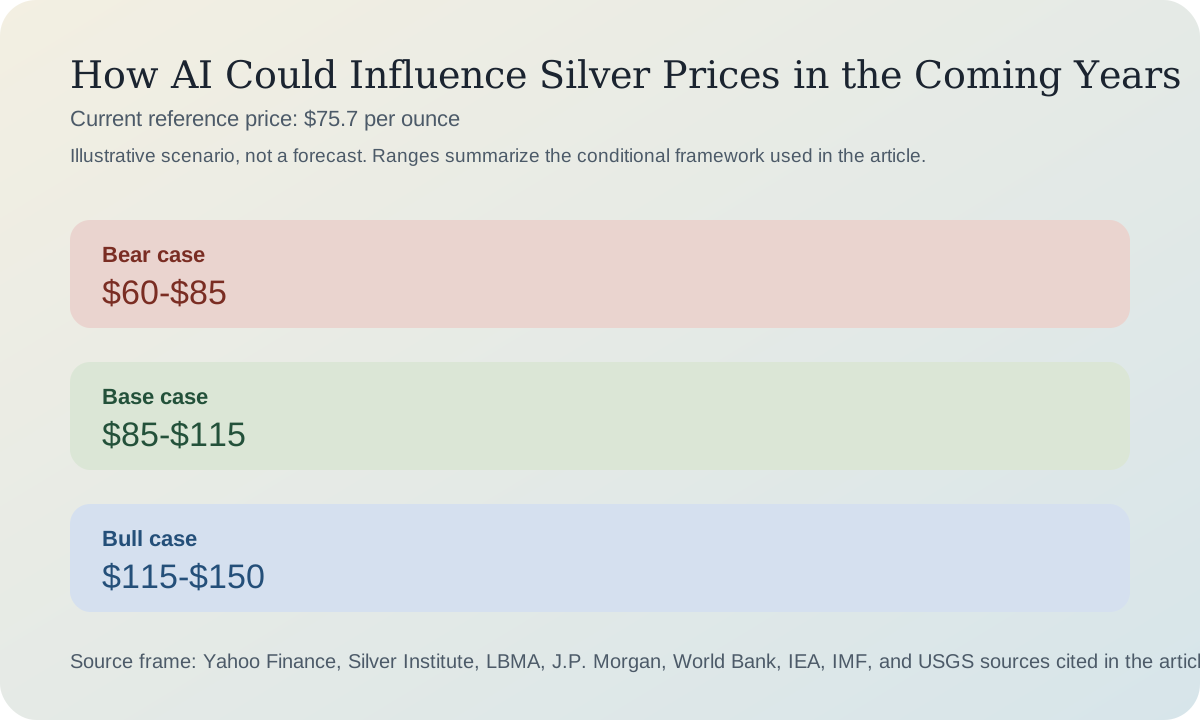
The bull case is $115 to $150 over the coming years if AI-linked infrastructure, grid spending, and broader electronics demand reinforce an already tight silver market and attract additional investor interest.
Base-case scenario
The base case is $85 to $115. This assumes AI adds real support to industrial demand, but that the impact is gradual, partially offset by substitution and by the fact that not all capex translates directly into silver-intensive uses.
Bearish AI scenario
The bear case is $60 to $85. In this version, AI mainly boosts productivity and confidence in risk assets while silver intensity per unit keeps declining, limiting the precious-metal premium and keeping industrial benefits more modest.
Risks to watch
The key risks are overestimating silver content in AI hardware, underestimating substitution, assuming all electricity-system spending benefits silver equally, and ignoring the possibility that AI is macro-disinflationary.
What could invalidate the forecast
The constructive AI case would be too optimistic if capex growth slows, if productivity gains reduce macro hedging demand, or if silver intensity keeps falling faster than new applications grow. It would be too conservative if AI-led power and hardware investment collides with persistent physical deficits.
Conclusion
AI could influence silver prices materially, but not through one simple mechanism. The strongest conclusion available today is that AI broadens silver's industrial-demand story while simultaneously complicating its macro valuation story.
| Scenario | Illustrative range | Conditions | Probability |
|---|---|---|---|
| Bull | $115-$150 | AI hardware, data-centre, and grid demand reinforce tight physical balances. | 25% |
| Base | $85-$115 | AI adds support, but gradually and unevenly. | 50% |
| Bear | $60-$85 | AI boosts productivity more than silver demand, reducing monetary premium. | 25% |
| Path | Estimated probability | Comment |
|---|---|---|
| Probability of rising | 50% | AI is more likely to be a net support than a net negative, but the pass-through is unlikely to be linear. |
| Probability of falling | 20% | A lower path would require AI to help growth and substitution more than it helps hardware demand. |
| Probability of moving sideways | 30% | Sideways outcomes remain plausible because AI's industrial boost may be offset by macro re-rating effects. |
06. Investor Implications
Readers should treat AI as one silver driver among several, not as a shortcut around risk management
The most common mistake in thematic investing is to confuse a real theme with a guaranteed payout. AI clearly matters for silver, but the market is still influenced by deficits, inventory, investor flows, rates, and substitution pressure.
| Investor type | Cautious approach | What to watch |
|---|---|---|
| Investor already in profit | Hold a core allocation if the thesis still fits, but trim or rebalance if silver has become an outsized risk position. | The gold-silver ratio, ETF flows, and whether price spikes are being confirmed by physical demand. |
| Investor currently at a loss | Separate a broken thesis from a bad entry. Average in only if the horizon is long and the supply-demand case still holds. | Evidence that deficits persist and that corrections are orderly rather than panic-driven. |
| Investor with no position | Avoid chasing vertical rallies. Prefer staged entries, pullback plans, or dollar-cost averaging. | Macro risk sentiment, rate expectations, and whether physical-market tightness is easing. |
| Trader | Use stop-losses, respect gap risk, and trade silver as a volatility asset rather than as a tidy trend story. | Dollar moves, gold leadership, inventory headlines, and tariff or policy shocks. |
| Long-term investor | Think in terms of portfolio role, scenario ranges, and rebalancing bands instead of one target. | Whether silver keeps its dual industrial and monetary appeal through the cycle. |
| Reader seeking a hedge | Use silver as a partial hedge, not as a perfect crisis instrument. Combine it with cash, gold, or other defenses if needed. | Whether silver is behaving more like an industrial metal or a safe-haven asset in the current regime. |
Disclaimer: This AI-silver analysis is for informational purposes only. It is not personalized financial advice, and the scenarios described here are illustrative rather than predictive guarantees.
07. FAQ
Frequently asked questions about AI and silver prices
Why would AI increase silver demand?
Because AI requires physical infrastructure such as servers, networking equipment, data centres, and power systems, all of which can support silver use in electronics and electrical applications.
Could AI hurt silver prices as well?
Yes. If AI mainly boosts productivity, confidence, and real growth, silver's precious-metal premium could soften even while industrial demand improves.
Is AI enough on its own to justify a silver bull market?
No. AI is a meaningful tailwind, but silver still depends on physical deficits, investor flows, and whether substitution pressure stays manageable.
References
Sources
- Yahoo Finance SI=F recent daily chart
- Yahoo Finance SI=F 10-year monthly chart
- Silver Institute 2026 market outlook
- Silver Institute World Silver Survey 2026 release
- Silver Institute 2025 deficit outlook
- Silver Institute supply and demand overview
- Silver Institute technology demand release
- Silver Institute silver and solar page
- Silver Institute silver in industry page
- Silver Institute 2025 investment update
- Silver Institute physical silver investment overview
- LBMA 2026 forecast survey
- LBMA 2026 analysts forecasts
- LBMA Alchemist survey summary
- J.P. Morgan Global Research silver outlook
- World Bank commodity outlook October 2025
- World Bank commodity outlook April 2026
- World Bank commodity markets portal
- IEA Electricity 2026 demand analysis
- IEA data-centre electricity news
- IMF AI preparedness speech
- IMF AI Can Lift Global Growth
- IMF AI and Productivity in Europe
- USGS Mineral Commodity Summaries 2026