01. Quick Answer
The most realistic AI outcome is that it broadens and deepens the AEX quality premium over time
The AEX closed at 1,010.44 on 2026-05-15, up from 435.88 at the start of its 10-year Yahoo Finance monthly series on 2016-06-01, for a price-only CAGR of about 8.77% (Yahoo Finance 10-year history; recent daily closes). The index does not need to become a software benchmark to benefit from AI. It only needs its existing leaders to monetize the physical, informational, and workflow requirements of AI adoption.
That channel already exists through ASML, the Dutch Semiconductor Vision 2035, the Generative AI vision, and AI-adjacent workflow leaders such as RELX, Wolters Kluwer, and Adyen.
| Point | Why it matters |
|---|---|
| AI matters through hardware and software-like channels | ASML is the obvious beneficiary, but workflow and data businesses matter too. |
| The effect is likely to be gradual rather than explosive | AI can reshape sector leadership before it changes the whole index identity. |
| Policy support is real | Dutch government semiconductor and AI strategy adds an ecosystem layer to the listed-company case. |
| The market still needs proof | Policy and AI narratives matter only if they convert into earnings quality and durable returns. |
02. Historical Context
The AEX already contains more AI-sensitive channels than its old Europe-quality stereotype implies
The usual shorthand is that the AEX is a high-quality European index with one unusually important chip stock. The AEX closed at 1,010.44 on 2026-05-15, up from 435.88 at the start of its 10-year Yahoo Finance monthly series on 2016-06-01, for a price-only CAGR of about 8.77% (Yahoo Finance 10-year history; recent daily closes). But AI makes that description too narrow.
ASML sits directly inside the physical AI infrastructure stack. RELX and Wolters Kluwer sit closer to the information and workflow layer. Adyen offers payments and commerce infrastructure that can be enhanced by AI. The Dutch policy layer matters too, because official semiconductor and generative-AI strategy suggests the ecosystem is being treated as strategically important rather than incidental.
The evidence is mixed on timing. AI headlines arrive faster than earnings impact. But over a decade, even gradual changes in leadership and valuation can be meaningful at the index level.
| Area | Example names | Why it matters |
|---|---|---|
| Chip tooling | ASML | AI infrastructure cannot scale without advanced semiconductor manufacturing tools. |
| Workflow and data products | RELX, Wolters Kluwer | AI can raise the value of expert data, automation, and productivity workflows. |
| Payments and commerce infrastructure | Adyen | AI can improve fraud control, routing, and merchant productivity. |
| Platform and internet optionality | Prosus | AI can affect marketplace efficiency, content, and monetization across digital assets. |
| Observation | Implication | Forecast effect |
|---|---|---|
| The Netherlands already has a chip leader | AI has a direct hardware channel in the index | Supports a durable premium relative to many European peers. |
| The AEX also has workflow leaders | AI can improve monetization beyond hardware | Broadens the thesis and lowers dependence on one name. |
| Policy support exists | The ecosystem may receive long-run strategic reinforcement | Strengthens the decade-long optionality case. |
03. Main Drivers
Five forces explain how AI could reshape Amsterdam over the next decade
1. AI spending still begins with hardware. That is why ASML remains central to the story.
2. Dutch policy is aligned with semiconductor relevance. The Semiconductor Vision 2035 helps explain why AI and the AEX intersect more directly than in many other European markets.
3. AI can deepen workflow economics. Wolters Kluwer and RELX can potentially monetize AI by embedding it into professional information, legal, tax, and risk products.
4. Payments and digital platforms can become more efficient. Adyen and Prosus represent AI optionality outside hardware and enterprise information.
5. Regulation and supervision will influence speed. The Dutch AI supervision update matters because the AI opportunity only helps public markets if adoption is trusted and commercially usable.
04. Institutional Forecasts and Analyst Views
Institutional and company evidence supports a measured AI leadership-shift thesis rather than AI hype
There are no credible public point forecasts saying AI will take the AEX to a specific level. That is the correct starting point. The more defensible approach is to combine official policy with index composition and company disclosures. The Dutch generative-AI vision provides the policy frame, while ASML, RELX, Wolters Kluwer, Adyen, and Prosus show where monetization may realistically emerge.
Analysts remain divided mainly on speed. The evidence does not support saying AI will suddenly redefine the whole AEX. It does support saying AI could reinforce Amsterdam’s premium status by making several existing leadership groups more valuable at the same time.
The practical mechanism is important. AI does not need to create entirely new listed sectors in Amsterdam. It can simply improve the economics of businesses that already sell tools, data, workflows, compliance, fraud control, and platform efficiency. If that happens across multiple leaders at once, the index mix becomes more durable even without a dramatic change in headline composition.
| Channel | Potential upside | Main constraint |
|---|---|---|
| Chip-tool demand | Supports ASML and the Dutch semiconductor ecosystem | Export policy and cycle timing still matter. |
| Workflow automation | Helps RELX and Wolters deepen pricing power | Adoption and monetization can be gradual. |
| Payments infrastructure | Can improve transaction economics and merchant tools | Competition and regulation remain relevant. |
| Platform efficiency | Can improve monetization at Prosus-linked assets | Internet valuations remain volatile. |
05. Scenarios, Risks, and Invalidation
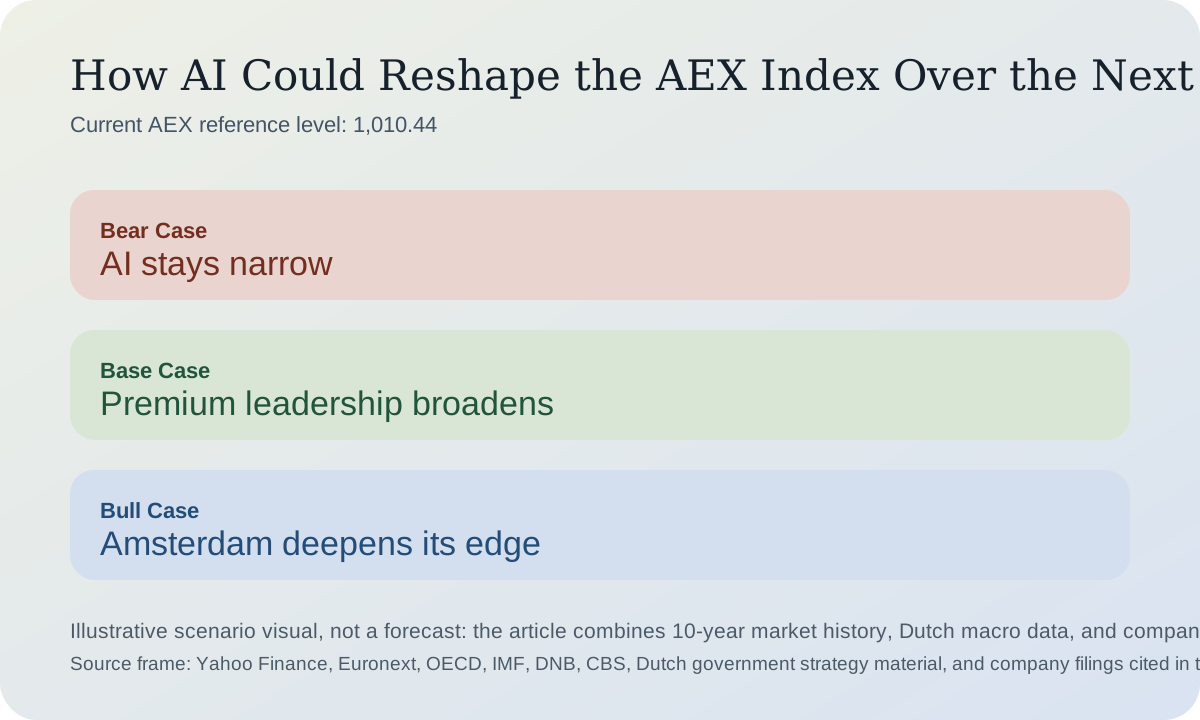
The AI bull case for the AEX is about broader premium leadership, not a sudden change of identity
Bullish AI scenario
The bullish AI case is that chip tooling, workflow software, information products, and payments infrastructure all receive durable valuation support because AI capex and adoption remain strong for years. In that world the AEX leadership mix becomes even more attractive.
Base-case AI scenario
The base case is more moderate. AI helps a handful of major constituents and gradually changes how investors value the index, but it does not transform Amsterdam into a pure technology benchmark.
Bearish AI scenario
The bear case is not that AI disappears. It is that monetization remains too narrow, too slow, or too cyclical to change index-level outcomes materially.
Risks to watch
Watch AI-capex durability, export-policy risk, enterprise adoption, payments competition, and whether policy support turns into commercially relevant advantage.
What could invalidate the AI outlook
The constructive AI view would be too strong if hardware demand cools and workflow monetization proves slower than expected. It would be too cautious if Amsterdam’s chip and information leaders become even more central to Europe’s AI stack than current markets assume.
Conclusion
AI could reshape the AEX less by changing its label than by deepening the value of the businesses already at its core. That is still a meaningful long-run shift for investors who care about sector leadership and valuation quality.
Disclaimer: This article is for research and informational purposes only. Any market impact from AI remains uncertain and depends on execution rather than headlines alone.
| Scenario | Business effect | Index implication | Probability |
|---|---|---|---|
| Bull | AI materially lifts hardware, workflow, and payments-related earnings | Broader leadership and a stronger quality premium | 25% |
| Base | AI helps several sectors but stays gradual | Meaningful mix shift and moderate index benefit | 55% |
| Bear | AI impact stays narrow or overhyped | Limited index effect beyond narrative surges | 20% |
| Path | Estimated probability | Comment |
|---|---|---|
| AI materially improves AEX leadership | 50% | The channels already exist, but monetization takes time. |
| AI disappoints relative to expectations | 20% | Possible if policy and capex narratives outrun economics. |
| AI helps only incrementally | 30% | Common outcome for diversified indices even when several constituents benefit. |
06. Investor Positioning
Investors should treat AI as selective upside rather than a substitute for discipline
| Investor type | Cautious approach | What to watch |
|---|---|---|
| Investor already in profit | Do not let AI headlines justify overconcentration in one theme. | Track whether AI-linked winners are actually improving earnings quality. |
| Investor currently at a loss | Avoid using AI as a retroactive excuse for weak entries. | Focus on real beneficiaries, not vague narratives. |
| Investor with no position | Build exposure selectively and in stages. | AI optionality helps, but valuation and diversification still matter. |
| Trader | Trade around AI headlines carefully. | Narrative volatility can outrun fundamentals quickly. |
| Long-term investor | Treat AI as a decade-long composition shift, not a one-quarter catalyst. | Workflow monetization, policy execution, and hardware demand. |
| Risk-hedging investor | Do not confuse AI exposure with downside protection. | Separate secular upside from macro hedging needs. |
07. FAQ
Frequently asked questions about the AEX outlook
Will AI turn the AEX into a technology index?
No. The more realistic outcome is a stronger premium for the index's existing mix of chip tooling, information, and workflow leaders.
Which AEX sectors benefit most from AI?
Chip tooling, information services, workflow software, payments infrastructure, and selected digital-platform assets appear the most direct channels.
What is the biggest risk to the AI thesis?
That AI excitement remains concentrated in narratives and hardware cycles without broad enough monetization to reshape the index.
References
Sources
- Yahoo Finance chart API for ^AEX, 10-year monthly history
- Yahoo Finance chart API for ^AEX, recent daily closes
- Euronext AEX index factsheet
- Euronext Amsterdam market page
- OECD economic snapshot for the Netherlands
- OECD Economic Survey of the Netherlands 2025
- IMF 2025 Article IV consultation for the Netherlands
- De Nederlandsche Bank economic outlook, March 2026
- Statistics Netherlands consumer prices archive
- Dutch government Semiconductor Vision 2035
- Dutch government Generative AI vision
- Dutch Authority for the Digital Infrastructure AI supervision update
- ASML Q1 2026 results
- Adyen Q1 2026 business update
- ING Q1 2026 results
- ABN AMRO Q1 2026 results
- RELX trading update 2026
- Wolters Kluwer 2026 trading update
- Shell first quarter 2026 results
- Philips Q1 2026 results
- Prosus annual results 2026