01. Quick Answer
AI could matter a lot for the ASX even though technology is only 2.1% of the benchmark
The official S&P sector breakdown puts information technology at just 2.1% of the ASX 200, versus 34.5% for financials and 25.0% for materials (S&P Dow Jones Indices, S&P/ASX 200 Index (AUD) Factsheet, as of April 30, 2026). That immediately tells investors something important: the AI impact on Australia is unlikely to look like the Nasdaq. It will probably show up through second-order effects such as data-center investment, software efficiency, bank automation, energy and grid demand, logistics, and critical minerals.
That does not make the AI theme weak; it makes it different. Australia's new National AI Plan, the National AI Centre's ecosystem work (AI ecosystem report; AI portal launch), and private-sector spending from companies such as NEXTDC, Goodman, and WiseTech all point to AI becoming an infrastructure and productivity story rather than a pure application-layer story.
| Point | Why it matters |
|---|---|
| Low direct tech weight does not mean low AI relevance | AI can improve earnings in banks, logistics, data centers, and miners without dominating sector weights. |
| Australia's AI route is physical as well as digital | Critical minerals, power, and data centers matter alongside software. |
| Productivity is the real prize | If AI lifts productivity, it can improve the whole index, not just a few names. |
| Execution risk is still high | AI spending can disappoint if power, permitting, margins, or monetization fall short. |
02. Historical Context
The ASX starts the AI era from a very different sector mix than U.S. indices
The ASX 200 has already compounded at roughly 5.15% over the past decade, yet it has done so with a tiny technology allocation and heavy bank-resource concentration (Yahoo Finance chart API for ^AXJO, 10-year monthly history; S&P Dow Jones Indices, S&P/ASX 200 Index (AUD) Factsheet, as of April 30, 2026). That history matters because it shows Australia does not need to mimic U.S. index composition to deliver returns. It does, however, need to adapt if AI becomes a meaningful source of productivity and capital spending globally.
The benchmark's composition suggests the AI impact will be distributed unevenly. Banks can use AI for fraud detection, servicing, compliance, and credit analysis. Miners can use it for exploration, maintenance, and logistics. REIT and infrastructure plays can benefit from data-center demand. Software exporters and platforms may see more direct monetization. But because IT is only 2.1% of the index, the overall market effect depends on diffusion, not just a few winners.
| Metric | Reading | AI relevance |
|---|---|---|
| Information technology sector weight | 2.1% | Direct AI exposure is low, so second-order effects matter most. |
| Financials sector weight | 34.5% | AI-driven productivity in banks could matter more than AI story stocks alone. |
| Materials sector weight | 25.0% | Critical minerals and automation can transmit AI demand into the index. |
| Top 10 weight | 48.6% | Adoption by large incumbents can move the whole benchmark. |
| Channel | Mechanism | Potential listed beneficiaries |
|---|---|---|
| Data centers and digital infrastructure | AI workloads need power-dense capacity and interconnection | NEXTDC, Goodman, utilities and suppliers. |
| Software and logistics | AI can lift workflow efficiency and monetization | WiseTech and select platform businesses. |
| Banks and insurers | Automation can improve service, fraud controls, and cost ratios | The major financial incumbents. |
| Resources and critical minerals | AI hardware and electrification increase demand for strategic materials | BHP, Rio, and specialist miners or processors. |
03. Main Drivers
Six AI channels could reshape the index over the next decade
1. National AI policy is now explicit. The federal National AI Plan and the National AI Centre's work show that AI is being treated as an economic capability, not only a private-sector experiment.
2. Data-center buildout is accelerating. NEXTDC's 2026 capital plan, growing contracted utilization, and expanded liquidity show that AI infrastructure demand is no longer theoretical (NEXTDC, Record Contracted Growth and A$2.2bn Capital Plan to Scale AI-Ready Infrastructure; NEXTDC bolsters liquidity to A$8.4 billion to accelerate AI infrastructure rollout). Goodman has likewise emphasized data-center related work in progress (Goodman Group Q1 FY26 operational update).
3. Software and workflow platforms may monetize AI unevenly but meaningfully. WiseTech has already described itself as accelerating an AI transformation (WiseTech Global, ASX Announcement 2026/14). That kind of statement matters because it is attached to operating businesses, not concept-stage speculation.
4. Critical minerals and energy-transition demand can transmit AI into the resources complex. The same policy machinery behind Future Made in Australia and critical minerals also supports the physical inputs that AI infrastructure ultimately consumes (Australian Treasury, Future Made in Australia; Department of Industry, Science and Resources, Critical minerals).
5. Banks can become AI beneficiaries through productivity, not narrative. Because financials are 34.5% of the benchmark, even incremental efficiency gains could matter materially at the index level (S&P Dow Jones Indices, S&P/ASX 200 Index (AUD) Factsheet, as of April 30, 2026).
6. The real long-run question is productivity diffusion. If AI meaningfully lifts productivity, it could help address one of the OECD's biggest concerns about Australia (OECD Economic Surveys: Australia 2026). If it does not, the AI effect may remain noisy and narrow.
04. Institutional Forecasts and Analyst Views
The AI case for the ASX is stronger when framed as infrastructure and productivity
Public institutions are not publishing neat ASX 200 price targets driven by AI alone, and that restraint is sensible. What they are doing is laying the groundwork for an investable framework. The National AI Plan and the National AI Centre describe ecosystem growth, skills, and adoption. NEXTDC and Goodman show that private capital is already funding the physical side of the buildout. Fidelity Australia also argues that practical AI adoption is becoming more relevant to incumbent earnings.
The challenge is that AI can still disappoint. The ASX's low direct tech weight means investors need broader productivity benefits to justify a materially different long-run range. That is why the evidence supports a constructive but measured AI outlook rather than a mania narrative.
| Source | What it signals | Index implication |
|---|---|---|
| Australian Government / NAIC | AI adoption is now a formal policy priority. | Improves the odds of sustained ecosystem development. |
| NEXTDC / Goodman | Infrastructure capex is accelerating. | AI can affect real assets and utilities, not just software. |
| WiseTech | Monetizable AI transformation is being discussed by listed operators. | Selective direct winners do exist. |
| OECD / Fidelity | Productivity remains the decisive long-run issue. | Broad market impact depends on diffusion, not headlines. |
05. Scenarios, Risks, and Invalidation
AI helps the ASX most if benefits spread beyond a few obvious winners
Bullish scenario
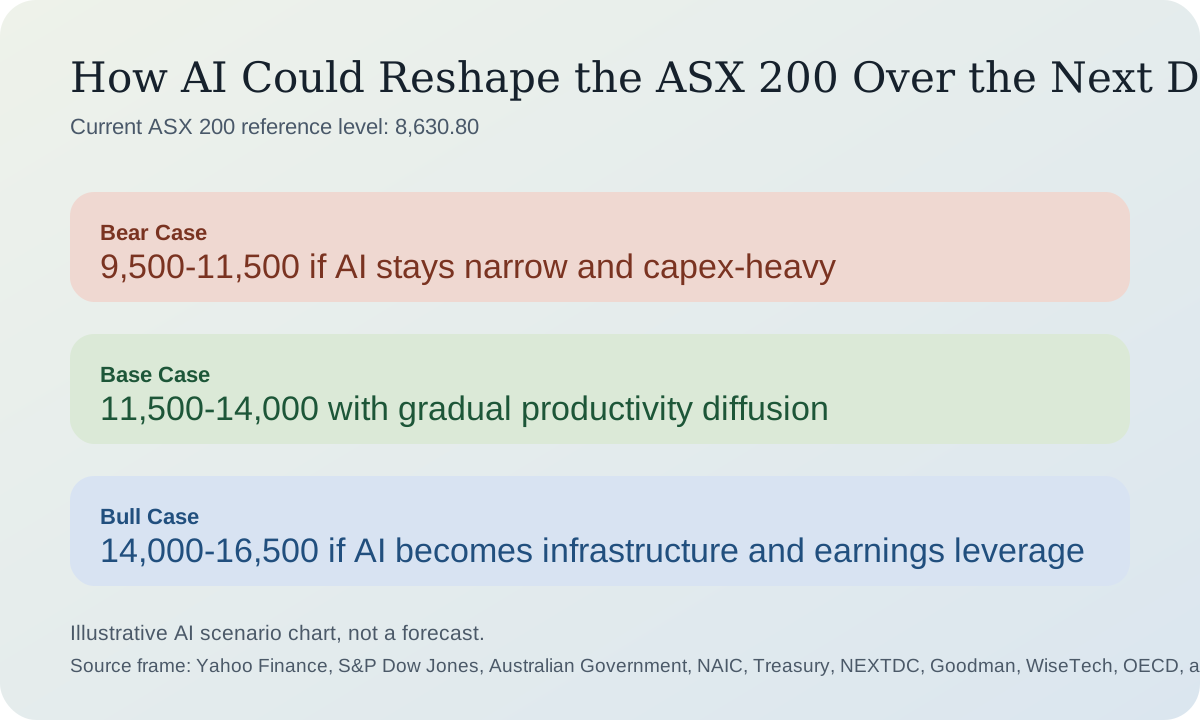
The AI bull case is 14,000 to 16,500 by the mid-2030s. This requires broad productivity gains, data-center scaling, effective software monetization, and stronger strategic demand for Australia's critical minerals and infrastructure assets.
Bearish scenario
The AI bear case is 9,500 to 11,500. That would likely happen if AI spending stays concentrated, power and permitting constraints slow projects, and the margin gains outside a few names prove weaker than expected.
Base-case scenario
The base case is 11,500 to 14,000. It assumes AI contributes to a better productivity and investment backdrop, but only gradually and unevenly.
| Scenario | Range | Conditions | Probability |
|---|---|---|---|
| Bull | 14,000-16,500 | AI diffuses into infrastructure, software, banking productivity, and critical minerals | 25% |
| Base | 11,500-14,000 | Meaningful but uneven productivity and capex uplift | 50% |
| Bear | 9,500-11,500 | AI remains narrow, expensive, and hard to monetize broadly | 25% |
| Outcome | Probability | Comment |
|---|---|---|
| Rising | 50% | AI can improve the benchmark gradually even without a giant tech sector. |
| Falling | 15% | A clearly lower outcome likely needs AI hype without productivity delivery. |
| Sideways | 35% | Plausible if AI benefits are real but too diffuse to reprice the whole index materially. |
Risks to watch
Power availability, data-center economics, the pace of enterprise adoption, margin dilution from capex, and whether AI savings are retained by shareholders or competed away.
What could invalidate the forecast
This framework would be too optimistic if AI remains mostly a cost center for Australian corporates. It would be too conservative if data-center, software, and productivity adoption scale much faster than current sector weights imply.
Conclusion
AI could reshape the ASX 200 materially, but probably through infrastructure and productivity more than through a single domestic superstar. That still matters a great deal for long-run index outcomes.
Disclaimer: This article is for research and educational purposes only. The AI scenario ranges are illustrative, conditional estimates based on public information, not guaranteed forecasts or advice.
06. Investor Positioning
Different investor profiles need different levels of patience and risk control
| Investor type | Cautious approach | Why it fits the setup |
|---|---|---|
| Investor already in profit | Keep AI-linked winners, but trim if the portfolio becomes a one-theme data-center or software bet. | The ASX AI story is broader than a single sub-sector. |
| Investor currently at a loss | Check whether the position has real AI monetization or only thematic appeal. | AI narratives can persist even when fundamentals weaken. |
| Investor with no position | Build exposure across infrastructure, software, and broader index beneficiaries rather than chasing one name. | Diffusion matters more than hype in Australia's market structure. |
| Trader | Use stops and watch contract wins, capex updates, and guidance language closely. | AI-linked names can re-rate sharply on execution news. |
| Long-term investor | Favor diversified exposure to AI infrastructure, critical minerals, and productivity winners. | The durable thesis is cumulative improvement, not one quarter's excitement. |
| Risk-hedging investor | Hedge concentration and execution risk rather than avoiding the theme completely. | AI can help Australia, but the winners may remain uneven and cyclical. |
07. FAQ
Frequently asked questions about AI and the ASX 200
If technology is only 2.1% of the index, why should AI matter?
Because AI can raise productivity and capital spending across banks, infrastructure, logistics, resources, and real assets, not just software stocks.
What are the clearest listed AI channels in Australia today?
Data centers, selected software platforms, digital infrastructure, and critical-mineral supply chains are among the most visible channels.
What is the biggest risk to the AI reshaping thesis?
The biggest risk is that AI spending remains narrow, expensive, and hard to monetize broadly across the economy.
References
Sources
- Yahoo Finance chart API for ^AXJO, 10-year monthly history
- S&P Dow Jones Indices, S&P/ASX 200 Index (AUD) Factsheet, as of April 30, 2026
- Australian Government, National AI Plan
- National AI Centre, Australia's artificial intelligence ecosystem: growth and opportunities
- National AI Centre, A new front door for AI in Australia
- Australian Treasury, Future Made in Australia
- Department of Industry, Science and Resources, Critical minerals
- NEXTDC, Record Contracted Growth and A$2.2bn Capital Plan to Scale AI-Ready Infrastructure
- NEXTDC bolsters liquidity to A$8.4 billion to accelerate AI infrastructure rollout
- WiseTech Global, ASX Announcement 2026/14
- Goodman Group Q1 FY26 operational update
- OECD Economic Surveys: Australia 2026
- Fidelity Australia, A word on: Australian equities