01. Quick Answer
The most realistic AI outcome is that it broadens and modernizes CAC 40 leadership over time
The most interesting AI question for the CAC 40 is not whether Paris will suddenly become a U.S.-style software market. It is whether AI can meaningfully reshape which sectors lead the French benchmark over the next decade. France is pushing a national AI strategy, private-sector investment pledges have been large, and several CAC constituents already sit directly in the path of AI infrastructure, software, services, advertising, automation, and semiconductors (Reuters on France AI pledges; French AI strategy).
| Theme | Why it matters |
|---|---|
| AI is a composition story for the CAC | It may shift leadership toward industrial tech, software, and infrastructure more than it changes the index label itself. |
| France has an explicit AI policy push | Government strategy and investment mobilization can shape the ecosystem around listed winners. |
| Not every CAC constituent benefits equally | Luxury and traditional defensives may feel AI indirectly, while Schneider, Capgemini, Dassault, Publicis, and STMicro are closer to the core. |
| Execution still matters more than hype | Available data suggests AI helps most when it turns into real capex, productivity, and earnings quality. |
02. Current Context
The CAC already contains more AI-sensitive channels than old France stereotypes suggest
The AI angle matters now because the CAC 40 is already more industrially and digitally exposed than its old stereotype implies. Euronext's top weights include Schneider Electric and Airbus, while the broader index includes Capgemini, Dassault Systèmes, STMicroelectronics, Publicis, Teleperformance, and Orange (Euronext factsheet; Euronext Paris). Those names sit in different parts of the AI stack: power infrastructure, systems integration, software, chip exposure, data services, and enterprise workflow transformation.
| Area | Example constituents | Why it matters |
|---|---|---|
| Power and data-center infrastructure | Schneider Electric, Legrand, Vinci | AI needs physical power, cooling, and build-out capacity. |
| Enterprise AI services | Capgemini, Publicis, Teleperformance | Adoption creates service and workflow opportunities. |
| Industrial and design software | Dassault Systèmes | AI can deepen automation, simulation, and design productivity. |
| Semiconductors and electronics | STMicroelectronics, Air Liquide | AI demand can lift adjacent hardware and industrial supply chains. |
The evidence is mixed on timing. AI can produce huge headlines long before it changes index-level earnings. But the strategic direction is already visible: more capex into digital infrastructure, more demand for electricity and cooling, and more enterprise software and services aimed at deploying AI productively rather than just discussing it.
That matters for a national benchmark because secular leadership shifts often happen quietly. If AI-linked infrastructure and software names keep winning a larger share of market attention and earnings revisions, the CAC can change character without ever changing its name.
03. Main Drivers
Five forces explain how AI could reshape the French benchmark over the next decade
1. France is actively trying to accelerate AI adoption
The French government says it is expanding its national AI strategy, including a third phase under France 2030, more training, and broader enterprise diffusion (national AI strategy; AI diffusion plan; Inria AI programme).
2. Private capital commitments are material
Reuters reported that President Macron announced around €109 billion of private-sector AI investment pledges for France. Even if not all of that converts linearly into public-equity earnings, it signals infrastructure and ecosystem momentum (Reuters on AI investment pledges).
3. Schneider Electric gives the index real AI infrastructure leverage
Schneider's recent announcements and Reuters-linked earnings coverage show how AI data-center demand is already feeding into a major CAC constituent through power, cooling, and automation (Schneider and NVIDIA blueprint; Reuters on Schneider results).
4. Services and software names can monetize AI in different ways
Capgemini's OpenAI alliance, Publicis' Microsoft expansion, and Dassault Systèmes' AI-powered virtual companions show that the CAC's AI exposure is not limited to hardware and infrastructure (Capgemini; Publicis and Microsoft; Dassault Systèmes).
5. Governance and industrial policy matter
France is also building institutions for AI evaluation and security, which matters because a more credible governance framework can help adoption scale in regulated and industrial settings (INESIA roadmap; French AI projects call).
04. Institutional Forecasts and Analyst Views
Public AI evidence supports a measured leadership-shift thesis rather than hype
Institutional AI forecasting for the CAC 40 remains more qualitative than numeric, which is appropriate. The available evidence supports a measured conclusion: AI is more likely to reshape sector leadership than to instantly transform the whole benchmark. That still matters, because index performance over a decade can be driven by which sectors earn the premium multiple, not only by aggregate GDP (French strategy; Publicis Q1 2026).
| Channel | Potential upside | Main constraint |
|---|---|---|
| Infrastructure build-out | Supports Schneider, Legrand, construction and energy-adjacent names | Power costs, project timing, and rates. |
| Enterprise transformation | Supports Capgemini, Publicis, and software-service providers | Client budgets and execution quality. |
| Industrial design and automation | Supports Dassault Systèmes and advanced manufacturing ecosystems | Adoption cycles are gradual. |
| Semiconductor and electronics demand | Helps STMicro and adjacent suppliers | Global cycle volatility can overwhelm the secular story in the short run. |
Analysts remain divided mainly on speed. The evidence does not support saying AI will make the CAC a new Nasdaq. It does support saying AI can broaden and modernize leadership inside the French benchmark over the next decade.
In practical terms, investors should think of AI as a transmission mechanism. It can help power infrastructure, consulting, software, automation, and semiconductor-adjacent names. That is enough to matter for index leadership even if the aggregate benchmark still looks diversified and mature.
05. AI Scenarios, Risks, and Invalidation
Bull, base, and bear AI cases should be tied to listed-company outcomes
Bullish AI scenario
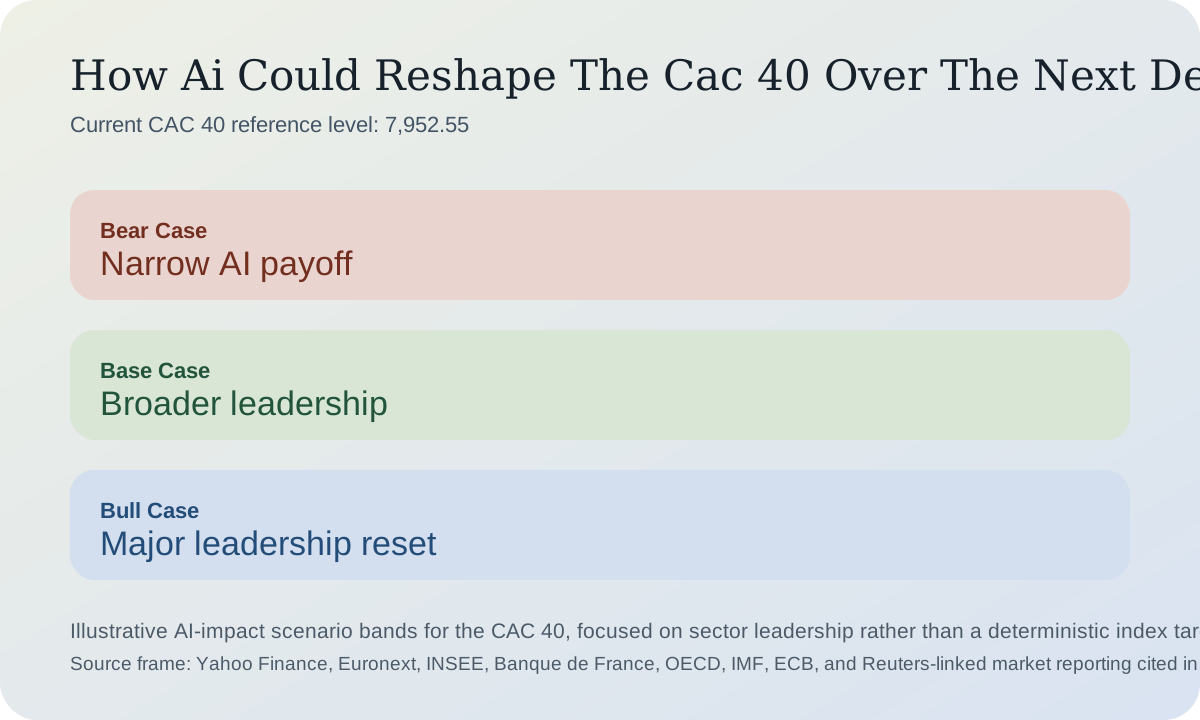
The bullish AI case is that France's policy push, private capital commitments, and listed winners in power infrastructure, services, and software all reinforce each other. In that world, the CAC's sector mix becomes more growth-oriented and more resilient, supporting stronger long-run performance.
Base-case AI scenario
The base case is more moderate: AI improves the relative earnings quality of certain constituents and gradually broadens leadership away from pure luxury dependence. That alone could materially change how investors view the benchmark.
Bearish AI scenario
The bear case is not that AI disappears. It is that adoption takes longer, private commitments convert slowly, and the biggest listed beneficiaries remain too few to shift index-level outcomes decisively.
| Scenario | Business effect | Index implication | Probability |
|---|---|---|---|
| Bull | AI meaningfully lifts infrastructure, services, and industrial software earnings | Broadens leadership and supports a stronger long-run premium | 25% |
| Base | AI helps several key constituents but does not redefine the whole benchmark overnight | Gradual improvement in sector mix and resilience | 55% |
| Bear | AI adoption is real but financially slow or narrow | Limited index-level impact beyond hype cycles | 20% |
| Path | Estimated probability | Comment |
|---|---|---|
| AI materially improves CAC leadership | 50% | The ingredients are present, but the conversion into earnings will take time. |
| AI disappoints relative to expectations | 20% | Execution, regulation, and financing cycles can slow the story. |
| AI helps only incrementally | 30% | This is common for broad equity benchmarks even when several constituents benefit. |
Risks to watch
Watch project conversion, power constraints, enterprise spending cycles, and whether listed French beneficiaries can monetize AI faster than the market already assumes.
What could invalidate the AI outlook
The optimistic view would be too strong if public and private AI spending failed to translate into earnings quality for listed constituents. It would be too cautious if infrastructure, services, and software beneficiaries begin to dominate index leadership more quickly than expected.
Conclusion
AI could reshape the CAC 40 less by replacing its identity than by reweighting its leadership. If the trend works, Paris becomes less dependent on luxury alone and more exposed to power, software, industrial design, and enterprise transformation.
That is a meaningful change even if it is gradual. For long-term investors, a benchmark with broader engines of leadership can become more resilient and more interesting at the same time.
Disclaimer: This article is for informational research only. Any long-run market implications from AI remain conditional and uncertain.
06. Investor Positioning
Investors should treat AI as optional upside inside the CAC, not as a substitute for discipline
| Investor type | Prudent approach | What to track |
|---|---|---|
| Investor already in profit | Do not overpay for the AI narrative alone. | Check whether AI-linked leadership is actually broadening. |
| Investor currently at a loss | Avoid using AI as a retroactive justification for any entry. | Focus on real beneficiaries rather than vague hope. |
| Investor with no position | Build exposure only if valuation and diversification make sense. | AI optionality is a plus, not the whole thesis. |
| Trader | Trade around AI headlines carefully. | Headline volatility can outrun fundamentals. |
| Long-term investor | Treat AI as a decade-long mix shift, not a one-quarter catalyst. | Project conversion and earnings quality. |
| Risk-hedging investor | Do not confuse AI exposure with downside protection. | Separate secular upside from macro hedging. |
07. FAQ
Frequently asked questions about AI and the CAC 40
Will AI turn the CAC 40 into a technology index?
No. The more realistic outcome is that AI broadens leadership inside a still-diversified French benchmark.
Which CAC sectors benefit most from AI?
Infrastructure, industrial automation, enterprise services, software, and some semiconductor-adjacent businesses appear best positioned.
What is the main risk to the AI thesis for the CAC?
The main risk is that investment headlines do not convert into enough listed-company earnings leverage to change index-level outcomes.
References
Sources
- Yahoo Finance chart API for ^FCHI, 10-year monthly history
- Yahoo Finance chart API for ^FCHI, recent daily closes
- Euronext CAC 40 factsheet, March 31, 2026
- INSEE economic dashboard for France
- INSEE Q1 2026 GDP release
- Banque de France macroeconomic projections page
- Banque de France March 2026 macroeconomic projections
- OECD Economic Outlook landing page
- OECD Economic Outlook Volume 2025 Issue 2
- IMF 2025 Article IV consultation for France
- ECB April 2026 economic outlook and monetary policy speech
- Reuters factbox on France's 2026 budget
- Reuters on €109 billion of AI investment pledges
- French national AI strategy
- France's AI evaluation and security roadmap
- France plan to diffuse AI across businesses
- Inria AI Programme France 2030
- Schneider and NVIDIA AI infrastructure partnership
- Capgemini OpenAI alliance
- Publicis and Microsoft agentic AI partnership
- Dassault Systèmes AI-powered virtual companions