01. Quick Answer
AI could reshape the EURO STOXX 50 mainly by broadening leadership, not by changing its label
AI is unlikely to turn the EURO STOXX 50 into a European Nasdaq. But it could still reshape the index in a financially meaningful way over the next decade. The right question is not whether Europe wins the consumer-AI race. It is whether AI raises productivity, capex, and earnings power for the benchmark's biggest industrial, semiconductor, software, and enterprise-platform names.
That question matters because the index already contains companies exposed to AI infrastructure and enterprise adoption, including ASML, SAP, Siemens, Schneider Electric, Infineon, and broader automation and software ecosystems. EU policy is also trying to reinforce that industrial path through AI factories and future gigafactories (EU AI Continent plan; AI Factories initiative; AI gigafactories).
| Theme | Why it matters |
|---|---|
| AI is a composition story | It can change which sectors lead the index even if the benchmark remains diversified. |
| Europe has real AI-adjacent winners | Semis, software, industrial automation, and power-infrastructure names can benefit directly. |
| Policy support is tangible | EU institutions are funding AI factories and discussing gigafactories rather than only publishing slogans. |
| The evidence is still mixed on speed | AI's index-level impact depends on monetization and productivity, not just announcements. |
02. Current Context
The benchmark already has more AI-sensitive channels than many investors assume
The EURO STOXX 50's older identity was built around banks, luxury, energy, and defensives. That identity is incomplete now. The benchmark still has those groups, but it also has deeper exposure to chips, enterprise software, industrial digitalization, and infrastructure that can benefit from AI-related investment. STOXX methodology and ETF holdings data confirm the benchmark's concentration in exactly the kind of large-cap platforms that can absorb AI capex and translate it into earnings if execution is good (STOXX index details; BlackRock holdings context).
This matters because the market does not need every constituent to become an AI winner. It only needs enough large constituents to improve their growth profile, defend margins better, or command a higher quality multiple. In broad blue-chip benchmarks, those incremental shifts can have a surprisingly large long-run effect.
| Channel | Examples | Why it matters |
|---|---|---|
| Semiconductor equipment and chips | ASML, Infineon, STMicroelectronics ecosystem exposure | AI demand increases pressure for more advanced chip capacity and tooling. |
| Enterprise software and data | SAP | AI can deepen workflow automation and make software more embedded in core operations. |
| Industrial automation | Siemens, Schneider Electric | Factories, grids, buildings, and industrial systems can become more AI-driven. |
| Power and infrastructure | Electrical equipment and industrial suppliers | AI workloads require power, cooling, and automation, not just models. |
Available data suggests the likely effect is a gradual leadership shift rather than a sudden transformation. That still matters over a decade, because long-run index performance often changes when one group of sectors consistently earns a premium multiple and another stops doing so.
03. Main Drivers
Five forces explain how AI could affect Europe's flagship index over the next decade
1. The EU is funding real AI infrastructure
The European Commission says the EU and participating EuroHPC countries have committed more than €2.6 billion to AI Factories and Antennas, while the Council has advanced a framework for AI gigafactories (AI Factories; AI gigafactories).
2. SAP is trying to become a deeper enterprise-AI platform
SAP's May 2026 Sapphire announcements introduced the Autonomous Enterprise framework, while SAP also said it would invest more than €1 billion over four years to scale a frontier AI lab in Europe (SAP Autonomous Enterprise; SAP frontier AI lab).
3. Siemens is tying AI to real industrial assets
Siemens used CES 2026 to frame industrial AI more aggressively and separately committed more than €200 million to an AI-based, digitalized and automated factory in Amberg (Siemens CES 2026; Siemens Amberg).
4. ASML and the semiconductor cycle link Europe to AI capex globally
ASML's Q1 2026 release said the industry's growth outlook continues to solidify, driven by ongoing AI-related infrastructure demand (ASML Q1 2026 release). That matters because Europe's AI upside is partly global, not purely domestic.
5. AI can improve productivity across non-tech sectors too
The biggest long-run impact may come from AI helping banks, insurers, manufacturers, logistics firms, and healthcare companies improve processes. If that happens, the index benefits even beyond its obvious tech-adjacent names.
04. Institutional Forecasts and Analyst Views
Public evidence supports a measured AI thesis rather than a hype thesis
No institution can credibly quantify AI's exact effect on the EURO STOXX 50 over ten years, but public evidence supports a measured conclusion. AI is more likely to reshape sector leadership and earnings mix than to redefine the whole benchmark overnight. That view is consistent with broad strategist notes that favor Europe's industrial and technology-linked pockets rather than treating the region as a pure AI winner or loser (UBS; BlackRock).
The safest way to think about AI in this context is as a transmission mechanism. If AI increases demand for chips, software, electrical equipment, and industrial automation while also improving productivity inside banks, manufacturers, and service firms, then the benchmark changes from within. If those gains stay narrow or fail to monetize, the reshaping effect remains smaller.
| Pathway | Potential upside | Main constraint |
|---|---|---|
| Semiconductor demand | Supports tooling and chip ecosystems | Cyclicality remains high. |
| Enterprise AI adoption | Supports SAP and services ecosystems | Monetization can lag hype. |
| Industrial automation | Supports Siemens and related capital goods | Adoption curves are gradual. |
| Productivity spillovers | Can help banks, insurers, and manufacturers | Benefits are hard to measure early. |
The evidence is mixed mainly on speed. That is why the base case for AI and the Euro Stoxx 50 should focus on leadership broadening over time, not on dramatic one-year valuation jumps.
05. AI Scenarios, Risks, and Invalidation
A useful AI framework links the thesis to profits and productivity, not just excitement
Bullish AI scenario
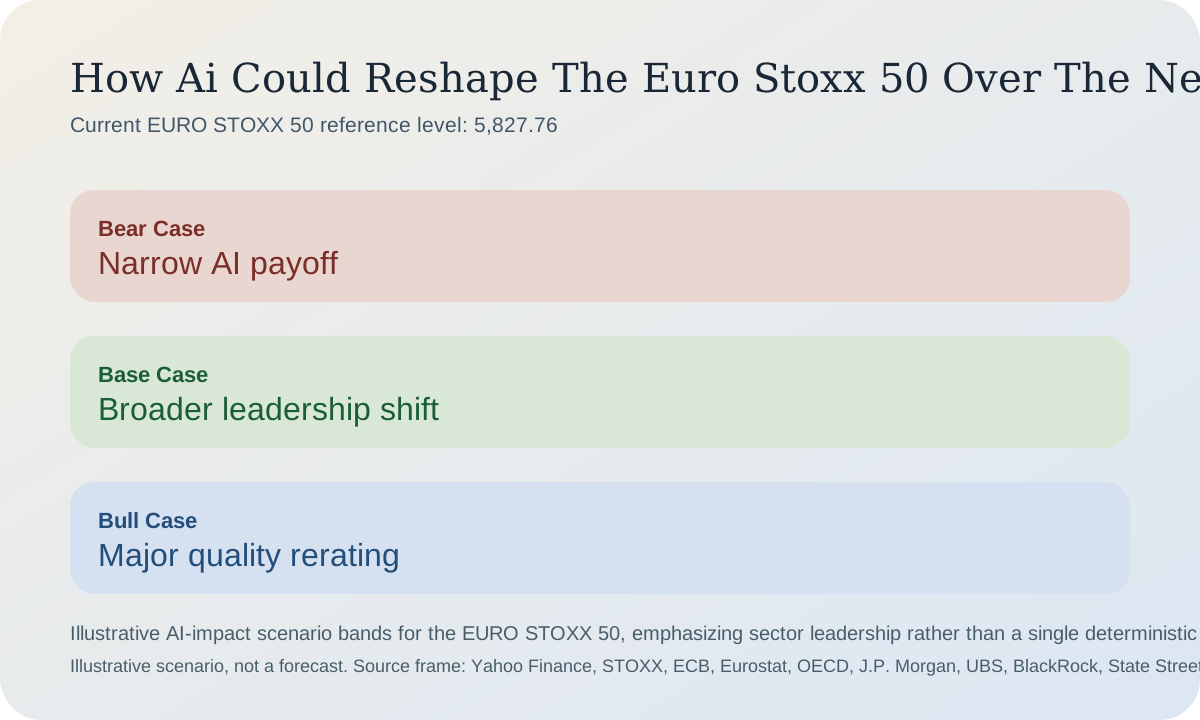
The bullish AI case is that semiconductors, enterprise software, automation, and infrastructure all reinforce each other, helping the benchmark earn a structurally higher quality multiple.
Base-case AI scenario
The base case is that AI gradually improves earnings quality and leadership breadth, but does not fully redefine the market. This is the most realistic scenario from current evidence.
Bearish AI scenario
The bear case is not that AI disappears. It is that adoption stays slower, capex monetizes poorly, and a few AI-adjacent winners are not enough to move the whole index materially.
| Scenario | Business effect | Index implication | Probability |
|---|---|---|---|
| Bull | AI materially lifts semis, software, automation, and productivity | Supports a higher-quality and more growth-oriented index profile | 25% |
| Base | AI gradually broadens leadership and earnings resilience | Meaningful but measured effect over a decade | 55% |
| Bear | AI benefits stay narrow or slower than hoped | Limited index-level reshaping beyond a few names | 20% |
| Path | Estimated probability | Comment |
|---|---|---|
| AI improves the STOXX50 meaningfully | 50% | The ingredients are present, but timing and monetization remain uncertain. |
| AI disappoints relative to expectations | 20% | A real risk if spending headlines outrun profit delivery. |
| AI has only modest impact | 30% | Quite plausible for a broad blue-chip benchmark. |
The forecast range and probabilities are built from current EU policy commitments, company-level evidence, and the sector mix of the index. They are scenario tools, not point forecasts.
06. Investment Implications
AI should be treated as optional upside inside a disciplined Europe allocation
| Investor type | Prudent approach | What to track |
|---|---|---|
| Investor already in profit | Do not let AI hype override valuation discipline. | Whether AI-linked leaders keep delivering. |
| Investor currently at a loss | Avoid treating AI as a retroactive justification for any entry point. | Actual earnings conversion from AI spending. |
| Investor with no position | Build only if the broader thesis works even without extreme AI optimism. | Sector weights and entry valuation. |
| Trader | Trade AI headlines carefully; they can move faster than fundamentals. | Product launches, capex data, and order books. |
| Long-term investor | Treat AI as an optionality layer on top of a diversified Europe thesis. | Productivity, not just announcements. |
| Risk-hedging investor | Remember AI upside does not eliminate macro or energy risk. | Keep hedges separate from the AI thesis. |
Risks to watch: weak monetization, chip-cycle downturns, power bottlenecks, regulation, and over-enthusiastic valuation resets.
What could invalidate the AI outlook: faster-than-expected productivity gains could make this article too cautious, while poor earnings conversion from AI spending could make even the base case too optimistic.
Conclusion: AI could reshape the EURO STOXX 50 less by changing its name than by changing its leadership. Over the next decade, that may be enough to matter a great deal.
Disclaimer: This article is for informational research only. Any AI-related market outcome remains conditional and uncertain.
07. FAQ
Frequently asked questions about AI and the EURO STOXX 50
Will AI turn the EURO STOXX 50 into a tech index?
Probably not. The more likely outcome is a broader leadership mix with stronger influence from semis, software, and automation.
Which constituents appear most directly exposed?
ASML, SAP, Siemens, Schneider Electric, and other semiconductor, software, and industrial-automation names appear most directly linked.
What is the biggest AI risk for investors?
The biggest risk is assuming headline AI spending automatically becomes durable index-level earnings growth.
References
Sources
- Yahoo Finance chart API for ^STOXX50E, 10-year monthly history
- Yahoo Finance chart API for ^STOXX50E, recent daily closes
- STOXX index details page for the EURO STOXX 50
- STOXX Index Guide, April 2026
- iShares Core EURO STOXX 50 UCITS ETF fact sheet, March 2026
- State Street SPDR EURO STOXX 50 ETF benchmark page
- Eurostat flash GDP estimate for Q1 2026
- Eurostat euro area inflation release for April 2026
- ECB staff macroeconomic projections for the euro area, March 2026
- ECB Economic Bulletin Issue 3, 2026
- OECD Economic Outlook, euro area chapter
- Reuters market coverage on European shares and inflation worries, via Investing.com
- European Commission AI Continent plan
- EU AI Factories initiative
- Council press release on AI gigafactories
- SAP Autonomous Enterprise announcement
- SAP frontier AI lab investment
- Siemens CES 2026 industrial AI release
- Siemens Amberg AI-based factory investment
- ASML Q1 2026 financial results
- UBS secular-growth note