01. Quick Answer
The most realistic AI outcome is that it broadens and modernizes FTSE MIB leadership over time
The FTSE MIB closed at 49,116.47 on 2026-05-15, up from 16,198 at the start of its 10-year Yahoo Finance monthly series on 2016-06-01, for a price-only CAGR of about 11.73% (Yahoo Finance 10-year history; recent daily closes). The index does not need a large software cohort to benefit from AI. It only needs a meaningful set of listed businesses whose earnings are helped by the physical and industrial requirements of AI adoption.
That channel already exists. Italy's AI strategy 2024-2026 and the IT4LIA AI Factory show policy intent, while listed companies such as Prysmian, STMicroelectronics, Enel, and Leonardo sit on different parts of the AI transmission chain.
| Point | Why it matters |
|---|---|
| AI matters through infrastructure first | Power, connectivity, and electronics are the most plausible public-equity channels for Milan. |
| The effect is likely to be gradual | AI can change index leadership before it changes the whole benchmark's identity. |
| Defense is part of the AI story | Leonardo links AI, software, and security spending in a way many index commentaries miss. |
| The market still needs proof | Policy and strategy headlines only matter if they convert into earnings quality and capex wins. |
02. Historical Context
The FTSE MIB already has more AI-sensitive industrial channels than its old stereotype suggests
The old stereotype of the Italian market as only banks, utilities, and cyclical value misses how AI can travel through infrastructure and industrial systems. The FTSE MIB closed at 49,116.47 on 2026-05-15, up from 16,198 at the start of its 10-year Yahoo Finance monthly series on 2016-06-01, for a price-only CAGR of about 11.73% (Yahoo Finance 10-year history; recent daily closes). That matters because a broad benchmark can be reshaped by changes in sector leadership even if it never looks like a pure technology index.
Prysmian sits close to data-center and connectivity build-out, STMicroelectronics sits closer to chips and electronics demand, Enel sits near electricity and grid reinforcement, and Leonardo sits near defense software, sensing, and digital systems. The policy layer also matters: Italy's AI strategy and the IT4LIA AI Factory are attempts to build national capability rather than merely consume imported technology.
The evidence is mixed on speed. AI headlines can arrive faster than the revenue impact. But on a decade view, sector-leadership changes can still be meaningful even when they start quietly.
| Area | Example names | Why it matters |
|---|---|---|
| Power and grids | Enel, Terna, Prysmian | AI data centers and digital industry increase demand for reliable electricity and network investment. |
| Electronics and semis | STMicroelectronics | AI hardware demand can support adjacent chip and industrial-electronics exposure. |
| Defense and security software | Leonardo | AI in surveillance, sensing, and mission systems can lift strategic technology content. |
| Industrial digitalization | Interpump and automation-adjacent suppliers indirectly | AI may raise the premium on smart manufacturing and control systems. |
| Observation | Implication | Forecast effect |
|---|---|---|
| Italy lacks US-style mega-cap software scale | AI will not transform the MIB overnight | Prevents unrealistic hype-based targets. |
| Italy has physical infrastructure winners | The AI capex boom can still reach listed companies | Supports a gradual rerating of selected sectors. |
| Policy support exists | Government strategy may improve ecosystem depth | Helps the long-run optionality case. |
03. Main Drivers
Five forces explain how AI could change the Italian market over the next decade
1. AI needs electricity and cables before it needs narratives. That is why Enel, Terna, and Prysmian matter. Data centers are physical systems that need power quality, grid reinforcement, and connectivity.
2. Electronics demand can benefit Italy selectively. STMicroelectronics gives the market real semiconductor and electronics exposure even if it is not a pure AI stock.
3. Defense technology is part of AI monetization. Leonardo links AI, cyber, sensing, and mission systems to a structural European spending trend.
4. Industrial productivity can rise through adoption, not just through suppliers. Italy's AI strategy explicitly focuses on diffusion across business processes. If that works, parts of the market could earn higher quality multiples because operations improve.
5. The national ecosystem is still early. The IT4LIA AI Factory and public policy can help, but the evidence is mixed on how quickly ecosystem ambition becomes public-market earnings.
04. Institutional Forecasts and Analyst Views
Institutional and company evidence supports a measured leadership-shift thesis rather than AI hype
There are no credible public point forecasts saying AI will take the MIB to a specific number. That is the right answer. The more defensible approach is to combine official policy and industrial evidence with index composition. AgID provides the policy frame, while company materials from Prysmian, STMicroelectronics, Enel, and Leonardo show where monetization might realistically emerge.
Analysts remain divided mainly on speed. The evidence does not support saying AI will redefine Italy's stock market overnight. It does support saying AI could push investors to reward more of the market's infrastructure and strategic-technology names over time.
| Channel | Potential upside | Main constraint |
|---|---|---|
| Data-center power demand | Supports grids, cables, and electricity infrastructure | Project timing and regulation still matter. |
| Electronics demand | Helps chip and component exposure | Semiconductor cycles remain volatile. |
| Defense AI | Adds strategic technology premium | Budget execution and procurement lags can slow the story. |
| Enterprise diffusion | Could improve quality of industrial earnings more broadly | Adoption can be slow and uneven. |
05. Scenarios, Risks, and Invalidation
The AI bull case for the MIB is about broader leadership and better earnings quality, not a sudden identity change
Bullish AI scenario
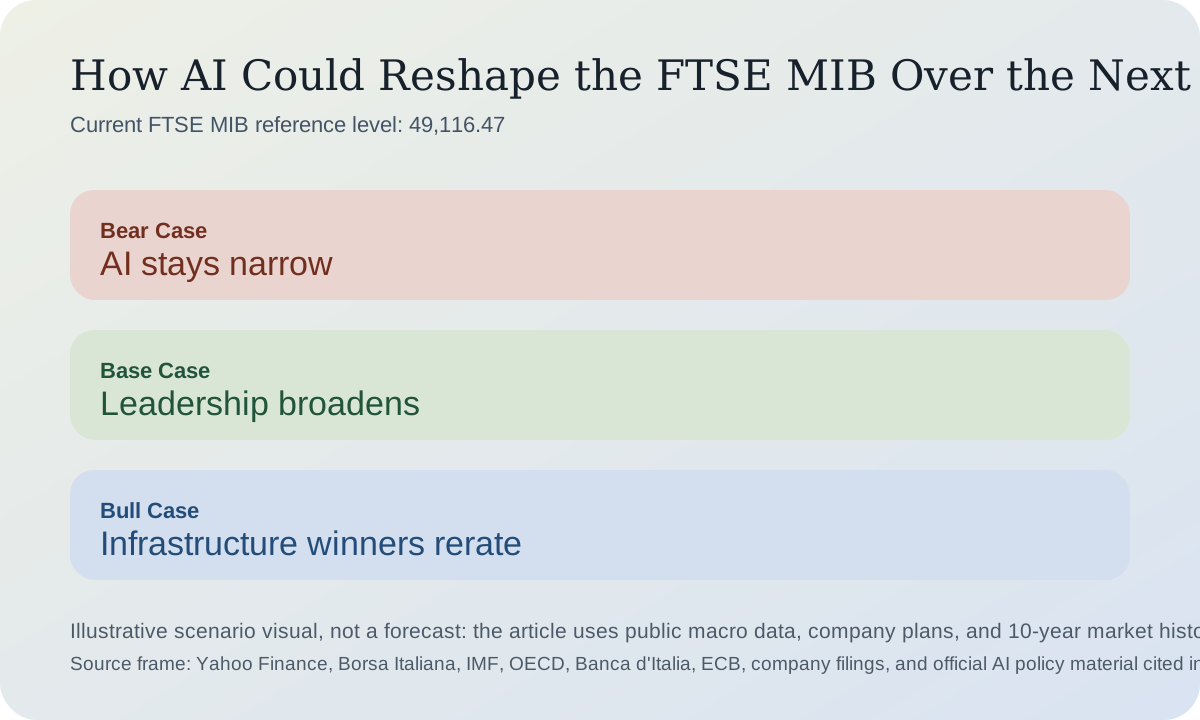
The bullish AI case is that power, grid, cable, electronics, and defense-technology names all attract more durable valuation support because AI capex stays strong for years. In that world the MIB's leadership mix becomes meaningfully better.
Base-case AI scenario
The base case is more modest. AI helps a handful of major constituents and gradually changes how investors rank sectors inside the benchmark, but it does not transform the whole market overnight.
Bearish AI scenario
The bear case is not that AI disappears. It is that AI benefits remain too narrow or too slow to change index-level outcomes meaningfully, while hype gets ahead of monetization.
Risks to watch
Watch capex conversion, energy bottlenecks, semiconductor cyclicality, defense procurement timing, and whether policy support creates commercially relevant projects.
What could invalidate the AI outlook
The constructive AI view would be too strong if physical-infrastructure beneficiaries fail to monetize demand or if AI capex cools faster than expected. It would be too cautious if Italy's grid, cable, and defense names become core European AI infrastructure winners.
Conclusion
AI could reshape the FTSE MIB less by turning it into a tech index than by lifting the relative importance of power, cables, electronics, and strategic software-heavy defense businesses. That is a meaningful long-run shift even if it looks incremental quarter to quarter.
Disclaimer: This article is for research and informational purposes only. Any market impact from AI remains uncertain and depends on execution, not headlines alone.
| Scenario | Business effect | Index implication | Probability |
|---|---|---|---|
| Bull | AI materially lifts infrastructure, electronics, and defense-tech earnings | Broader leadership and stronger quality premium | 25% |
| Base | AI helps several sectors but stays gradual | Meaningful mix shift, moderate index benefit | 55% |
| Bear | AI impact stays narrow or overhyped | Limited index effect beyond periodic narrative surges | 20% |
| Path | Estimated probability | Comment |
|---|---|---|
| AI materially improves MIB leadership | 50% | The channels exist, but conversion into earnings will take time. |
| AI disappoints relative to expectations | 20% | Possible if policy and capex headlines outrun commercial reality. |
| AI helps only incrementally | 30% | Common outcome for broad indices even when several constituents benefit. |
06. Investor Positioning
Investors should treat AI as selective upside, not as a substitute for discipline
| Investor type | Cautious approach | What to watch |
|---|---|---|
| Investor already in profit | Do not let AI headlines tempt you into overconcentration. | Track whether AI-linked winners are actually improving earnings quality. |
| Investor currently at a loss | Avoid using AI as a retroactive excuse for any weak position. | Focus on real beneficiaries, not vague stories. |
| Investor with no position | Build exposure selectively and in stages. | AI optionality is useful, but valuation and diversification still matter. |
| Trader | Trade around AI headlines carefully. | Narrative volatility can outrun fundamentals quickly. |
| Long-term investor | Treat AI as a decade-long composition shift, not a one-quarter catalyst. | Project conversion, capex visibility, and margin quality. |
| Risk-hedging investor | Do not confuse AI exposure with downside protection. | Separate secular upside from macro hedging needs. |
07. FAQ
Frequently asked questions about the FTSE MIB outlook
Will AI turn the FTSE MIB into a technology index?
No. The more realistic outcome is a gradual shift in leadership toward infrastructure, electronics, and defense technology.
Which Italian sectors benefit most from AI?
Power and grid infrastructure, cables, semiconductors and electronics, and defense systems appear the most direct channels.
What is the biggest risk to the AI thesis?
That investment headlines do not convert into enough sustained earnings power to matter at the index level.
References
Sources
- Yahoo Finance chart API for FTSEMIB.MI, 10-year monthly history
- Yahoo Finance chart API for FTSEMIB.MI, recent daily closes
- Borsa Italiana FTSE MIB performance page
- Borsa Italiana monthly market report, March 2026
- IMF 2025 Article IV consultation for Italy
- OECD Economic Surveys: Italy 2026
- European Commission Spring 2026 forecast for Italy
- Banca d'Italia Economic Bulletin 2/2026
- ECB monetary policy decisions, April 2026
- ISTAT consumer prices, April 2026
- UniCredit first quarter 2026 results
- Intesa Sanpaolo first quarter 2026 results
- Leonardo industrial plan update, March 12 2026
- Enel 2026-2028 strategic plan
- Prysmian first quarter 2026 results
- STMicroelectronics first quarter 2026 results
- Stellantis 2025 second-half preliminary results
- AgID Italian artificial intelligence strategy 2024-2026
- IT4LIA AI Factory official page