01. Quick Answer
AI could matter a lot to the HSI, but mostly through selected constituents and Hong Kong's market role
The fast answer is that AI probably changes the Hang Seng more through relative winners than through an automatic index-wide surge. The official policy and infrastructure evidence is real. Cyberport says Hong Kong's first and largest AI Supercomputing Centre began first-phase operations in December 2024 and references HK$3 billion in subsidy support. The HKMA GenA.I. Sandbox++ shows regulators actively trying to foster AI use across financial services. The ITIB has also linked AI, cross-boundary data flow, and Northern Metropolis infrastructure directly to Hong Kong's long-run innovation agenda. On the company side, Alibaba reported 40% external cloud revenue growth and triple-digit AI-product growth in FY2026, while Tencent said AI improved ad targeting, game engagement, and cloud momentum. That is enough evidence to treat AI as economically relevant, not just fashionable.
| Point | Why it matters |
|---|---|
| Historical data still matters | The HSI's 2.25% 10-year price CAGR shows why scenario analysis is more credible than one-line optimism. |
| Current conditions are better, not solved | GDP, turnover, and market activity improved, but CRE and geopolitics still limit certainty. |
| Institutional views are constructive but conditional | Public research from IMF, Invesco, UBS, Goldman Sachs, and J.P. Morgan supports nuance rather than hype. |
| Forecast ranges must separate bull, bear, and base cases | The evidence is mixed enough that any serious HSI forecast should explain why probabilities differ across scenarios. |
02. Historical Context
The HSI's last decade explains why long-run forecasting must stay humble
The Hang Seng Index has not behaved like a simple developed-market benchmark. Yahoo Finance data show a move from 20,794.37 on 2016-05-31 to 25,962.73 on 2026-05-15, a price CAGR of only 2.25%. That flat-looking long-run path hides extremely large cycles inside the range: the index fell as low as 14,687.02 and reached 32,887.27 during the same decade. In other words, the HSI has been much better at repricing macro expectations than at compounding smoothly.
| Metric | Latest reading | Why it matters |
|---|---|---|
| Recent close | 25,962.73 | Every scenario in this article starts from the most recent Yahoo Finance close on 2026-05-15. |
| 10-year starting point | 20,794.37 | Anchors the long-run compounding math rather than assuming a straight line from the last rally. |
| 10-year price CAGR | 2.25% | Shows that HSI has been a low-compounding but highly cyclical index over the last decade. |
| 10-year range | 14,687.02 to 32,887.27 | Defines realistic historical boundaries for bullish and bearish scenario work. |
| Recent 1-month range | 25,679.78 to 26,626.28 | Captures the current trading regime and the market's near-term volatility. |
| Fact | Latest public evidence | Interpretation |
|---|---|---|
| Constituent count | 90 stocks | The benchmark is broader than the old 50-stock HSI, which changes sector balance and stock-specific concentration. |
| Total market value | HK$30.94 trillion | The HSI still captures the core investable Hong Kong blue-chip complex. |
| Market-cap coverage | 64.26% | The index remains the clearest public barometer for the HKEX main-board large-cap market. |
| Dividend yield | 3.04% | Income still matters in total-return math, even if the price chart looks unimpressive. |
| P/E ratio | 14.08x | Valuation is not distressed in the absolute sense, but it remains below many developed-market growth benchmarks. |
| Composition signal | Official review evidence | Forecast implication |
|---|---|---|
| Hong Kong companies | 23 names, 26.83% weight after the February 2026 review | Local banks, insurers, developers, and utilities still matter, but they no longer dominate the whole benchmark. |
| Mainland-related companies | 67 names, about 73% combined weight across H-shares, red chips, and other mainland companies | Mainland growth, regulation, and sentiment remain the biggest index-level drivers. |
| Top weights | HSBC 8.26%, Alibaba 7.48%, Tencent 7.33%, AIA 5.51% | The HSI is simultaneously a financials index, a China internet index, and a Hong Kong confidence barometer. |
The official HSI factsheet and February 2026 review materials show why. The benchmark now has 90 constituents, a 3.04% indicated dividend yield, a 14.08x P/E ratio, and a weight structure where Hong Kong names represent only 26.83% after the latest review while mainland-related companies make up the balance. That mix means the HSI depends on Hong Kong as a financial hub, but it also depends heavily on China's earnings cycle, internet-platform regulation, southbound flow momentum, and the durability of offshore-fundraising demand. Investors who treat it as only a Hong Kong property or bank proxy usually miss the bigger picture.
03. Main Drivers
Six channels through which AI could reshape the HSI
1. Alibaba gives the index direct AI monetization exposure
Alibaba FY2026 results said Cloud Intelligence external revenue climbed 40% and AI-related product revenue delivered triple-digit growth for the eleventh consecutive quarter. Because Alibaba is a large HSI weight, that is not thematic fluff. It is a direct earnings variable for the benchmark.
2. Tencent adds AI optionality across several profit pools
Tencent 2025 annual results said AI improved ad targeting, supported engagement in games, and justified rising AI investment. That matters because Tencent is not only an AI infrastructure story. It is an AI distribution and monetization story inside an HSI heavyweight.
3. Hong Kong is trying to build actual AI infrastructure
Cyberport says the AI Supercomputing Centre is already in operation and that the first phase supports local R&D in AI, data science, advanced manufacturing, and other sectors. The same source references HK$3 billion in subsidy support. That gives Hong Kong a more concrete AI angle than a pure policy slogan.
4. Regulators are opening a financial-services AI lane
The HKMA GenA.I. Sandbox++ explicitly extends AI experimentation to a broader set of financial-market participants. That matters because the HSI still has major exposure to banks, insurers, and exchange infrastructure. AI can therefore affect operating efficiency, product innovation, and compliance productivity even outside pure tech names.
5. Cross-boundary data policy is becoming part of the thesis
ITIB ties AI development to data flow within the Greater Bay Area, the Northern Metropolis, and new data-facility infrastructure. If these plans are implemented effectively, Hong Kong could strengthen its role as a legal and financial bridge for AI-related capital, data, and commercialization.
6. AI probably changes leadership before it changes the whole market
The HSI still contains large financial, consumer, telecom, healthcare, and industrial weights. So the evidence is mixed on whether AI lifts the whole benchmark evenly. More likely, it first rewards a subset of platform, cloud, healthcare, and infrastructure names while gradually improving the productivity profile of financial and utility businesses.
| Channel | Public evidence | Potential market effect |
|---|---|---|
| Alibaba cloud and models | 40% external cloud growth, AI ARR ramp | Supports top-line and narrative rerating. |
| Tencent advertising, cloud, and apps | AI strengthened core businesses | Supports margin quality and platform stickiness. |
| Hong Kong AI infrastructure | Cyberport AISC and subsidy scheme | Supports local AI ecosystem credibility. |
| Financial-services adoption | GenA.I. Sandbox++ | Can improve productivity across HSI financial names. |
| Cross-boundary data and compute | ITIB and Northern Metropolis agenda | Could deepen Hong Kong's strategic role in AI commercialization. |
04. Institutional Forecasts and Analyst Views
The institutional backdrop supports an AI-related HSI reweighting, not an automatic tech-market conversion
J.P. Morgan AM is explicit that Chinese tech firms are well positioned to benefit from future AI development and sees the tech sector as a key earnings driver. UBS also argues that innovation and new-economy sectors are taking a larger share of China's GDP. The evidence therefore supports a medium-term HSI impact from AI. What it does not support is the lazy claim that the Hang Seng is about to become an Asian Nasdaq. The benchmark's sector mix still matters, and AI's contribution will likely be uneven.
| Source | Signal | HSI implication |
|---|---|---|
| J.P. Morgan AM | Chinese tech earnings and AI positioning remain favorable | Supports upside for AI-linked HSI heavyweights. |
| UBS | New-economy sectors keep taking GDP share | Supports a gradual composition shift in what drives the benchmark. |
| HKMA | Regulators want responsible AI adoption in finance | Supports efficiency gains beyond pure tech stocks. |
| Cyberport and ITIB | Hong Kong is building compute, data, and policy infrastructure | Supports the city as an AI commercialization hub. |
05. Bull, Bear, and Base Cases
AI is more likely to reshape leadership than to rewrite the entire benchmark overnight
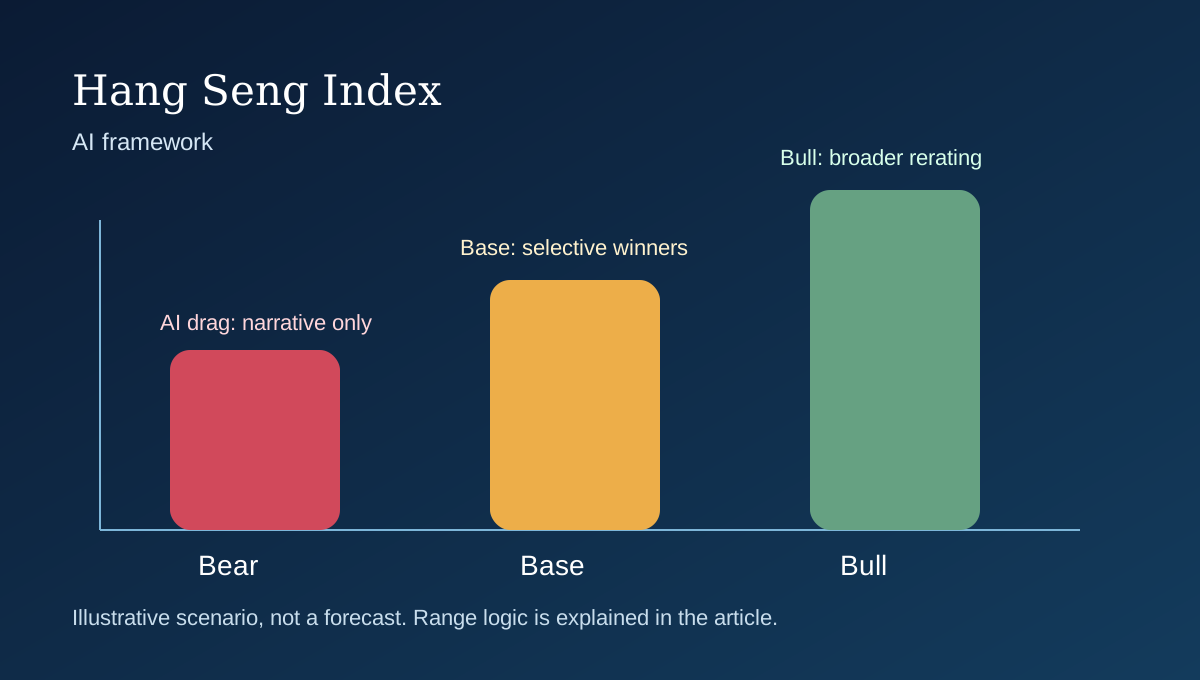
Bullish AI scenario
The bull AI scenario has a 30% probability. It assumes Alibaba, Tencent, and a broader cluster of healthcare, platform, and infrastructure names translate AI into visible earnings acceleration, while Hong Kong strengthens its role in AI financing and cross-border commercialization.
Base-case AI scenario
The base case has a 50% probability. AI matters, but selectively. A handful of large constituents benefit materially, financials and utilities capture efficiency gains more slowly, and the benchmark improves in quality without becoming a pure tech market.
Bearish AI scenario
The bear AI scenario has a 20% probability. It assumes AI remains more narrative than profit center for most HSI names, and that market excitement fades faster than monetization arrives.
| Scenario | Probability | What changes | Measured trigger |
|---|---|---|---|
| Bull AI | 30% | Broader earnings rerating and leadership shift | Repeated company disclosures showing AI-led revenue, margin, or productivity gains |
| Base AI | 50% | Selective winners outperform inside a still-diversified index | Steady AI monetization without a full-market transformation |
| Bear AI | 20% | AI remains mostly thematic for the index | Few tangible gains beyond pilot programs and headlines |
| Path for AI's HSI impact | Estimated probability | Interpretation |
|---|---|---|
| AI contributes to a higher HSI over time | 55% | Most plausible if platform heavyweights keep monetizing and Hong Kong's AI infrastructure scales. |
| AI contributes to lower HSI performance | 15% | This mainly happens if spending rises but profits do not, or if sentiment reverses hard. |
| AI has broadly neutral net impact | 30% | Still possible if benefits stay concentrated and the rest of the index barely changes. |
Risks to watch
The main risks are weak monetization, rising capex without adequate returns, renewed regulatory friction, and the possibility that AI improves narratives more than earnings.
What could invalidate this framework
This framework would be too cautious if AI monetization broadens across more HSI sectors than current disclosures suggest. It would be too optimistic if high-profile platform progress does not translate into lasting margin or revenue improvements.
Conclusion
AI could reshape the Hang Seng over the next decade, but mostly by changing which companies lead, how earnings are valued, and how Hong Kong positions itself in the regional capital stack.
Disclaimer: This article is for research and informational purposes only. AI-related scenario work reflects conditional judgments about policy, company execution, and market structure, not guaranteed outcomes.
06. Investor Positioning
Different readers should respond to the same forecast in different ways
| Investor profile | Cautious approach | What to monitor |
|---|---|---|
| Investor already in profit | Hold a core position but consider trimming into strength if the move is running well ahead of earnings revisions. | Southbound flow momentum, EPS revisions, and whether the rally broadens beyond a few heavyweights. |
| Investor currently at a loss | Avoid averaging down automatically; first decide whether the original thesis was valuation mean reversion, income, China tech recovery, or Hong Kong reopening. | Policy follow-through, index breadth, and whether downside is cyclical or structural. |
| Investor with no position | Use staggered entries or wait for pullbacks instead of chasing breakouts after sentiment spikes. | Valuation discipline, U.S. rate path, and cross-border flow data. |
| Trader | Use stop-loss discipline and treat HSI as a macro-sensitive trading instrument rather than a low-volatility income index. | Geopolitics, earnings season, and U.S.-China rate and policy headlines. |
| Long-term investor | Dollar-cost averaging is more defensible than heroic point forecasting, but only if the portfolio can tolerate multi-year drawdowns. | Dividend resilience, structural earnings mix, and capital-market reforms. |
| Risk-hedging investor | Rebalance or hedge if Hong Kong and China exposure is already large elsewhere in the portfolio. | Correlation spikes, USD strength, and commercial real estate stress. |
07. FAQ
Common questions investors ask about this HSI outlook
Will AI turn the Hang Seng into a tech-only index?
Probably not. The HSI still has major financial, healthcare, consumer, telecom, and infrastructure weights. AI is more likely to change leadership and quality than erase diversification.
Which HSI constituents have the clearest public AI evidence today?
Alibaba and Tencent currently provide some of the clearest large-cap evidence because both have reported AI-related monetization, cloud progress, or direct product integration.
Why does Hong Kong policy matter for an AI article about the HSI?
Because infrastructure, regulation, compute access, and cross-boundary data rules all influence whether Hong Kong can capture financing and commercialization value from AI rather than merely listing AI-adjacent companies.
08. Sources
Primary and high-credibility references used in this article
- Yahoo Finance chart API for ^HSI, 10-year monthly history
- Yahoo Finance chart API for ^HSI, recent daily closes
- Hang Seng Index factsheet, data as at April 30, 2026
- Hang Seng Indexes Company February 2026 index review results
- HKEX Monthly Market Highlights, April 2026
- HKEX Q1 2026 Hong Kong Market Update
- HKEX Stock Connect 2025 Review
- HKEX 2025 annual results presentation
- IMF staff concluding statement for Hong Kong SAR, May 15, 2026
- Hong Kong 2026-27 Budget speech, economic outlook section
- Hong Kong advance GDP estimates for Q1 2026
- Hong Kong retail sales statistics for March 2026
- HKMA Half-Yearly Monetary and Financial Stability Report, March 2026
- Hong Kong Property Review 2026 preliminary findings
- Invesco 2026 investment outlook for Chinese equities
- Invesco China outlook for 2026
- UBS China Outlook 2026-27: Resilience and Rebalancing
- Goldman Sachs view on China's 2026 growth outlook
- J.P. Morgan Asset Management global ex-US equities outlook, China section
- HKMA GenA.I. Sandbox++ announcement
- Cyberport AI Supercomputing Centre overview
- ITIB legislative council response on AI infrastructure and cross-boundary data flow
- Alibaba FY2026 results and AI update
- Tencent 2025 annual and fourth quarter results