01. Quick Answer
AI could reshape the KOSPI materially, but mostly by changing market leadership and valuation quality
The KOSPI closed at 7,493.18 on 2026-05-15 after starting the current 10-year Yahoo Finance series at 1,970.35 on 2016-05-31, implying a price-only CAGR of roughly 14.36% (Yahoo Finance chart API for ^KS11, 10-year monthly history; Yahoo Finance chart API for ^KS11, recent daily closes). That is an extraordinary run for a market long associated with the so-called Korea discount. It also means the easy part of the rerating is probably over. Any serious forecast now has to weigh a real semiconductor and AI earnings engine against Korea's cyclical exposure to trade, oil, geopolitics, and currency shocks. The key AI question for Korea is not whether the country has exposure. It clearly does. The better question is whether the benefits remain concentrated in memory and packaging or diffuse into a broader Korean productivity and capital-allocation story.
| Point | Why it matters |
|---|---|
| Korea's AI exposure is industrial and infrastructural | Memory, semis, computing, autos, and automation matter more than app-layer hype alone. |
| Policy support is visible | MSIT and MOTIE are treating AI and semiconductors as national competitiveness issues. |
| AI can reshape valuation as well as earnings | Markets may pay more for Korean firms if AI leadership looks durable and strategic. |
| The main risk is over-concentration | If only a few names benefit, AI can raise cyclicality even while lifting headline prices. |
02. Historical Context
The KOSPI's AI story starts with an already-transformed market
The KOSPI closed at 7,493.18 on 2026-05-15 after starting the current 10-year Yahoo Finance series at 1,970.35 on 2016-05-31, implying a price-only CAGR of roughly 14.36% (Yahoo Finance chart API for ^KS11, 10-year monthly history; Yahoo Finance chart API for ^KS11, recent daily closes). That is an extraordinary run for a market long associated with the so-called Korea discount. It also means the easy part of the rerating is probably over. Any serious forecast now has to weigh a real semiconductor and AI earnings engine against Korea's cyclical exposure to trade, oil, geopolitics, and currency shocks.
Reuters connected the 7,000 break directly to an AI-powered rally in semiconductor stocks, and that is directionally correct. But a decade-long AI article has to go further. It must ask whether AI changes the composition of winners, the duration of the earnings cycle, and the market's structural valuation.
| Metric | Latest reading | Why it matters |
|---|---|---|
| Recent close | 7,493.18 | Every forecast in this article starts from the latest available close, not an old cyclical trough. |
| 10-year starting point | 1,970.35 | Helps frame how much rerating has already happened. |
| 10-year price CAGR | 14.36% | Useful for calibrating whether a future range is conservative or aggressive. |
| 10-year observed range | 1,754.64 to 7,493.18 | Shows how cyclical KOSPI outcomes can be even across a strong decade. |
| Recent 1-month range | 6,091.39 to 7,981.41 | Confirms that the market is still moving in large swings, not a calm trend. |
| Signal | Evidence | Forecast implication |
|---|---|---|
| Memory and HBM leadership | Samsung and SK hynix both tie profits to AI-related memory demand. | Gives the KOSPI direct AI earnings exposure today. |
| National compute policy | MSIT and the AI Computing Center plan show public backing for compute expansion. | Raises the odds that AI becomes an ecosystem, not just a temporary export theme. |
| Industrial policy reinforcement | MOTIE treats semiconductors as strategic economic assets in the AI era. | Supports long-run capital spending and policy continuity. |
| Platform and sovereign AI angle | NAVER continues to build HyperCLOVA X-related capabilities. | Shows AI exposure is not limited to hardware alone. |
03. Main Drivers
Six AI channels could reshape the KOSPI over the next decade
1. High-bandwidth memory and advanced DRAM. Samsung says strong memory demand continues amid AI, while its AMD partnership shows how central Korean memory remains to next-generation accelerator systems.
2. SK hynix and the AI memory supercycle. SK hynix says the spread of memory-efficiency technologies will expand the overall scale of AI services and further drive memory demand. That makes Korea a direct beneficiary of AI infrastructure capex.
3. National AI computing capacity. MSIT says the government will secure large GPU resources and support the National AI Computing Center. That matters because domestic compute capacity can create local AI demand, testing, and ecosystem depth.
4. Industrial automation and productivity. AI can matter in Korea because demographics create a practical need for automation, not just a speculative opportunity. That can benefit industrial and manufacturing names over time.
5. Autos and edge AI. Hyundai continues to invest heavily, and AI increasingly intersects with mobility software, sensors, manufacturing efficiency, and supply-chain optimization.
6. Sovereign AI and local platforms. NAVER and the AI Basic Act framework show that Korea wants an AI stack that is not wholly dependent on foreign platforms.
| AI channel | Public evidence | Potential index effect |
|---|---|---|
| HBM and advanced memory | Samsung and SK hynix results and partnerships | Supports profit leadership and premium multiples. |
| Domestic compute infrastructure | MSIT GPU and AI-center plans | Helps local ecosystem depth and demand formation. |
| Industrial automation | Demographic pressure and productivity need | Could broaden AI benefits beyond chip suppliers. |
| Autos and mobility | Large capex and R&D by Hyundai | Connects AI to non-memory industrial earnings. |
| Platform AI and sovereign models | NAVER HyperCLOVA X development | Expands the AI narrative beyond hardware dependence. |
04. Institutional Forecasts and Analyst Views
Institutions mostly publish shorter-horizon inputs, so long-range KOSPI estimates need explicit translation
There is a practical problem with very long-range KOSPI forecasting: major institutions rarely publish exact 2030 or 2035 KOSPI targets with enough methodological detail to treat them as hard forecasts. What they do publish are the ingredients. J.P. Morgan Global Research sees emerging markets supported by lower local rates, earnings growth, attractive valuations, and governance improvements. J.P. Morgan Private Bank says global AI tailwinds should continue to support exporters such as South Korea. Invesco says Korea is accelerating governance reforms to strengthen shareholder value, while UBS keeps a favorable lens on Asia tech and a neutral to constructive view on Korea within Asia. MSCI adds that South Korean equities had still been trading around 10 times forward earnings in mid-2025, below the broader MSCI EM multiple near 13, even after strong performance.
Those inputs do not give a clean 2030 number. They do justify a scenario framework. In these articles, the range logic uses five building blocks: the current index level; the 10-year price CAGR; public macro forecasts from OECD, IMF, the BOK, and KDI; public evidence on earnings engines from Samsung, SK hynix, and Hyundai; and the probability that governance reform and foreign-access improvements keep narrowing the Korea discount through the decade.
| Source | What it says | How it influences the scenario work |
|---|---|---|
| IMF, OECD, BOK, KDI | Growth is recovering, but risks remain tilted to trade, energy, and domestic leverage. | Supports moderate earnings growth, not blind extrapolation. |
| J.P. Morgan and UBS | Asia tech and exporters such as Korea still benefit from AI and easing-cycle support. | Strengthens the bull and base cases for semiconductors. |
| Invesco and MSCI | Governance reforms and still-reasonable valuation remain important. | Supports the case for a lower structural discount versus history. |
| Company disclosures | Samsung, SK hynix, and Hyundai all provide evidence on capex, demand, and export sensitivity. | Grounds the index view in the earnings power of major constituents. |
For an AI-themed KOSPI article, institutions and public policy sources matter more than neat index targets. J.P. Morgan is optimistic about AI tailwinds for Korea, while MSIT and MOTIE provide concrete evidence that the state sees AI and semiconductors as strategic infrastructure.
05. Bull, Bear, and Base Cases
Scenario ranges are more defensible than a single-number prediction
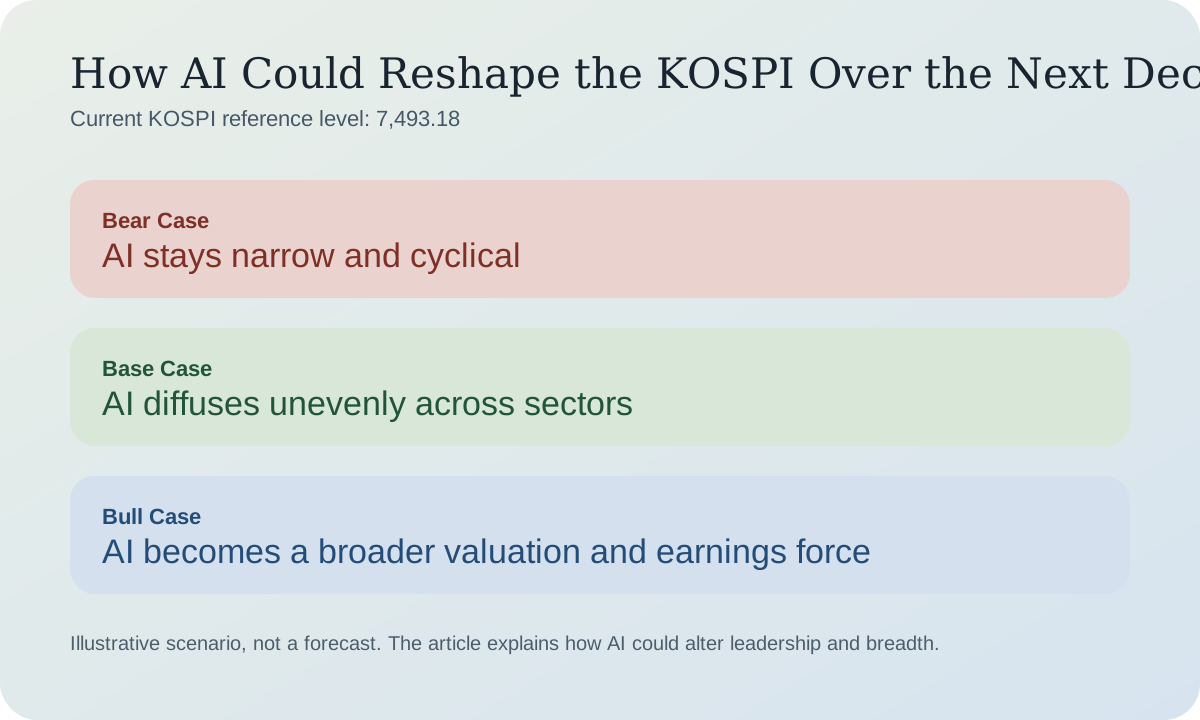
The AI base case in this article is not a separate index target so much as a structural pathway: AI helps keep the KOSPI in a higher long-run range by sustaining profit leadership and gradually broadening demand into computing, autos, industrials, and platforms. The evidence is real, but analysts remain divided on how broad the monetization will become.
| Scenario | Range logic | Conditions | Probability |
|---|---|---|---|
| Bull AI | KOSPI sustains a higher valuation regime and pushes into the upper end of long-run ranges | AI benefits spread across memory, infrastructure, autos, and productivity software. | 30% |
| Base AI | AI helps, but unevenly | Memory leaders stay strong while the rest of the market improves only gradually. | 50% |
| Bear AI | AI remains mostly a narrow hardware trade | Capex stays concentrated and broader profit diffusion disappoints. | 20% |
| Path for AI's market impact | Estimated probability | Comment |
|---|---|---|
| AI lifts the KOSPI meaningfully over time | 60% | Most plausible if hardware leadership turns into broader ecosystem strength. |
| AI has neutral net impact | 25% | Possible if gains stay concentrated and valuation simply rotates around them. |
| AI eventually disappoints the market | 15% | Would likely require weak monetization outside a handful of leaders. |
Bullish scenario
The AI bull case is that Korea moves from being merely essential to AI hardware toward being strategically important across memory, compute, industrial automation, and sovereign AI infrastructure.
Bearish scenario
The AI bear case is not that AI disappears. It is that too much of the economic upside remains trapped in a few cyclical names, leaving the broader market exposed to the same old concentration risk.
Base-case scenario
The base case is that AI does reshape the KOSPI, but selectively. It changes leadership and valuation quality more than it transforms every sector equally.
Risks to watch
Watch capex discipline, memory pricing, domestic compute execution, export concentration, and whether sovereign-AI efforts produce real products rather than national-tech symbolism.
What could invalidate the forecast
This framework would be too cautious if AI monetization broadens faster into autos, industrial software, and domestic platforms. It would be too optimistic if the AI trade remains mostly a narrow memory cycle without durable follow-through.
Conclusion
AI could reshape the KOSPI over the next decade, but the strongest version of that thesis is not just a bigger chip rally. It is a broader shift in Korea's earnings mix, infrastructure depth, and market-quality perception.
Disclaimer: This article is for research and informational purposes only. AI-related scenario analysis is conditional and should not be read as a guaranteed roadmap for Korean equities.
06. Investor Positioning
Different investor profiles should react differently to the same KOSPI outlook
| Investor profile | Cautious approach | What to watch |
|---|---|---|
| Investor already in profit | Consider holding a core stake but trimming if one semiconductor or ETF has become too dominant. | Watch whether the AI-diffusion thesis keeps broadening or becomes a narrow momentum trade. |
| Investor currently at a loss | Separate thesis from timing. Reassess balance between semiconductors, cyclicals, and Korea-specific governance catalysts before averaging down. | Monitor earnings revisions, FX moves, and whether the Korea discount is genuinely narrowing. |
| Investor with no position | Prefer staged entry or dollar-cost averaging rather than chasing a vertical rally. | Pullbacks linked to oil, rates, or trade headlines may offer cleaner entry points. |
| Trader | Use stop-loss discipline and respect event risk around chip earnings, BOK decisions, and export releases. | Short-term KOSPI moves can be amplified by foreign flows and KRW volatility. |
| Long-term investor | Focus on scenario ranges, governance progress, and the durability of AI and industrial policy support. | The long-run case improves only if earnings growth spreads beyond a handful of names. |
| Risk-hedging investor | Consider partial hedges or rebalancing if portfolio risk is already highly correlated with semiconductors and energy-import shocks. | Korea remains sensitive to oil, geopolitics, and the US dollar. |
07. FAQ
Frequently asked questions about this KOSPI outlook
Is the KOSPI basically an AI memory trade now?
It is heavily influenced by AI memory and semiconductor demand, but the more interesting long-run question is whether AI spreads into other Korean sectors and raises the market's overall quality.
Why does sovereign AI matter for a stock-market article?
Because domestic compute, data policy, and local AI models can influence who captures value inside the Korean economy rather than exporting all of it to foreign platforms.
What is the biggest risk to the AI-driven KOSPI thesis?
The biggest risk is concentration. If the benefits stay trapped in a few names, AI can boost the index while also making it more fragile.
References
Sources
- Yahoo Finance chart API for ^KS11, 10-year monthly history
- Yahoo Finance chart API for ^KS11, recent daily closes
- Bank of Korea Economic Outlook, February 2026
- IMF 2025 Article IV consultation with the Republic of Korea
- IMF blog: Asia's economic resilience is being tested by the energy shock
- KDI Economic Outlook Update, February 2026
- MSCI: 'Hallyu' Moment - how investors rode the Korean Wave
- J.P. Morgan Private Bank 2026 Asia outlook
- Samsung Electronics 1Q 2026 earnings presentation
- Samsung and AMD expand collaboration on next-generation AI memory solutions
- SK hynix announces 1Q26 financial results
- Hyundai Motor 2025 annual and Q4 business results
- MSIT AI strategy press release on compute, data, and policy support
- MSIT National AI Computing Center implementation plan
- NAVER unveils HyperCLOVA X-based image and speech processing technology