01. Quick Answer
AI could help the Nifty more through productivity than through pure tech exposure
The evidence suggests AI could reshape the Nifty 50 primarily by lifting productivity, improving margins, and accelerating demand for digital infrastructure rather than by turning the index into a direct semiconductor proxy. IMF work points to meaningful potential productivity gains across emerging Asia, including India, while IndiaAI and MeitY initiatives show active policy support for the ecosystem. Still, analysts remain divided because the Nifty has limited direct exposure to some of the most obvious global AI winners, and adoption can create both winners and losers within the index.
- AI's biggest Nifty impact may be indirect: productivity, margins, and sector rotation.
- India has policy momentum through IndiaAI and the semiconductor push, but monetization takes time.
- The index's current composition means AI benefits may be uneven across constituents.
- A bullish AI thesis still needs to address valuation, adoption frictions, and execution risk.
02. Current Market Snapshot
Why the current Nifty is not a simple AI proxy
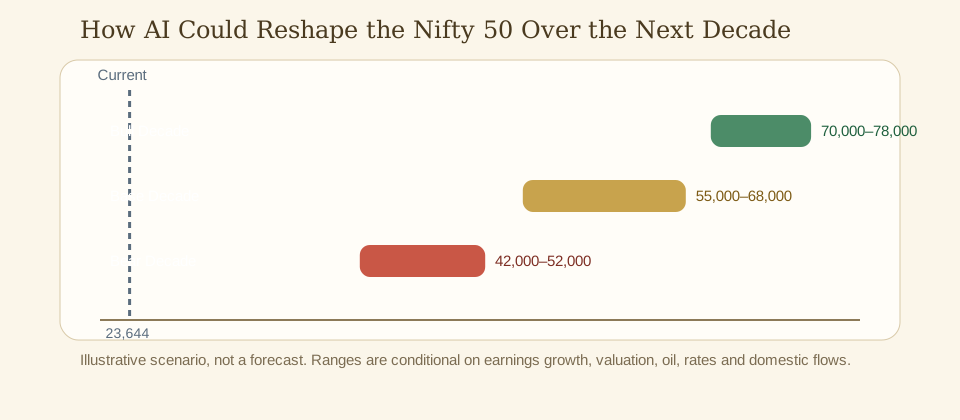
As of May 15, 2026, the Nifty 50 closed near 23,643.50, according to Yahoo Finance chart data[1]. That puts the benchmark well above its 10-year monthly low of 8,185.80 but still below the 1-year high of 26,328.55 reached on January 02, 2026[1]. In other words, this is not a washed-out index, but it is no longer trading at the peak optimism seen in early 2026.
The official April 30, 2026 Nifty factsheet adds useful context: the index still showed a negative 1-year price return of 1.38%, a 5-year price CAGR of 10.40%, a P/E of 20.94, a P/B of 3.29, and a dividend yield of 1.3%[2]. Those figures matter because most long-range Nifty forecasts ultimately come down to three variables: earnings growth, starting valuation, and how much domestic liquidity continues to cushion external shocks.
| Metric | Value | Why it matters |
|---|---|---|
| Recent close | 23,643.50 on May 15, 2026 | Starting point for all scenario work |
| 10-year range | 8,185.80 to 26,202.95 | Shows how much repricing India large caps have already delivered |
| 10-year CAGR | 11.11% | Useful reality check against aggressive long-term projections |
| 1-year high / low | 26,328.55 / 22,331.40 | Captures the early-2026 correction and rebound window |
| Deepest 10-year drawdown | -38.44% | Distinguishes normal volatility from a true crisis phase |
| Official valuation snapshot | P/E 20.94, P/B 3.29, yield 1.3% | Valuation discipline is central to any Nifty forecast |
Today's Nifty is dominated by financials, energy, IT, telecom, consumer and industrial names, not by a large roster of pure-play AI chip leaders. That means investors should think less about direct exposure and more about how AI changes productivity, capital expenditure, customer acquisition, and sector margins inside India's listed large-cap universe.
03. Historical Context And Main Drivers
AI could reshape the benchmark through productivity, infrastructure, and sector winners
Over the past decade, the Nifty 50 compounded at roughly 11.11% annually from 8,287.75 to 23,643.50[1]. That record supports a constructive long-run view on Indian large caps, but it also reminds investors that heroic forecasts should be tested against what the index has historically delivered. Even strong structural stories rarely move in straight lines.
The most severe drawdown in the 10-year daily series was about -38.44%, from 26,328.55 on January 02, 2026 to 7,610.25 on March 23, 2020[1]. That distinction matters. A correction can be uncomfortable; a bear market involves deeper multiple compression and earnings stress; a crash usually requires forced liquidation or a macro shock. Readers searching for a Nifty forecast should be explicit about which regime they are actually discussing.
| Driver | Current evidence | Bullish implication | Bearish implication |
|---|---|---|---|
| Productivity uplift | IMF says innovation and AI adoption can lift productivity materially | Higher output per worker can raise margins and returns on capital | Benefits may concentrate in a few sectors first |
| Digital public infrastructure | India already has strong digital rails and AI policy momentum | Lowers adoption friction across finance and services | Execution gaps can delay monetization |
| Compute and data centers | IndiaAI and public policy increasingly treat AI as infrastructure | Telecom, utilities and industrial beneficiaries could emerge | Capex intensity can pressure returns before revenues arrive |
| Semiconductor ecosystem | MeitY highlights approved fab and ATMP/OSAT projects | Builds a domestic hardware base over time | Commercial scale may take years to affect benchmark earnings |
| Labor and competitive dynamics | AI can widen productivity dispersion between firms | Best-managed large caps gain share | Laggards may face margin pressure or disruption |
The IMF's January 2026 productivity note is one of the most useful sources for this topic because it frames AI as a productivity amplifier rather than as a speculative buzzword. It argues that stronger innovation and AI-enabled efficiency could materially improve India's trend productivity. For the Nifty, that matters most in banks, IT services, telecom, logistics, and industrial businesses where better data use can improve operating leverage.
The policy angle matters too. IndiaAI, the AI Impact Summit process, and MeitY's semiconductor and electronics updates show that the Indian state increasingly sees AI as an ecosystem play involving compute, talent, applications, and hardware capacity. That does not guarantee listed-equity winners, but it raises the probability that AI becomes a real earnings theme rather than merely a story imported from U.S. megacaps.
04. Institutional Forecasts And Analyst Views
There is no clean institutional AI target for the Nifty, so scenarios matter more
There is a practical limit to what institutional forecasts can tell investors beyond one or two years. Banks publish abundant 12-month targets, but very few publish formal 2030 or 2035 Nifty targets. That means any long-range projection should be treated as a scenario framework built on current earnings expectations, macro assumptions, and plausible valuation bands, not as a precise institutional consensus number[6].
| Source | Target / stance | Core thesis | What it signals |
|---|---|---|---|
| IMF | AI can lift annual global growth and productivity | Macro productivity tailwind if adoption is broad | Supports upper-end long-run earnings assumptions |
| J.P.Morgan | India lacks large-cap AI and semiconductor exposure | A cautionary note on direct benchmark capture | Explains why AI may not immediately rerate the index |
| MeitY / IndiaAI | Policy treats AI and semiconductors as strategic priorities | Infrastructure and ecosystem support are expanding | Improves medium-term optionality |
| Morgan Stanley / other bulls | Constructive on India equities more broadly | If macro and capex stay strong, AI can amplify rather than create the trend | AI works best as a second-order accelerator |
The absence of formal Nifty AI targets is not a problem; it is a reminder to focus on mechanism. AI can help the benchmark through cost savings, faster credit underwriting, better telecom monetization, smarter industrial operations, and more scalable software exports. It can also hurt some firms by eroding pricing power or exposing weak execution.
That is why the scenario approach works best. Instead of predicting a single AI number, investors should ask how deeply AI adoption diffuses through current Nifty sectors and whether policy support translates into real listed-company earnings.
05. Bullish Scenario
The bullish AI case is a productivity-plus-infrastructure story
In the bullish AI scenario, Indian large caps adopt AI fast enough to improve customer service, underwriting, coding productivity, network efficiency, and industrial automation without destroying margins through excessive price competition. Banks process and price risk better. Telecom and digital infrastructure firms monetize rising data demand. IT services firms move from labor-arbitrage exposure toward higher-value AI integration work.
Layer on state-backed ecosystem development, data-center investment, and a gradually deeper semiconductor packaging and design capability, and the Nifty could capture more of India's AI upside than skeptics currently assume. Under that broad-adoption path, the index's long-run valuation ceiling and earnings base could both move higher.
06. Bearish Scenario
The bearish AI case is that the benefits arrive slowly or outside the benchmark
A bearish AI interpretation does not require AI to fail. It only requires the Nifty 50 to capture less of the upside than investors hope. If direct AI winners remain mostly outside the benchmark, if IT services face pricing pressure before new revenue pools mature, or if capital spending rises faster than profits, the index could underwhelm even while India's AI ecosystem expands.
There is also execution risk. The IMF explicitly notes adoption frictions such as skills gaps and integration challenges. In listed markets, those frictions usually show up as delayed margins, uneven capex returns, and dispersion between leaders and laggards.
07. Base Case
Why an AI-lite to AI-broad pathway is the most credible middle ground
The most realistic base case is not that AI revolutionizes every Nifty constituent quickly. It is that AI gradually improves productivity and profit quality in selected heavyweight sectors while policy support builds a stronger domestic ecosystem over time. That kind of diffusion is slower than hype cycles suggest but still economically meaningful.
Under that framework, the next decade's Nifty outcome is better thought of as a range that shifts upward if AI adoption deepens. An AI-lite path still supports long-term gains. An AI-broad path supports a higher band. A genuine AI-led bull case needs much clearer evidence of widespread monetization.
08. Probability Framework And Investor Positioning
AI probabilities and positioning across investor types
These probabilities measure the likelihood that AI meaningfully changes Nifty earnings power over the next decade, not the likelihood that AI becomes a popular headline.
| Path | Probability | Conditions |
|---|---|---|
| Rising under AI-broad or AI-led scenarios | 55% | Requires broad adoption, policy follow-through, and sector monetization |
| Falling relative to AI hype expectations | 15% | Would occur if benefits stay narrow or margins disappoint |
| Moving sideways versus AI narrative | 30% | Likely if AI helps productivity but not enough to materially rerate the index |
| Investor profile | Prudent approach | Why that stance fits |
|---|---|---|
| Investor already in profit | Hold leaders, rebalance away from pure narrative chasing | AI dispersion can widen fast |
| Investor currently at a loss | Focus on whether the company is an AI adopter or an AI victim | The distinction matters more than the headline theme |
| Investor with no position | Prefer staggered exposure through broad leaders, not hype names | The benchmark benefits indirectly more than directly |
| Trader | Trade earnings proof, not AI press releases | Adoption headlines alone rarely sustain price moves |
| Long-term investor | Favor high-quality financials, telecom, IT and industrial enablers | These sectors are more likely to monetize AI steadily |
| Hedger / risk-only investor | Use valuation discipline because AI stories can overheat | Execution risk remains real even in a good ecosystem |
The investment implication is that AI should be treated as a filter on Nifty sector quality, not as a shortcut to indiscriminate bullishness.
09. Risks To Watch And What Could Invalidate The Forecast
The forecast fails if AI adoption is broad in theory but weak in listed-company results
The key risks are adoption friction, skills shortages, capex overspend, and benchmark mismatch. India can build a powerful AI ecosystem while the Nifty captures only a portion of it. Investors should therefore watch reported productivity, margin trends, and revenue quality rather than rely on conference narratives alone.
This framework would be invalidated upward if listed companies start showing broad AI-linked margin or revenue improvements sooner than expected. It would be invalidated downward if the ecosystem grows but benchmark earnings do not. Either way, the test is execution, not enthusiasm.
| Signal | Why it matters | Implication for the thesis |
|---|---|---|
| Listed large caps show clear AI-linked earnings gains | Would prove the monetization channel is real | Higher-end scenarios gain credibility |
| AI capex rises but profits do not follow | Would signal poor return on investment | Lower scenarios become more likely |
| Semiconductor and digital infrastructure build-out stalls | Would reduce ecosystem depth | Long-run AI optionality for the index would weaken |
Disclaimer: This article is an editorial scenario analysis, not personalized investment advice. Forecast ranges are conditional and can fail if earnings, policy, energy prices, or global liquidity move materially away from current assumptions.
10. Conclusion
AI could reshape the Nifty, but mostly through earnings quality and productivity
AI is likely to matter for the Nifty 50 over the next decade, but not in the simplistic way many market narratives imply. The biggest effect may come from higher productivity, better operating leverage, and stronger digital infrastructure rather than from direct chip-style exposure. That still matters a great deal. It means AI can widen the Nifty's long-run upside if India translates policy ambition into listed-company earnings, while leaving plenty of room for sector-level winners and losers along the way.
FAQ
Frequently asked questions
Will AI make the Nifty 50 a direct tech winner like the Nasdaq?
Probably not. The Nifty's current sector mix means most AI benefits should arrive indirectly through productivity and infrastructure rather than pure-play AI exposure.
Which Nifty sectors could benefit most from AI?
Financials, IT services, telecom, selected industrials, and digital infrastructure-linked businesses look like the clearest candidates.
What is the biggest risk to the AI thesis?
Execution risk. AI adoption can raise costs before it raises profits, and some benefits may occur outside the benchmark.
Why include semiconductors in a Nifty AI discussion?
Because India's policy effort around semiconductors and electronics can deepen the ecosystem that supports broader AI commercialization over time.
References
Sources
- Yahoo Finance chart data for ^NSEI - 10-year monthly and 1-year daily history
- NSE Indices, Nifty 50 Factsheet, April 30, 2026
- IMF Executive Board Concludes 2025 Article IV Consultation with India
- World Bank India Development Update, April 2026
- AMFI Monthly Note, April 2026 - SIP contributions and equity flows
- Reuters via MarketScreener - J.P.Morgan downgrades India to neutral and cuts Nifty target to 27,000
- Moneycontrol - Morgan Stanley sees a bull market ahead for Indian equities with Sensex at 95,000
- IMF article - Business Growth and Innovation Can Boost India's Productivity
- IMF Managing Director speech - A Global Vision for Indian AI
- IndiaAI Mission official site
- MeitY monthly achievements, February 2026 - semiconductor and electronics ecosystem update
- Invest India - semiconductor mission and ecosystem development in India