01. Quick Answer
AI could help the Sensex more through productivity than through pure chip exposure
The evidence suggests AI could reshape the Sensex primarily by lifting productivity, improving margins, and accelerating demand for digital infrastructure rather than by turning the benchmark into a direct semiconductor proxy. IMF work points to meaningful potential productivity gains across emerging Asia, including India, while IndiaAI and MeitY initiatives show active policy support for the ecosystem.
Still, analysts remain divided because the Sensex has limited direct exposure to some of the most obvious global AI winners, and adoption can create both winners and losers inside the benchmark. That is why AI should be modeled as a scenario catalyst, not as an automatic rerating story.
- Historical data supports a constructive long-run view, but not a straight-line rally.
- Current market conditions show resilience, yet Sensex concentration makes breadth important.
- Institutional forecasts are strongest over 12 to 24 months, so longer targets should stay scenario-based.
- Bull, bear, and base cases depend on earnings growth, domestic flows, oil, and valuation discipline.
02. Current Market Snapshot
A Sensex outlook needs a current anchor before it can become a forecast
As of May 15, 2026, the Sensex closed near 75,237.99, according to Yahoo Finance chart data[1]. That leaves the benchmark below its 52-week high of 86,159.02 but above the 52-week low of 71,545.81[2]. The market is therefore not washed out, but neither is it trading at the euphoric high reached in late 2025.
History also matters here. Over the past decade, monthly closes moved from about 26,999.72 in late May 2016 to 75,237.99 in mid-May 2026, a roughly 10.79% annualized gain[1]. The BSE's 40-year paper adds a longer lens: it notes about 13.4% annualized Sensex growth over 39 years, in line with nominal GDP growth, while also emphasizing that sector leadership has changed materially over time[5].
| Metric | Value | Why it matters |
|---|---|---|
| Recent close | 75,237.99 on May 15, 2026 | Starting point for all scenario work |
| 10-year range | 26,626.46 to 85,706.67 | Shows how much India's large-cap benchmark has already repriced |
| 10-year CAGR | 10.79% | Useful reality check against aggressive long-run projections |
| 1-year high / low | 86,159.02 / 71,545.81 | Captures the 2025 peak and the 2026 stress window |
| Deepest 10-year drawdown | -38.07% | Helps separate a correction from a true bear market |
| Structural concentration | Top 10 names about 65% of index weight | Leadership breadth matters more than headline GDP alone |
The other reason current structure matters is concentration. According to the BSE Sensex at 40 paper, financial-services weight nearly doubled from about 22% in 2005 to roughly 39.5% in 2025, and the top 10 names represent about 65% of the benchmark's weight[5]. That means the headline market story can look healthy even when leadership is narrower than many investors assume.
03. Historical Context And Main Drivers
AI could reshape the benchmark through productivity, infrastructure, and sector winners
Sensex behavior over the last decade already shows why forecast language has to stay disciplined. The daily series implies a maximum drawdown of roughly -38.07%, from 41,952.63 on January 14, 2020 to 25,981.24 on March 23, 2020[2]. That was a genuine crisis drawdown, not a routine correction. Distinguishing correction, bear market, and crash is not semantics; it changes how investors should interpret risk.
| Driver | Current evidence | Bullish implication | Bearish implication |
|---|---|---|---|
| Productivity uplift | IMF says innovation and AI adoption can lift productivity materially | Higher output per worker can raise margins and returns on capital | Benefits may concentrate in a few sectors first |
| Digital public infrastructure | India already has strong digital rails and an active IndiaAI policy push | Lowers adoption friction across finance and services | Execution gaps can delay monetization |
| Compute and data centers | IndiaAI increasingly treats AI as infrastructure | Telecom, utilities, and industrial beneficiaries could emerge | Capex intensity can pressure returns before revenue arrives |
| Semiconductor ecosystem | PRS highlights approved fab and ATMP or OSAT projects | Builds a domestic hardware base over time | Commercial scale may take years to affect benchmark earnings |
| Labor and competitive dynamics | AI can widen productivity dispersion between firms | Best-managed large caps gain share | Laggards may face margin pressure or disruption |
The IMF's January 2026 productivity note is one of the most useful sources for this topic because it frames AI as a productivity amplifier rather than as a speculative buzzword. It argues that AI-driven productivity gains, scaled by preparedness and sector exposure, could lift total factor productivity across emerging Asia over a decade[15]. For the Sensex, that matters most in banks, telecom, IT-linked services, logistics, industrials, and consumer platforms where better data use can improve operating leverage.
The policy angle matters too. India's March 2024 IndiaAI Mission approval and the February 2026 PIB update show a government ecosystem approach built around compute, talent, data, applications, and indigenous capability[16]. PRS India also notes that semiconductor-related projects approved under MeitY have reached a cumulative investment figure of roughly Rs 1.6 lakh crore[17]. That does not guarantee listed-equity winners, but it does increase the probability that AI becomes an earnings theme rather than a purely imported narrative from U.S. megacaps.
04. Institutional Forecasts And Analyst Views
There is no clean institutional AI target for the Sensex, so scenarios matter more
There is a practical limit to what institutional forecasts can tell investors beyond one or two years. Most sell-side houses publish 12-month targets, not clean 2030 or 2035 endpoints. That means any longer-horizon Sensex estimate should be treated as a scenario framework built from current valuation, earnings assumptions, macro conditions, and credible institutional anchors rather than as a precise consensus number[10][11][12][13].
| Source | Target / stance | Core thesis | What it signals |
|---|---|---|---|
| IMF productivity work | No index target, but meaningful AI-related productivity upside | AI matters through efficiency and output, not only through software hype | Provides a macro foundation for scenario building |
| IndiaAI Mission | Policy push with Rs 10,372 crore outlay | Government support can reduce adoption friction | Helps explain why AI could become broader than a niche theme |
| PRS MeitY analysis | Ten semiconductor projects approved; large cumulative investment | Hardware and packaging ecosystem can support future AI capacity | Shows AI is tied to physical capex, not only software narratives |
| Invesco / broker sector work | Constructive on telecom, data-center, and digital themes | AI beneficiaries may emerge across existing large-cap sectors | Suggests indirect rather than pure-play exposure |
There is no widely accepted institutional AI price target for the Sensex. That makes scenario analysis more useful than borrowed hype. The right approach is to ask how AI changes growth quality, margins, cost structures, and sector mix within a benchmark still dominated by financials and large domestic leaders.
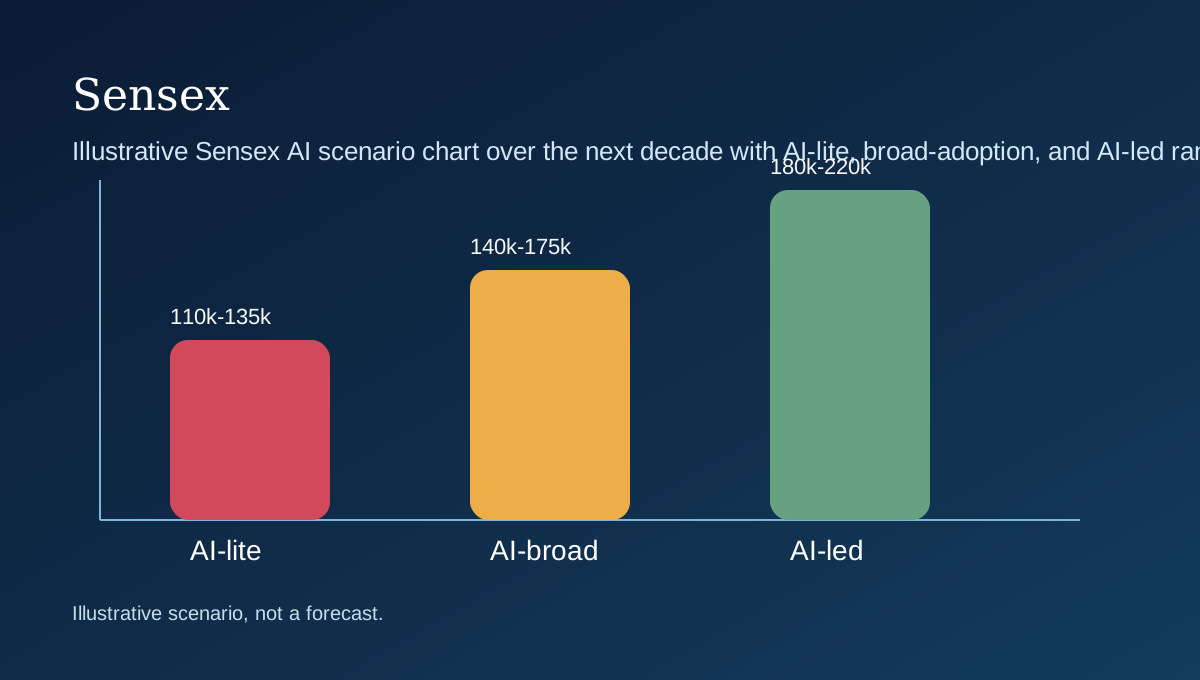
If AI stays mostly incremental, the benchmark may still benefit through productivity and operating leverage, supporting an AI-lite 110,000 to 135,000 range over the next decade. If adoption becomes broader across finance, telecom, logistics, industrial automation, and digital consumer businesses, the upside range expands materially. A true AI-led bull case needs both policy execution and monetization, not just excitement.
05. Bullish Scenario
What an AI-led Sensex bull case would actually require
A genuine AI-led bull case would require more than software adoption headlines. It would need measurable productivity improvements, durable compute and data-center investment, stronger digital monetization in large-cap businesses, and enough breadth that the gains do not stay trapped in a tiny set of winners.
If that broader monetization occurs, the Sensex could justify a meaningfully higher long-run range because AI would be affecting both earnings growth and returns on capital. That is the logic behind the 180,000 to 220,000 upper-end scenario.
06. Bearish Scenario
Why the AI story could still disappoint Sensex investors
The bearish AI argument is not that AI is fake. It is that adoption could remain uneven, expensive, or concentrated in private firms and unlisted ecosystems for longer than public-market investors expect. A benchmark can benefit from AI in the economy and still underperform if the listed winners are too few or if capex intensity erodes near-term returns.
There is also a valuation risk. If investors start paying for an AI future long before profits show up, the benchmark could become more fragile rather than less. That is a real possibility in any excitement-heavy theme.
07. Base Case
Why the most defensible AI view is still the middle scenario
The base case is that AI helps the Sensex more through gradual productivity improvement than through sudden thematic transformation. That still matters a lot over a decade. Better underwriting, customer analytics, network optimization, logistics efficiency, and automation can all compound into stronger earnings without changing the benchmark's identity overnight.
That is why the 140,000 to 175,000 broad-adoption scenario is the more balanced long-run AI case. It assumes AI matters, but it also respects execution lags, sector concentration, and the reality that benchmarks change more slowly than narratives do.
08. Probability Framework And Investor Positioning
Probability table and positioning by investor type
The probabilities below are judgment calls, not objective odds. They combine the starting valuation, the Sensex's concentration, official macro material, domestic flow data, and current institutional notes. The point is to show how a forecast range is built rather than to pretend precision where none exists.
| Path | Probability | Conditions |
|---|---|---|
| Rising through AI-linked productivity gains | 58% | Requires steady adoption, policy support, and monetization across large-cap sectors |
| Falling short of AI hopes | 17% | Would likely reflect weak monetization, high capex drag, or narrow winners |
| Mostly sideways relative to AI hype | 25% | Possible if productivity gains are real but already priced too early |
| Investor profile | Prudent approach | Why that stance fits |
|---|---|---|
| Investor already in profit | Hold core, trim weak positions, rebalance on strength | Protect gains without treating every rally as permanent |
| Investor currently at a loss | Avoid panic selling; review thesis, stagger exits or adds | Entry price risk is different from broken market structure |
| Investor with no position | Wait for pullbacks or use staged dollar-cost averaging | A full-size entry into a premium market raises regret risk |
| Trader | Use stop-loss rules and respect oil, rupee, and earnings catalysts | Short-term price action can diverge sharply from the macro story |
| Long-term investor | Accumulate selectively and rebalance sector concentration | Time horizon helps only if sizing stays disciplined |
| Hedger / risk-only investor | Use partial hedges, avoid overpaying for tail risk | India has macro risk, but not every risk deserves an extreme hedge |
For most readers, the practical implication is the same across themes: avoid treating a structural India story as a license to chase price. The benchmark can remain attractive over the long run while still being vulnerable to valuation resets, oil shocks, and leadership rotations.
09. Risks To Watch And What Could Invalidate The Forecast
The AI debate is really about monetization, breadth, and timing
The key risks to watch are whether AI spending produces measurable productivity, whether listed large caps capture enough of the value, and whether investors overpay before the cash flows appear. Those are very different questions, and serious AI market analysis should separate them.
What would invalidate this framework? If AI adoption stays mostly incremental and profits do not respond, even the middle case could be too optimistic. If India executes faster on compute, models, semiconductors, and enterprise adoption than expected, the upside case could prove too conservative.
| Signal | Why it matters | Implication for the thesis |
|---|---|---|
| Enterprise AI adoption lifts margins faster than expected | Would provide hard evidence of monetization | The middle case would likely prove too low |
| AI capex rises but profits do not follow | Cost inflation without cash-flow payoff hurts returns | The lower-end scenarios gain credibility |
| AI winners remain mostly outside the benchmark | Economic gains would not translate cleanly into Sensex earnings | The benchmark could lag the broader IndiaAI story |
Disclaimer: This article is editorial scenario analysis, not personalized financial advice. Forecast ranges are conditional and can fail if earnings, policy, liquidity, inflation, or geopolitics move materially away from current assumptions.
10. Conclusion
AI can matter a lot to the Sensex without turning it into an AI index
The most realistic AI thesis for the Sensex is not that it becomes India's version of a semiconductor benchmark. It is that AI gradually changes productivity, margins, infrastructure demand, and sector leadership across a concentrated large-cap index. That is still powerful. It just needs to be analyzed with more discipline than the average AI headline allows.
FAQ
Frequently asked questions
Is the Sensex a direct AI play today?
Not really. It has more indirect exposure through finance, telecom, digital infrastructure, and large domestic leaders than through pure AI hardware names.
Why can AI still matter if the benchmark lacks many pure-play AI names?
Because productivity and cost structure changes can lift earnings even in traditional sectors.
What is the biggest risk to an AI-led Sensex bull case?
The biggest risk is that spending and excitement arrive before broad monetization does.
What would make the AI case stronger?
Clearer evidence that listed large caps are converting AI adoption into better margins, faster growth, or stronger returns on capital.
References
Sources
- Yahoo Finance chart data for ^BSESN - 10-year monthly history
- Yahoo Finance chart data for ^BSESN - daily history for drawdowns and 52-week range
- BSE Sensex at 40 research paper, January 2026
- World Bank India Development Update, April 2026
- Invesco 2026 Outlook - India Equities
- IMF note: Business Growth and Innovation Can Boost India's Productivity
- PIB: IndiaAI Mission update, February 13, 2026
- PRS India - MeitY Demand for Grants 2026-27 analysis