01. Quick Answer
AI could matter a lot to the Shanghai Composite, but mostly through composition and earnings quality
The fast answer is that AI is likely to reshape the SSEC more through selective winners than through a uniform surge in every sector. The policy support is real. January 2026 official plan targets secure and reliable supply of key AI technologies by 2027 and deeper integration of AI with manufacturing. February 2026 premier remarks called for broader AI innovation and application across the chain, and the new quality productive forces agenda places AI directly inside the 2026-2030 growth framework. On the market side, the STAR Market Composite report says the STAR ecosystem now covers more than 97% of STAR market capitalization. That is enough evidence to treat AI as an economically relevant factor for the Shanghai market, not just a buzzword.
| Point | Why it matters |
|---|---|
| Historical data still matters | The SSEC's 3.52% 10-year price CAGR shows why scenario analysis is more credible than simple hype. |
| Current conditions are better, not fully healed | GDP, PMI, and industrial data improved, but property and consumption still limit certainty. |
| Institutional views are constructive but conditional | Public research from IMF, Goldman Sachs, UBS, Invesco, and J.P. Morgan supports nuance rather than certainty. |
| Forecast ranges must separate bull, bear, and base cases | The evidence is mixed enough that any serious SSEC forecast should explain probability, not just destination. |
02. Historical Context
The last decade shows why the Shanghai Composite resists simple narratives
Yahoo Finance data show the Shanghai Composite rising from 2,929.61 on 2016-05-31 to 4,135.39 on 2026-05-15, a 10-year price CAGR of 3.52%. That sounds respectable until you remember how range-bound the index has been. Over the same period, it traded between 2,493.90 and 4,162.88. This is not a market that rewards lazy extrapolation. It oscillates between policy support, domestic-demand skepticism, and bursts of enthusiasm around technology, liquidity, and reform.
| Metric | Latest reading | Why it matters |
|---|---|---|
| Recent close | 4,135.39 | Every scenario in this article starts from the latest Yahoo Finance close on 2026-05-15. |
| 10-year starting point | 2,929.61 | Anchors long-run scenario math instead of using a cherry-picked low. |
| 10-year price CAGR | 3.52% | Shows the market has compounded, but far less cleanly than a smooth growth benchmark. |
| 10-year range | 2,493.90 to 4,162.88 | Defines realistic historical limits for bull and bear scenario work. |
| Recent 1-month range | 4,027.21 to 4,242.57 | Captures the current near-term regime and volatility. |
| Fact | Latest public evidence | Interpretation |
|---|---|---|
| Listed A-share companies | 2,308 as of March 2026 | The Shanghai market is broad and systemically important, not a narrow sector trade. |
| Total market capitalization | RMB63.85 trillion | The exchange remains one of the world's largest pools of onshore equity capital. |
| Average daily trading value | RMB1.023 trillion | Liquidity remains deep even during choppy sentiment phases. |
| SSE Composite P/E | 16.10x in March 2026 | The market is not obviously distressed, but it is also not priced like a high-trust U.S. growth benchmark. |
| STAR Market listed companies | 606 by March 31, 2026 | Innovation and hard-tech exposure are becoming a more visible part of Shanghai's equity story. |
The official SSE March 2026 monthly statistics help explain that behavior. As of March 2026, the exchange had 2,308 A-share listings, total market capitalization of RMB63.85 trillion, average daily trading value of RMB1.023 trillion, and an official March closing P/E of 16.10x for the SSE Composite. The SSE overview page also reminds investors that Shanghai is not a niche market: the exchange is one of the world's largest by market capitalization and turnover. Even so, the index remains heavily shaped by the policy cycle, state-linked sectors, manufacturing, banks, brokers, energy, and the newer innovation complex around the STAR Market. That is why the SSEC often behaves differently from U.S. benchmarks and even from Hong Kong's more offshore-facing market.
03. Main Drivers
Six channels through which AI could reshape the SSEC
1. AI is now an official industrial priority, not just a private-sector theme
The January 2026 action plan aims for secure AI core-tech supply by 2027, support for AI chips, models, industrial datasets, and hundreds of application scenarios. That matters because onshore equity markets often respond strongly when policy priorities line up with listed-company capex and earnings opportunity.
2. AI fits directly into the new quality productive forces framework
Official 15th Five-Year Plan framing explicitly links AI to future industries, advanced manufacturing, and productivity. This gives the SSEC a structural narrative that is broader than one consumer-tech cycle.
3. The STAR Market creates a more visible hard-tech pipeline
The STAR Market Composite report says the benchmark covers more than 97% of the STAR Market's total capitalization, while SSE continues to emphasize support for new quality productive forces. That means the Shanghai equity ecosystem has a capital-market channel for AI-adjacent firms that barely existed a decade ago.
4. AI could improve industrial productivity before it transforms consumer narratives
For the SSEC, the first AI beneficiaries may be manufacturing, industrial software, automation, semiconductors, and engineering supply chains rather than purely internet advertising models. That fits the exchange's sector mix better than a pure platform-led story.
5. AI can deepen the gap between higher-quality and lower-quality listed companies
The SSE leading-companies report shows how concentrated profit contribution already is among large leaders. AI may widen that gap if only the best-capitalized firms can monetize compute, data, and industrial scale effectively.
6. AI does not remove the need for earnings discipline
Available data suggest AI can improve the market's long-run quality, but the evidence is mixed on how much of that upside will reach the broad index rather than a subset of firms. That is why an AI article about the SSEC still needs a base case and a bear case.
| Channel | Public evidence | Potential market effect |
|---|---|---|
| Industrial AI policy | 2027 core-tech and manufacturing AI action plan | Supports capex and valuation for strategic sectors. |
| STAR Market pipeline | 606 listed firms and broad composite coverage | Supports a deeper hard-tech capital base. |
| Manufacturing productivity | Government emphasis on AI plus industrial integration | Can improve margins and competitiveness over time. |
| Market leadership concentration | Large leaders dominate profits and market cap | AI may widen the quality gap inside the index. |
04. Institutional Forecasts and Analyst Views
The institutional backdrop supports an AI-related reweighting, not an automatic tech-market conversion
Invesco remains constructive on innovation-led Chinese sectors. J.P. Morgan AM says stock selection aligned with state priorities matters. Official policy documents now place AI and industrial upgrading at the center of the medium-term growth agenda. That supports the case that AI can reshape the Shanghai Composite. What it does not support is the lazy claim that the entire benchmark will suddenly trade like a pure software index.
| Source | Signal | SSEC implication |
|---|---|---|
| Government AI plan | AI core-tech and manufacturing integration are strategic priorities | Supports multi-year policy tailwinds. |
| SSE / STAR Market materials | New quality productive forces are central to exchange development | Supports a deeper hard-tech listed ecosystem. |
| Invesco | Industrial transformation is a key China equity theme | Supports selective upside in AI-linked sectors. |
| J.P. Morgan AM | State-priority-aligned stock selection matters | Supports selective rather than indiscriminate optimism. |
05. Bull, Bear, and Base Cases
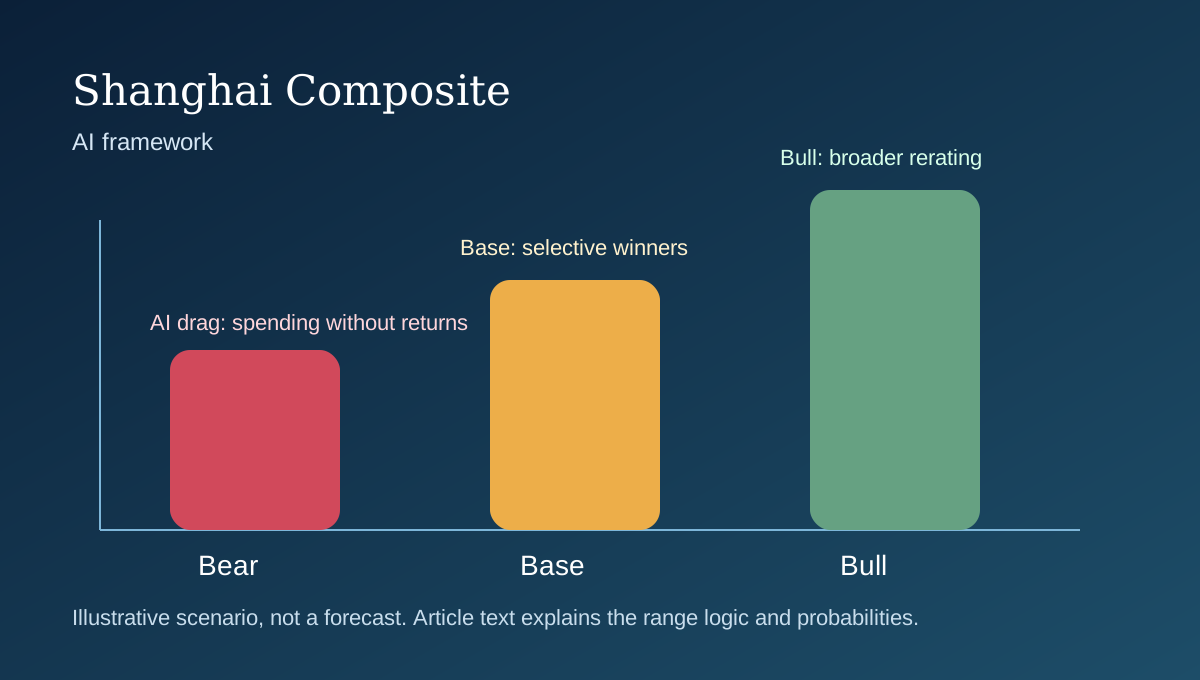
AI is more likely to change leadership than to lift every part of the index equally
Bullish AI scenario
The bull AI scenario has a 30% probability. It assumes industrial AI, chips, automation, and software monetization produce visible earnings upgrades across a broader set of listed firms.
Base-case AI scenario
The base case has a 50% probability. AI matters, but selectively. A subset of higher-quality industrial and technology names benefit first, while the wider index only improves gradually.
Bearish AI scenario
The bear AI scenario has a 20% probability. It assumes AI spending outruns monetization, benefits remain narrow, and broad-index investors see more hype than profit impact.
| Scenario | Probability | What changes | Measured trigger |
|---|---|---|---|
| Bull AI | 30% | Broader earnings rerating and higher-quality leadership | Repeated company disclosures showing AI-linked margin, revenue, or productivity gains |
| Base AI | 50% | Selective winners outperform inside a still-diversified market | Steady monetization without full-market transformation |
| Bear AI | 20% | AI remains more narrative than financially material for the broad index | Few tangible gains beyond pilot and policy headlines |
| Path for AI's market impact | Estimated probability | Interpretation |
|---|---|---|
| AI contributes to a higher SSEC over time | 55% | Most plausible if industrial and hard-tech monetization keeps broadening. |
| AI contributes to lower SSEC performance | 15% | Mainly if capex rises faster than returns and the market punishes disappointment. |
| AI has broadly neutral net impact | 30% | Still possible if benefits stay too concentrated to move the broad index materially. |
Risks to watch
The main risks are weak monetization, capital misallocation, rising spending without returns, and the possibility that policy enthusiasm runs ahead of listed-company economics.
What could invalidate this framework
This framework would be too cautious if AI-driven productivity and earnings gains spread faster across industrial and software ecosystems. It would be too optimistic if those gains remain too narrow or too slow to matter for the broad index.
Conclusion
AI could reshape the Shanghai Composite over the next decade, but mainly by changing which sectors lead and how the market values industrial and hard-tech earnings.
Disclaimer: This article is for research and informational purposes only. AI-related scenario work reflects conditional judgments about policy, company execution, and market structure, not guaranteed outcomes.
06. Investor Positioning
Different readers should respond to the same SSEC outlook in different ways
| Investor profile | Cautious approach | What to monitor |
|---|---|---|
| Investor already in profit | Hold a core position but consider trimming into policy-driven spikes if gains have outrun earnings follow-through. | Monitor breadth, earnings revisions, and whether the move is led by quality sectors or only by speculative pockets. |
| Investor currently at a loss | Avoid averaging down automatically; first decide whether the thesis was valuation, policy easing, industrial upgrading, or a cyclical rebound. | Property data, demand indicators, and whether policy support is improving fundamentals or only sentiment. |
| Investor with no position | Scale in gradually or wait for pullbacks instead of chasing rallies after macro headlines. | Valuation discipline, liquidity, and whether earnings breadth is improving. |
| Trader | Use stop-losses and treat the SSEC as a policy- and liquidity-sensitive market rather than a pure earnings market. | Two Sessions follow-through, PMIs, credit signals, and sector rotation. |
| Long-term investor | Dollar-cost averaging is more defensible than all-in timing, but only if the portfolio can tolerate long periods of range-bound performance. | Dividend discipline, market reforms, and the profit share of higher-quality sectors. |
| Risk-hedging investor | Rebalance or hedge if China exposure is already large elsewhere in the portfolio. | Correlation shifts, RMB moves, and renewed property or trade stress. |
07. FAQ
Common questions investors ask about this Shanghai Composite outlook
Will AI turn the Shanghai Composite into a pure technology index?
Probably not. The market remains diversified and still includes many sectors that respond more to domestic demand, policy, and traditional industrial cycles.
Why does the STAR Market matter so much for an AI article?
Because it gives Shanghai a listed hard-tech pipeline and a clearer capital-market channel for innovation-led companies than the broad market had in earlier cycles.
What is the most important proof point to watch?
Tangible listed-company evidence that AI is improving revenue, margins, or productivity rather than just generating policy headlines.
08. Sources
Primary and high-credibility references used in this article
- Yahoo Finance chart API for 000001.SS, 10-year monthly history
- Yahoo Finance chart API for 000001.SS, recent daily closes
- SSE Newsletter - March 2026 monthly market statistics
- Shanghai Stock Exchange overview page
- Focus on SSE: Post-Two Sessions Outlook 2026
- China Securities Journal report on 132 SSE companies above RMB 100 billion market cap
- SSE ETF industry report summary, February 2026
- STAR Market Composite Index benchmark report, April 2026
- China GDP preliminary accounting results for Q1 2026
- National Economy Got off to a Good Start in the First Quarter
- Total Retail Sales of Consumer Goods from January to March 2026
- Industrial Production Operation in March 2026
- Investment in Fixed Assets from January to March 2026
- Investment in Real Estate Development from January to March 2026
- Purchasing Managers’ Index for April 2026
- Consumer Price Index in April 2026
- Industrial Producer Price Indexes in April 2026
- IMF Executive Board concludes 2025 Article IV consultation with China
- IMF staff report on China 2025 Article IV consultation
- Goldman Sachs: China's economy is expected to grow 4.8% in 2026
- UBS China Outlook 2026-27: Resilience and Rebalancing
- Invesco 2026 investment outlook - Chinese equities
- Invesco China economy and markets update - Q1 2026
- J.P. Morgan AM: What China's 1Q 2026 GDP data tells us
- China aims for secure, reliable supply of AI core tech by 2027
- Chinese premier calls for comprehensive push in AI innovation and application
- Xi Focus: charting a course for China's growth with new quality productive forces