01. Quick Answer
The most realistic AI outcome is that it broadens and deepens the quality of the SMI rather than turning it into a tech index
The SMI closed at 13,220.17 on 2026-05-15, up from 8,020.15 at the start of its 10-year Yahoo Finance monthly series on 2016-06-01, for a price-only CAGR of about 5.12% (Yahoo Finance 10-year history; recent daily closes). The SMI does not need a large domestic software sector to benefit from AI. It only needs its existing leaders to improve productivity, analytics, and monetization through AI adoption.
That channel already exists through Digital Switzerland Strategy 2026, the Swiss AI policy track, and listed businesses such as ABB, Zurich Insurance, Swiss Re, and healthcare leaders that increasingly use data and digital tools.
| Point | Why it matters |
|---|---|
| AI matters through operational quality first | Healthcare analytics, insurance underwriting, and automation are the most plausible channels for the SMI. |
| The effect is likely to be gradual | AI can reshape valuation leadership before it changes the identity of the whole index. |
| ABB gives the benchmark a real automation channel | Swiss industry is not only pharma and food. |
| The market still needs proof | Policy and AI headlines matter only if they convert into earnings quality and efficiency gains. |
02. Historical Context
The SMI already contains more AI-sensitive channels than its old defensive stereotype suggests
The standard description of the SMI is healthcare, staples, and safe-haven finance. The SMI closed at 13,220.17 on 2026-05-15, up from 8,020.15 at the start of its 10-year Yahoo Finance monthly series on 2016-06-01, for a price-only CAGR of about 5.12% (Yahoo Finance 10-year history; recent daily closes). AI makes that picture too narrow.
Healthcare companies can use AI in discovery, diagnostics, and commercial workflows. Insurers can use AI in pricing, claims, and risk selection. ABB can benefit from AI through industrial automation, electrification, and productivity. That means the SMI can be reshaped by AI even if it never looks like a classic software benchmark.
The evidence is mixed on timing. AI headlines often arrive faster than accounting benefits. But over a decade, even gradual improvements in margin quality and capital efficiency can matter a lot for a defensive index.
| Area | Example names | Why it matters |
|---|---|---|
| Healthcare analytics and workflow | Roche, Novartis | AI can improve research efficiency, diagnostics, and commercialization workflows. |
| Insurance analytics | Zurich Insurance, Swiss Re | AI can improve underwriting, pricing, claims handling, and capital efficiency. |
| Industrial automation | ABB | AI can deepen automation, predictive maintenance, and electrification value. |
| Banking and client workflows | UBS | AI can improve advisor productivity, operations, and compliance workflows. |
| Observation | Implication | Forecast effect |
|---|---|---|
| Switzerland is not a mega-cap software market | AI will not turn the SMI into Nasdaq Europe | Prevents unrealistic hype-based targets. |
| The SMI already has operationally rich businesses | AI can improve economics within existing leaders | Supports gradual valuation reinforcement. |
| Policy support exists | The ecosystem may become more AI-ready over time | Strengthens the decade-long optionality case. |
03. Main Drivers
Five forces explain how AI could reshape Swiss blue chips over the next decade
1. AI can improve healthcare efficiency and discovery economics. For Roche and Novartis, operational and workflow gains may matter as much as headline science narratives.
2. AI can strengthen insurance underwriting. Zurich Insurance and Swiss Re have clear data and pricing channels through which AI can matter.
3. Industrial automation is a real AI pathway. ABB gives the SMI a practical automation and electrification lever that many defensive indices lack.
4. Banking and client-service workflows can improve. UBS can benefit operationally even if the market does not market it as an AI stock.
5. Swiss digital policy and AI regulation will shape adoption. Credible governance can help AI adoption scale in a quality-conscious market.
04. Institutional Forecasts and Analyst Views
Swiss policy and company evidence support a measured quality-upgrade thesis rather than AI hype
There are no credible public point forecasts saying AI will take the SMI to a specific level. That is the correct starting point. The more defensible approach is to combine Digital Switzerland Strategy 2026, Swiss AI policy, and company disclosures from ABB, Zurich, Swiss Re, Roche, and Novartis rather than forcing a false-precision AI target.
Analysts remain divided mainly on speed. The evidence does not support saying AI will suddenly redefine the whole SMI. It does support saying AI could make several existing leaders more efficient and therefore more deserving of a quality premium.
The practical mechanism matters. AI helps the SMI most if it improves underwriting, diagnostics, industrial efficiency, and workflow productivity across multiple sectors at once. That is a richer thesis than simply claiming Switzerland will somehow become a software-heavy market.
It also matters that AI does not need to transform one company dramatically to help the index. Modest but recurring improvements across several large constituents can still reinforce margins, capital efficiency, and valuation resilience over time for investors globally too.
| Channel | Potential upside | Main constraint |
|---|---|---|
| Healthcare workflows | Improves efficiency and potentially pipeline productivity | Adoption and regulation can be gradual. |
| Insurance analytics | Supports better pricing and claims economics | Benefits can take time to show in reported numbers. |
| Industrial automation | Helps ABB and adjacent Swiss industrial capabilities | Capex cycles still matter. |
| Banking operations | Improves productivity and compliance efficiency | Operational gains may be less visible to investors at first. |
05. Scenarios, Risks, and Invalidation
The AI bull case for the SMI is about better economics inside existing leaders, not a sudden identity change
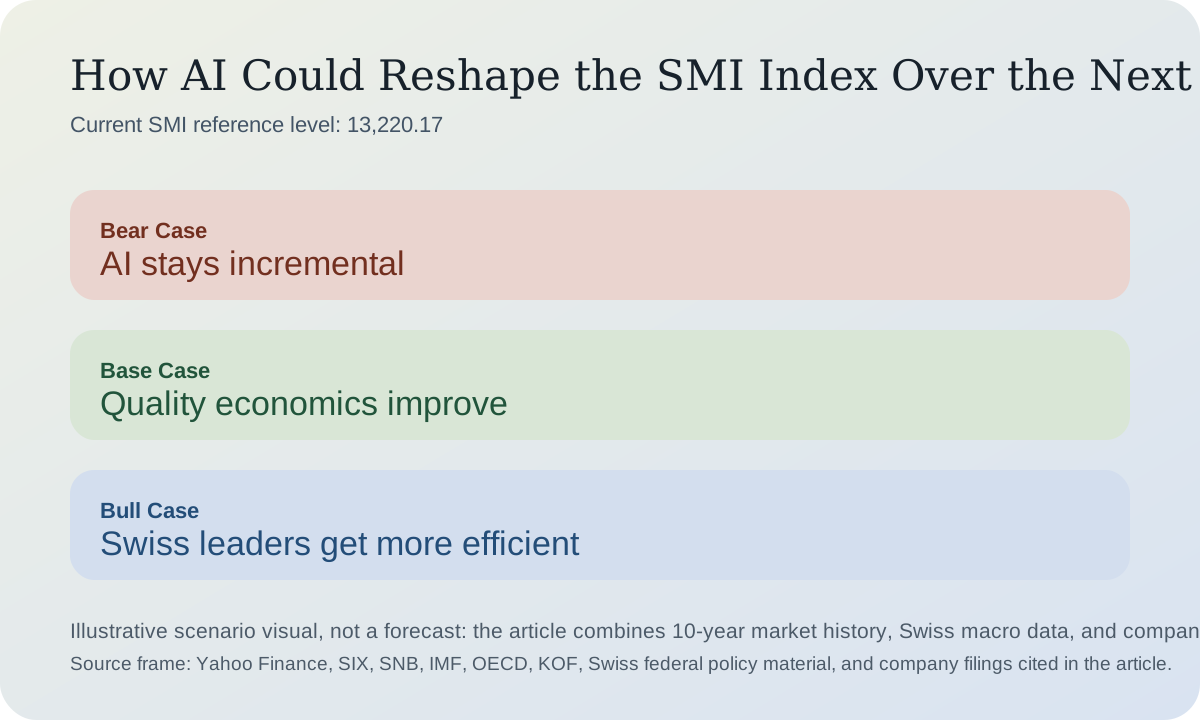
Bullish AI scenario
The bullish AI case is that healthcare, insurance, and industrial automation all improve enough to deepen earnings quality across the benchmark. In that world the SMI's defensive profile becomes more attractive, not less.
Base-case AI scenario
The base case is more moderate. AI helps several sectors and gradually strengthens quality metrics, but it does not transform the whole market overnight.
Bearish AI scenario
The bear case is not that AI disappears. It is that the operational benefits remain too slow, too small, or too invisible to materially change valuation outcomes.
Risks to watch
Watch healthcare deployment, insurance analytics, ABB automation demand, regulatory clarity, and whether AI moves from pilot programs into measurable operational gains.
What could invalidate the AI outlook
The constructive AI view would be too strong if Swiss leaders adopt more slowly than expected or if benefits remain mostly narrative. It would be too cautious if AI meaningfully upgrades the economics of several heavyweight sectors at once.
Conclusion
AI could reshape the SMI less by changing what Switzerland is and more by improving how Swiss blue chips operate. That is still a meaningful long-run shift for investors who care about earnings quality and valuation durability.
Disclaimer: This article is for research and informational purposes only. Any market impact from AI remains uncertain and depends on execution rather than headlines alone.
| Scenario | Business effect | Index implication | Probability |
|---|---|---|---|
| Bull | AI materially improves healthcare, insurance, and automation economics | Broader quality premium and stronger defensive appeal | 25% |
| Base | AI helps several sectors but stays gradual | Meaningful support for quality, moderate index benefit | 55% |
| Bear | AI impact stays narrow or too slow to matter much | Limited index effect beyond occasional narrative support | 20% |
| Path | Estimated probability | Comment |
|---|---|---|
| AI materially improves SMI leadership | 50% | The channels are clear, but monetization is likely to be gradual. |
| AI disappoints relative to expectations | 20% | Possible if adoption remains slower or less visible than the market hopes. |
| AI helps only incrementally | 30% | Common outcome for defensive indices even when several constituents benefit. |
06. Investor Positioning
Investors should treat AI as selective quality upside rather than a substitute for discipline
| Investor type | Cautious approach | What to watch |
|---|---|---|
| Investor already in profit | Do not let AI headlines justify overconcentration in one defensive story. | Track whether operational gains are becoming measurable. |
| Investor currently at a loss | Avoid using AI as a retroactive excuse for weak entries. | Focus on genuine adoption and economics, not only narrative. |
| Investor with no position | Build exposure selectively and in stages. | AI optionality helps, but valuation and concentration still matter. |
| Trader | Trade around AI headlines carefully. | Narrative volatility can outrun actual operating impact. |
| Long-term investor | Treat AI as a decade-long quality-upgrade thesis, not a quarterly catalyst. | Efficiency gains, underwriting quality, and industrial productivity. |
| Risk-hedging investor | Do not confuse AI exposure with downside protection. | Separate secular upside from macro and currency risk. |
07. FAQ
Frequently asked questions about the SMI outlook
Will AI turn the SMI into a technology index?
No. The more realistic outcome is that AI strengthens the economics of healthcare, insurance, and automation-heavy businesses already inside the benchmark.
Which SMI sectors benefit most from AI?
Healthcare, insurance analytics, industrial automation, and selected banking workflows appear the most plausible channels.
What is the biggest risk to the AI thesis?
That operational gains remain too slow or too hard to see to materially change valuation outcomes.
References
Sources
- Yahoo Finance chart API for ^SSMI, 10-year monthly history
- Yahoo Finance chart API for ^SSMI, recent daily closes
- SIX SMI overview page
- SIX SMI methodology 2026
- SIX Exchanges Figures February 2026
- Swiss National Bank Quarterly Bulletin 1/2026
- IMF 2025 Article IV consultation for Switzerland
- OECD Switzerland economic snapshot
- KOF Spring 2026 economic forecast
- Federal Council adopts Digital Switzerland Strategy 2026
- Swiss AI regulation overview
- Nestlé three-month sales 2026
- Roche first quarter sales 2026
- Novartis Q1 2026 results
- UBS first-quarter 2026 results
- ABB Q1 2026 results
- Zurich Insurance May 2026 operating update
- Swiss Re Q1 2026 results