01. Quick Answer
AI could reshape the dollar mostly through macro transmission channels rather than through the DXY formula itself
Artificial intelligence does not directly sit inside DXY the way a stock theme sits inside an equity index. Instead, AI affects the dollar through productivity, capital spending, energy demand, rates, geopolitical competition, and the relative strength of the U.S. versus other major currency areas. That means AI can strengthen the dollar if it boosts U.S. productivity and capital-market leadership, but it can also weaken it if the rest of the world closes the gap or if AI amplifies fiscal and energy strains in ways the market does not currently expect.
| Question | Most defensible answer | Why |
|---|---|---|
| Will AI matter for DXY? | Yes, indirectly but materially | AI affects growth, rates, capital flows, and relative macro performance |
| Will AI automatically strengthen the dollar? | No | The effect depends on relative, not absolute, advantage |
| Is the long-run impact constructive? | Potentially, but evidence is mixed | The U.S. leads in some areas, but the transmission path remains uncertain |
02. Historical Context
The dollar tends to benefit when the U.S. leads the world in profitable innovation
That has often been true historically, but it has never been automatic. The dollar benefits most when innovation improves relative growth, attracts global capital, and reinforces institutional trust. AI could do that for the U.S., but only if it translates into durable productivity rather than just expensive buildout.
03. Main Drivers
Five ways AI could reshape the U.S. Dollar Index
1. AI could improve U.S. productivity faster than in Europe or Japan
That would support relative growth and potentially sustain the dollar.
2. AI could intensify capital flows into the U.S.
If global investors keep funding the leading AI ecosystem through U.S. markets, the dollar can benefit.
3. AI could raise energy and infrastructure strains
That matters because higher power demand and capex can affect inflation, rates, and relative macro performance.
4. AI could deepen geopolitical fragmentation
Competition around semiconductors, data, and compute could reinforce safe-haven demand for the dollar even while encouraging alternative payment systems elsewhere.
5. AI could narrow the gap if other blocs catch up
If Europe, China, or BRICS members become more competitive than expected, the dollar benefit could be smaller.
04. Bull, Bear, and Base Case
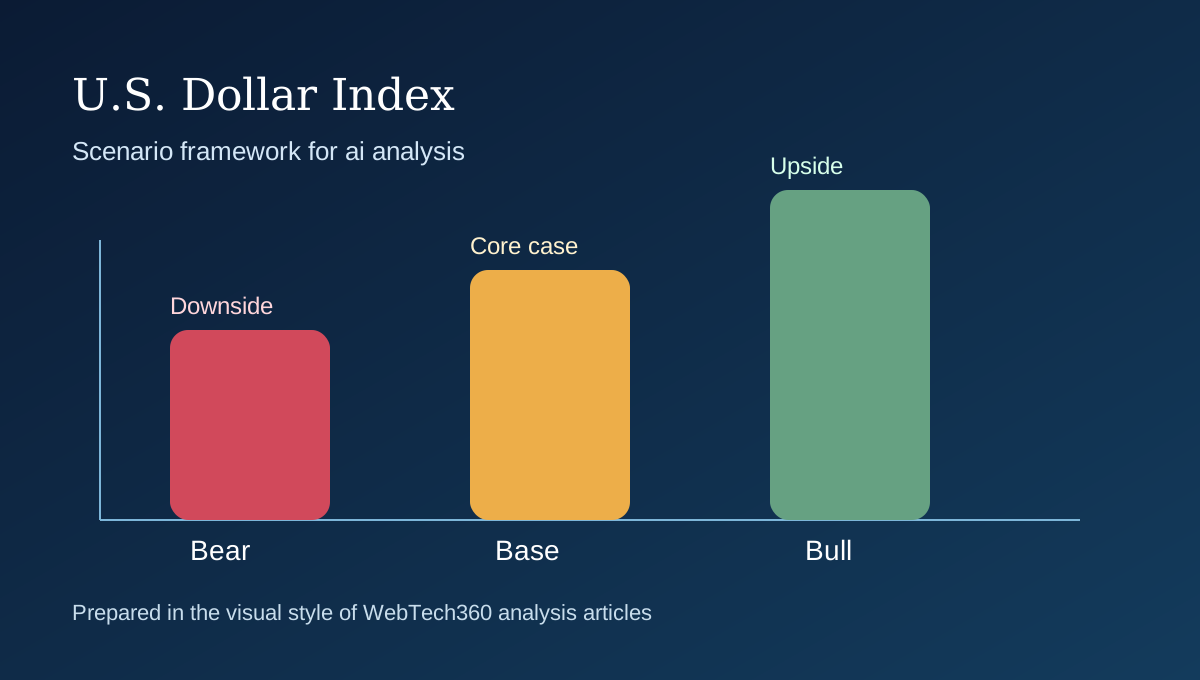
How AI could affect DXY under different transmission paths
| Scenario | Likely effect | Conditions | Probability |
|---|---|---|---|
| Bull | Stronger dollar regime | AI boosts U.S. productivity and attracts capital faster than alternatives | 30% |
| Base | Mixed but supportive | AI helps the U.S., but fragmentation and fiscal costs offset part of the gain | 45% |
| Bear | Limited help or eventual drag | Other blocs catch up or AI's macro costs outweigh relative advantages | 25% |
| Directional outcome | Probability | Comment |
|---|---|---|
| AI lifts DXY structurally | 50% | Most likely if U.S. productivity leadership remains clear |
| AI has limited net effect | 25% | Possible if benefits are more globally distributed |
| AI becomes a source of fragmentation and instability | 25% | Possible if competition and energy strain overwhelm growth gains |
05. Investment Implications
How investors can think about AI and the dollar without reducing everything to one macro slogan
| Investor type | Prudent approach | Main watchpoints |
|---|---|---|
| Investor already in profit | Hold or trim depending on whether AI optimism is already crowded into U.S. assets | Capital flows and rate expectations |
| Investor currently at a loss | Reassess whether the thesis was innovation leadership or crisis hedging | Productivity evidence and fiscal risk |
| Investor with no position | Stage exposure and avoid forcing a one-factor AI dollar view | Relative growth and Europe data |
| Trader | Trade event windows and policy repricing rather than decade-long narratives | Rates, chips, and geopolitical headlines |
| Long-term investor | Use AI as one input into the dollar view, not the entire thesis | Relative productivity and reserve trends |
| Risk-hedging investor | Keep perspective: AI can strengthen the U.S. and still create macro instability | Volatility and cross-asset stress |
Conclusion: AI could reshape DXY over the next decade, but mainly through macro transmission channels such as productivity, energy demand, and capital flows rather than through any mechanical change to the index itself. Disclaimer: This article is for informational and research purposes only and does not constitute investment advice.
06. FAQ
Frequently asked questions
Can AI strengthen the dollar?
Yes, if it raises relative U.S. productivity and attracts global capital faster than in competing blocs.
What is the biggest AI upside for DXY?
Clear U.S. productivity leadership and stronger capital inflows are the biggest upside drivers.
What is the main AI downside risk?
The main risk is that AI intensifies fiscal, energy, or geopolitical strain without producing enough relative advantage.
Why is the effect indirect?
Because DXY is a currency benchmark shaped by macro conditions, not a technology basket.
Methodology and Invalidation
How to interpret this DXY framework and what would change it
Inline evidence matters because DXY discussions can easily drift into slogans. ICE's own materials confirm that DXY is still primarily a developed-market basket with the euro carrying 57.6% of the weight, which is why euro-area weakness can disproportionately matter for the benchmark even when the broader dollar story is more complex (ICE USDX methodology). At the same time, IMF COFER data still show the dollar as the leading reserve currency, while BIS turnover data continue to show the currency's central role in global FX dealing, underscoring why structural dollar decline remains a slow-moving story rather than an overnight transition (IMF COFER Q4 2025; BIS FX turnover 2025). ECB projections and Eurostat growth releases, meanwhile, help explain why European softness and energy vulnerability still matter for any serious DXY forecast (ECB March 2026 projections; Eurostat Q1 2026 flash GDP).
A useful U.S. dollar article should not collapse every currency question into one trade. That is particularly important for DXY because the index itself is structurally narrow. ICE defines the U.S. Dollar Index as a geometrically averaged basket of six currencies, with the euro representing 57.6% of the weight and the rest spread across the yen, pound, Canadian dollar, Swedish krona, and Swiss franc. That means DXY is not a complete measure of the dollar's role in the world economy. It is best understood as a highly liquid benchmark for the dollar's performance against a historically important developed-market basket. For that reason, these articles pair DXY-specific analysis with broader official evidence from the Federal Reserve's broad dollar index, IMF reserve data, BIS FX turnover statistics, ECB projections, and BRICS and geopolitical developments.
The scenario ranges in these articles are therefore conditional rather than deterministic. A bullish dollar outcome typically requires some combination of policy divergence, relative growth resilience, reserve-system inertia, safe-haven demand, or renewed pressure on Europe and other alternatives. A bearish dollar outcome requires either cleaner U.S. disinflation with rate convergence, fiscal credibility concerns overwhelming safe-haven demand, a broader improvement in non-U.S. growth, or a more credible long-run diversification path away from the dollar. Available data suggests the dollar still benefits from enormous incumbency advantages. IMF COFER data continue to show that the dollar remains the leading reserve currency, and BIS turnover data still point to the dollar's central role in global FX markets. But the same official material also shows a gradual structural erosion in the dollar's reserve share and a wider discussion about local-currency settlement, cross-border payment systems, and fragmentation.
This is why political and geopolitical issues matter in a DXY analysis. Eastern Europe and the Middle East influence the dollar through risk sentiment, energy prices, and capital flows. ECB staff projections from March 2026 explicitly note that euro-area growth was revised down and energy assumptions revised up in the wake of the Middle East conflict, while BRICS official communications continue to discuss local-currency use, cross-border payments, and broader representation outside the U.S.-Europe axis. None of that means the dollar is about to lose reserve dominance. It does mean that a serious 2030 or 2035 outlook has to evaluate both cyclical support and structural erosion at the same time. A benchmark can remain dominant and still gradually lose share. Those are not mutually exclusive outcomes.
Investor positioning also depends heavily on horizon. A trader may care most about yield differentials, headline risk, and short-term safe-haven flows. A long-term allocator should care more about reserve-system inertia, fiscal credibility, the health of Europe and Japan as alternatives, and whether the BRICS and Global South payment initiatives remain symbolic or become operationally meaningful. Someone already in profit on a strong-dollar view may rationally trim or hedge if relative-rate support weakens. Someone with no position may decide that staging exposure makes more sense than chasing safe-haven strength after a geopolitical shock. These are different decision problems, and the same forecast range can imply different prudent actions depending on the reader's objective.
What would invalidate a constructive DXY outlook? The clearest candidates would be a broad improvement in non-U.S. growth led by a less fragile euro area, deeper U.S. fiscal concerns that overpower safe-haven demand, or evidence that cross-border settlement in local currencies is becoming much more operationally significant than markets currently assume. What would invalidate a stronger bear case? Renewed geopolitical stress, more obvious European weakness, higher U.S. real yields, or fresh evidence that reserve managers still prefer the dollar despite diversification rhetoric would all weaken that downside thesis. That is the discipline investors should want from any dollar article. The thesis should be falsifiable, and it should explain what evidence would cause the author to revise the range.
The practical conclusion is that DXY remains one of the world's most useful macro benchmarks precisely because it sits at the intersection of monetary policy, geopolitics, reserve management, and global growth dispersion. The market often treats the dollar as either permanently unassailable or permanently doomed. Available data suggests the more realistic answer is more nuanced: the dollar can remain dominant for years while still facing a slow structural challenge. That is the logic behind the ranges in these articles, and it is also the most defensible way to update them as the macro and geopolitical backdrop evolves.
References
Sources
- ICE, Currency Indices overview
- ICE, USDX and DXY methodology overview
- ICE, A surging U.S. dollar presents fresh opportunity
- FRED, Nominal Broad U.S. Dollar Index
- IMF Data Brief, COFER Q4 2025
- IMF Blog, Dollar dominance in the international reserve system: an update
- IMF, 2025 External Sector Report
- BIS, OTC foreign exchange turnover in April 2025
- ECB staff macroeconomic projections for the euro area, March 2026
- Eurostat, euro area GDP Q1 2026 flash estimate
- BRICS Brazil, Leaders’ declaration summary, July 2025
- BRICS, Chair’s Statement, April 29, 2026
- BlackRock, 2026 global macro outlook: patience
- J.P. Morgan AM, Policy divergence reshapes the front end