01. Quick Answer
The clearest 2027 HSBC framework is a catalyst map, not a one-line rates story
By 2027, HSBC stock will likely be judged on whether NII remains resilient, whether wealth and transaction banking in Asia keep growing, whether simplification improves returns without too much revenue leakage, and whether capital returns remain generous. Available data suggests a 2027 base case around $95 to $108 is defensible.
| Point | Why it matters |
|---|---|
| The next 18 months are mostly about catalysts | HSBC is better understood as a global bank with concentrated Asia growth leverage than as a generic European bank. |
| Asia wealth momentum still matters more than broad narrative | RoTE, CET1, and capital returns still shape the stock as much as top-line growth does. |
| Capital-return policy remains a key signal | Wealth, fees, and simplification are increasingly important to the premium or discount investors assign. |
| Shorter-horizon forecasting should stay conditional | Scenario ranges are more defensible than one-number certainty in a geopolitically exposed bank. |
02. Historical Context
HSBC is still a global bank first, but the modern thesis increasingly depends on Asian wealth, NII resilience, and simplification
HSBC moved from roughly $31.31 to about $90.72 over the last 10 years based on Yahoo Finance monthly data, implying a 10-year CAGR of about 11.22%. That is a respectable long-run outcome for a universal bank that has had to navigate low-rate eras, China concerns, Hong Kong property stress, geopolitical fragmentation, and repeated restructuring waves. The current HSBC investment case is not just about a high dividend or a cheap bank multiple. It is about whether the group can translate its Asian franchise, transaction banking, wealth platform, and simplification agenda into sustainably higher returns on tangible equity.
| Metric | Latest official reading | Why it matters |
|---|---|---|
| 1Q26 revenue excluding notable items | $19.1 billion | Useful clean baseline for judging whether strategic momentum is translating into revenue quality |
| 1Q26 PBT excluding notable items | $10.1 billion | Shows the group is still generating strong profitability despite a more uncertain macro backdrop |
| CET1 ratio | 14.0% | Capital strength matters for dividends, buybacks, and stress resilience |
| 1Q26 dividend | $0.10 per share | Payout support remains central to the shareholder story |
| Feature | HSBC implication | Forecast effect |
|---|---|---|
| Heavy Asia and Middle East growth focus | Wealth, trade, and transaction banking growth is tied to regional capital formation and cross-border flows | Supports the long-run bull case, but adds geopolitical and China exposure |
| Universal bank mix | NII, wealth fees, wholesale transaction banking, and markets all matter | Helps diversify earnings, but makes macro forecasting more complex |
| Large capital-return component | Dividends and buybacks materially shape investor sentiment | Valuation can remain supported even when growth is not spectacular |
| Ongoing simplification | Strategic exits and reallocation to Asia can improve returns if execution remains disciplined | Creates upside if the group becomes simpler and more profitable, but also execution risk |
03. Main Drivers
Five forces are most likely to shape HSBC stock over the next several years
1. Asian wealth and transaction banking are at the center of the growth story
HSBC's own annual-results materials and Reuters reporting both stress the strategic importance of Asia and the Middle East, especially wealth, fee income, and cross-border banking. That matters because the growth narrative is increasingly regional and client-flow driven, not just spread-income driven.
2. NII still matters, but the debate is now about mix and trajectory rather than just rate levels
The 1Q26 release showed NII and banking NII still growing, helped by structural-hedge reinvestment and deposit growth. The real question is whether those supports fade too quickly if rates normalize lower or if deposit competition intensifies.
3. Simplification and geographic reallocation can improve returns if management executes cleanly
Reuters reported that HSBC is reviewing or shrinking some businesses outside Asia and the Middle East. That can help returns if capital is reallocated productively, but markets will punish the stock if the simplification story looks messy or too costly.
4. Capital returns remain central to the investment case
Dividends and buybacks are not secondary in HSBC. They are a large part of why many investors own the stock. If returns stay strong and capital remains comfortable, payouts can support valuation. If capital gets tighter, one of the key supports weakens.
5. Geopolitics and China-related exposure remain enduring risk factors
A bank tied this deeply to Hong Kong, mainland China flows, and broader Asian growth will always trade partly on geopolitical confidence. That exposure can be an advantage in a strong Asian cycle and a constraint when regional stress rises.
04. Institutional Forecasts and Analyst Views
The strongest evidence base comes from current HSBC targets, revenue mix, and capital-return policy rather than a heroic one-number target
There are fewer credible long-range point forecasts for HSBC than for US tech stocks or narrow domestic banks, because the path depends on Asia, rates, wealth, geopolitics, capital rules, and execution on simplification. The better approach is to combine current operating evidence, management's multi-year return targets, and Reuters coverage of how the market is interpreting the strategy.
| Source | What it says | Implication for HSBC |
|---|---|---|
| 1Q26 quick read and earnings release | Revenue and profit excluding notable items remain strong, with RoTE above target basis | Supports the argument that operational momentum remains intact |
| Annual Results 2025 | HSBC targets 17% RoTE or better for 2026-2028 and revenue growth rising to 5% by 2028 | Gives the long-run bull case a clear management framework |
| Investment case page | Management emphasizes quality growth, capital returns, and wealth | Shows why the valuation depends on more than rates alone |
| Reuters, February and May 2026 | Investors are focused on Asia, restructuring, wealth growth, and macro uncertainty | Confirms that the market sees HSBC as both a growth reallocation story and a macro-sensitive bank |
| HSBC and AI materials | AI is being pushed into legal, operations, service, and broader bank productivity workflows | AI optionality may improve long-run efficiency and execution quality even if not immediately obvious in revenue |
05. Scenarios
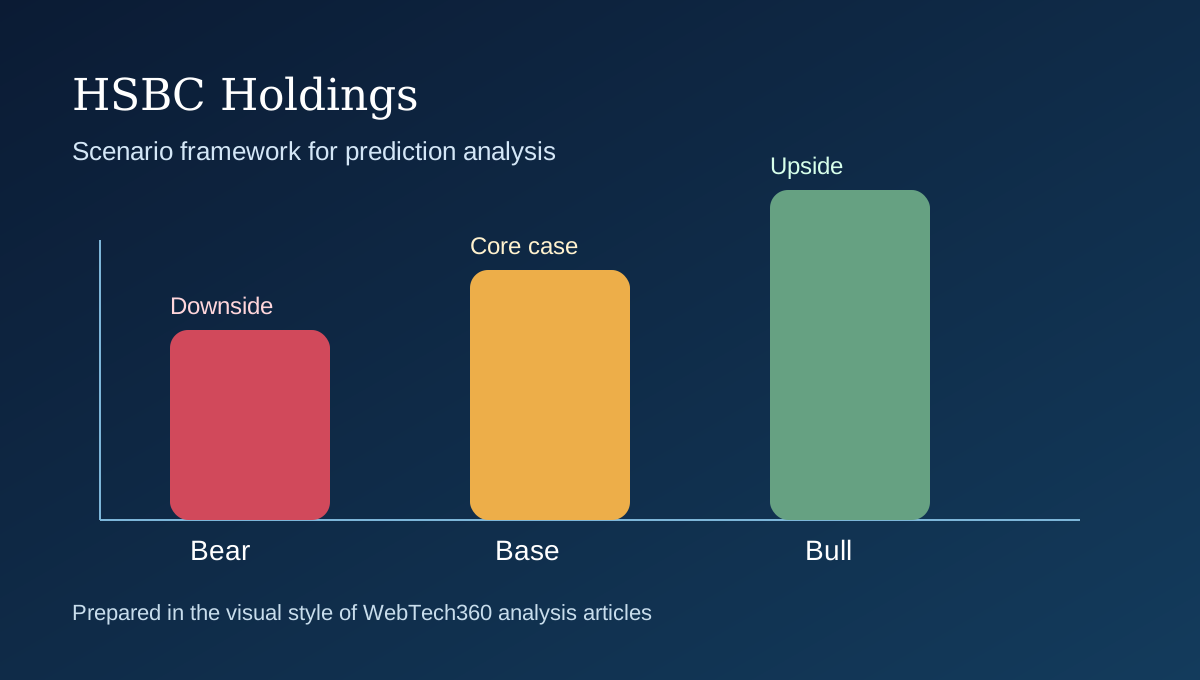
Bull, bear, and base-case scenarios for HSBC
| Scenario | 2027 range | Conditions | Probability |
|---|---|---|---|
| Bull | $108-$122 | Wealth growth, NII resilience, and simplification all reinforce higher returns and steady payouts | 30% |
| Base | $95-$108 | Execution remains healthy, though valuation still reflects caution around rates and geopolitics | 45% |
| Bear | $75-$95 | Weaker Asia activity, lower NII, or capital-return caution reduce confidence in the strategic path | 25% |
| Direction | Probability | Comment |
|---|---|---|
| Higher | 40% | Possible if the market keeps rewarding improving mix and Asia-led growth with a firmer bank multiple |
| Lower | 25% | Most likely if several catalysts turn negative at the same time |
| Sideways | 35% | Likely if fundamentals stay decent but the bank remains boxed in by macro and geopolitical discounts |
06. Investor Positioning
How different investors might respond
| Investor type | Prudent stance | Why |
|---|---|---|
| Investor already in profit | Hold core, trim if bank exposure or China-linked risk has become too concentrated | HSBC can keep compounding, but macro and geopolitical surprises can reprice the stock quickly |
| Investor currently at a loss | Reassess thesis around Asia wealth, NII, and capital returns rather than price alone | The long-run case depends on strategic execution, not just on the last quarter's share action |
| Investor with no position | Use staggered entries and avoid chasing after record highs or buyback headlines | Large global banks can remain attractive but still correct sharply on macro scares |
| Trader | Use stop-losses and watch Asia macro, rates, CET1, and restructuring headlines | Short-term moves can hinge on policy or geopolitics as much as on earnings |
| Long-term investor | Focus on RoTE, payout durability, wealth growth, and simplification progress; consider dollar-cost averaging | HSBC is better suited to patient capital that can look through bank-cycle noise |
| Hedging-focused investor | Use HSBC as part of a diversified financials and Asia-exposure sleeve, not as a pure defensive asset | It can diversify domestic-bank exposure, but it remains cyclical and region-sensitive |
07. Risks to Watch
What could change the outlook quickly
Near-term risk management matters because even a strong bank can re-rate lower if NII softens, Asia data worsen, or restructuring starts to look more disruptive than accretive. The current evidence base is supportive, but not one-way.
| Possible invalidation | Why it matters |
|---|---|
| Asia wealth and transaction-banking growth stays stronger than expected | Would support the long-run bull case and justify a higher-quality banking multiple |
| Rates normalize lower faster than management can offset through mix | Would pressure NII and make the base case too optimistic |
| Simplification and capital reallocation exceed current expectations | Could improve returns faster than the market now credits |
| Geopolitical stress around China or Hong Kong intensifies materially | Would challenge the Asian growth thesis and likely compress valuation |
| AI and automation benefits become visible in costs and execution sooner | Would weaken the bear case that technology spend is mostly a cost burden |
08. Conclusion
Bottom line
For 2027, the cleanest HSBC framework is conditional rather than absolute. The stock still has upside, but it depends on NII, wealth, and simplification all holding together at the same time.
FAQ
Frequently asked questions
Is HSBC mainly an Asia growth story now?
Increasingly yes. The group still operates globally, but management has made clear that Asia and the Middle East offer the most attractive growth opportunities, especially in wealth and transaction banking.
Why do RoTE and CET1 matter so much for HSBC?
Because they shape how much capital the bank can return, how safe the balance sheet looks, and how much confidence investors should have in through-cycle profitability.
How were the forecast ranges built?
The ranges combine the current HSBC price, the 10-year CAGR, 1Q26 revenue and profit excluding notable items, management's RoTE targets, the Asia wealth thesis, and scenario analysis around rates, regulation, and geopolitics. They are editorial scenario ranges, not guaranteed targets.
Can AI really matter for a global bank like HSBC?
Yes, but mainly through automation, legal workflows, service, risk, and productivity rather than a direct new revenue line. Over time, that can still matter meaningfully for operating leverage.
Methodology and Invalidation
How these HSBC ranges were built and what would change them
These scenario ranges are editorial frameworks, not guarantees or institutional targets. They start with the live HSBC price near $90.72` in mid-May 2026, then layer on the stock's 10-year CAGR of roughly 11.22%, the current 1Q26 earnings profile, management's RoTE and revenue-growth targets through 2028, and the strategic importance of Asia, wealth, and transaction banking. A purely mechanical projection of the last decade would ignore restructuring, geopolitics, and rate sensitivity. That is why a scenario matrix is more useful than a single target.
For downside language, a correction usually means around 10% down from a recent high, a bear market closer to 20%, and a crash something sharper tied to systemic stress or sudden macro dislocation. HSBC can experience all three because it is both a global bank and a regionally concentrated Asia story. But the stock can also remain resilient through softer economic periods if capital returns, NII quality, and fee growth stay supportive.
The evidence base here is intentionally current. HSBC's 1Q26 quick read showed $19.1 billion` of revenue excluding notable items, $10.1 billion` of profit before tax excluding notable items, a 14.0% CET1 ratio, and a $0.10` dividend per share. The 2025 annual results and investment-case materials show management targeting RoTE of 17% or better for 2026 to 2028 and revenue growth that rises to 5% by 2028 on the target basis. Reuters reporting reinforces that the market is watching Asia, wealth, simplification, and macro uncertainty closely. The evidence is constructive, but not one-directional, because global-bank valuations always remain exposed to rates, credit, and geopolitics.
What would invalidate the constructive case? A sharper China or Hong Kong slowdown, weaker wealth momentum, lower NII, or more difficult capital treatment would all matter. What would invalidate the bearish case? Continued strong wealth and fee income, stable credit, successful reallocation toward Asia and the Middle East, and visible AI-driven efficiency gains would weaken it. Investors should treat these articles as conditional research tools that need updating as rates, Asia growth, and capital-return policy evolve.
Disclaimer: This material is for research and editorial purposes only, does not constitute investment advice, and should not be treated as a recommendation to buy, sell, or hold HSBC Holdings plc or any related security.
References
Sources
- Yahoo Finance chart API, HSBC 10-year monthly history and current price
- HSBC Holdings plc 1Q 2026 earnings release
- HSBC 1Q 2026 quick read
- HSBC Holdings plc annual results 2025
- HSBC Annual Report and Accounts 2025
- HSBC investment case
- HSBC announces Harvey AI for legal platform
- HSBC and AI
- HSBC Innovation Horizons Report 2026
- Reuters via Investing.com, HSBC reviews investment banking outside Asia and the Middle East, March 2026
- Reuters via Investing.com, HSBC CEO sees more opportunities in Asia and Middle East than Europe, February 2026
- Reuters via Investing.com, HSBC shares hit record high after 2025 results, February 2026
- Reuters via Investing.com, HSBC warns of economic uncertainty after quarterly profit falls, May 2026
- Reuters via Investing.com, HSBC puts more focus on wealth in Asia while simplifying operations, February 2026