01. Quick Answer
A 2035 Nasdaq forecast should be read as a range of compounding outcomes, not a promise
The quickest answer is that the Nasdaq Composite still has one of the strongest long-run structural stories among major U.S. benchmarks, but it also has one of the widest dispersion bands. A benchmark with more than 60% technology exposure and top-10 concentration near 58% can compound powerfully when innovation remains profitable, yet it can also spend long stretches digesting valuation and competition risk (Nasdaq factsheet, March 31, 2026).
That is why a 2035 forecast has to focus on compounding drivers rather than one-year sentiment. Institutional assumptions from J.P. Morgan, BlackRock, and Vanguard all imply that earnings growth, margins, and discount rates matter more over a decade than any single narrative. The market may remain enthusiastic about AI, chips, cloud, and software, but investors still have to ask how much of that value ultimately reaches public shareholders and how concentrated those profits remain.
| Issue | Evidence-based read | Why it matters |
|---|---|---|
| Long-term outlook | Constructive if technology leadership remains profitable and adaptive | Nasdaq's edge is earnings quality, not just hype |
| Main restraint | Valuation and concentration are already high | 2035 returns may rely more on EPS growth than on multiple expansion |
| Institutional support | Broadly positive for U.S. equities, but cautious on starting valuation | Supports a base case, not certainty |
| Forecast method | Scenario ranges are more honest than point targets | Technology cycles change too quickly for false precision |
02. Historical Context
The longer the horizon, the more Nasdaq becomes an innovation-and-valuation question
Over very long periods, Nasdaq has tended to outperform because the U.S. public market keeps producing new technology leaders. But the index is also a reminder that transformative innovation does not guarantee smooth returns. Competitive moats erode, hardware cycles change, regulation appears, and valuation can overshoot even strong fundamentals. That historical pattern is why a 2035 outlook cannot just assume that today's biggest winners will still dominate in the same way a decade from now.
Nasdaq's methodology gives the index a built-in ability to evolve, but evolution is not the same thing as immunity. If new profit pools emerge outside the current mega-cap cluster, the index can still benefit over time. If too much value creation stays captured by private markets, lower-margin suppliers, or global rivals, long-term public-market returns can underwhelm the narrative. Available data suggests the secular technology case remains strong. The evidence is mixed on how much of the next decade's upside is already reflected in current concentration and valuation.
| Metric | Latest reading | Interpretation |
|---|---|---|
| Constituents | 3,350 | Still a broad benchmark, but heavily led by a small set of giants |
| Technology weight | 60.61% | Tech remains both the opportunity and the concentration risk |
| Top-10 weight | About 58% | Leadership durability is critical to long-term compounding |
| Q1 2026 return | -7.11% | Confirms that even strong secular stories still reprice sharply |
03. Long-Run Drivers
Five variables will matter most between now and 2035
1. Whether AI becomes a margin story, not just a spending story
Goldman Sachs and S&P Global both show that the infrastructure buildout remains aggressive. For a 2035 forecast, the essential question is whether the returns on that capital become broad and durable enough to justify premium valuation over time.
2. Semiconductor leadership and replacement risk
Nasdaq's future will be shaped by whether today's semiconductor and compute leaders keep their edge or whether competition compresses economics. Long-run outperformance requires technology leadership to remain economically scarce.
3. Software and platform resilience
The highest-quality version of the bull case assumes not only hardware demand, but resilient software pricing power, enterprise adoption, and service monetization. If that broadens, Nasdaq's return profile improves materially.
4. Discount rates and macro regime
Vanguard's caution on valuation and BlackRock's focus on margin durability both point to the same conclusion: a tech-heavy index can remain structurally attractive and still deliver less impressive future returns if real rates stay structurally higher.
5. Benchmark renewal
The positive long-run argument for Nasdaq is that the index can refresh as leadership changes. The risk is that the next wave of innovation may not be as profitable, as public, or as concentrated in existing listed leaders as markets assume today.
04. Institutional Forecasts and Analyst Views
Long-run institutions support U.S. equity returns, but not an unchecked tech melt-up
J.P. Morgan's 6.7% U.S. large-cap return assumption, BlackRock's constructive five-year margin view, and Vanguard's valuation caution combine into a simple message: a positive 2035 Nasdaq outcome is plausible, but it likely requires earnings compounding to do more of the work than multiple expansion. That is especially true for a benchmark already dominated by high-quality, expensive franchises.
| Source | View | 2035 implication |
|---|---|---|
| J.P. Morgan AM | Mid- to high-single-digit long-run U.S. large-cap returns | Supports constructive compounding, not permanent double-digit annual returns |
| BlackRock | AI can support U.S. profitability over time | Helps justify a robust base or bull case if margins stay durable |
| Vanguard | Starting valuation still matters a lot | Warns against assuming today's premium grows forever |
05. Bull, Bear, and Base Case
The 2035 range should be treated as a compounding map
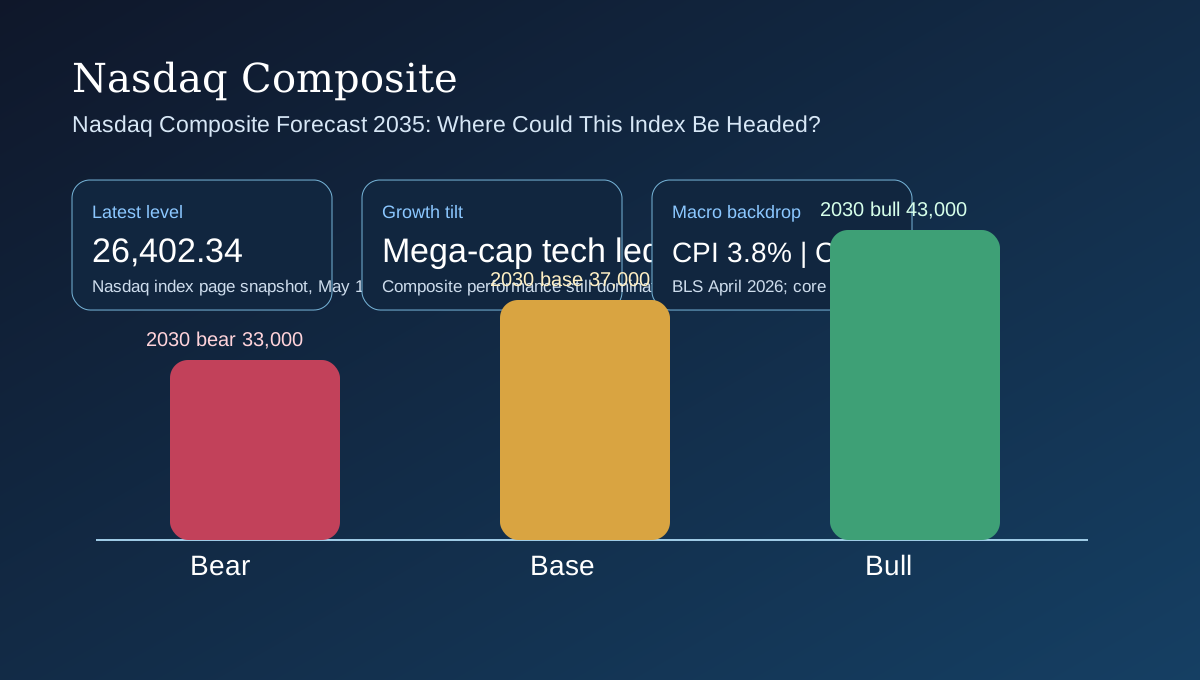
The ranges below assume Nasdaq remains the main listed home of U.S. technology leadership, but they differ sharply on how much valuation the market will still pay for that leadership by the early 2030s.
| Scenario | 2035 range | Conditions | Probability |
|---|---|---|---|
| Bull | 43,000-52,000 | AI productivity broadens, top franchises defend margins, and valuation stays above long-run averages | 25% |
| Base | 35,000-43,000 | Returns compound near long-run large-cap assumptions with periodic drawdowns and only modest multiple change | 50% |
| Bear | 26,000-35,000 | Competition, regulation, or persistently high real rates reduce valuation support | 25% |
| Outcome | Probability | Comment |
|---|---|---|
| Higher | 65% | The long-run innovation and earnings case remains the dominant path |
| Lower | 10% | Would likely require repeated multiple compression and weaker-than-expected monetization |
| Sideways in real terms | 25% | Plausible if the secular tech story stays intact but valuation gradually normalizes |
06. Investor Positioning
Long-horizon investors should think in terms of compounding quality, not short-term excitement
| Investor type | Prudent approach | Main watchpoints |
|---|---|---|
| Investor already in profit | Hold core exposure, but rebalance if a few mega-caps dominate total portfolio risk | Weight concentration and free-cash-flow trends |
| Investor currently at a loss | Separate the long-run tech thesis from short-term entry timing mistakes | Revisions and valuation reset risk |
| Investor with no position | Use staged entries and avoid assuming the strongest theme always offers the safest timing | Rate regime and breadth |
| Trader | Trade setups, not decade-long narratives | Guidance, options, and macro shocks |
| Long-term investor | Favor diversified exposure and systematic rebalancing as leadership changes | Whether AI benefits remain concentrated or broaden |
| Risk-hedging investor | Use selective hedges if enthusiasm runs far ahead of operating evidence | Real yields and competition risk |
What would invalidate the constructive 2035 case? Much stronger-than-expected competition, sustained regulatory friction, or a rate regime that compresses premium multiples for much longer than the market currently assumes. Conclusion: the Nasdaq Composite still has one of the most credible long-run secular growth stories in public markets, but the quality of future returns will depend on earnings durability more than on narrative intensity.
Disclaimer: This article is for informational and educational purposes only and should not be treated as individualized investment advice.
Methodology and Invalidation
How to interpret this Nasdaq framework and what would change it
A useful Nasdaq article should not be read as a promise that one exact index level will print on one exact date. It should be read as a scenario framework built from observable variables: concentration, earnings breadth, AI monetization quality, supply-chain and power constraints, discount rates, and regulation. That is why the ranges in this article are wider than the single-number targets often used in click-driven market commentary. Available data suggests the Nasdaq Composite still deserves a structural growth premium because it remains the public market home of many of the companies building, financing, or commercializing the AI and software stack. At the same time, the same official factsheet that supports that structural premium also shows a benchmark where the largest names carry unusual influence. That combination means the right question is rarely "Is Nasdaq good or bad?" The better question is whether the current mix of growth, concentration, and valuation is becoming healthier or more fragile.
That distinction matters for forecast ranges. A bullish Nasdaq outcome does not require every company in the index to win equally. It requires enough of the largest leaders to keep earning premium economics, and enough second-order beneficiaries to stop the benchmark from becoming too narrow. A bearish Nasdaq outcome does not require technology to stop mattering. It only requires investors to decide that margins, competition, or returns on AI capex are not quite as durable as currently priced. This is why probability tables in these articles are framed as editorial judgments, not machine precision. Real market paths are shaped by changing evidence. If software pricing power improves, hyperscaler spending finds revenue support, semiconductor bottlenecks ease, and rate pressure fades, the constructive path deserves a higher probability. If the opposite happens, the more cautious or bearish path deserves more weight even if the long-run technology story remains intact.
The benchmark's structure is the second reason point forecasts are not enough. A technology-heavy index with top-weight concentration near the levels shown in Nasdaq's official March 31, 2026 factsheet behaves differently from a more balanced or more value-oriented benchmark. It can rise faster when the largest franchises compound, but it can also punish investors faster when expectations reset. That is why breadth matters so much. Investors should not only watch whether the biggest names keep delivering. They should also watch whether AI-related profitability spreads to more software names, more service providers, more hardware and equipment suppliers, and more adjacent growth industries. The healthier the participation becomes, the healthier the long-run Nasdaq case becomes. If breadth keeps narrowing while valuation stays rich, then even a structurally attractive benchmark can produce frustrating real-world returns over intermediate horizons.
Investor positioning should also be matched to timeframe. A trader and a long-term allocator are not solving the same problem. A trader may care most about rates, earnings reactions, option positioning, and guidance revisions over weeks or months. A long-term investor should care more about whether the index is becoming more dependent on a tiny set of names, whether AI spending is being converted into free cash flow, and whether the next layer of beneficiaries is broadening the earnings base. Investors already in profit may rationally rebalance without abandoning the secular case. Investors with no position may reasonably scale in over time rather than chase after every surge. Risk-hedging investors should recognize that even a valid long-term innovation thesis can coexist with painful multiple compression or concentration-driven drawdowns along the way.
What would invalidate a constructive Nasdaq outlook most clearly? Several developments would matter. A sustained gap between capex and monetization would be one. A harsher rate regime that keeps pushing discount rates higher would be another. So would more meaningful competition, export controls, or regulation that weakens the economics of the largest listed beneficiaries. Conversely, what would invalidate a stronger bear case? Broader earnings participation, more visible productivity gains in software and services, and evidence that market leadership is widening rather than narrowing would all weaken the downside argument. This is the discipline investors should want from any market article. A thesis should be falsifiable. It should tell readers what evidence would make the author more constructive and what evidence would make the author less constructive.
The main practical takeaway is that Nasdaq remains one of the most important long-duration growth benchmarks in the world, but that status should make investors more analytical, not less. The benchmark is too influential to be reduced to slogans such as "AI wins everything" or "tech is in a bubble." Available data suggests both overconfidence and excessive pessimism can be expensive. The better approach is to monitor whether growth is broadening, whether valuation is being justified by cash-flow evidence, whether the competitive moat of the largest firms remains intact, and whether the macro regime is becoming more or less supportive of premium-growth assets. That is the lens through which the scenarios in these articles are built, and it is also the clearest way to decide whether the forecast range should be revised over time.
07. FAQ
Frequently asked questions
Can the Nasdaq double again by 2035?
It is possible, but that outcome would likely require a favorable combination of strong earnings growth, AI monetization, and only limited long-run valuation compression.
Why use a range instead of one target?
Because over a decade, changes in rates, competition, regulation, and index leadership can materially shift realized outcomes.
What is the strongest bullish force?
Broad AI-enabled productivity and durable software and semiconductor economics are the strongest long-run bullish combination.
What is the biggest long-run risk?
A mix of weaker monetization and multiple compression would be the clearest challenge.
References
Sources
- Nasdaq, Nasdaq Composite overview
- Nasdaq Indexes, COMP overview page
- Nasdaq, Nasdaq Composite factsheet, March 31, 2026
- Nasdaq, Index Methodology Guide
- FactSet, Earnings Insight, May 8, 2026
- Goldman Sachs, Why AI Companies May Invest More than $500 Billion in 2026
- Goldman Sachs, What to Expect From AI in 2026
- S&P Global Market Intelligence, Sell-side signals: short-term pain, long-term gain for top US hyperscalers
- S&P Global Market Intelligence, Electronics Supply Chain Outlook
- S&P Global Market Intelligence, Answering 3 key questions about data centers for generative AI
- Vanguard, 2026 outlook: Economic upside, stock market downside
- Vanguard, The fading U.S. small-cap premium
- BlackRock, Investment Directions, Spring 2026
- J.P. Morgan AM, 2026 Long-Term Capital Market Assumptions