01. Quick Answer
JPMorgan still has a constructive 2030 framework, but the next leg of value depends on protecting earnings quality through the next macro and regulatory cycle
The most defensible 2030 JPMorgan view is constructive but measured. The company still combines strong consumer banking, broad fee businesses, leadership in capital markets, high capital levels, and the technology budget to defend its moat. By 2030, however, the market will likely care less about whether JPM can grow in one strong year and more about whether the bank can keep compounding earnings and capital returns through a less friendly macro environment. That is why the base case remains positive, but not unlimited.
| Category | Evidence-based read | Implication |
|---|---|---|
| Historical data | JPM moved from about $62.14 to about $299.91 over 10 years | Long-run upside is credible, but future ranges should reflect cycle sensitivity and regulation |
| Current market conditions | NII, trading, and banking fees remain strong, though credit and macro risks still need monitoring | Forecasts should stay scenario-based, not purely momentum-driven |
| Institutional signals | Official reporting, Reuters, and S&P all show a high-quality franchise with visible macro sensitivity | Analysts remain constructive, but not one-directional |
| Most important watchpoints | NII, deposit costs, credit losses, investment-banking fees, capital rules, and AI productivity gains | These variables will likely shape the stock range more than generic bank-sector optimism |
02. Historical Context
JPMorgan is still a bank first, but the modern thesis is really about scale, mix, and resilience
JPM stock moved from roughly $62.14 to about $299.91 over the last 10 years based on Yahoo Finance monthly data, implying a 10-year CAGR of about 17.05%. That is a strong long-run result for a large bank, especially considering the period included near-zero rates, inflation shocks, regional-bank stress, and repeated debates over regulation and credit risk. The current JPMorgan thesis is not simply about being big. It is about having the scale to benefit from consumer resilience, investment-banking recoveries, trading depth, payments, wealth, and technology spending at the same time.
| Metric | Latest official reading | Why it matters |
|---|---|---|
| Q1 2026 net revenue | `$45.3 billion | Shows the franchise is still delivering at very large scale |
| Net income | `$14.6 billion | Profitability remains unusually strong relative to the wider banking sector |
| Common Equity Tier 1 ratio | 15.4% | Capital strength matters for buybacks, dividends, and stress resilience |
| Technology spend | `$18 billion planned for 2026 | Shows management is willing to defend the moat aggressively, especially around AI and data infrastructure |
03. Main Drivers
Five forces are most likely to shape JPMorgan stock over the next several years
1. Net interest income remains central, even if the business is more diversified than peers
JPMorgan's Q1 2026 presentation and S&P's preview work both make clear that net interest income still matters a great deal, even for a bank with broad fee businesses. The question is not only where rates go, but also whether deposit pricing, loan growth, and balance-sheet mix stay favorable enough to defend spread income.
2. Investment banking and markets can lift the quality of earnings when the cycle turns
Reuters reported that record equity trading and stronger banking fees helped Q1 2026 results beat expectations. That matters because JPMorgan's earnings mix improves when it can pair sturdy consumer banking with better capital-markets activity.
3. Credit quality and consumer behavior still define the downside case
Management and Reuters both emphasized that the U.S. consumer remains resilient, but that credit costs still need monitoring. For a bank of JPMorgan's scale, the difference between a healthy slowdown and a true recession can materially change earnings quality, reserve builds, and valuation.
4. Regulation, capital rules, and private-credit spillovers can change returns even if the franchise stays strong
The 10-K and Reuters coverage around private-credit risk both show that the debate is not just about revenue growth. It is also about how much capital the bank must hold, what exposures remain systemically relevant, and how the competitive landscape evolves outside the regulated banking perimeter.
5. Technology and AI spending are increasingly strategic, not optional
JPMorgan's planned `\$18 billion` technology spend for 2026 is large even by mega-bank standards. That can widen the moat in fraud prevention, client service, automation, and internal productivity. It can also reduce flexibility if returns prove slower or narrower than management expects.
04. Institutional Forecasts and Analyst Views
The market rewards JPMorgan's franchise quality, but it still reprices the stock through macro and rate cycles
Official reporting, the shareholder letter, Reuters, and S&P all support that framing. NII is strong, investment-banking and trading revenues have improved, and capital is solid. But the evidence is mixed enough on credit costs, regulatory pressure, and rate-path uncertainty that a 2030 forecast should remain scenario-based rather than simply extending the last decade's stock CAGR.
| Source | Message | Interpretation |
|---|---|---|
| JPMorgan official reporting | NII, markets, and overall profitability remained strong in Q1 2026 | Operational quality remains strong |
| Reuters | Record equity trading and better banking fees helped offset macro worries | Supports a constructive but macro-aware base case |
| S&P Global | NII durability, provisions, and fee recovery remain the key questions | Keeps both upside and credit-cycle risk visible |
| Dimon shareholder commentary | Management remains ambitious on technology and AI, but cautious on macro uncertainty | Strengthens the strategic quality of the thesis without removing downside risk |
05. Bull, Bear, and Base Case
How the forecast range and probability table are built
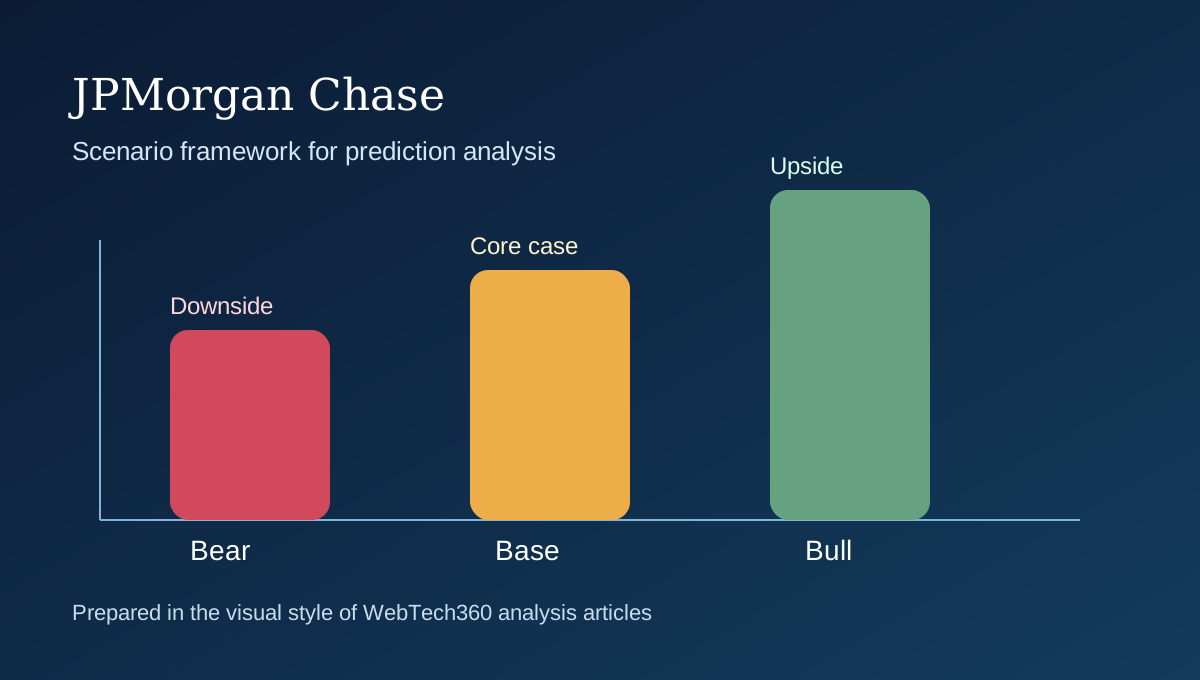
The ranges in this article are not institutional point targets. They are editorial scenario matrices built from current price, 10-year compounding history, NII durability, fee-business strength, credit quality, capital returns, and the extent to which JPMorgan's technology and AI spending improve franchise economics over time.
| Scenario | 2030 range | Conditions | Probability |
|---|---|---|---|
| Bull | $430-$520 | NII remains durable, fee businesses stay strong, credit costs stay contained, and technology spending lifts productivity | 30% |
| Base | $360-$430 | JPMorgan compounds well, though rate normalization and cyclical credit noise keep valuation expansion moderate | 45% |
| Bear | $250-$360 | Lower NII, rising credit costs, or tougher capital rules reduce earnings quality and multiple support | 25% |
| Direction | Probability | Comment |
|---|---|---|
| Higher | 45% | Most plausible if JPMorgan keeps converting its scale and fee diversity into resilient through-cycle returns |
| Lower | 20% | Would likely require a broader reset in credit, regulation, or the rate environment rather than one weak quarter |
| Sideways to moderate gains | 35% | Plausible because even great banks can spend long periods digesting macro and regulatory uncertainty |
| Investor type | Prudent approach | Main watchpoints |
|---|---|---|
| Investor already in profit | Hold a core stake, but trim if portfolio bank exposure has become too concentrated after the rally | Position size, credit cycle, and rate sensitivity |
| Investor currently at a loss | Reassess whether the thesis is NII durability, franchise quality, or capital-markets recovery before averaging down | Credit costs, capital rules, and macro deterioration |
| Investor with no position | Stage entries or wait for macro-driven pullbacks instead of chasing a high-quality bank at peak optimism | Rates, recession risk, and valuation |
| Trader | Use stop-loss discipline and trade around earnings, Fed signals, NII revisions, and macro surprises | Volatility, rate moves, and sector rotations |
| Long-term investor | Dollar-cost average only if convinced JPMorgan can keep compounding per-share value through cycles better than peers | Credit discipline, fee mix, and capital returns |
| Risk-hedging investor | Rebalance if bank exposure has become too correlated with one rate or macro thesis | Portfolio concentration and recession sensitivity |
Conclusion: JPMorgan still looks like a high-quality long-term financial compounder, but the 2030 upside case depends on whether earnings quality, capital returns, and technology productivity can stay ahead of credit and regulatory headwinds. Disclaimer: This article is for informational and research purposes only and does not constitute personalized financial advice.
06. FAQ
Frequently asked questions
Is JPMorgan still mainly a rate-sensitive bank?
Yes, rates still matter, especially through net interest income. But JPMorgan is far more diversified than many banks because markets, investment banking, payments, and wealth also matter.
What matters most for the next forecast revision?
NII guidance, deposit costs, reserve builds, consumer credit quality, investment-banking activity, and capital-return flexibility are the key inputs.
Is the biggest risk recession or regulation?
Right now the evidence suggests both matter. Recession risk can hit credit quality, while regulation and capital requirements can pressure long-run returns even if the franchise stays healthy.
What would invalidate the bullish case?
Sharper credit deterioration, lower NII, heavier capital-rule pressure, or weaker fee businesses would all weaken the bullish case.
Methodology and Invalidation
How to interpret this JPMorgan framework and what would change it
JPMorgan should not be analyzed like a simple rate-sensitive bank, but it also should not be treated as immune to the credit cycle because of its scale. The company sits at the intersection of consumer banking, commercial banking, investment banking, markets, payments, wealth, and corporate services. That breadth is why a single ratio or macro forecast rarely explains the stock well. JPM can look expensive relative to weaker banks and still look justified because of earnings quality, capital strength, and mix. It can also look safe right before a macro slowdown changes credit assumptions.
These articles therefore use a range-based framework anchored to three things: current price, 10-year growth history, and present operating evidence. Yahoo Finance chart data place JPM around `$299.91` in mid-May 2026, versus roughly `$62.14` at the start of the 10-year comparison window. That implies a 10-year CAGR of about 17.05%. For a large financial institution, that is a strong long-run result, but it is not a forecast by itself. Banks rarely compound in a straight line, and the next decade will depend heavily on the rate regime, regulation, consumer credit, capital markets activity, and how much technology spending actually improves the franchise.
Primary documents matter most. JPMorgan's Q1 2026 presentation showed net revenue of `$45.3 billion`, net income of `$14.6 billion`, ROTCE of 23%, managed NII ex-Markets of `$22.3 billion`, and a CET1 ratio of 15.4%. The 2025 Form 10-K adds deeper context around loan quality, reserves, capital, deposit behavior, stress testing, legal exposure, and fee-business diversification. Those documents make it clear why JPMorgan often trades at a premium to many banks: the franchise is broad, profitable, and well-capitalized. They also show why downside risk never disappears in a credit-sensitive business.
External reporting helps frame the market debate now. Reuters highlighted that record equity trading and better banking fees supported the latest quarter, but also emphasized Jamie Dimon's warning that tariffs could slow growth and raise inflation. S&P Global's preview and review work similarly focuses on NII durability, reserve quality, and capital-markets recovery. Reuters also reported that the bank plans to spend `$18 billion` on technology in 2026, with AI a major focus. Available data suggests JPMorgan currently benefits from both macro resilience and strategic spending momentum. The key question is whether those strengths persist if economic conditions become less friendly.
Investor positioning should therefore depend on time horizon. A trader may care most about rate expectations, NII revisions, trading revenue, and macro headlines. A long-term allocator should care more about whether JPMorgan can keep compounding book value and per-share earnings through cycles while maintaining superior capital returns. Someone already in profit may trim if bank exposure has become too concentrated after a strong rally. Someone with no position may prefer to wait for pullbacks tied to macro scares rather than chase peak optimism around NII or investment-banking recovery. What would invalidate a constructive JPMorgan view? A sharper recession, faster credit deterioration, materially lower NII, heavier capital-rule pressure, or slower returns on technology spending would all matter. What would invalidate a more bearish JPMorgan view? Continued consumer resilience, stable credit, durable NII, stronger fee businesses, and evidence that AI spending is improving productivity would weaken it.
Inline evidence anchors the framework (Yahoo JPM chart API; JPMorgan 1Q26 earnings presentation; JPMorgan 2025 Form 10-K; S&P Global post-quarter snapshot; Reuters on Q1 profit beat; Reuters on Dimon's macro warning). That combination is why the forecast ranges here are scenario tools rather than certainty theater.
References
Sources
- Yahoo Finance chart API, JPM 10-year monthly history and current price
- JPMorgan quarterly earnings hub
- JPMorgan Chase, 1Q26 earnings presentation
- JPMorgan Chase, Form 10-K for fiscal year ended December 31, 2025
- JPMorgan Chase 2026 chairman letter to shareholders
- S&P Global, JPMorgan post-quarter snapshot, April 2026
- S&P Global, JPMorgan Q1 2026 preview
- Reuters, JPMorgan profit tops estimates on trading and banking fees, April 11, 2026
- Reuters, Dimon says tariffs could slow growth and raise inflation, April 17, 2026
- Reuters, JPMorgan to spend $18 billion on technology with AI a major focus, March 19, 2026
- Reuters, JPMorgan says U.S. consumer remains resilient but credit costs need watching, April 24, 2026
- Reuters, banks rally on hopes rate cuts will not crush margins, May 1, 2026
- Reuters, JPMorgan on private credit risks, April 11, 2026
- Axios, JPMorgan earnings and Dimon macro warnings, April 11, 2026