01. Quick Answer
By 2035, the KOSPI is more likely to be shaped by breadth and governance than by a single chip supercycle
The KOSPI closed at 7,493.18 on 2026-05-15 after starting the current 10-year Yahoo Finance series at 1,970.35 on 2016-05-31, implying a price-only CAGR of roughly 14.36% (Yahoo Finance chart API for ^KS11, 10-year monthly history; Yahoo Finance chart API for ^KS11, recent daily closes). That is an extraordinary run for a market long associated with the so-called Korea discount. It also means the easy part of the rerating is probably over. Any serious forecast now has to weigh a real semiconductor and AI earnings engine against Korea's cyclical exposure to trade, oil, geopolitics, and currency shocks. For 2035, the central question is whether Korea keeps transitioning from a cheap cyclical exporter to a more trusted capital market with deeper shareholder discipline, stronger technology infrastructure, and broader domestic demand support.
| Point | Why it matters |
|---|---|
| 2035 is mostly a breadth question | A single HBM boom is not enough to explain where the KOSPI sits a decade from now. |
| Long-run compounding should be assumed to slow | The index has already risen far too much to justify simplistic high-teens annual return assumptions. |
| Governance and demographics both matter | Lower discounts help, but an aging workforce and capital intensity still cap upside. |
| Extreme outcomes remain possible | Korea's market structure still allows unusually wide long-run ranges compared with many developed peers. |
02. Historical Context
A 2035 framework has to start with what the last decade already pulled forward
The KOSPI closed at 7,493.18 on 2026-05-15 after starting the current 10-year Yahoo Finance series at 1,970.35 on 2016-05-31, implying a price-only CAGR of roughly 14.36% (Yahoo Finance chart API for ^KS11, 10-year monthly history; Yahoo Finance chart API for ^KS11, recent daily closes). That is an extraordinary run for a market long associated with the so-called Korea discount. It also means the easy part of the rerating is probably over. Any serious forecast now has to weigh a real semiconductor and AI earnings engine against Korea's cyclical exposure to trade, oil, geopolitics, and currency shocks.
MSCI described South Korea as one of the best performers in the first half of 2025 while still trading at a discount to broader emerging markets. That matters for 2035 because if the discount compresses further, long-run total returns can stay decent even without heroic earnings assumptions. If the discount widens again, a lot of the decade thesis becomes harder.
| Metric | Latest reading | Why it matters |
|---|---|---|
| Recent close | 7,493.18 | Every forecast in this article starts from the latest available close, not an old cyclical trough. |
| 10-year starting point | 1,970.35 | Helps frame how much rerating has already happened. |
| 10-year price CAGR | 14.36% | Useful for calibrating whether a future range is conservative or aggressive. |
| 10-year observed range | 1,754.64 to 7,493.18 | Shows how cyclical KOSPI outcomes can be even across a strong decade. |
| Recent 1-month range | 6,091.39 to 7,981.41 | Confirms that the market is still moving in large swings, not a calm trend. |
| Signal | Evidence | Forecast implication |
|---|---|---|
| Growth rebound in 2026 | KDI projects roughly 1.9% growth in 2026 and the BOK projects 2.0%. | Supports earnings, but not enough to justify uncritical extrapolation. |
| Policy rate backdrop | The BOK kept the base rate at 2.50% in February, then cut it by 25bp in May. | Lower rates can support valuation, but the central bank remains constrained by household debt and FX risk. |
| Governance reform | FSC and value-up guidelines continue to target the Korea discount. | Valuation support is now partly structural, not only cyclical. |
| External vulnerability | IMF highlights Korea as a tech exporter but also an energy importer exposed to shock scenarios. | Oil and geopolitical stress can still compress margins and risk appetite quickly. |
| Foreign ownership narrative | Reuters highlights renewed foreign buying after March stress. | Long-run upside improves if Korea keeps becoming easier for global capital to own and understand. |
03. Main Drivers
Six long-run drivers will decide whether the KOSPI earns a higher 2035 regime
1. AI infrastructure must become an ecosystem, not just a memory cycle. MSIT says Korea is expanding AI compute, data infrastructure, and policy finance, while the National AI Computing Center plan aims to create a domestic platform for AI models and semiconductors. That broadening matters more for 2035 than for 2027.
2. Korea's industrial policy needs execution, not slogans. The semiconductor special act and the MOTIE budget narrative support long-term competitiveness, but policy promises only help the index if they turn into capacity, talent, and return on capital.
3. Shareholder returns have to stay better than history. The value-up framework is one of the few structural reasons to believe the KOSPI can hold a higher multiple than it used to.
4. Domestic demand must stop being a chronic weak spot. The IMF expects the negative output gap to close gradually as domestic demand strengthens. For a 2035 forecast, that matters because broader domestic resilience reduces the index's dependence on external cycles.
5. Demographics could either drag or force productivity gains. An aging population is a real long-term headwind, but it may also strengthen the case for automation, software, and AI-led productivity investment.
6. External energy and trade risks will not disappear. IMF stress work remains relevant because Korea is still an energy importer and a trade-sensitive exporter. The long run is not just about innovation; it is also about resilience.
04. Institutional Forecasts and Analyst Views
Institutions mostly publish shorter-horizon inputs, so long-range KOSPI estimates need explicit translation
There is a practical problem with very long-range KOSPI forecasting: major institutions rarely publish exact 2030 or 2035 KOSPI targets with enough methodological detail to treat them as hard forecasts. What they do publish are the ingredients. J.P. Morgan Global Research sees emerging markets supported by lower local rates, earnings growth, attractive valuations, and governance improvements. J.P. Morgan Private Bank says global AI tailwinds should continue to support exporters such as South Korea. Invesco says Korea is accelerating governance reforms to strengthen shareholder value, while UBS keeps a favorable lens on Asia tech and a neutral to constructive view on Korea within Asia. MSCI adds that South Korean equities had still been trading around 10 times forward earnings in mid-2025, below the broader MSCI EM multiple near 13, even after strong performance.
Those inputs do not give a clean 2030 number. They do justify a scenario framework. In these articles, the range logic uses five building blocks: the current index level; the 10-year price CAGR; public macro forecasts from OECD, IMF, the BOK, and KDI; public evidence on earnings engines from Samsung, SK hynix, and Hyundai; and the probability that governance reform and foreign-access improvements keep narrowing the Korea discount through the decade.
| Source | What it says | How it influences the scenario work |
|---|---|---|
| IMF, OECD, BOK, KDI | Growth is recovering, but risks remain tilted to trade, energy, and domestic leverage. | Supports moderate earnings growth, not blind extrapolation. |
| J.P. Morgan and UBS | Asia tech and exporters such as Korea still benefit from AI and easing-cycle support. | Strengthens the bull and base cases for semiconductors. |
| Invesco and MSCI | Governance reforms and still-reasonable valuation remain important. | Supports the case for a lower structural discount versus history. |
| Company disclosures | Samsung, SK hynix, and Hyundai all provide evidence on capex, demand, and export sensitivity. | Grounds the index view in the earnings power of major constituents. |
For 2035 specifically, analysts remain divided because the evidence is mixed on how far Korea's structural discount can narrow. The safest approach is to anchor the long-run range to slower compounding than the recent decade, then widen the bands to reflect unusually high macro and geopolitical uncertainty.
05. Bull, Bear, and Base Cases
Scenario ranges are more defensible than a single-number prediction
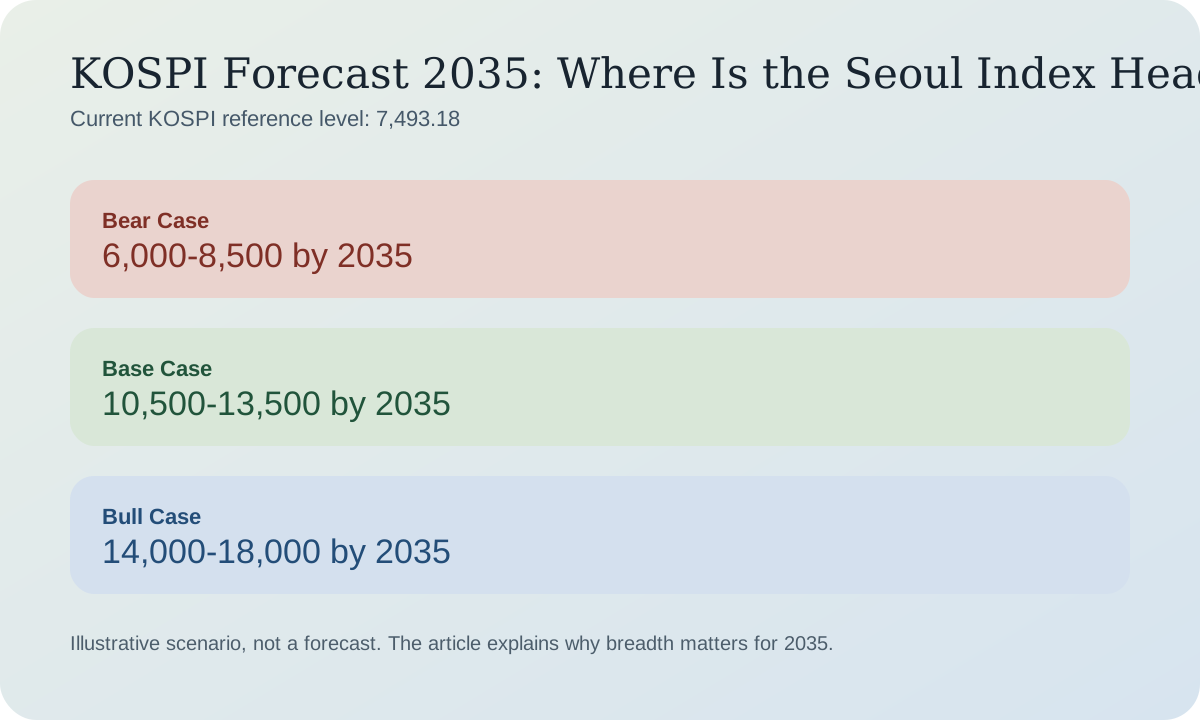
The 2035 base-case range here is 10,500 to 13,500. That assumes the KOSPI compounds from today's level at a clearly lower pace than the recent decade, while still benefiting from stronger shareholder returns, decent nominal GDP growth, and a technology mix that stays globally relevant.
| Scenario | Range | Conditions | Probability |
|---|---|---|---|
| Bull | 14,000-18,000 | AI broadens into software, industrial automation, cloud, autos, and value-up reform keeps shrinking the discount. | 20% |
| Base | 10,500-13,500 | Semiconductors remain strong, policy execution is decent, and governance improvement sticks. | 50% |
| Bear | 6,000-8,500 | Leadership stays narrow, demographics weigh on breadth, and Korea's risk premium stays elevated. | 30% |
| Path | Estimated probability | Interpretation |
|---|---|---|
| Rising by 2035 | 60% | The base assumption is that Korea stays globally relevant in advanced manufacturing and AI hardware. |
| Falling materially from current levels | 15% | A long-duration decline likely requires both macro weakness and a structural loss of competitiveness. |
| Moving sideways in real terms | 25% | Still plausible if strong earnings are offset by recurring derating episodes. |
Bullish scenario
The bull case needs breadth. It is not enough for memory earnings to stay high. The Seoul market would need more durable support from autos, financials, industrial automation, internet platforms, and domestic AI infrastructure.
Bearish scenario
The bear case is a world where the Korea discount narrows only temporarily, semiconductors remain cyclical, and global investors decide Korea deserves a lower multiple whenever oil, geopolitics, or the dollar surge.
Base-case scenario
The base case assumes decent but unspectacular broadening. That means Korea stays investable and profitable enough to move higher, but not in a straight line and not at the pace implied by the most euphoric recent years.
Risks to watch
Watch capital spending discipline, the pace of payout reform, labor-force trends, energy costs, and whether AI remains profitable beyond training-related hardware demand.
What could invalidate the forecast
This range is too low if Korea becomes a top-tier beneficiary of sovereign AI infrastructure and spreads the benefits across many sectors. It is too high if governance progress stalls and the market slips back into a lower-trust valuation regime.
Conclusion
By 2035, where the Seoul index is headed depends less on whether Korea can build another short-term rally and more on whether it can institutionalize better compounding. That is why governance, productivity, and breadth matter as much as semiconductors in any serious long-term KOSPI forecast.
Disclaimer: This article is for research and informational purposes only. Long-range scenario ranges involve substantial uncertainty and should not be treated as guaranteed outcomes.
06. Investor Positioning
Different investor profiles should react differently to the same KOSPI outlook
| Investor profile | Cautious approach | What to watch |
|---|---|---|
| Investor already in profit | Consider holding a core stake but trimming if one semiconductor or ETF has become too dominant. | Watch whether the broadening-of-compounding thesis keeps broadening or becomes a narrow momentum trade. |
| Investor currently at a loss | Separate thesis from timing. Reassess balance between semiconductors, cyclicals, and Korea-specific governance catalysts before averaging down. | Monitor earnings revisions, FX moves, and whether the Korea discount is genuinely narrowing. |
| Investor with no position | Prefer staged entry or dollar-cost averaging rather than chasing a vertical rally. | Pullbacks linked to oil, rates, or trade headlines may offer cleaner entry points. |
| Trader | Use stop-loss discipline and respect event risk around chip earnings, BOK decisions, and export releases. | Short-term KOSPI moves can be amplified by foreign flows and KRW volatility. |
| Long-term investor | Focus on scenario ranges, governance progress, and the durability of AI and industrial policy support. | The long-run case improves only if earnings growth spreads beyond a handful of names. |
| Risk-hedging investor | Consider partial hedges or rebalancing if portfolio risk is already highly correlated with semiconductors and energy-import shocks. | Korea remains sensitive to oil, geopolitics, and the US dollar. |
07. FAQ
Frequently asked questions about this KOSPI outlook
Is 14,000 or higher realistic for the KOSPI by 2035?
It is possible, but it belongs in a bullish scenario, not the base case. That outcome likely requires Korea to keep both the AI hardware edge and stronger market-quality reforms for years.
Why is the 2035 range so wide?
Because Korea combines structural strengths with structural vulnerabilities. Strong exporters, improving governance, and AI support coexist with oil sensitivity, demographics, and geopolitical risk.
What should investors watch first for a decade-long thesis?
Watch whether earnings and shareholder returns broaden beyond the dominant semiconductor names. That is the cleanest signal that long-term compounding quality is improving.
References
Sources
- Yahoo Finance chart API for ^KS11, 10-year monthly history
- Yahoo Finance chart API for ^KS11, recent daily closes
- Bank of Korea Economic Outlook, February 2026
- Bank of Korea base-rate decision, February 26, 2026
- Bank of Korea base-rate decision, May 2026
- Bank of Korea Q1 2026 GDP release
- IMF 2025 Article IV consultation with the Republic of Korea
- IMF blog: Asia's economic resilience is being tested by the energy shock
- OECD Economic Outlook, Korea chapter, Volume 2025 Issue 2
- KDI Economic Outlook Update, February 2026
- FSC first seminar on the Corporate Value-up Program
- FSC guidelines on Corporate Value-up Plans
- FTSE Russell reminder on South Korea's inclusion in the WGBI
- MSCI: 'Hallyu' Moment - how investors rode the Korean Wave
- MSCI Korea Index overview