01. Quick Answer
A useful 2035 LVMH forecast has to be scenario-based, not falsely precise
A 2035 LVMH forecast has to start from humility. Publicly available brokerage research is usually built around one to three years, not nearly a decade. That means the right framework is not a false promise of precision. It is a structured set of bull, bear, and base cases grounded in what we know now: brand power, divisional diversification, luxury-sector cyclicality, AI-enabled clienteling, and the fact that MC has already compounded massively over the last 10 years (Yahoo Finance; LVMH key documents).
| Point | Why it matters |
|---|---|
| 2035 requires scenario thinking | No serious luxury forecast nine years out should be reduced to a single deterministic number. |
| LVMH still starts from franchise strength | The company retains the scale, desirability, and cash generation to influence its own destiny. |
| Long-run upside depends on compounding quality | The next decade is more about durable returns and cash flow than about temporary euphoria. |
| The bear case is about weak compounding, not franchise collapse | The strongest luxury group can still deliver mediocre returns if the cycle stays difficult. |
02. Historical Context
MC's past decade proves it can compound, but also that its premium multiple is not invulnerable
MC's history is exactly why 2035 needs a wide range. A stock that moved from roughly €136.00 in May 2016 to €871.00 in March 2023 and then back to €455.60 by May 2026 has already demonstrated both its compounding power and its vulnerability to derating (Yahoo Finance history). That pattern argues against simplistic extrapolation. Investors should not assume that past CAGR mechanically repeats, but they also should not ignore the evidence that LVMH can create enormous value across a full cycle.
| Dimension | Near-term focus | Long-horizon focus |
|---|---|---|
| Luxury cycle | Quarterly China and U.S. demand trends | Whether the personal luxury market regains durable mid-single-digit growth. |
| Creative renewal | Immediate brand momentum | Whether new creative directions deepen long-run desirability. |
| Capital return | Current dividend and sentiment support | Total-return compounding over many years. |
| Technology and AI | Pilots and experiments | Whether AI meaningfully improves clienteling, marketing, and operations by the mid-2030s. |
Another reason the range has to be wide is sector structure. Bain's 2025 study suggested the global luxury market was broadly flat, while McKinsey highlighted a more difficult backdrop for fashion and luxury executives going into 2026 (Bain; McKinsey). That means the 2035 path depends heavily on whether the current slowdown is cyclical and repairable or evidence of a more selective, structurally slower market.
03. Main Drivers
Five structural forces are most likely to shape the 2035 outcome
1. Luxury growth normalization is the core variable
If the personal luxury goods market returns to steadier growth after the 2024-2026 slowdown, LVMH's long-run earnings power becomes much easier to project. If growth stays structurally sluggish, even the best operator can look expensive for long periods.
2. Brand renewal at Louis Vuitton, Dior, and key maisons matters more over nine years than one quarter's print
Arnault repeatedly emphasized innovation, selective retail, and creative energy in the 2025 results commentary. Over a long horizon, those softer variables can matter as much as one year's revenue wobble (2025 results).
3. Jewelry, beauty, and selective retail can keep diversifying the earnings engine
The stronger these divisions become, the less the equity story depends on fashion and leather goods alone. That would deserve a higher-quality multiple over time.
4. AI and omnichannel data could widen the moat
LVMH's official tech and startup material makes clear that the group sees data and AI as central to luxury customer experience, brand desirability, and exemplary leadership (LVMH startups and tech partners; LVMH x VivaTech 2025).
5. Succession and governance can influence the long-range multiple
Over a horizon as long as 2035, investors cannot ignore governance continuity, capital allocation discipline, and how the market interprets leadership transition risk inside a family-controlled empire.
04. Institutional Forecasts and Analyst Views
Public financial and industry evidence matters more than scarce 2035 point targets
The strongest public inputs for a 2035 forecast are not point targets but durable signals: financial resilience, cash conversion, sector outlooks, and LVMH's sustained reinvestment in desirability. In 2025 the group still produced €11.333 billion of operating free cash flow and approved a €13.00 dividend for the year (2025 results; 2025 dividend). Those are not trivial statistics. They show the company retains substantial flexibility even in a slower luxury environment.
| Source | Signal | Long-run implication |
|---|---|---|
| LVMH annual results | Large cash flow and still-high margins despite slower growth | Supports a durable base case rather than a collapse thesis. |
| Bain / Altagamma | Luxury remains resilient but more selective | Implies future upside may be slower and more conditional than the old boom years. |
| McKinsey | Industry executives see 2026 as challenging | Keeps the long-run range wide and the bear case alive. |
| LVMH innovation materials | AI and data are becoming more embedded across métiers | Supports optional upside to productivity and clienteling by the mid-2030s. |
Available data suggests the cleanest long-range base case is measured compounding rather than a return to the frenzy that priced MC near €871 in 2023. The bull case requires a stronger recovery in luxury growth and a market willing to restore a richer multiple. The bear case requires a much longer period of muted demand and persistent rerating lower.
05. Bull, Bear, and Base Cases
Long-range luxury forecasting should be conditional and range-based
Bull case for 2035
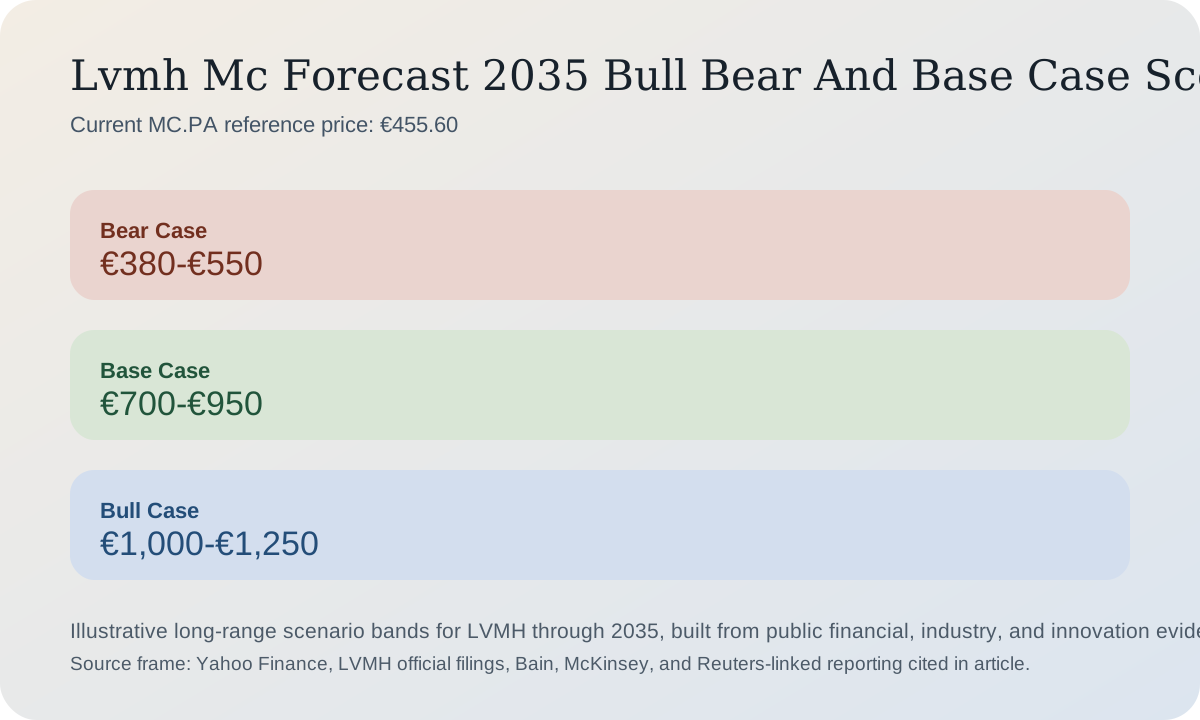
The bull range is €1,000 to €1,250. This requires a healthy luxury growth regime, a stronger Asia recovery, consistent brand renewal, and continued leadership in jewelry, beauty, and selective retail. It also assumes that AI and data initiatives improve client conversion and productivity enough to strengthen margins over time.
Base case for 2035
The base case is €700 to €950. That range assumes that LVMH continues compounding from a lower 2026 base, but more moderately than in its strongest rerating phase. The business would still look elite, but the market would remain more valuation-disciplined.
Bear case for 2035
The bear case is €380 to €550. This path would likely mean that personal luxury growth remains structurally slower, fashion and leather goods never fully regain prior momentum, and the premium multiple remains capped.
| Scenario | Range | Core assumptions | Probability |
|---|---|---|---|
| Bull | €1,000-€1,250 | Luxury upcycle returns and LVMH regains strong premium leadership. | 20% |
| Base | €700-€950 | Moderate compounding, stable cash returns, and a still-premium but disciplined valuation. | 55% |
| Bear | €380-€550 | Luxury stays slower for longer and rerating never fully returns. | 25% |
| Direction | Estimated probability | Interpretation |
|---|---|---|
| Higher by 2035 | 60% | The franchise quality still supports a positive long-run bias. |
| Lower by 2035 | 15% | A durable decline likely needs an unusually long period of sector disappointment. |
| Mostly sideways over a long span | 25% | A high-quality premium stock can still spend years digesting old excess valuation. |
Risks to watch
Watch whether new entrants and secondhand luxury keep changing consumer behavior, whether price increases remain sustainable, and whether the next generation of clients values traditional maisons as strongly as prior cohorts did.
What could invalidate the framework
This framework would be too cautious if LVMH's portfolio proves far more anti-cyclical than the current market assumes, especially through jewelry, beauty, and selective retail. It would be too bullish if 2024-2026 turns out to be the beginning of a structurally lower-growth era for personal luxury goods.
Conclusion
The 2035 outlook for MC is still constructive, but the path will probably be less linear and less valuation-rich than the decade that ended at the 2023 peak. LVMH remains luxury's highest-quality benchmark, but a benchmark can still compound more slowly than investors once expected.
Disclaimer: These scenarios are for research purposes only and are not guarantees or personal investment recommendations.
06. Investor Positioning
Position sizing and patience matter even more over a nine-year horizon
| Investor profile | Prudent stance | Scenario-based note |
|---|---|---|
| Investor already in profit | Hold core exposure if the thesis is multi-cycle brand compounding, but rebalance if MC became outsized. | The biggest risk is confusing quality with immunity to valuation swings. |
| Investor currently at a loss | Refresh the investment case rather than anchoring on old highs. | Averaging only makes sense if the long-run sector thesis still holds. |
| Investor with no position | Prefer staged entries or deep pullback buying over narrative chasing. | The long-range bull case does not remove entry-price risk. |
| Trader | Keep horizon discipline and use stop-losses. | 2035 stories do not neutralize 2026-2027 volatility. |
| Long-term investor | Dollar-cost averaging still fits best for a premium consumer compounder. | Total return, including dividends, matters more than timing one perfect entry. |
| Risk-hedging investor | Treat MC as cyclical quality exposure, not as a hedge substitute. | Pair with explicit hedges if macro protection is needed. |
07. FAQ
Frequently asked questions about an LVMH 2035 forecast
Could LVMH exceed its old all-time high by 2035?
Yes. That is implicit in both the base and bull cases. The real question is how cleanly and how sustainably that happens, not whether it is mathematically possible.
Why is the 2035 range so wide?
Because luxury demand, valuation, geography, succession, and technology adoption can all change materially over a nine-year horizon.
Does the 2035 thesis depend mostly on China?
China remains the most important swing factor, but the long-run outlook also depends on the U.S., Europe, jewelry growth, Sephora, pricing power, and brand desirability.
References
Sources
- Yahoo Finance chart API for MC.PA, 10-year monthly history
- Yahoo Finance chart API for MC.PA, recent daily closes
- LVMH 2025 full-year results press release
- LVMH Q1 2026 revenue press release
- LVMH key documents page, including 2025 annual report
- LVMH 2025 dividend announcement
- Reuters on LVMH shares diving after 2025 results
- Reuters on LVMH fourth-quarter sales and China improvement
- Reuters on LVMH shares after Q1 2026 and Middle East disruption
- Reuters analysis on luxury-stock volatility in 2026
- Bain & Company / Altagamma 2025 luxury market study
- McKinsey State of Fashion 2026
- Bain on luxury slowdown and future prospects
- LVMH startups and tech partners
- LVMH x VivaTech 2025