01. Quick Answer
The most credible 2030 MC forecast is constructive, but still tied to a more selective luxury cycle
The most useful way to think about LVMH in 2030 is not as a simple luxury stock but as a complex portfolio of global brands with different exposure to fashion, jewelry, beauty, retail, and aspirational spending. MC.PA sits at €455.60 as of 2026-05-15, down sharply from a 10-year high of €871.00 in March 2023 but still well above the €136.00 level from May 2016 (Yahoo Finance). That long arc matters because it shows both the strength of the franchise and the market's willingness to derate it when luxury demand cools.
| Point | Why it matters |
|---|---|
| LVMH is still a luxury bellwether | Its size and brand portfolio make it one of the cleanest ways to express a long-run view on high-end consumer demand. |
| 2030 is a sector outlook as much as a company forecast | The stock cannot be separated from the broader luxury cycle, especially China, the U.S., and aspirational consumer behavior. |
| The evidence is mixed in the near term | 2025 and early 2026 confirmed resilience in some divisions but weakness in fashion and leather goods. |
| A range is more defensible than a single number | Public information supports scenarios better than point-target certainty five years out. |
02. Historical Context
LVMH's long-run compounding power is real, but so is its sensitivity to luxury-sector derating
Historical data gives the 2030 discussion proper discipline. MC.PA rose from about €136.00 in May 2016 to a peak near €871.00 in March 2023 before retracing to €455.60 in May 2026, which still implies a price-only CAGR of about 12.91% over roughly a decade (Yahoo Finance 10-year history). That path is a reminder that LVMH can compound powerfully when the luxury cycle is favorable, but also that even world-class franchises can compress hard when investors question the durability of growth.
| Metric | Latest reading | Why it matters |
|---|---|---|
| 2025 revenue | €80.8 billion | LVMH remains enormous and globally diversified even after a softer luxury cycle. |
| 2025 profit from recurring operations | €17.8 billion | The earnings base is still very large, which matters for downside support and long-run optionality. |
| Q1 2026 revenue | €19.1 billion | The first quarter showed organic growth despite a difficult backdrop, but reported revenue was down because of FX and mix. |
| 2025 dividend | €13.00 per share | Capital returns remain meaningful even during a slower luxury environment. |
| Feature | LVMH implication | Forecast effect |
|---|---|---|
| Multi-division model | Fashion, jewelry, beauty, retail, wines and spirits all matter | The stock is less tied to one brand or category than many peers. |
| Scale and desirability | Louis Vuitton and Dior still anchor the premium | The company can invest through downturns instead of retreating. |
| Geographic balance | The U.S., Europe, Japan, and Asia all shape results | A weaker China does not automatically break the whole thesis. |
| Valuation sensitivity | A premium stock can derate sharply when growth slows | Quality alone does not remove equity risk. |
LVMH's 2025 full-year release showed the tension clearly. Revenue fell 5% reported and 1% organic to €80.8 billion, while profit from recurring operations fell 9% to €17.755 billion and group share net profit fell 13% to €10.878 billion (2025 full-year results). Yet free cash flow still rose 8% to €11.333 billion, and management stayed confident about reinforcing its leadership in 2026. That combination of softer top-line growth and stubborn cash-generation power is exactly why the 2030 outlook must be balanced rather than one-directional.
03. Main Drivers
Five forces are most likely to shape LVMH into 2030
1. China and broader Asia remain the single most important swing factor
Both Reuters coverage and LVMH's own releases emphasize that Asia excluding Japan showed improving trends into late 2025 and early 2026, but that investors remain cautious about how durable that recovery is (Reuters January 2026; Q1 2026 release). If Asia accelerates sustainably, the 2030 base case becomes easier to defend.
2. Fashion and leather goods still dominate the narrative
The Fashion & Leather Goods division remains the emotional and financial center of the LVMH story. In 2025 revenue in the segment fell to €37.77 billion from €41.06 billion, with profit from recurring operations down to €13.209 billion from €15.230 billion (LVMH 2025 results). That means any serious forecast must keep asking whether Louis Vuitton, Dior, and the wider maison portfolio can restore steadier growth.
3. Jewelry and beauty provide real offsets
Tiffany, Bvlgari, Sephora, and parts of perfumes and cosmetics matter because they keep the group from being a one-theme equity. LVMH reported 7% organic growth in watches and jewelry in Q1 2026, which is exactly the sort of internal diversification that makes the long-term thesis more resilient (Q1 2026 release).
4. The sector backdrop remains cautious but not broken
Bain and McKinsey both describe a luxury market that is no longer in its effortless post-pandemic boom. Bain's late-2025 update said global luxury spending was broadly flat in 2025, while McKinsey described 2026 as challenging, with tariffs and recalibrating consumer behavior complicating growth (Bain luxury study; McKinsey 2026 outlook).
5. AI and tech-enabled clienteling could matter more by 2030 than by 2027
LVMH has been explicit at VivaTech that data, AI, and generative AI are being tested across métiers, customer experience, vineyards, design, and marketing (LVMH at VivaTech 2025; VivaTech 2024). The immediate payoff may be modest, but by 2030 these tools could support better productivity and conversion at scale.
04. Institutional Forecasts and Analyst Views
The strongest evidence base comes from public financials and industry research, not from forced 2030 targets
There are few credible public 2030 point forecasts for LVMH, which is normal. The better evidence base is a combination of the company's current financial trajectory, the luxury sector outlook, and what the market has historically been willing to pay for a business of this quality. LVMH's own 2025 results show a business that remains profitable and cash-generative even in a difficult year, while Bain and McKinsey both argue that luxury is in a slower, more selective phase rather than a structural collapse (LVMH results; Bain June 2025 luxury outlook; State of Fashion 2026).
| Source | What it indicates | Forecast implication |
|---|---|---|
| LVMH 2025 results | Revenue and profit softened, but cash flow stayed strong | Supports a constructive base case if growth normalizes. |
| LVMH Q1 2026 release | Organic growth returned, but FX and mix pressures remained | Suggests the rebound is real but not yet clean. |
| Bain / Altagamma | Luxury is resilient but more selective and volatile | Supports scenario ranges instead of heroic one-way optimism. |
| McKinsey | 2026 remains challenging for fashion and luxury | Keeps the bear and sideways probabilities meaningful. |
Available data suggests the most defensible 2030 framework is neither a return to 2023-style exuberance nor a permanent stagnation story. The brand power and cash generation remain too strong for an easy collapse thesis. But analysts remain divided on how fast aspirational and Chinese luxury demand can normalize, which is why the range should stay wide.
05. Scenarios, Risks, and Invalidation
Bull, bear, and base cases are more credible than one-number certainty
Bullish scenario
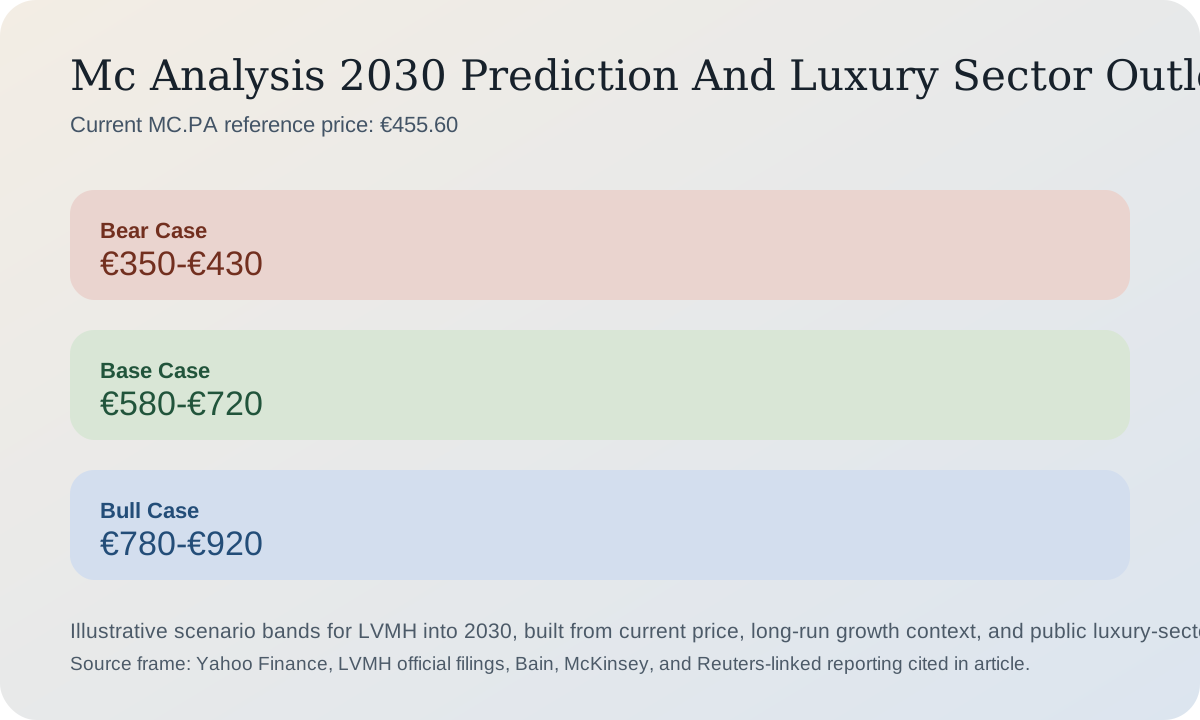
The bull range for 2030 is €780 to €920. That scenario depends heavily on a cleaner luxury upcycle, especially in Asia and the U.S., alongside renewed momentum in fashion and leather goods, ongoing jewelry strength, and a market willing to restore a premium multiple to a clearly recovering cash machine.
Bearish scenario
The bear range is €350 to €430. This path does not require a collapse in brand desirability. It only requires a prolonged period in which growth remains muted, pricing power is harder to monetize, and the market keeps paying less for even the best luxury franchises.
Base-case scenario
The base case remains €580 to €720. That range assumes gradual normalization in the sector, stable cash generation, and a valuation that remains premium but below the peak exuberance of 2023.
| Scenario | Range | Key conditions | Probability |
|---|---|---|---|
| Bull | €780-€920 | Luxury recovery broadens, fashion improves, and the multiple rerates. | 25% |
| Base | €580-€720 | Gradual normalization with continued cash generation and selective growth. | 50% |
| Bear | €350-€430 | Luxury remains sluggish and the premium multiple stays compressed. | 25% |
| Path | Estimated probability | Why |
|---|---|---|
| Rising from current levels by 2030 | 55% | The franchise quality and cash flow still support a constructive long-run bias. |
| Falling below current levels by 2030 | 20% | A materially lower outcome likely needs a long luxury slowdown plus further derating. |
| Moving broadly sideways | 25% | A premium consumer stock can spend years consolidating if earnings and multiples offset each other. |
Risks to watch
Watch Chinese demand, fashion and leather goods margins, U.S. aspirational spending, high gold and raw-material costs, FX, and any signs that the sector is structurally less accessible to new consumers.
What could invalidate the forecast
This framework would be too conservative if LVMH's post-2025 creative and retail initiatives drive a sharper recovery than the market expects. It would be too optimistic if the personal luxury goods market enters a longer and more structural period of muted demand, as some severe Bain scenarios have warned could happen in demand-dip conditions.
Conclusion
The most reasonable 2030 view on MC is constructive but selective. LVMH still looks like the highest-quality expression of luxury-sector exposure, yet its premium status does not remove cyclicality or rerating risk.
Disclaimer: This article is for informational and research purposes only. Scenario ranges are editorial judgments based on public information and are not personalized financial advice.
06. Investor Positioning
Different investor types should treat MC differently
| Investor type | Cautious approach | What to watch |
|---|---|---|
| Investor already in profit | Hold the core if the thesis is long-term brand compounding, but trim if the position became oversized at peak valuations. | Whether the recovery is broadening beyond jewelry and selective retail. |
| Investor currently at a loss | Refresh the thesis before averaging. Do not assume old highs are automatic magnets. | Fashion and leather goods trends plus China recovery evidence. |
| Investor with no position | Use staged entries or wait for pullbacks rather than chasing luxury rebounds. | Sector recovery breadth and valuation relative to growth. |
| Trader | Use stop-losses and respect earnings and macro risk events. | Luxury volatility, hedge-fund positioning, and macro headlines. |
| Long-term investor | Dollar-cost averaging is more defensible than all-in timing on a premium consumer stock. | Dividend support and cash-generation durability. |
| Risk-hedging investor | Do not confuse a high-quality luxury name with a hedge asset. | Pair with actual hedges if macro risk is the main concern. |
07. FAQ
Frequently asked questions about LVMH's 2030 outlook
Is LVMH still the best long-term luxury benchmark?
It remains one of the strongest candidates because of its diversification, brand quality, and cash generation, but the stock is still exposed to sector cycles.
Why not use a single 2030 target?
Because the luxury cycle, China, FX, raw materials, and valuation multiples are all too uncertain to justify point precision five years out.
What matters most right now for MC?
Fashion and leather goods recovery, Chinese demand trends, and whether jewelry and Sephora can keep offsetting softer areas.
References
Sources
- Yahoo Finance chart API for MC.PA, 10-year monthly history
- Yahoo Finance chart API for MC.PA, recent daily closes
- LVMH 2025 full-year results press release
- LVMH Q1 2026 revenue press release
- LVMH key documents page, including 2025 annual report
- LVMH 2025 dividend announcement
- Reuters on LVMH shares diving after 2025 results
- Reuters on LVMH fourth-quarter sales and China improvement
- Reuters on LVMH shares after Q1 2026 and Middle East disruption
- Reuters analysis on luxury-stock volatility in 2026
- Bain & Company / Altagamma 2025 luxury market study
- McKinsey State of Fashion 2026
- Bain on luxury slowdown and long-term fundamentals
- McKinsey on the 2026 fashion industry outlook
- LVMH on AI and innovation at VivaTech 2025