01. Quick Answer
The most realistic 2035 MIB forecast is higher than today, but it depends on Italy turning a cyclical rerating into a durable investment case
The FTSE MIB closed at 49,116.47 on 2026-05-15, up from 16,198 at the start of its 10-year Yahoo Finance monthly series on 2016-06-01, for a price-only CAGR of about 11.73% (Yahoo Finance 10-year history; recent daily closes). A 2035 estimate must therefore answer a harder question than a 2027 call: can Italian equities keep compounding once the obvious recovery trade matures?
The long-range institutional backdrop is cautious. The OECD and IMF both stress Italy's structural constraints, while public institutions also acknowledge better banking resilience and stronger fiscal credibility than the market used to assume. That combination argues for long-run upside, but only in a wide band.
| Point | Why it matters |
|---|---|
| 2035 is a regime question, not a headline target | The answer depends on debt, reform, energy, productivity, and Europe's rate structure more than on short-term tape action. |
| Cash returns can matter more than multiple expansion | Dividends and buybacks are likely to remain a large share of total return for Italy's blue chips. |
| Italy's best long-run assets are sector-specific | Utilities, defense, premium industrials, and selected technology-adjacent businesses may matter more than broad domestic demand. |
| The bear case is still real | High debt and low productivity mean the market can underperform for long stretches if policy credibility breaks. |
02. Historical Context
The last decade proves the MIB can rerate hard, but a nine-year forecast needs a different logic than a rebound trade
The last decade was unusually favorable for anyone who bought the Italian market from a depressed base. The FTSE MIB closed at 49,116.47 on 2026-05-15, up from 16,198 at the start of its 10-year Yahoo Finance monthly series on 2016-06-01, for a price-only CAGR of about 11.73% (Yahoo Finance 10-year history; recent daily closes). Yet the very success of that move changes the forward math. A long-range 2035 forecast cannot just assume that a market that tripled from a low base will keep compounding at the same pace indefinitely.
The more relevant historical lesson is that the MIB tends to alternate between valuation repair and earnings digestion. Borsa Italiana data show a benchmark heavily exposed to financials, utilities, industrials, and premium consumer franchises. Those sectors can create durable cash flow, but they are also tied to macro regimes, regulation, and capital intensity. Over a nine-year horizon, that means total return can still be attractive even if price appreciation alone is less dramatic.
For 2035, the right baseline is modest national growth, recurring cash return to shareholders, periodic sovereign-risk scares, and selective leadership from sectors linked to power infrastructure, defense, and digital industrialization. That is a sturdier framework than assuming Italy will suddenly become a high-growth market.
| Metric | Latest reading | Why it matters |
|---|---|---|
| Current index level | 49,116.47 | Every forecast range in this set is anchored to the latest available close rather than an older peak. |
| 52-week range | 38,605.00 to 50,050.00 | Shows that the MIB has already rerated materially and is no longer a deeply depressed market. |
| 10-year start point | 16,198 | Provides a disciplined baseline for long-run compounding and avoids narrative-only projections. |
| Editorial base range | 72,000-90,000 | A scenario range is more defensible than a single-number target in a macro-sensitive index. |
| Feature | Implication | Forecast effect |
|---|---|---|
| Heavy financial weight | Banks and insurers remain central to earnings and sentiment | ECB policy and sovereign spreads matter more here than in tech-heavy benchmarks. |
| National champions in utilities, defense, and industrials | Enel, Leonardo, Prysmian, Ferrari, and Stellantis create sector diversification | The index can benefit from defense, grid capex, or premium manufacturing even if domestic demand is uneven. |
| Italy-specific risk premium | Public debt and politics still influence foreign allocations | Valuation can rerate both up and down faster than fundamentals alone would suggest. |
| Strong 10-year recovery | Price compounded about 11.73% annually over the last decade | Forward returns are unlikely to simply repeat that pace without continued earnings and rerating support. |
03. Main Drivers
Six long-range forces are likely to decide where the MIB stands by 2035
1. Debt sustainability and spread discipline. Italy's public debt remains one of the core variables in any decade-long forecast. If nominal growth, primary balances, and ECB conditions keep spreads contained, the market can remain investable. If that credibility slips, the rerating can reverse.
2. Bank normalization after peak rates. UniCredit and Intesa show how powerful the recent bank cycle has been. But by 2035 investors will care less about peak net interest income and more about cost discipline, fee businesses, consolidation, and capital allocation.
3. Europe-wide defense spending. Leonardo is strategically important because it turns the MIB into more than a pure rates-and-banks trade. If European rearmament remains structural, the index gains a source of durable earnings growth.
4. Energy networks and electricity demand. Enel and Prysmian sit in a long-cycle investment theme around grids, electrification, renewable integration, and data-center power. That may be one of the most underestimated reasons Italy can still matter in a global portfolio.
5. Premium manufacturing and brand resilience. Ferrari remains the cleaner example of Italy's ability to monetize scarcity and pricing power across cycles. That does not transform the entire index, but it supports the argument that the MIB includes franchises with global moats rather than only macro-sensitive domestic assets.
6. AI and digital industrial adoption. AI is more likely to reshape sector leadership than to turn the MIB into a technology benchmark. Still, data-center cabling, power demand, electronics, and defense software can matter more by 2035 than they do today.
04. Institutional Forecasts and Analyst Views
The right 2035 framework combines official macro caution with company-level strategic optionality
Decade-long institutional point targets for the MIB are scarce, which is normal. What public institutions do offer is a map of the constraints: the OECD sees modest growth, the European Commission remains careful on the outlook, and the Bank of Italy still highlights uncertainty around external demand. None of that supports a straight-line boom.
The positive case comes from composition. If Italy's banks remain cash-return machines, grids and utilities spend into electrification, Leonardo compounds with defense budgets, and selected industrial-tech names capture AI-related demand, then the MIB can keep rising despite mediocre national GDP. Analysts remain divided because this outcome depends on execution, not only valuation.
| Source | What it implies | Why it matters |
|---|---|---|
| IMF and OECD | Structural growth remains modest | Caps the plausible upside multiple unless earnings become more diversified. |
| ECB and Commission | Rates and fiscal credibility still shape financial conditions | Important for spreads, bank valuations, and capital-intensive sectors. |
| Corporate strategic plans | Leonardo, Enel, and Prysmian provide multi-year investment roadmaps | Creates long-duration upside channels beyond the bank trade. |
| Yahoo Finance 10-year history | The market already delivered an outsized recovery | A disciplined 2035 range should assume slower compounding than the last decade. |
05. Scenarios, Risks, and Invalidation
A long-range bull case exists, but the base case still assumes volatility, drawdowns, and slower compounding than the last decade
Bullish scenario
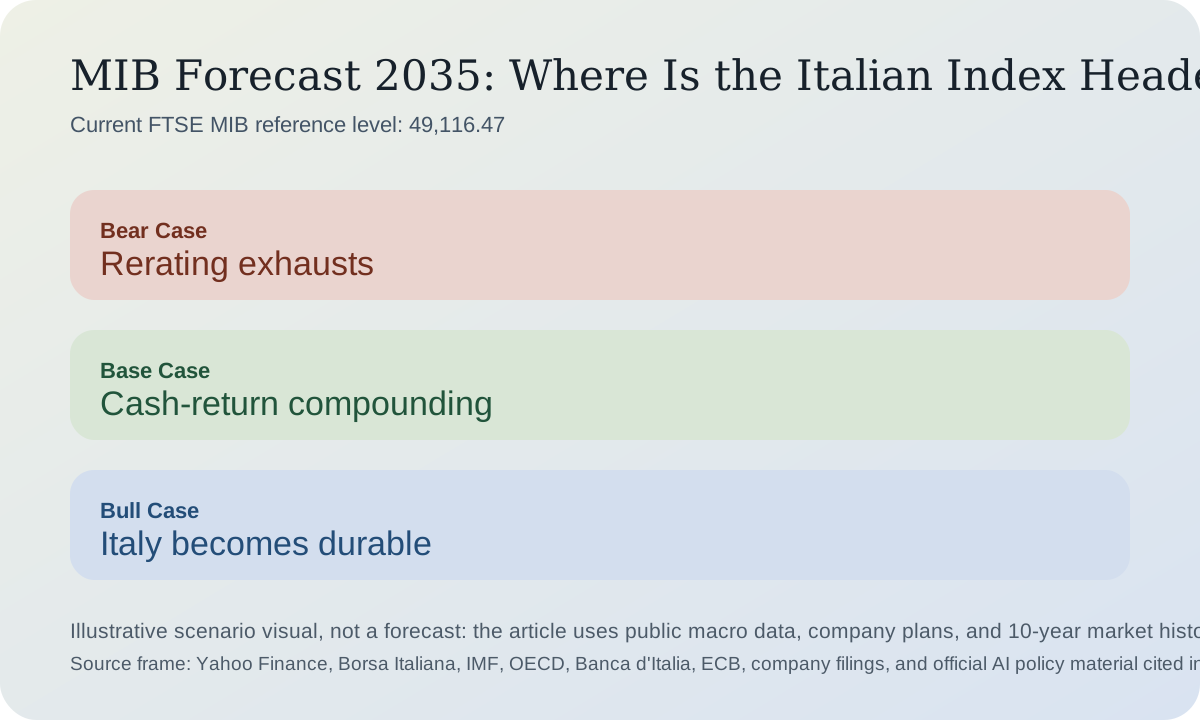
The long-range bull case is 92,000 to 110,000 by 2035. That would likely require contained sovereign spreads, sustained cash returns from banks, durable grid and defense capex, and better-than-feared productivity support from AI and digitization.
Bearish scenario
The bear case is 45,000 to 60,000. This would imply that the current rerating largely exhausts itself, Italy slips back into a persistent low-growth and high-risk-premium regime, and the market spends years digesting gains.
Base-case scenario
The base case is 72,000 to 90,000. That range assumes moderate earnings growth, recurring dividends and buybacks, and periodic macro drawdowns that do not break the whole thesis.
Risks to watch
Watch the debt trajectory, labor-force trends, productivity, the shape of euro rates, geopolitical shocks, and whether bank earnings normalize abruptly or gradually.
What could invalidate the forecast
The range would be too optimistic if Italy re-enters a serious spread crisis or if post-rate-cut bank earnings fall harder than current data suggest. It would be too cautious if Italy's industrial and infrastructure leaders prove able to compound like long-duration quality assets for most of the decade.
Conclusion
The most credible 2035 MIB view is constructive, but only inside a broad range. Italy can still deliver respectable long-run returns, yet the market remains too policy-sensitive for false precision.
Disclaimer: This article is for research and informational purposes only. Long-range scenarios are conditional frameworks, not guarantees or individualized advice.
| Scenario | Range | Conditions | Probability |
|---|---|---|---|
| Bull | 92,000-110,000 | Contained spreads, durable shareholder returns, strong defense and grid capex, and better productivity | 20% |
| Base | 72,000-90,000 | Moderate compounding with recurring volatility | 50% |
| Bear | 45,000-60,000 | Renewed Italy risk premium and prolonged multiple compression | 30% |
| Direction | Probability | Comment |
|---|---|---|
| Higher than today by 2035 | 60% | Nine years is enough time for cash return and modest earnings growth to matter, even without a boom. |
| Lower than today by 2035 | 15% | This likely requires a material policy or debt accident rather than ordinary volatility. |
| Sideways to moderate gains | 25% | Still plausible because mature value markets can spend long periods consolidating. |
06. Investor Positioning
A long horizon changes the way investors should think about the MIB
| Investor type | Cautious approach | What to watch |
|---|---|---|
| Investor already in profit | Rebalance and keep exposure aligned with your thesis rather than letting one bank or defense name dominate. | Total return drivers, not just price momentum. |
| Investor currently at a loss | Test whether your holding period is long enough for a 2035 thesis at all. | If your thesis depends on quick rerating, this is the wrong horizon. |
| Investor with no position | Use phased entries and accept that decade-long returns will not be linear. | Spreads, valuation, and dividend reinvestment opportunities. |
| Trader | Do not confuse a long-range scenario with a short-term setup. | Trade around catalysts, but separate that from the decade thesis. |
| Long-term investor | Dollar-cost averaging and periodic rebalancing are more sensible than trying to time every Italy headline. | Total return, taxes, and concentration risk. |
| Risk-hedging investor | Pair any MIB exposure with explicit hedges if sovereign-risk sensitivity is a concern. | Rates, EUR risk, and drawdown tolerance. |
07. FAQ
Frequently asked questions about the FTSE MIB outlook
Can the MIB still compound well after such a strong decade?
Yes, but probably at a slower pace. Cash returns and sector diversification become more important than simple rerating.
What matters most over a nine-year horizon?
Debt credibility, the quality of bank earnings after peak rates, and whether utilities, defense, and industrial infrastructure become a broader leadership set.
Why not give one exact 2035 target?
Because a market this sensitive to rates, spreads, and policy can plausibly travel through multiple regimes before 2035.
References
Sources
- Yahoo Finance chart API for FTSEMIB.MI, 10-year monthly history
- Yahoo Finance chart API for FTSEMIB.MI, recent daily closes
- Borsa Italiana FTSE MIB performance page
- Borsa Italiana monthly market report, March 2026
- IMF 2025 Article IV consultation for Italy
- OECD Economic Surveys: Italy 2026
- European Commission Spring 2026 forecast for Italy
- Banca d'Italia Economic Bulletin 2/2026
- ECB monetary policy decisions, April 2026
- ISTAT consumer prices, April 2026
- UniCredit first quarter 2026 results
- Intesa Sanpaolo first quarter 2026 results
- Leonardo industrial plan update, March 12 2026
- Enel 2026-2028 strategic plan
- Prysmian first quarter 2026 results
- STMicroelectronics first quarter 2026 results
- Stellantis 2025 second-half preliminary results
- AgID Italian artificial intelligence strategy 2024-2026
- IT4LIA AI Factory official page
- Ferrari investor relations and results center