01. Quick Answer
A credible 2035 Mitsubishi UFJ forecast should start with the possibility that Japan's banking model has structurally improved, but not assume a straight line
Mitsubishi UFJ's ADR has already risen from 4.43 to 18.84 over the past 10 years (Yahoo Finance chart API for MUFG, 10-year monthly history). That strong history matters because the 2035 forecast begins from a bank that has already re-rated sharply on the idea that higher domestic rates and better capital discipline are no longer temporary.
Even so, the evidence is mixed on how far that rerating can run. MUFG's latest official materials show FY2025 net income of ¥2.427 trillion and a FY2026 target of ¥2.7 trillion, while Visible Alpha consensus cited by S&P Global still projects continued earnings growth after that. But the IMF and BOJ both argue that the new regime still carries market-structure and funding vulnerabilities that did not disappear just because profitability improved.
| Point | Why it matters |
|---|---|
| 2035 depends on duration of the new regime | A long horizon amplifies both the benefits of higher rates and the risk of policy reversal. |
| MUFG has multiple growth levers | Domestic rates, Asia, wealth, capital markets, and digital channels all feed the thesis. |
| Point forecasts are weak tools here | Public long-range bank targets are scarce and the macro path matters too much. |
| Scenario design matters more than certainty | The best forecasts explain conditions, not only outcomes. |
02. Historical Context
The 2035 debate is really about how durable the post-zero-rate transition becomes
MUFG's medium-term business plan still frames the current period as one of growth, transformation, and better capital productivity. The company first set an FY2026 ROE target of about 9%, then effectively lifted the end-state ambition closer to 12% in the latest full-year materials (MUFG Financial Highlights under Japanese GAAP for the fiscal year ended March 31, 2026; integrated report). That shift matters because a bank that can sustainably earn double-digit ROE deserves a very different valuation conversation from one trapped in low-return equilibrium.
Still, a 2035 forecast cannot ignore the cautionary side. The ratings page shows MUFG remains an A-category global bank rather than a riskless institution. The BOJ financial system report keeps warning about JGB liquidity, foreign NBFI spillovers, and private-credit monitoring. The IMF highlights securities valuation, FX funding, and commercial real-estate vulnerabilities. Those are not reasons to reject the long case, but they are reasons to model a range.
| Item | Current evidence | 2035 relevance |
|---|---|---|
| 10-year price CAGR | 15.65% | Shows how much rerating has already happened. |
| FY2025 net income | ¥2.427 trillion | Current earnings base matters for long-run compounding. |
| FY2026 dividend forecast | ¥96 per share | Dividend growth is a major part of long-run total return. |
| ROE target | Approx. 12% | Long-run valuation support depends on whether this proves durable. |
| Driver | Bull interpretation | Bear interpretation |
|---|---|---|
| Domestic rates | Support lasting spread expansion | Stall or reverse before economics fully reset |
| Asia growth | Adds secular expansion beyond Japan | Creates geopolitical and credit volatility |
| Capital returns | Keep boosting per-share value | Fade if capital or regulation tightens |
| Digital and AI investments | Improve operating leverage and customer reach | Stay useful but financially incremental |
03. Main Drivers
Five variables will likely dominate the 2035 outcome
1. Whether Japan sustains a positive-rate economy. The April 2026 BOJ policy statement shows a regime that is already very different from the old negative-rate era. If that lasts, MUFG's domestic economics change structurally.
2. Whether double-digit ROE proves durable rather than cyclical. Management now targets around 12% ROE (MUFG Financial Highlights under Japanese GAAP for the fiscal year ended March 31, 2026). That is the single most important reason the long-run valuation debate has improved.
3. Whether Asia x Digital actually broadens the moat. MUFG Report 2025 describes a 67 million user base tied to its Asia x Digital strategy. If that becomes a profitable ecosystem, 2035 upside broadens materially.
4. Whether market-risk management stays disciplined. The BOJ and IMF both warn that securities and funding risks remain real even when capital buffers look solid.
5. Whether Japan keeps earning a global banking premium. S&P Global's January 2026 work argues Japanese megabanks may keep widening margins while peers in other markets see compression. If that relative edge persists for years, MUFG's multiple can remain above old-cycle norms.
04. Institutional Forecasts and Analyst Views
Analyst evidence helps the medium term, but the 2035 range still needs editorial scenario work
The strongest institutional support for the 2035 case is indirect. S&P Global's May 2026 article shows consensus expecting MUFG net income to keep climbing from ¥2.262 trillion for the fiscal year ended March 2026 to ¥2.446 trillion and then ¥2.788 trillion over the next two fiscal years, with net interest margin improving along the way. That does not reach 2035, but it does support the idea that the earnings base is still rising.
S&P Global Ratings also described Japan banking conditions as supported by a changing rate environment and a broadly stable economy, even while warning that global uncertainty could still test resilience. Put differently, institutions are not calling for a blowout decade. They are saying the old constraints on Japanese banks have eased, but a new set of market risks has emerged.
| Input | Observed evidence | Forecast use |
|---|---|---|
| Current price | 18.84 | Prevents the long-horizon forecast from ignoring today's rerating. |
| 10-year CAGR | 15.65% | Shows that repeating the last decade in full may be too optimistic for the base case. |
| ROE direction | 11.3% actual, about 12% target | Supports a structurally higher long-run quality band. |
| Consensus earnings trend | Positive through the next two fiscal years | Supports a constructive near-to-medium bridge into the longer horizon. |
05. Scenarios, Risks, and Invalidation
Bull, bear, and base case ranges for 2035
Bullish scenario
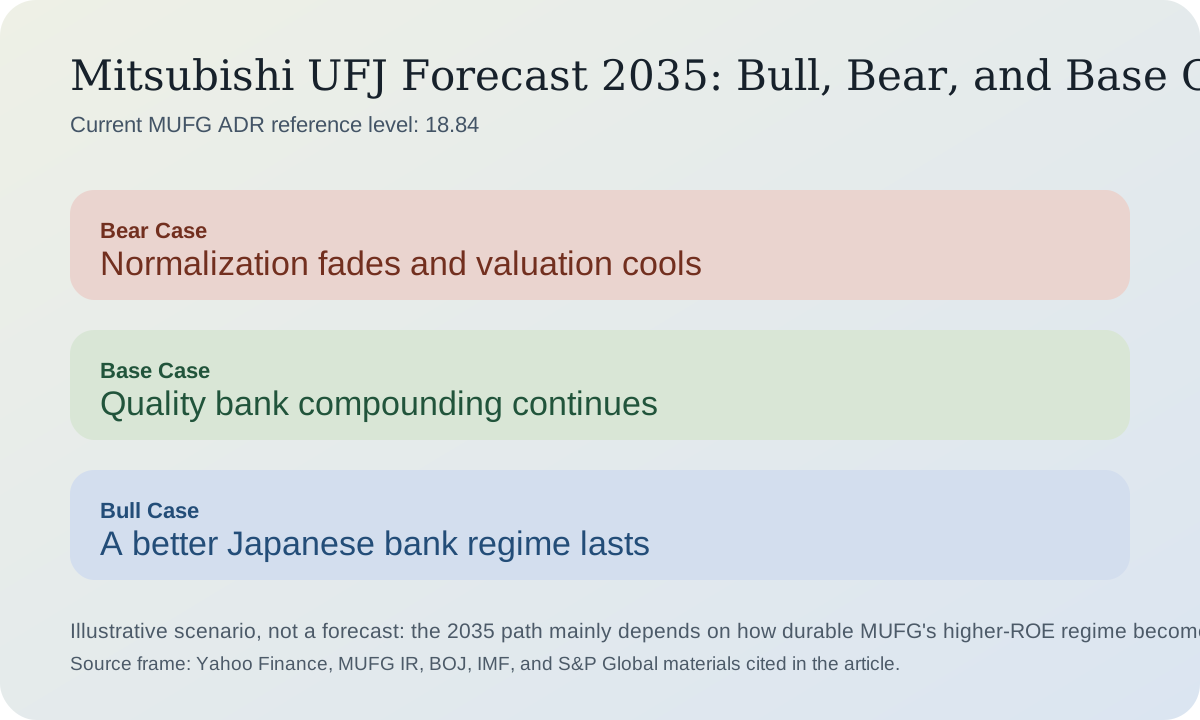
The bull case is $36 to $48 by 2035. This requires a sustained positive-rate Japan, durable double-digit ROE, strong capital returns, and evidence that Asia and digital channels are raising structural growth rather than only complexity.
Bearish scenario
The bear case is $14 to $24. That scenario depends on a broken rate-normalization thesis, more severe market-value losses, or a decade where payouts remain decent but valuation never escapes old bank-stock skepticism.
Base-case scenario
The base case is $26 to $34. It assumes MUFG compounds from a better earnings base, but with lower annualized returns than the last 10 years because today's starting valuation and profitability are already much stronger.
The probability design is intentionally conservative. Long-dated bank forecasts should respect mean reversion, regulation, and the possibility that better economics attract tighter competition or more volatile capital markets.
Risks to watch
Watch long-run BOJ policy, securities sensitivity, cross-currency funding, regulatory capital standards, and whether digital investments deepen customer economics or merely absorb expense.
What could invalidate the forecast
This framework is too bullish if double-digit ROE proves a short-cycle peak. It is too bearish if Japan's megabank model genuinely shifts into a higher-return, better-valued regime for a decade or more.
Conclusion
The cleanest 2035 MUFG view is constructive but not reckless. The bank now has enough earnings and payout quality to deserve serious long-range attention, yet not enough certainty to justify ignoring macro and market-structure risk.
Disclaimer: This article is for research and informational purposes only. Long-run scenario ranges are conditional estimates based on cited public information, not promises or personalized financial advice.
| Scenario | Range | Conditions | Probability |
|---|---|---|---|
| Bull | $36-$48 | Higher-rate Japan persists and MUFG compounds with strong payouts | 25% |
| Base | $26-$34 | Good but less explosive compounding than the last decade | 50% |
| Bear | $14-$24 | Profitability normalizes lower or policy support fades | 25% |
| Direction | Probability | Comment |
|---|---|---|
| Higher by 2035 | 60% | The evidence still favors a better long-run regime than the past zero-rate era. |
| Lower by 2035 | 15% | That likely requires both macro disappointment and weaker capital returns. |
| Sideways to modest gains | 25% | Bank stocks can deliver income-rich but valuation-light outcomes for years. |
06. Investor Positioning
Position sizing should reflect starting point, time horizon, and macro tolerance
The 2035 horizon especially rewards disciplined assumptions because dividend compounding, not only multiple expansion, drives the total-return story.
| Investor type | Prudent approach | Why |
|---|---|---|
| Investor already in profit | Hold the core, but trim if Japanese bank exposure has become oversized after MUFG's long rerating. | That preserves gains while leaving room for BOJ upside if margins keep widening. |
| Investor currently at a loss | Re-check whether the original thesis was about dividends, rates, or broad value re-rating before averaging down. | Losses in bank stocks often come from wrong catalysts rather than wrong franchises. |
| Investor with no position | Build exposure in stages or wait for pullbacks instead of chasing strong sentiment. | Japanese bank stocks can reprice sharply around BOJ meetings, FX moves, and credit headlines. |
| Trader | Use stop-losses, focus on BOJ dates, JGB volatility, and earnings guidance, and avoid treating dividends as a short-term shield. | Near-term price action is still macro-driven. |
| Long-term investor | Favor dollar-cost averaging, periodic rebalancing, and disciplined review of ROE, CET1, and payout quality. | The long case depends on multi-year profitability, not one quarter of excitement. |
| Risk-hedging investor | Consider hedging market beta or rebalancing against cyclical financial exposure. | MUFG can be a hedge against rising Japanese rates, but not against every global risk shock. |
07. FAQ
Frequently asked questions about Mitsubishi UFJ through 2035
Why is the 2035 base case not more aggressive after a strong decade?
Because the stock has already rerated substantially and long-horizon bank forecasts should assume some moderation from unusually strong starting momentum.
What is the biggest bull-case driver?
The biggest driver is durable double-digit ROE supported by positive domestic rates and disciplined capital returns.
What is the main bear-case risk?
The main risk is that better profitability proves cyclical while securities, funding, or macro stress compress valuation again.
References
Sources
- Yahoo Finance chart API for MUFG, 10-year monthly history
- Yahoo Finance chart API for MUFG, recent daily closes
- MUFG Financial Highlights under Japanese GAAP for the fiscal year ended March 31, 2026
- MUFG Consolidated Summary Report under Japanese GAAP for the fiscal year ended March 31, 2026
- MUFG Report 2025 integrated report
- MUFG strategy page and medium-term business plan
- MUFG ratings page
- Bank of Japan Statement on Monetary Policy, April 28, 2026
- Bank of Japan Financial System Report, April 2026
- IMF staff concluding statement for the 2026 Article IV mission to Japan
- S&P Global Market Intelligence on Japan megabank earnings expectations, May 2026
- S&P Global Market Intelligence on Japanese lender margin outlook, January 2026
- S&P Global Ratings Japan Banking Outlook 2025