01. Quick Answer
The most defensible MUFG 2030 forecast is constructive, but it depends on Japan's rate normalization holding long enough to change bank economics
MUFG's NYSE-listed ADR closed at 18.84 on 2026-05-15, versus 4.43 on 2016-06-01 in the 10-year Yahoo series, for a price-only CAGR of about 15.65% (10-year price history; recent daily closes). That is already a strong rerating, so the 2030 question is no longer whether MUFG is merely cheap. It is whether Japanese banking has structurally changed enough to support another five years of improving returns.
Available data suggests the answer is yes, but only conditionally. MUFG reported fiscal-year net income of ¥2.427 trillion, up 31% year over year, with ROE at 11.3% and a new FY2026 target of ¥2.7 trillion and roughly 12% ROE (MUFG FY2026 highlights; summary report). At the same time, the Bank of Japan kept the policy rate at 0.75% on April 28, 2026 while leaving the door open to further hikes, and both the IMF and BOJ financial system report still describe the core Japanese banking system as resilient even as they warn about securities, funding, and market-liquidity risks.
| Point | Why it matters |
|---|---|
| MUFG is no longer only a value trade | Higher domestic rates, stronger payouts, and cleaner ROE discipline have changed the story. |
| The Japanese banking backdrop matters almost as much as company execution | BOJ policy and JGB-market stability drive net interest margins and valuation multiples. |
| Management guidance is supportive | FY2026 targets imply profit growth, higher dividends, and continued buybacks. |
| 2030 should be modeled as ranges | Credit costs, FX, and market-risk exposures can materially change the path. |
02. Historical Context
MUFG's past decade shows why a higher-rate Japan matters so much
Over the last 10 years, MUFG's ADR moved from 4.43 to 18.84, with a 10-year observed range of 3.66 to 18.84 (Yahoo Finance chart API for MUFG, 10-year monthly history). That history is useful because it spans zero-rate Japan, pandemic stress, inflation, the first BOJ exit from negative rates, and the market's realization that Japanese megabanks could again earn decent spreads at home.
MUFG Report 2025 and the latest May 15, 2026 results materials show a business that is not relying on one engine. Domestic rate sensitivity, overseas corporate and transaction banking, Asia partner-bank optionality, wealth, and the Morgan Stanley alliance all matter. That diversification helps the base case, but it also means investors must watch more moving parts than they would for a narrow domestic lender.
| Metric | Latest reading | Why it matters |
|---|---|---|
| Current ADR price | 18.84 | Anchors the forecast to the latest available close. |
| 52-week range | 13.19 to 20.15 | Shows the stock is closer to the top of the recent range than to the bottom. |
| FY2025 net income | ¥2.427 trillion | Confirms that earnings already broke to a record high. |
| FY2026 net income target | ¥2.7 trillion | Provides a concrete official marker for the next leg of the story. |
| Feature | Implication | Forecast effect |
|---|---|---|
| Domestic rate normalization | MUFG is one of the clearest listed ways to express a higher-rate Japan | Supports the bull and base cases if BOJ normalization continues. |
| Large overseas franchise | Overseas earnings smooth domestic weakness but add FX and credit risk | Keeps upside broad, but downside is not purely Japanese. |
| Asia platform and partner-bank model | Thailand, Indonesia, the Philippines, Vietnam, and India matter strategically | Adds long-run growth optionality beyond domestic lending. |
| Large securities holdings and market sensitivity | JGB volatility and securities valuation still matter | Prevents the 2030 outlook from becoming a one-way rate story. |
03. Main Drivers
Six structural drivers should shape MUFG into 2030
1. BOJ policy normalization remains the central swing factor. The BOJ policy statement of April 28, 2026 kept the overnight call rate around 0.75%, and MUFG's own FY2026 assumptions point to a domestic policy rate of about 1% (MUFG Financial Highlights under Japanese GAAP for the fiscal year ended March 31, 2026). If Japan truly sustains positive nominal rates, MUFG's domestic earnings power keeps improving.
2. Management guidance is already signaling another step up. MUFG's FY2026 targets include ¥2.9 trillion in net operating profits, ¥2.7 trillion in net income, and an ROE target of roughly 12%, along with a ¥96 annual dividend forecast and a ¥100 billion first-half buyback (MUFG Financial Highlights under Japanese GAAP for the fiscal year ended March 31, 2026). That is supportive, but it also raises the bar for execution.
3. Asia and digital growth matter more than many U.S. investors appreciate. The integrated report says MUFG's Asia x Digital strategy reached a 67 million user base in Asia. That matters because MUFG is trying to build a broader economic sphere, not just a traditional branch network.
4. The Morgan Stanley alliance remains a differentiator. MUFG's disclosures continue to frame the Morgan Stanley partnership as an earnings-quality advantage across project finance, capital markets, and integrated-firm opportunities (MUFG Report 2025). That alliance is hard to replicate and helps justify a premium to plain domestic-bank valuations.
5. Capital discipline still supports the equity case. The current dividend framework, payout ratio near 40%, and repeated buybacks matter because they force management to translate better macro conditions into shareholder returns rather than only into balance-sheet expansion (summary report; IR page).
6. Risk is moving from credit scarcity to market complexity. The IMF and BOJ both highlight vulnerabilities around mark-to-market securities, cross-currency funding, private credit, and commercial real estate. The outlook is favorable, but not frictionless.
04. Institutional Forecasts and Analyst Views
The best institutional evidence is directionally bullish, but it is not certainty theater
There are not many credible third-party 2030 point targets for MUFG in the public domain, so the most useful inputs are management guidance, bank-sector research, and consensus earnings trajectories. The evidence is mostly constructive, but it still argues for scenario ranges rather than a single heroic number.
S&P Global Market Intelligence reported before MUFG's May 15 release that Visible Alpha consensus expected fiscal-year net income of ¥2.262 trillion for the year ended March 2026, then ¥2.446 trillion for FY2027 and ¥2.788 trillion for FY2028, with MUFG's net interest margin moving from 0.71% to 0.81% and then 0.90%. The fact that MUFG then reported ¥2.427 trillion in actual FY2025 earnings means the bank cleared that pre-result consensus reference point, but the path ahead still assumes domestic rate support and manageable credit costs.
A January 2026 S&P Global article also emphasized that Japanese megabanks are one of the few places in Asia-Pacific where margins could still widen as other banking systems face compression. That is why the long-run MUFG thesis remains unusually tied to Japan's policy regime change.
| Source | What it says | Implication for MUFG |
|---|---|---|
| MUFG FY2026 highlights | Record FY2025 earnings, ROE at 11.3%, FY2026 target of ¥2.7 trillion | Supports a constructive internal baseline. |
| S&P Global consensus article | Consensus still expects net income and NIM to rise over the next two fiscal years | Supports the case that earnings momentum is not only backward-looking. |
| IMF 2026 Japan mission | Japanese banks are resilient, but securities and funding exposures still matter | Explains why investors should respect downside tails. |
| BOJ Financial System Report | Market liquidity, private credit, and foreign NBFI spillovers need close monitoring | Suggests the main risks are increasingly market and funding related. |
05. Scenarios, Risks, and Invalidation
The cleaner way to model MUFG into 2030 is through explicit conditions
Bullish scenario
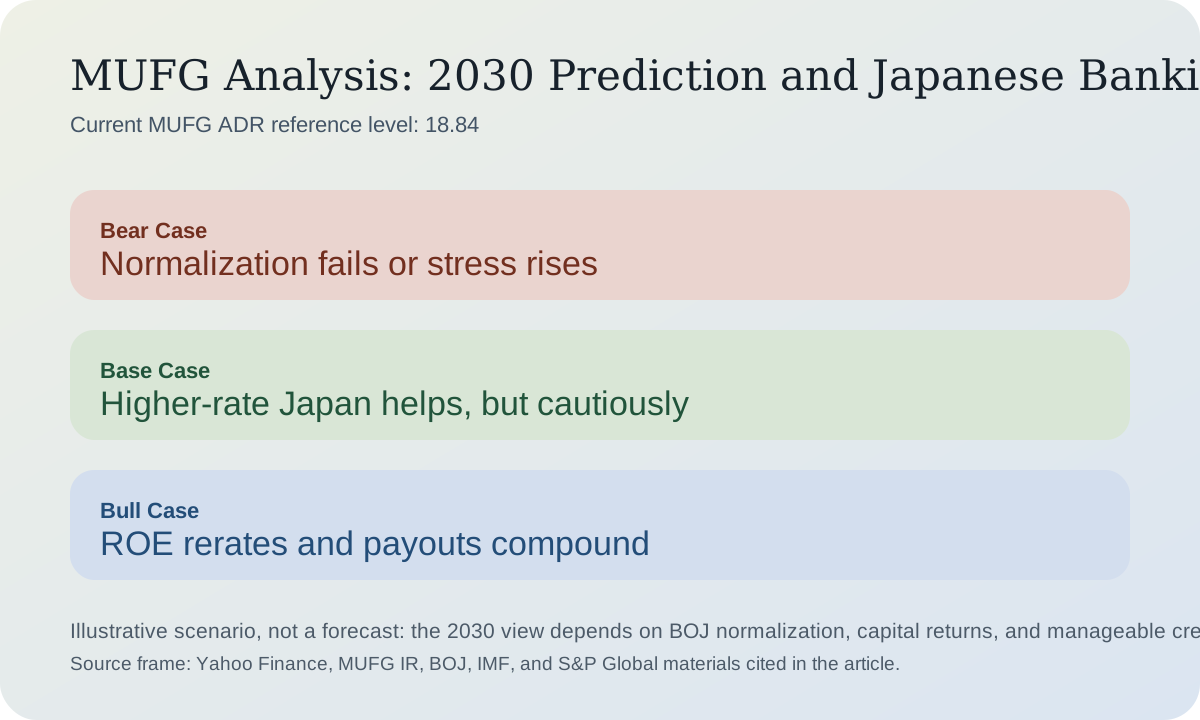
The bull case is roughly $28 to $36 by 2030. This scenario depends heavily on the BOJ lifting the domestic policy rate toward or above 1%, MUFG sustaining ROE around 12%, Asia and integrated-firm earnings remaining strong, and payouts continuing to rise without a capital squeeze.
Bearish scenario
The bear case is $13 to $18. That path likely requires either a reversal in the Japan rate narrative, a sharp rise in credit costs, or market-stress losses large enough to compress valuation even if the franchise remains sound.
Base-case scenario
The base case is $22 to $28. It assumes rates remain supportive, profit growth is real but not spectacular, and MUFG continues returning capital while trading on a still-discounted but improving multiple.
The methodology behind those ranges is straightforward. The base case assumes MUFG compounds more slowly than its unusually strong 10-year share-price CAGR of 15.65%, but better than its old zero-rate regime. The probability weights also reflect the evidence that public institutions remain constructive on Japanese bank margins while still flagging market-structure risk.
Risks to watch
Watch BOJ policy decisions, JGB volatility, credit provisions, Asia growth, FX funding conditions, and whether the profit uplift from higher rates starts to fade into higher costs or valuation losses.
What could invalidate the forecast
This framework would be too optimistic if Japan's normalization story breaks and domestic rates settle back near zero. It would be too conservative if MUFG demonstrates that 12% ROE is sustainable while the market decides Japanese megabanks deserve materially higher multiples.
Conclusion
MUFG's 2030 outlook is stronger than it was a few years ago because the economic regime around it has changed. But the stock is now pricing in some of that change already, which is why disciplined scenario work matters more than simple value-language.
Disclaimer: This article is for research and informational purposes only. Scenario ranges and probabilities are editorial estimates based on cited public information, not guarantees or personalized investment advice.
| Scenario | Range | Key conditions | Probability |
|---|---|---|---|
| Bull | $28-$36 | BOJ normalization persists, ROE stays near 12%, and capital returns keep expanding | 30% |
| Base | $22-$28 | Moderate earnings growth with stable but not euphoric sentiment | 45% |
| Bear | $13-$18 | Rate momentum stalls or market and credit stress overwhelm higher spreads | 25% |
| Path | Estimated probability | Comment |
|---|---|---|
| Rising from current levels by 2030 | 55% | Available data supports a structurally better earnings regime than the old zero-rate era. |
| Falling below current levels by 2030 | 20% | A lower outcome likely needs both macro disappointment and valuation compression. |
| Moving broadly sideways | 25% | Plausible if profits improve but the market refuses a richer multiple. |
06. Investor Positioning
Position sizing should reflect starting point, time horizon, and macro tolerance
Different investor groups should handle MUFG differently because this is both a bank stock and a macro expression of Japan's policy regime.
| Investor type | Prudent approach | Why |
|---|---|---|
| Investor already in profit | Hold the core, but trim if Japanese bank exposure has become oversized after MUFG's long rerating. | That preserves gains while leaving room for BOJ upside if margins keep widening. |
| Investor currently at a loss | Re-check whether the original thesis was about dividends, rates, or broad value re-rating before averaging down. | Losses in bank stocks often come from wrong catalysts rather than wrong franchises. |
| Investor with no position | Build exposure in stages or wait for pullbacks instead of chasing strong sentiment. | Japanese bank stocks can reprice sharply around BOJ meetings, FX moves, and credit headlines. |
| Trader | Use stop-losses, focus on BOJ dates, JGB volatility, and earnings guidance, and avoid treating dividends as a short-term shield. | Near-term price action is still macro-driven. |
| Long-term investor | Favor dollar-cost averaging, periodic rebalancing, and disciplined review of ROE, CET1, and payout quality. | The long case depends on multi-year profitability, not one quarter of excitement. |
| Risk-hedging investor | Consider hedging market beta or rebalancing against cyclical financial exposure. | MUFG can be a hedge against rising Japanese rates, but not against every global risk shock. |
07. FAQ
Frequently asked questions about MUFG's 2030 outlook
Why not use one exact MUFG target for 2030?
Because MUFG's path depends on rates, credit, FX, and market valuations. A range is more credible than pretending one number is inevitable.
Is MUFG mainly a Japan rates trade now?
It is partly that, but not only that. Asia exposure, Morgan Stanley, and digital initiatives also matter to long-run earnings quality.
What should investors watch first?
The most important indicators are BOJ policy, ROE, credit costs, dividend growth, and whether net interest margins keep widening.
References
Sources
- Yahoo Finance chart API for MUFG, 10-year monthly history
- Yahoo Finance chart API for MUFG, recent daily closes
- MUFG investor relations homepage
- MUFG Financial Highlights under Japanese GAAP for the fiscal year ended March 31, 2026
- MUFG Consolidated Summary Report under Japanese GAAP for the fiscal year ended March 31, 2026
- MUFG Report 2025 integrated report
- MUFG strategy page and medium-term business plan
- MUFG ratings page
- Bank of Japan Statement on Monetary Policy, April 28, 2026
- Bank of Japan Financial System Report, April 2026
- IMF staff concluding statement for the 2026 Article IV mission to Japan
- S&P Global Market Intelligence on Japan megabank earnings expectations, May 2026
- S&P Global Market Intelligence on Japanese lender margin outlook, January 2026