01. Quick Answer
The cleanest 2027 MUFG forecast is a catalyst map, not a generic value call
By 2027, MUFG will probably be judged less on distant strategy slogans and more on a compact list of visible catalysts: BOJ policy, net interest margin expansion, credit costs, buybacks, and whether management actually delivers its ¥2.7 trillion FY2026 target (MUFG Financial Highlights under Japanese GAAP for the fiscal year ended March 31, 2026; Bank of Japan Statement on Monetary Policy, April 28, 2026).
That is why available data suggests a 2027 base range of $19 to $23 is more defensible than a dramatic one-number call. The stock already closed at 18.84 on 2026-05-15 after a strong decade (Yahoo Finance chart API for MUFG, recent daily closes; Yahoo Finance chart API for MUFG, 10-year monthly history). To outperform meaningfully by 2027, MUFG likely needs proof that higher Japanese rates are still widening margins and that market-risk and credit costs are not rising fast enough to offset the benefit.
| Point | Why it matters |
|---|---|
| 2027 is about catalyst execution | Management's FY2026 target now serves as the bridge into 2027 sentiment. |
| Rates still dominate the debate | The BOJ remains the fastest way to change earnings expectations for MUFG. |
| Payout policy matters | Dividends and buybacks can support the stock even if growth is only moderate. |
| Market risk still matters | Investors should not confuse better spreads with zero risk. |
02. Historical Context
The near-term setup starts from an already stronger earnings base
MUFG's official FY2025 result of ¥2.427 trillion in net income means the company enters the next year from a higher level of profitability than many investors would have modeled a few years ago (MUFG Financial Highlights under Japanese GAAP for the fiscal year ended March 31, 2026). That reduces the need for a rescue narrative. The 2027 forecast is instead about whether the next increments still arrive.
S&P Global's May 2026 article said consensus had expected MUFG to earn ¥2.262 trillion for the year ended March 2026 before the company reported above that level. That matters because beating a pre-result consensus reference point can support sentiment in the short run, but it does not eliminate the need to keep delivering in FY2026 and FY2027.
| Metric | Reading | 2027 relevance |
|---|---|---|
| Current ADR price | 18.84 | Sets the hurdle for near-term upside. |
| FY2025 net income | ¥2.427 trillion | Establishes a strong base for forward comparisons. |
| FY2026 target | ¥2.7 trillion | Most important official near-term marker. |
| Annual dividend forecast | ¥96 | Important for total-return support if the stock consolidates. |
| Catalyst | Bullish read | Bearish read |
|---|---|---|
| BOJ path | Another hike or sustained 0.75%-1.0% regime | Pause or dovish shift weakens margin expectations |
| Credit costs | Stay contained near guidance | Rise enough to absorb spread gains |
| Buybacks | Second-half repurchases expand | Capital caution cools sentiment |
| Asia and investment-banking fees | Add upside on top of domestic rates | Weaken if macro conditions soften |
03. Main Drivers
Five catalysts likely matter most through 2027
1. Delivery against FY2026 guidance. The single biggest catalyst is whether MUFG reaches or approaches its ¥2.7 trillion net-income target and maintains the path toward 12% ROE (MUFG Financial Highlights under Japanese GAAP for the fiscal year ended March 31, 2026).
2. BOJ policy and domestic NIM. The April 2026 BOJ statement and January 2026 S&P Global margin outlook both support the idea that Japanese lender margins can still rise. 2027 sentiment depends on that remaining true.
3. Capital-return follow-through. FY2025's annual dividend was raised to ¥86, FY2026 is forecast at ¥96, and first-half buybacks were authorized at ¥100 billion (MUFG Financial Highlights under Japanese GAAP for the fiscal year ended March 31, 2026). Investors will watch whether management stays generous if conditions remain supportive.
4. Market and credit discipline. The BOJ and IMF both say credit and market conditions still require vigilance. A one-way rates narrative can break if provisions or valuation losses surprise.
5. Strategic growth proof points. Progress in Asia, digital channels, and the integrated-firm model with Morgan Stanley can help the stock if investors decide MUFG is more than a domestic spread beneficiary (MUFG Report 2025 integrated report).
04. Institutional Forecasts and Analyst Views
The near-term institutional setup still leans constructive
S&P Global's May 2026 coverage pointed to Visible Alpha estimates of ¥2.446 trillion for MUFG in the following fiscal year and ¥2.788 trillion in the subsequent year, alongside a projected rise in net interest margin from 0.71% to 0.81% and then 0.90%. While consensus can change quickly, it supports a constructive 2027 setup as long as BOJ normalization is not derailed.
MUFG's own disclosures reinforce that the bank still prefers target language over rigid earnings forecasts because market conditions can shift. That caution is appropriate. For 2027, the evidence supports a positive bias, but not a certainty claim.
| Source | Signal | Implication |
|---|---|---|
| Official FY2026 targets | Profit and ROE targets moved higher | Positive catalyst if delivered. |
| S&P Global consensus data | Earnings and NIM expected to keep rising | Supports constructive street expectations into 2027. |
| BOJ policy stance | Still restrictive relative to the old regime | Keeps the domestic margin thesis alive. |
| IMF and BOJ stability work | Resilience is real, but vulnerabilities remain | Explains why the stock still trades as a bank, not a bond proxy. |
05. Scenarios, Risks, and Invalidation
A practical 2027 MUFG forecast should stay conditional
Bullish scenario
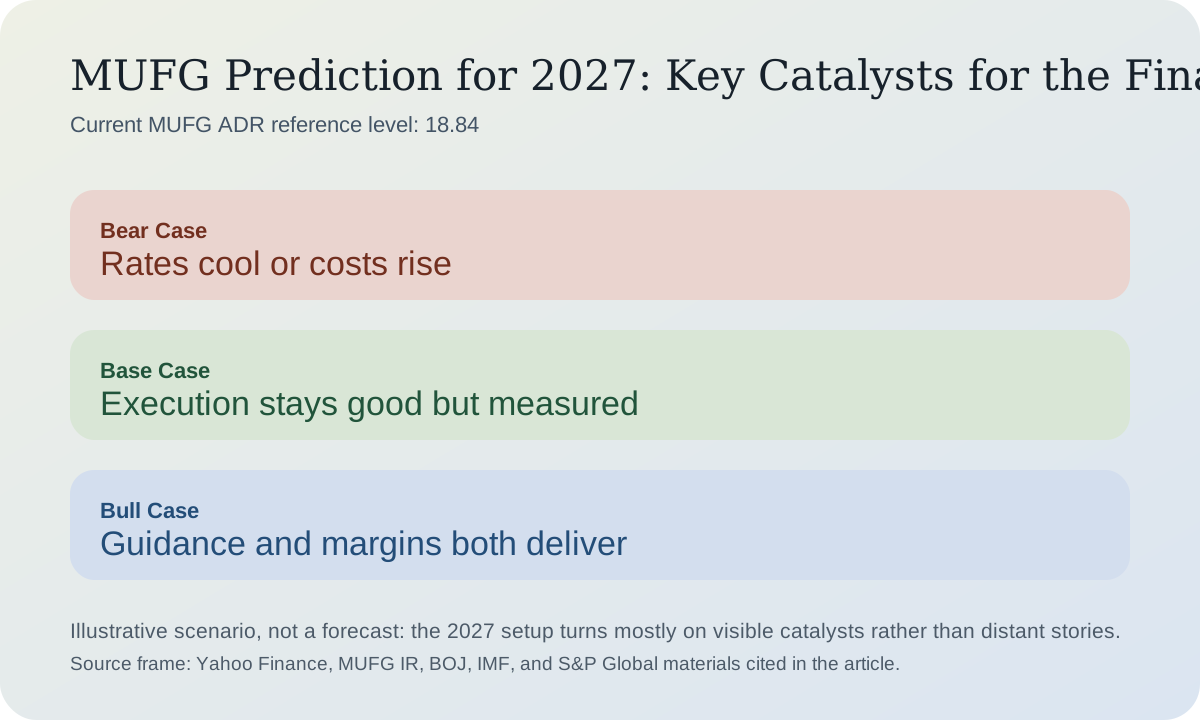
The bull case is $23 to $27 by 2027. That likely requires another leg of BOJ normalization or at least a stable positive-rate backdrop, continued buybacks, and earnings landing near or above current management ambition.
Bearish scenario
The bear case is $15 to $19. That likely happens if rates stall, credit costs rise, or investors conclude the earnings uplift was mostly cyclical.
Base-case scenario
The base case is $19 to $23. It assumes MUFG keeps compounding from a higher earnings base, but with more moderate upside than the most bullish macro enthusiasts expect.
Risks to watch
Watch BOJ meetings, loan-loss provisions, securities valuation swings, and whether the second half of FY2026 produces more buybacks.
What could invalidate the forecast
This framework is too cautious if margins and fee income both improve while investors rerate Japanese banks harder. It is too optimistic if the BOJ story cools before earnings quality fully resets.
Conclusion
MUFG's 2027 path is visible enough to analyze through catalysts rather than slogans. The stock can still move higher, but the next leg probably needs confirmation from profits, rates, and payouts all at once.
Disclaimer: This article is for research and informational purposes only. The scenario ranges below are conditional editorial estimates based on public information and cited sources.
| Scenario | Range | Conditions | Probability |
|---|---|---|---|
| Bull | $23-$27 | Margins, payouts, and sentiment all improve together | 30% |
| Base | $19-$23 | Steady execution with limited multiple expansion | 45% |
| Bear | $15-$19 | Rate support weakens or credit and market costs rise | 25% |
| Path | Estimated probability | Why |
|---|---|---|
| Higher by 2027 | 45% | Visible catalysts still lean constructive, especially if Japan stays in a higher-rate regime. |
| Lower by 2027 | 25% | A lower outcome needs several concerns to align at once. |
| Sideways | 30% | Plausible because much of the easy rerating has already happened. |
06. Investor Positioning
Position sizing should reflect starting point, time horizon, and macro tolerance
A 2027 MUFG trade should be treated as a catalyst-driven setup, which means entries and trims matter more than in a pure decade-long thesis.
| Investor type | Prudent approach | Why |
|---|---|---|
| Investor already in profit | Hold the core, but trim if Japanese bank exposure has become oversized after MUFG's long rerating. | That preserves gains while leaving room for BOJ upside if margins keep widening. |
| Investor currently at a loss | Re-check whether the original thesis was about dividends, rates, or broad value re-rating before averaging down. | Losses in bank stocks often come from wrong catalysts rather than wrong franchises. |
| Investor with no position | Build exposure in stages or wait for pullbacks instead of chasing strong sentiment. | Japanese bank stocks can reprice sharply around BOJ meetings, FX moves, and credit headlines. |
| Trader | Use stop-losses, focus on BOJ dates, JGB volatility, and earnings guidance, and avoid treating dividends as a short-term shield. | Near-term price action is still macro-driven. |
| Long-term investor | Favor dollar-cost averaging, periodic rebalancing, and disciplined review of ROE, CET1, and payout quality. | The long case depends on multi-year profitability, not one quarter of excitement. |
| Risk-hedging investor | Consider hedging market beta or rebalancing against cyclical financial exposure. | MUFG can be a hedge against rising Japanese rates, but not against every global risk shock. |
07. FAQ
Frequently asked questions about MUFG into 2027
What is the biggest 2027 catalyst for MUFG?
The biggest catalyst is whether BOJ normalization keeps lifting domestic margins while MUFG converts that into higher profits and payouts.
Why is the 2027 range narrower than the 2030 or 2035 range?
Because more of the relevant evidence is already visible in guidance, consensus estimates, and near-term macro policy.
Does MUFG need another buyback to support the stock?
Not necessarily, but additional repurchases would likely strengthen confidence that management still sees excess capital and durable earnings power.
References
Sources
- Yahoo Finance chart API for MUFG, 10-year monthly history
- Yahoo Finance chart API for MUFG, recent daily closes
- MUFG Financial Highlights under Japanese GAAP for the fiscal year ended March 31, 2026
- MUFG Consolidated Summary Report under Japanese GAAP for the fiscal year ended March 31, 2026
- MUFG investor relations homepage
- MUFG Report 2025 integrated report
- Bank of Japan Statement on Monetary Policy, April 28, 2026
- Bank of Japan Financial System Report, April 2026
- IMF staff concluding statement for the 2026 Article IV mission to Japan
- S&P Global Market Intelligence on Japan megabank earnings expectations, May 2026
- S&P Global Market Intelligence on Japanese lender margin outlook, January 2026