01. Quick Answer
The most reasonable N225 2030 forecast is constructive, but the easy rerating phase already happened
The Nikkei 225 closed at 61,409.29 on 2026-05-15, up from 15,575.92 on 2016-05-31 in the 10-year monthly Yahoo Finance series, which works out to a price-only CAGR of about 14.78% (Yahoo Finance 10-year history; recent daily closes). That is an exceptional run for a mature developed-market benchmark, and it means the 2030 debate is no longer about whether Japan can simply escape deflation. It is about how much of that macro regime shift has already been capitalized into the index.
Available data suggests the long-run case for Japanese equities still has substance. The Nikkei 225 guidebook reminds investors that the index is a price-weighted basket of 225 Tokyo Stock Exchange Prime names, so leadership in a handful of expensive stocks matters more than many global investors assume. At the same time, OECD, IMF, and the Bank of Japan all describe a Japan that is closer to a normal inflation and wage environment than at any point in decades. That supports upside, but it also argues for scenario ranges rather than false precision.
| Point | Why it matters |
|---|---|
| Japan has already rerated hard | A 10-year CAGR near 14.78% leaves less room for simple multiple expansion. |
| The Nikkei is not TOPIX | Its price-weighted construction amplifies the effect of high-priced winners such as Fast Retailing and semiconductor names. |
| Macro normalization is supportive but incomplete | Wages, inflation, and rates are all moving away from the old regime, yet Japan still faces debt, energy, and demographic constraints. |
| 2030 should be framed as scenarios | The evidence is mixed enough that a range is more defensible than a single target. |
02. Historical Context
The historical backdrop is strong, but it also warns against straight-line extrapolation
Measured only on price, the N225 moved from 15,575.92 in late May 2016 to 61,409.29 on 2026-05-15, with the 10-year observed range stretching from 15,575.92 to 61,409.29 in the same Yahoo series (Yahoo Finance chart API for ^N225, 10-year monthly history). A market that has already quadrupled does not need to crash to disappoint; it can simply compound more slowly.
Index design matters here. The Nikkei factsheet and guidebook show that the Nikkei 225 is price weighted, reviewed for liquidity and sector balance, and recalculated continuously while the market is open. That creates a different behavior pattern than capitalization-weighted benchmarks. Fast Retailing, Tokyo Electron, Advantest, SoftBank Group, and other high-priced constituents can influence the headline benchmark out of proportion to their economic footprint.
Historical context also supports caution on valuation. Tokyo Stock Exchange reforms aimed at capital efficiency helped re-rate corporate Japan, while yen weakness boosted exporters and overseas earnings translation. Those were real tailwinds, but investors should ask whether the next four years can repeat the same combination without interruption.
| Metric | Latest reading | Why it matters |
|---|---|---|
| Current index level | 61,409.29 | Anchors the forecast to the latest available close rather than a prior cycle high. |
| 52-week range | 36,855.83 to 63,799.32 | Shows that the benchmark is already trading close to the top of its recent range. |
| 10-year start point | 15,575.92 | Helps prevent unrealistic long-run compounding assumptions. |
| Editorial base range | 68,000-78,000 | Assumes slower gains than the last decade but continued earnings growth and governance progress. |
| Feature | Implication | Forecast effect |
|---|---|---|
| Price-weighted methodology | High-priced leaders distort benchmark behavior | Concentration risk is higher than many broad-Japan narratives imply. |
| Wage and inflation normalization | Domestic demand can improve, but margins may also face labor cost pressure | Supports banks and domestic cyclicals more than the old deflation regime did. |
| Governance reform | Buybacks, balance-sheet discipline, and shareholder focus remain live themes | Can still support rerating, but less dramatically than in the first wave. |
| Semiconductor exposure | AI and chip capital expenditure increasingly matter for the index | Makes the Nikkei more sensitive to global technology cycles. |
03. Main Drivers
Six forces are most likely to shape the Tokyo market into 2030
1. Bank of Japan normalization without over-tightening. The most important macro issue is not whether rates are high by global standards, but whether they keep rising without breaking equity multiples. BOJ outlook reports and the March 2026 Tankan suggest the economy is still expanding, with inflation closer to target and wages firmer than in the old zero-inflation era. A gentle normalization path helps banks and financials, but a policy mistake could hit duration-sensitive growth names.
2. Wage growth and domestic demand. The IMF argues that stronger real wage growth should support private consumption, while the OECD still expects growth to slow rather than boom. That mix is constructive for retailers and domestic cyclicals, but it does not justify a euphoric demand story.
3. Corporate governance and capital efficiency. Tokyo Stock Exchange pressure around cost of capital and stock price remains one of the cleanest structural reasons to stay constructive on Japan (TSE action document; 2026 governance code revisions). The governance story is no longer new, but it is still altering payout policy, cross-shareholding behavior, and management communication.
4. Semiconductor and test-equipment demand. The N225 has more AI and semiconductor leverage than many older Japan narratives recognized. Advantest explicitly said AI-related investment drove a firm global environment in fiscal 2026, while Tokyo Electron continues to frame itself around advanced semiconductor equipment demand. If the AI cycle stays healthy, the Nikkei keeps a genuine structural growth engine.
5. Yen direction and export translation. A moderate yen is still helpful for exporters, but the relationship is not one-dimensional. The IMF 2026 mission statement notes that the yen-dollar relationship had decoupled from rate differentials since mid-2025. That matters because the market cannot rely on a simplistic weak-yen trade forever.
6. Energy security and imported inflation. Japan remains highly exposed to imported energy costs. The OECD explicitly tied its 2026 slowdown call to higher energy prices and Middle East uncertainty. That does not kill the long-run thesis, but it means any 2030 forecast must leave room for external shocks.
04. Institutional Forecasts and Analyst Views
Institutions remain constructive on Japan, but few credible sources argue for a one-way market
The institutional backdrop is supportive rather than reckless. Invesco highlighted wage growth, domestic demand, and corporate governance as key reasons Japanese equities can remain attractive in 2026. Goldman Sachs Research described Japan's fundamentals as steady but flagged policy risks. UBS kept Japan rated Attractive in its house view, but even there the framework is scenario-based, not unconditional.
Official macro institutions are somewhat more restrained. OECD expects GDP growth to slow from 1.2% in 2025 to 0.7% in 2026 and 0.9% in 2027, while the IMF describes potential growth closer to 0.5% over the long run. That gap between moderate macro growth and stronger equity performance is not a contradiction; it is the essence of the Japan bull argument. Corporate governance, balance-sheet repair, and sector leadership can let equities outgrow GDP. But it also means that if governance momentum stalls, the equity story gets thinner quickly.
Analysts remain divided on how much upside is already priced in. Available data suggests the best institutional case for the Nikkei is a continued premium for capital-discipline reform plus sustained AI-linked earnings growth. The weak case is that macro growth stays only moderate while valuations in the most influential stocks remain full.
| Source | What it says | Implication for the Nikkei |
|---|---|---|
| OECD | Japan is growing, but forecasts still point to a modest macro pace | Supports a constructive but not explosive base case. |
| IMF | Inflation normalization is real, yet public debt and demographics remain constraints | Argues for upside with risk premia, not a straight line higher. |
| Goldman Sachs / UBS / Invesco | Japan remains attractive because of reform, earnings breadth, and foreign-investor relevance | Institutional bulls are focused on structure, not only cyclical momentum. |
| JPX and TSE reforms | Governance and disclosure changes are still progressing | Provides a fundamental case for rerating even if GDP growth stays ordinary. |
05. Scenarios, Risks, and Invalidation
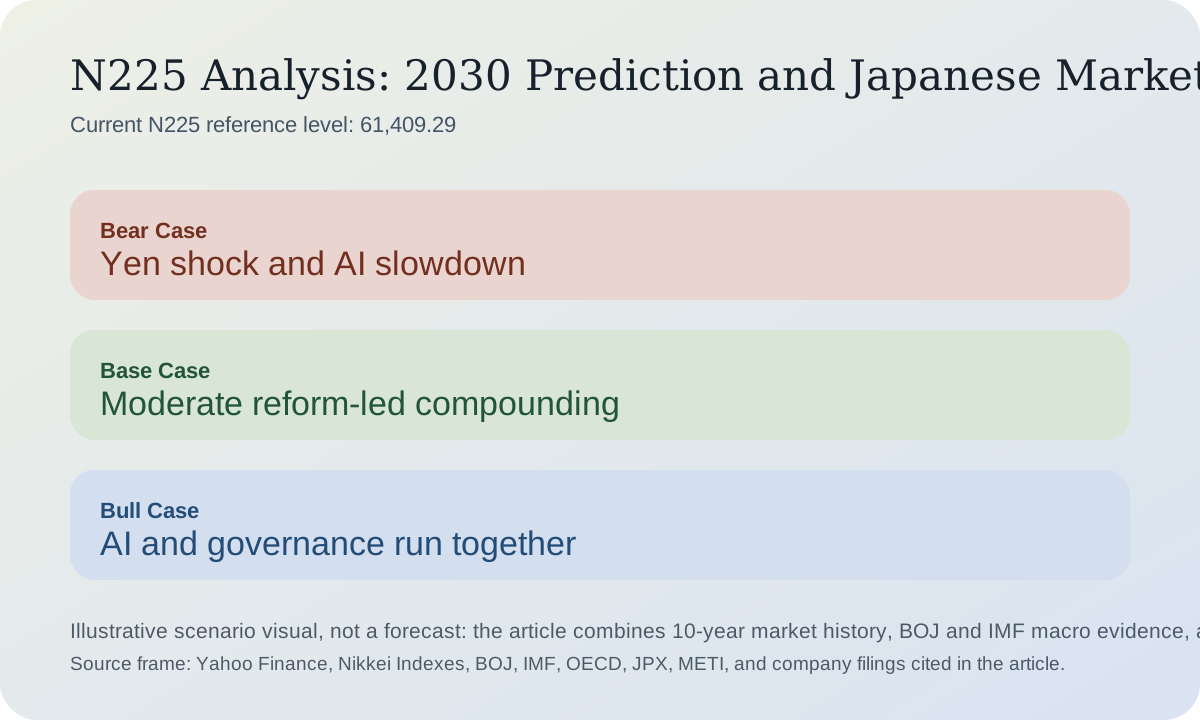
Bull, bear, and base cases are more useful than pretending 2030 can be forecast to the point
Bullish scenario
The bull case is roughly 85,000 to 95,000 by 2030. This scenario depends heavily on AI-related semiconductor demand remaining durable, BOJ normalization staying orderly, governance reform continuing to unlock buybacks and better returns on capital, and foreign investors continuing to treat Japan as a rare non-US reform market.
Bearish scenario
The bear case is 45,000 to 55,000. That path would likely require a sharper yen, a policy or energy shock, global semiconductor weakness, and a market decision that the first wave of governance rerating is largely complete.
Base-case scenario
The base case is 68,000 to 78,000. That assumes earnings continue to rise, but at a slower pace than in the last decade; governance continues to help valuation support; and Japan avoids a major macro accident.
Risks to watch
Watch BOJ communication, wage settlements, yen volatility, imported energy costs, AI-capex guidance at semiconductor suppliers, and whether TSE reform pressure still translates into better capital allocation.
What could invalidate the forecast
This range would prove too optimistic if Japan slips back into weak domestic demand while global technology leadership narrows sharply. It would prove too conservative if governance reform broadens beyond large caps and if AI demand lifts a wider set of industrial, testing, automation, and telecom names than the market currently assumes.
Conclusion
The most credible N225 2030 outlook is constructive, but not careless. Japan still has reform momentum, strong balance sheets, and better sector leadership than many developed peers. What it does not have is room for lazy extrapolation after such a strong decade.
Disclaimer: This article is for research and informational purposes only. Scenario ranges and probabilities are editorial judgments based on public data and cited sources, not guarantees or personalized investment advice.
| Scenario | Range | Key conditions | Probability |
|---|---|---|---|
| Bull | 85,000-95,000 | AI-capex strength, reform continuity, and orderly rate normalization | 25% |
| Base | 68,000-78,000 | Moderate compounding with some multiple support | 50% |
| Bear | 45,000-55,000 | Yen shock, energy pressure, and global growth disappointment | 25% |
| Path | Estimated probability | Why |
|---|---|---|
| Rising from current levels by 2030 | 50% | Japan still has reform, earnings, and AI-linked leadership on its side. |
| Falling below current levels by 2030 | 20% | A lower 2030 level likely needs both domestic policy friction and global tech weakness. |
| Moving broadly sideways | 30% | Valuation digestion could offset further earnings growth after a very strong decade. |
06. Investor Positioning
Different investor profiles should approach the Nikkei differently into 2030
| Investor type | Cautious approach | What to watch |
|---|---|---|
| Investor already in profit | Hold core exposure but trim if the position has become a narrow bet on a few high-priced winners. | Rebalance if semiconductor or retail concentration has grown too far. |
| Investor currently at a loss | Separate timing pain from thesis quality before averaging down. | Check whether the original thesis depended only on yen weakness or AI momentum. |
| Investor with no position | Stage entries or wait for pullbacks instead of chasing a mature rally. | BOJ meetings, earnings revisions, and yen volatility can create better setups. |
| Trader | Use stop-losses and avoid confusing headline strength with broad market breadth. | Policy headlines and moves in key index heavyweights can swing the benchmark fast. |
| Long-term investor | Dollar-cost averaging and periodic rebalancing are more defensible than all-in timing calls. | Governance progress, payout discipline, and earnings breadth matter more than daily index noise. |
| Risk-hedging investor | Use hedges or partial overlays if yen, energy, or global tech shocks would disrupt the portfolio. | Imported inflation and global semiconductor cycles remain the main external risk channels. |
07. FAQ
Frequently asked questions about the N225 outlook
Why use a range instead of one Nikkei 225 target for 2030?
Because the index is price weighted, globally exposed, and unusually sensitive to a handful of high-priced leaders. A scenario range is more credible than false precision.
Does the Nikkei always move with a weaker yen?
No. A weaker yen can help exporters and overseas earnings translation, but policy credibility, imported inflation, and the global technology cycle matter too.
What matters most right now for the Nikkei?
BOJ normalization, AI-related semiconductor demand, governance reform follow-through, and whether domestic wage growth can support consumption without crushing margins.
References
Sources
- Yahoo Finance chart API for ^N225, 10-year monthly history
- Yahoo Finance chart API for ^N225, recent daily closes
- Nikkei Stock Average factsheet
- Nikkei Stock Average guidebook, July 2025 edition
- Bank of Japan Outlook for Economic Activity and Prices, April 2026
- Bank of Japan Tankan, March 2026 survey
- IMF 2025 Article IV consultation with Japan
- IMF 2026 staff concluding statement for Japan
- OECD economic snapshot for Japan
- OECD Economic Survey of Japan press release, May 13 2026
- TSE draft revisions to the Corporate Governance Code, April 10 2026
- TSE action to implement management conscious of cost of capital and stock price
- Invesco 2026 investment outlook for Japan equities
- Goldman Sachs Japan Economic Outlook 2026
- UBS House View with Japan rated Attractive
- Advantest financial review for fiscal year ended March 2026
- Tokyo Electron investor relations and FY2026 earnings release