01. Quick Answer
The most defensible 2030 IXIC outlook is bullish on earnings, cautious on valuation
The short answer is that the Nasdaq Composite still has a credible path materially higher by 2030, but that path depends much more on earnings breadth than on another wave of multiple expansion. Nasdaq's own March 31, 2026 factsheet showed the index had 3,350 constituents and a 60.61% technology weight, while the top 10 names accounted for roughly 58% of index weight when the largest constituents are summed from the same document (Nasdaq factsheet, March 31, 2026). That concentration makes the index powerful in strong innovation cycles and vulnerable when the market questions capex discipline or AI monetization.
Current market conditions support both the bull and bear arguments. Nasdaq's official overview page showed the index at 26,247.08 on May 8, 2026, while the latest official factsheet showed a 24.81% trailing 12-month total return and a -7.11% first quarter of 2026 return. In plain English, IXIC remains near record territory, but recent volatility already shows how quickly leadership-heavy benchmarks can reprice when investors worry about crowded positioning, tariffs, supply chains, or the timing of AI payoffs.
| Issue | Evidence-based read | Why it matters |
|---|---|---|
| Historical data | Nasdaq has produced superior long-run returns, but often through concentrated surges and large drawdowns | A strong secular trend does not remove cyclical or valuation risk |
| Current market conditions | Earnings remain strong, but tech concentration and capex expectations are already high | 2030 upside increasingly depends on delivery, not just story flow |
| Institutional forecasts | Large-cap U.S. equity assumptions remain constructive, but strategists are not uniformly comfortable with extrapolation | The evidence is supportive, not unconditional |
| Best framework | Use scenarios and ranges rather than one heroic target | AI, rates, regulation, and competition can all materially alter the path |
02. Historical Context
Nasdaq's long-term record is strong, but the path has never been smooth
The Nasdaq Composite was launched in 1971 and has always behaved differently from broad large-cap benchmarks because of its heavier technology, communications, and consumer-discretionary tilt (Nasdaq methodology guide). That distinction is not cosmetic. When innovation, liquidity, and earnings momentum align, IXIC can outperform dramatically. When the market questions the sustainability of growth, the same concentration becomes a weakness. The dot-com bust remains the obvious historical reference, but the more practical lesson is broader: tech-heavy indices can remain structurally advantaged and still suffer long periods of repricing.
Nasdaq's March 31, 2026 factsheet showed technology at 60.61% of index weight and consumer discretionary at 19.12%. That is why comparisons to the S&P 500 only go so far. IXIC is not just "more growth." It is a benchmark whose future returns are disproportionately shaped by semiconductors, hyperscalers, digital advertising, e-commerce, software, and AI infrastructure. For a 2030 forecast, the key question is whether those industries broaden their profit contribution or simply become more crowded.
| Metric | Latest reading | Interpretation |
|---|---|---|
| IXIC level | 26,247.08 on May 8, 2026 | Official level remains near record highs |
| 1-year total return | 24.81% | Momentum is still powerful on a trailing basis |
| Q1 2026 total return | -7.11% | Short-term repricing risk is still very real |
| Technology weight | 60.61% | Tech remains the dominant sector and the dominant risk |
Available data suggests the long-term Nasdaq case is still credible because the index can refresh leadership over time. But the evidence is mixed on how much of the next decade's growth is already reflected in the largest names. That is why 2030 should be framed as a range built from earnings and valuation assumptions, not from a straight-line extension of the last cycle.
03. Main Drivers
Five forces are likely to drive the tech-heavy index through 2030
1. AI capex must become broad monetization
Goldman Sachs argued that AI companies may invest more than $500 billion in 2026, and S&P Global's hyperscaler research showed consensus still expects heavy spending despite near-term margin pressure (Goldman Sachs, December 2025; S&P Global, March 2026). For Nasdaq, the bullish case is obvious if those outlays create durable demand for cloud, software, chips, networking, and services. The bearish case is equally obvious if spending outruns realized returns.
2. Supply chains and power infrastructure still matter
S&P Global's electronics supply-chain and data-center research both underline a point that many equity narratives miss: the AI trade depends on components, logistics, cooling, and electricity, not just model announcements. If bottlenecks ease, Nasdaq earnings breadth improves. If bottlenecks persist, the index can remain profitable but more volatile.
3. Concentration can help and hurt at the same time
Summing the top 10 weights in Nasdaq's official factsheet produces a figure of roughly 58%, showing just how heavily IXIC depends on its biggest franchises. That concentration is a source of strength when those firms keep compounding. It is also a structural risk because even modest disappointments in a handful of names can matter disproportionately.
4. Rates and valuation are still part of the story
Vanguard's 2026 outlook warned that AI can create economic upside and stock-market downside at the same time, especially if valuation gets too far ahead of deliverable cash flows (Vanguard, 2026 outlook). That warning is especially relevant for Nasdaq because long-duration growth exposure is more sensitive to discount-rate conditions than many other equity styles.
5. Competition and regulation can cap enthusiasm
Even when the secular case stays intact, regulators, antitrust disputes, export controls, and global competition can reduce how much of the economic value accrues to public shareholders. For IXIC through 2030, that means the difference between a healthy base case and an extreme bull case may come down to who captures AI economics and how defensible those economics prove to be.
04. Institutional Forecasts and Analyst Views
Institutions support a constructive large-cap outlook, but not a one-way tech market
J.P. Morgan Asset Management's 2026 Long-Term Capital Market Assumptions kept expected U.S. large-cap equity returns at 6.7% over 10 to 15 years. BlackRock's 2026 capital-market and outlook work remained constructive on U.S. equities, partly because AI could help profit margins over time. Vanguard was more careful, stressing that U.S. equities still looked above fair value and that future returns could be more muted than investors have grown used to. None of those sources publish a clean Nasdaq Composite 2030 target, which is why the most responsible approach is to convert their assumptions into scenario ranges instead of inventing a false consensus.
| Source | View | Implication for IXIC |
|---|---|---|
| J.P. Morgan AM | 6.7% long-run U.S. large-cap return assumption | Supports constructive, but not euphoric, compounding |
| BlackRock | AI can support profit margins and U.S. return leadership | Favors the bull or high-base scenario if earnings broaden |
| Vanguard | Valuation remains a restraint even when growth is healthy | Warns against assuming another uninterrupted multiple re-rating |
| Goldman Sachs / S&P Global | AI capex remains large, but monetization quality matters | Tech upside depends on whether capex turns into durable cash flow |
The evidence is mixed, but directionally constructive. That is enough to justify a bullish long-horizon bias. It is not enough to justify ignoring valuation, competition, or the possibility of repeated drawdowns along the way.
05. Bull, Bear, and Base Case
How the 2030 Nasdaq range is built
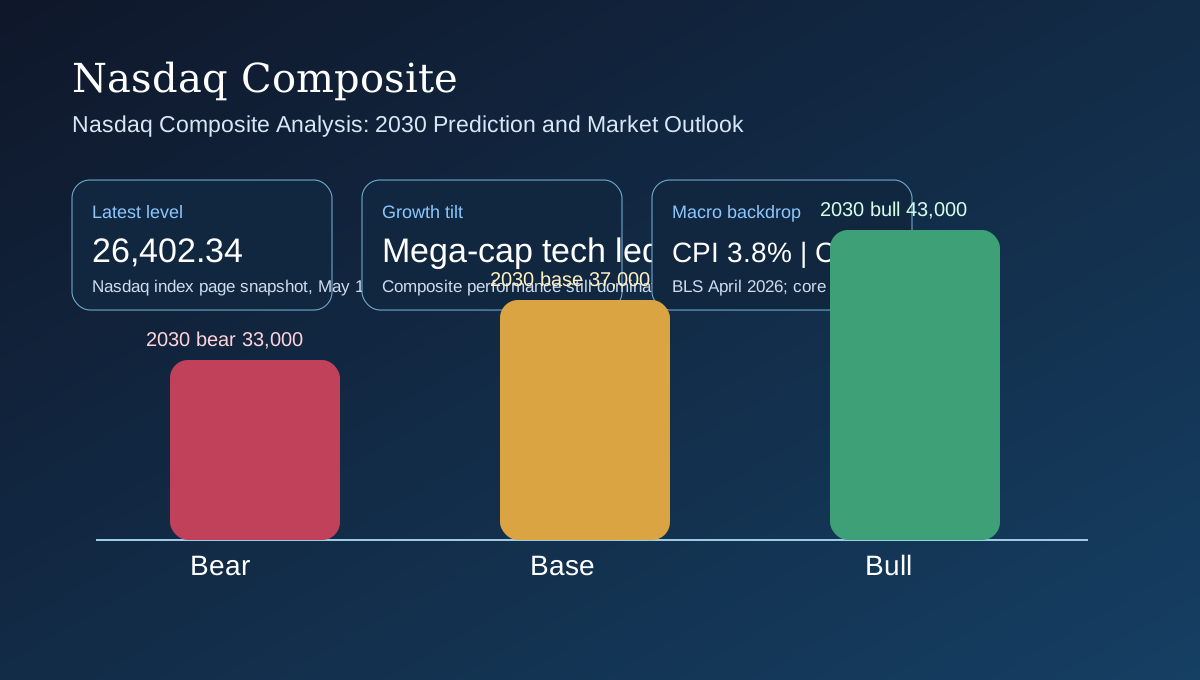
The scenario ranges below are editorial judgments built from Nasdaq's current level, its concentration profile, the pace of AI capex, and long-term return assumptions from major institutions. The bull case assumes AI productivity broadens and the largest growth franchises keep defending high margins. The base case assumes earnings keep compounding but valuation expands little from here. The bear case assumes capex fatigue, multiple compression, or more aggressive competition in core profit pools.
| Scenario | 2030 range | Conditions required | Probability |
|---|---|---|---|
| Bull | 34,000-39,000 | AI spending translates into broad earnings power, supply constraints ease, and leading firms keep premium valuations | 25% |
| Base | 29,000-34,000 | Earnings remain strong, but multiple expansion is limited and leadership stays concentrated | 50% |
| Bear | 22,000-29,000 | Capex runs ahead of payoff, real rates remain restrictive, or regulation and competition pressure margins | 25% |
| Direction | Probability | Comment |
|---|---|---|
| Higher by 2030 | 60% | Most likely if earnings growth continues to outrun valuation drag |
| Lower by 2030 | 15% | Would likely require repeated multiple compression or a serious capex disappointment |
| Sideways but volatile | 25% | Plausible if the secular trend remains intact but valuation keeps oscillating |
These probabilities are not machine-generated. They are editorial estimates based on institutional assumptions, official index composition, and the current macro and AI investment cycle. That matters because the true risk to Nasdaq is not that technology stops mattering. It is that the market may already be discounting too much too soon.
06. Investor Positioning
How different investor groups can think about a tech-heavy benchmark
| Investor type | Prudent approach | Main watchpoints |
|---|---|---|
| Investor already in profit | Hold core exposure, but trim if the largest AI names have become disproportionate to risk tolerance | Top-weight concentration and earnings guidance |
| Investor currently at a loss | Reassess whether the thesis was broad tech leadership or short-term momentum chasing | Capex quality and estimate revisions |
| Investor with no position | Stage entries and avoid chasing vertical rallies | Valuation, breadth, and policy headlines |
| Trader | Use stop-losses and respect event risk around mega-cap earnings | Options pricing, guidance, and rates |
| Long-term investor | Use diversified exposure and rebalance as winners rotate | Whether AI broadens beyond infrastructure |
| Risk-hedging investor | Hedge selectively if valuation runs ahead of cash-flow evidence | Real yields, antitrust risk, and supply constraints |
What could invalidate this forecast? A much larger-than-expected wave of AI productivity could push the range higher, while persistent real-rate pressure, weaker monetization, or harsher regulation could push it lower. The point is not that one outcome is certain. It is that the most defensible Nasdaq outlook is conditional on delivery. Conclusion: IXIC can still be one of the strongest major U.S. benchmarks through 2030, but only if earnings keep proving that concentrated tech leadership is deserved rather than merely popular.
Disclaimer: This article is for informational and research purposes only and does not constitute investment advice.
07. FAQ
Frequently asked questions
Is Nasdaq 2030 mainly an AI forecast?
Not entirely. AI is the dominant narrative, but the actual forecast also depends on rates, competition, regulation, supply chains, and how broad the earnings base becomes.
Why is concentration so important for IXIC?
Because the largest companies carry so much weight that their execution matters disproportionately for index-level outcomes.
What is the main bear-case risk?
The main risk is that capex and valuation stay elevated while monetization broadens more slowly than investors expect.
What is the strongest bullish signal?
Evidence that AI-related gains are spreading into more software, semiconductor, hardware, and service categories rather than remaining narrow.
References
Sources
- Nasdaq, Nasdaq Composite overview
- Nasdaq Indexes, COMP overview page
- Nasdaq, Nasdaq Composite factsheet, March 31, 2026
- Nasdaq, Index Methodology Guide
- FactSet, Earnings Insight, May 8, 2026
- Goldman Sachs, Why AI Companies May Invest More than $500 Billion in 2026
- Goldman Sachs, What to Expect From AI in 2026
- S&P Global Market Intelligence, Sell-side signals: short-term pain, long-term gain for top US hyperscalers
- S&P Global Market Intelligence, Electronics Supply Chain Outlook
- S&P Global Market Intelligence, Answering 3 key questions about data centers for generative AI
- Vanguard, 2026 outlook: Economic upside, stock market downside
- Vanguard, The fading U.S. small-cap premium
- BlackRock, Investment Directions, Spring 2026
- J.P. Morgan AM, 2026 Long-Term Capital Market Assumptions