01. Quick Answer
2027 is likely to be a year of dispersion, not a simple continuation trade
The short answer is that Nasdaq still has a credible 2027 upside path, but the benchmark is likely to remain far more path-dependent than the strongest bull narratives imply. The index is still dominated by a relatively small set of mega-cap technology leaders, and those leaders are simultaneously benefiting from AI enthusiasm and carrying the burden of very high expectations (Nasdaq factsheet, March 31, 2026).
That is why 2027 should be framed through risks and growth scenarios rather than through one clean target. Available data suggests earnings momentum remains healthy, but the evidence is mixed on whether broad technology monetization will keep pace with capex, tariffs, regulation, and valuation pressure.
| Issue | Current read | Why it matters |
|---|---|---|
| Current market snapshot | Strong trailing returns, but a negative Q1 2026 reminder that repricing risk is alive | Nasdaq can stay structurally strong while remaining tactically fragile |
| Main upside driver | Broader AI-linked earnings growth | Reduces dependence on a narrow cluster of winners |
| Main downside driver | Multiple compression and capex fatigue | High expectations amplify disappointment risk |
| Best framework | Distinguish correction, bear market, and crash | Not every tech drawdown deserves the same label |
02. Historical Risk Context
A 2027 Nasdaq call needs a correction-versus-bear-market framework
Investors often blur together three different outcomes: correction, bear market, and crash. That is a mistake, especially for a benchmark like Nasdaq. A correction is a meaningful but normal repricing that can happen even when the secular growth story stays intact. A bear market usually implies deeper and more durable earnings or valuation damage. A crash suggests disorderly and abrupt downside, usually tied to systemic stress rather than simply expensive technology stocks.
Available data does not force a crash thesis for 2027. What it does support is a live debate between an earnings-led advance and a choppy, valuation-sensitive market where even strong companies can suffer repeated resets. That is consistent with Nasdaq's historical pattern: secular growth can remain real while tactical timing stays difficult.
| Regime | Typical driver | What it would mean for IXIC |
|---|---|---|
| Correction | Valuation reset or guidance disappointment | Likely and manageable if earnings power remains intact |
| Bear market | Sustained multiple compression and weaker tech profits | Would require more than a single quarter of noise |
| Crash | Systemic shock or disorderly deleveraging | Possible, but not the base-case risk supported by current evidence |
03. Risks and Catalysts
Five variables will likely determine Nasdaq's 2027 direction
1. Earnings breadth inside tech
If software, semiconductors, cloud, hardware, and digital-platform earnings all keep improving, 2027 can absorb valuation concerns. If leadership narrows further, risk rises.
2. AI monetization versus AI spending
Goldman and S&P Global both imply that investors are increasingly separating high-quality capex from spending that has weaker visibility. That distinction will likely matter even more by 2027.
3. Rates and long-duration equity sensitivity
Nasdaq remains more rate-sensitive than many value-heavy indices, so a restrictive real-rate environment could limit upside even if earnings stay decent.
4. Geopolitics and supply chains
Export controls, tariffs, and semiconductor supply-chain stress can alter margins and revenue expectations quickly, especially in the hardware and chip ecosystem.
5. Competition and regulation
Large technology firms can remain dominant and still see their economics pressured by competition, legal action, or pricing normalization.
04. Institutional Forecasts and Analyst Views
Institutional assumptions support growth, but not complacency
J.P. Morgan, BlackRock, and Vanguard do not publish a standardized 2027 Nasdaq target, but their frameworks still help. BlackRock remains constructive on U.S. assets and AI-linked margin support, Vanguard remains more careful on valuation, and broader earnings research from FactSet confirms that the earnings backdrop can remain strong even when price action becomes unstable. That combination supports a positive but conditional 2027 outlook.
| Source | Message | 2027 implication |
|---|---|---|
| FactSet | Strong broad-market earnings momentum in 2026 | Supports upside if technology leaders keep converting capex into growth |
| BlackRock | Constructive on U.S. equities and AI margin support | Helps the bull and base cases |
| Vanguard | Valuation still matters materially | Supports caution on chasing after large rallies |
05. Bull, Bear, and Base Case
How the 2027 range is built
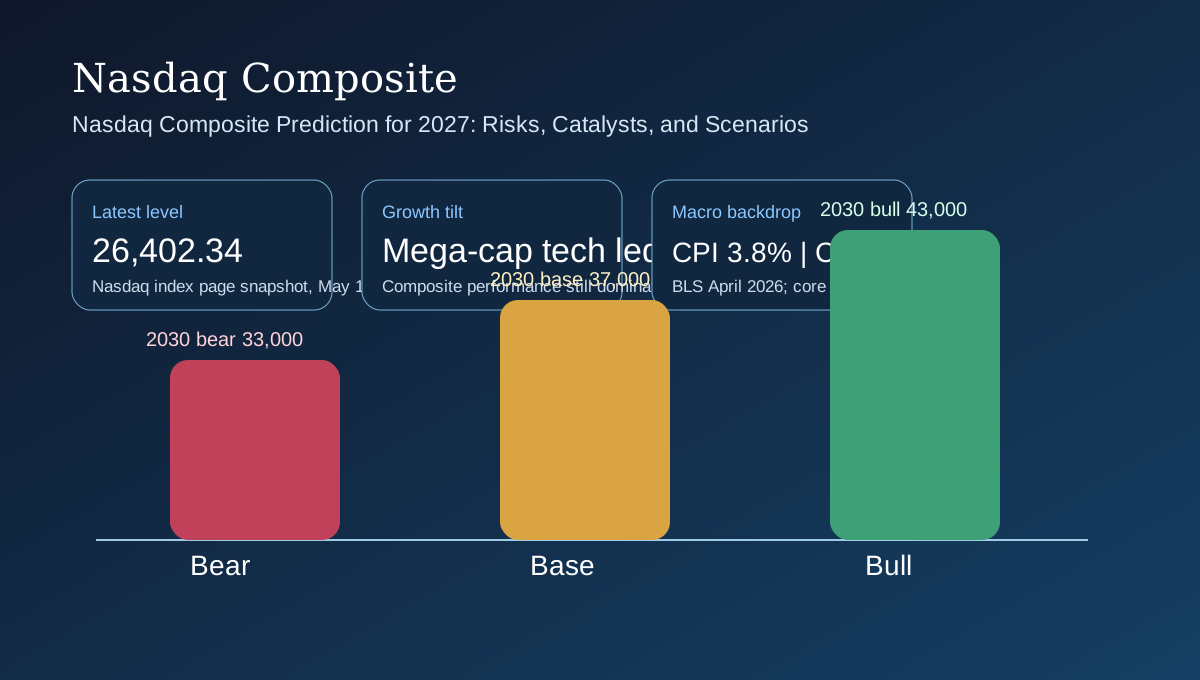
| Scenario | 2027 range | Conditions | Probability |
|---|---|---|---|
| Bull | 28,000-31,000 | AI monetization improves, rates stabilize, and earnings breadth broadens | 30% |
| Base | 24,500-28,000 | Strong but uneven earnings with periodic valuation resets | 45% |
| Bear | 20,000-24,500 | Valuation compresses and capex payoffs arrive more slowly than expected | 25% |
| Direction | Probability | Comment |
|---|---|---|
| Higher | 45% | Most likely if AI becomes a broader earnings story rather than only an infrastructure story |
| Lower | 20% | Would likely require deeper multiple compression or weaker growth |
| Sideways but volatile | 35% | Plausible if secular optimism coexists with repeated valuation resets |
These probabilities are editorial judgments built from current earnings, concentration, and institutional macro assumptions. They are not statistical certainties. The point is to explain why 2027 can be constructive without being simple.
06. Investor Positioning
Investor implications for a volatile growth benchmark
| Investor type | Prudent approach | Watchpoints |
|---|---|---|
| Investor already in profit | Hold core positions, but trim if risk concentration has grown too large | Breadth and top-weight exposure |
| Investor currently at a loss | Review whether the thesis was long-term tech exposure or short-term momentum | Revisions and capex quality |
| Investor with no position | Use staggered entries and avoid chasing emotionally | Rates and valuation |
| Trader | Respect stops and event risk | Earnings reactions and policy headlines |
| Long-term investor | Keep diversified exposure and rebalance as leadership changes | Whether profitability broadens |
| Risk-hedging investor | Use selective hedges if volatility rises faster than earnings certainty | Volatility and real yields |
What would invalidate this forecast? A stronger earnings cycle and faster AI diffusion would raise the upside odds, while higher-for-longer rates or more obvious capex fatigue would raise the downside odds. Conclusion: Nasdaq has a credible 2027 growth path, but it is likely to remain a benchmark where investors are paid for being right over time, not for assuming the path will be smooth.
Disclaimer: This article is for informational and research purposes only and does not constitute investment advice.
Methodology and Invalidation
How to interpret this Nasdaq framework and what would change it
A useful Nasdaq article should not be read as a promise that one exact index level will print on one exact date. It should be read as a scenario framework built from observable variables: concentration, earnings breadth, AI monetization quality, supply-chain and power constraints, discount rates, and regulation. That is why the ranges in this article are wider than the single-number targets often used in click-driven market commentary. Available data suggests the Nasdaq Composite still deserves a structural growth premium because it remains the public market home of many of the companies building, financing, or commercializing the AI and software stack. At the same time, the same official factsheet that supports that structural premium also shows a benchmark where the largest names carry unusual influence. That combination means the right question is rarely "Is Nasdaq good or bad?" The better question is whether the current mix of growth, concentration, and valuation is becoming healthier or more fragile.
That distinction matters for forecast ranges. A bullish Nasdaq outcome does not require every company in the index to win equally. It requires enough of the largest leaders to keep earning premium economics, and enough second-order beneficiaries to stop the benchmark from becoming too narrow. A bearish Nasdaq outcome does not require technology to stop mattering. It only requires investors to decide that margins, competition, or returns on AI capex are not quite as durable as currently priced. This is why probability tables in these articles are framed as editorial judgments, not machine precision. Real market paths are shaped by changing evidence. If software pricing power improves, hyperscaler spending finds revenue support, semiconductor bottlenecks ease, and rate pressure fades, the constructive path deserves a higher probability. If the opposite happens, the more cautious or bearish path deserves more weight even if the long-run technology story remains intact.
The benchmark's structure is the second reason point forecasts are not enough. A technology-heavy index with top-weight concentration near the levels shown in Nasdaq's official March 31, 2026 factsheet behaves differently from a more balanced or more value-oriented benchmark. It can rise faster when the largest franchises compound, but it can also punish investors faster when expectations reset. That is why breadth matters so much. Investors should not only watch whether the biggest names keep delivering. They should also watch whether AI-related profitability spreads to more software names, more service providers, more hardware and equipment suppliers, and more adjacent growth industries. The healthier the participation becomes, the healthier the long-run Nasdaq case becomes. If breadth keeps narrowing while valuation stays rich, then even a structurally attractive benchmark can produce frustrating real-world returns over intermediate horizons.
Investor positioning should also be matched to timeframe. A trader and a long-term allocator are not solving the same problem. A trader may care most about rates, earnings reactions, option positioning, and guidance revisions over weeks or months. A long-term investor should care more about whether the index is becoming more dependent on a tiny set of names, whether AI spending is being converted into free cash flow, and whether the next layer of beneficiaries is broadening the earnings base. Investors already in profit may rationally rebalance without abandoning the secular case. Investors with no position may reasonably scale in over time rather than chase after every surge. Risk-hedging investors should recognize that even a valid long-term innovation thesis can coexist with painful multiple compression or concentration-driven drawdowns along the way.
What would invalidate a constructive Nasdaq outlook most clearly? Several developments would matter. A sustained gap between capex and monetization would be one. A harsher rate regime that keeps pushing discount rates higher would be another. So would more meaningful competition, export controls, or regulation that weakens the economics of the largest listed beneficiaries. Conversely, what would invalidate a stronger bear case? Broader earnings participation, more visible productivity gains in software and services, and evidence that market leadership is widening rather than narrowing would all weaken the downside argument. This is the discipline investors should want from any market article. A thesis should be falsifiable. It should tell readers what evidence would make the author more constructive and what evidence would make the author less constructive.
The main practical takeaway is that Nasdaq remains one of the most important long-duration growth benchmarks in the world, but that status should make investors more analytical, not less. The benchmark is too influential to be reduced to slogans such as "AI wins everything" or "tech is in a bubble." Available data suggests both overconfidence and excessive pessimism can be expensive. The better approach is to monitor whether growth is broadening, whether valuation is being justified by cash-flow evidence, whether the competitive moat of the largest firms remains intact, and whether the macro regime is becoming more or less supportive of premium-growth assets. That is the lens through which the scenarios in these articles are built, and it is also the clearest way to decide whether the forecast range should be revised over time.
07. FAQ
Frequently asked questions
Could Nasdaq still rise in 2027 even after a correction?
Yes. A correction does not invalidate the secular tech thesis if earnings and cash-flow quality remain strong.
What is the biggest 2027 catalyst?
Broader AI-linked monetization across multiple subsectors would be the strongest catalyst.
What is the biggest downside risk?
Multiple compression tied to high rates or disappointing capex payback remains the clearest downside risk.
Why distinguish correction, bear market, and crash?
Because they imply very different levels of earnings damage, systemic stress, and investor response.
References
Sources
- Nasdaq, Nasdaq Composite overview
- Nasdaq Indexes, COMP overview page
- Nasdaq, Nasdaq Composite factsheet, March 31, 2026
- Nasdaq, Index Methodology Guide
- FactSet, Earnings Insight, May 8, 2026
- Goldman Sachs, Why AI Companies May Invest More than $500 Billion in 2026
- Goldman Sachs, What to Expect From AI in 2026
- S&P Global Market Intelligence, Sell-side signals: short-term pain, long-term gain for top US hyperscalers
- S&P Global Market Intelligence, Electronics Supply Chain Outlook
- S&P Global Market Intelligence, Answering 3 key questions about data centers for generative AI
- Vanguard, 2026 outlook: Economic upside, stock market downside
- Vanguard, The fading U.S. small-cap premium
- BlackRock, Investment Directions, Spring 2026
- J.P. Morgan AM, 2026 Long-Term Capital Market Assumptions