01. Quick Answer
A 2035 natural gas forecast should be wide by design because supply flexibility and demand durability are both unusually uncertain
NYMEX natural gas futures settled at about $3.04/MMBtu on May 18, 2026 on the Yahoo Finance chart API, NG=F 1-month daily data, while EIA's official monthly Henry Hub benchmark averaged $2.77/MMBtu in April 2026 according to the EIA, Short-Term Energy Outlook: Natural gas, May 12, 2026. That split matters. Futures reflect the market's latest expectations and risk premium, while the Henry Hub cash benchmark is the cleaner official anchor for medium-term scenario work.
For the 2030s, EIA's EIA, Annual Energy Outlook 2026 year-by-year data workbook shows a counterfactual baseline Henry Hub path of about $4.48/MMBtu in 2030 and $5.05/MMBtu in 2035 in real 2025 dollars, while the EIA, Annual Energy Outlook 2026 narrative PDF says prices remain between roughly $5 and $6/MMBtu through the early 2030s in most cases. Those are not guarantees, but they provide a useful institutional center of gravity for long-range scenario building.
The key difference between a 2030 and a 2035 view is that the latter depends less on weather and more on structural questions: how much LNG the world needs, how much U.S. supply can expand without destroying price, how much gas-fired generation AI and electrification still require, and how quickly policy or technology displace that demand.
| Category | Evidence-based read | Implication |
|---|---|---|
| Current market | Spot futures near $3 suggest no structural scarcity premium today. | The market is not pre-pricing a durable 2035 bull regime. |
| Official long-term baseline | EIA AEO 2026 centers the early 2030s around roughly $4.5-$5.0 in real terms. | Institutional modeling already implies a higher band than today's futures. |
| Bull-case trigger | Delayed LNG easing plus power-sector demand and supply discipline. | A high-single-digit 2035 outcome needs multiple structural supports, not just one. |
| Bear-case trigger | Cheap associated gas and faster efficiency or renewables adoption. | A soft long-run path is still plausible if abundance persists. |
02. Historical Context
The 2035 horizon has to respect both shale abundance and the 2022 scarcity shock
Long-range commodity forecasting often fails because analysts overfit the latest regime. In natural gas, that mistake is especially costly. The 2010s taught investors that shale innovation can crush price for years. The 2022 spike taught the opposite lesson: when LNG, geopolitics, and weather converge, U.S. gas can behave like a globally scarce fuel rather than a trapped regional commodity.
Over the last decade, the same benchmark has traded from a 10-year low near $1.43/MMBtu in June 2020 to a 10-year high near $10.03/MMBtu in August 2022 based on the Yahoo Finance chart API, NG=F 10-year monthly data. That range is why any serious natural gas forecast needs regimes and probabilities, not a single heroic target. The correct lesson for 2035 is not that either extreme will repeat exactly. It is that both abundance and scarcity remain credible. That is why bull, bear, and base cases are not optional formatting; they are the only intellectually honest way to present a 2035 price outlook.
| Marker | Approximate level | Interpretation |
|---|---|---|
| June 2020 low | $1.43/MMBtu | Pandemic-era demand destruction and oversupply showed how quickly gas can break when storage and weather turn against bulls. |
| August 2022 high | $10.03/MMBtu | The European energy crisis and LNG-linked scarcity proved that U.S. gas is no longer insulated from global stress. |
| March 2024 low close | $1.76/MMBtu | Warm weather, strong output, and ample inventories can still push the market back toward sub-$2 conditions. |
| January 2026 spike | $7.83 intramonth high | Short-term squeezes remain possible when winter weather, storage withdrawals, and export utilization line up. |
| May 18, 2026 close | $3.04/MMBtu | The latest tape sits near the middle of the long-run range, which is why scenarios matter more than momentum extrapolation. |
03. Main Drivers
The 2035 debate is really a debate about four structural balances
1. Global LNG demand versus global LNG capacity
The Shell LNG Outlook 2025 press release remains constructive on LNG demand through 2040, and the IEA, Gas Market Report Q2 2026 executive summary says the expected easing wave has already been delayed by at least two years. If demand continues to rise faster than reliable liquefaction capacity, Henry Hub can keep a higher floor.
2. Associated gas abundance versus capital discipline
The EIA, Short-Term Energy Outlook: Natural gas, May 12, 2026 shows how quickly oil-linked gas can soften the outlook. If oil-rich basins keep generating associated gas and pipeline bottlenecks ease, the supply response could remain strong enough to prevent a 2035 squeeze.
3. Power demand growth versus efficiency and policy substitution
The EIA press release, strongest four-year growth in U.S. electricity demand since 2000, fueled by data centers, January 13, 2026 and IEA, Energy and AI: Energy demand from AI both support stronger electricity demand, but the evidence is mixed on how much of that translates into incremental gas burn after grid upgrades, renewables, and storage scale. This is one of the biggest reasons analysts remain divided.
4. U.S. export policy versus domestic affordability
A tight 2035 domestic market could invite political pressure around export approvals or consumer costs. That risk is hard to quantify, but it is one reason long-dated bull cases should not be treated as linear extrapolations.
| Driver | What the latest evidence suggests | Why it matters for price |
|---|---|---|
| LNG exports | EIA expects U.S. LNG exports to rise from 15.1 Bcf/d in 2025 to 17.0 in 2026 and 18.2 in 2027. | Higher export capacity links Henry Hub more tightly to global gas balances. |
| Associated gas | May 2026 STEO assumes more oil-linked gas output from the Permian than earlier forecasts did. | If oil stays firm, gas supply can grow even without a gas-drilling boom. |
| Storage | EIA estimated March-end inventories at 1,908 Bcf, around 4% above the five-year average. | Storage direction affects whether winter risk premium can stick. |
| Global LNG security | IEA says Middle East disruption has delayed the LNG easing wave by at least two years. | International tightness can still pull U.S. gas prices higher through arbitrage and export utilization. |
| Power demand and AI | EIA and IEA both point to data centers as a meaningful electricity-demand driver through 2027 and beyond. | Natural gas remains one of the fastest scalable firm-power options in many U.S. regions. |
04. Institutional Forecasts and Analyst Views
Institutional guidance supports a higher 2035 midpoint than today's market, but not an automatic supercycle
The cleanest long-run institutional anchor remains the EIA, Annual Energy Outlook 2026 year-by-year data workbook, where Henry Hub is around $5.05/MMBtu in 2035 in the baseline. The EIA, Annual Energy Outlook 2026 narrative PDF also says prices stay in roughly the $5-$6 zone through the early 2030s in most cases. That is constructive, but still far from a guaranteed structural spike.
The IEA, Gas Market Report Q2 2026 executive summary is more useful for the bull case because it highlights how damage to Middle East LNG infrastructure and delays to supply additions can keep global balances tighter for longer. Meanwhile, the EIA, Domestic and international demand drive natural gas production growth, April 8, 2026 makes the long-run abundance case by projecting U.S. dry gas production growth across most modeled scenarios. Put together, the evidence suggests a broad middle around 5 dollars, a credible higher tail, and a still-plausible lower path if supply remains elastic.
| Source | 2035-relevant signal | Interpretation |
|---|---|---|
| EIA AEO 2026 | Henry Hub baseline near $5.05/MMBtu in 2035. | Base case should not start below the official long-run center without a clear reason. |
| EIA AEO narrative | Most cases keep Henry Hub in a $5-$6 band through the early 2030s. | Long-run official dispersion is meaningful but not extreme. |
| IEA Gas Market Report Q2 2026 | LNG easing delayed by at least two years. | Tighter global gas balances support upper-end outcomes. |
| Shell LNG Outlook | LNG demand can rise materially toward 2040. | Export demand remains a structural pillar of the bullish view. |
| World Bank and IMF | Macro growth remains vulnerable to shocks. | Demand-side disappointments still keep a bear path alive. |
05. Bull, Bear, and Base Case
A 2035 range is more useful than a point target
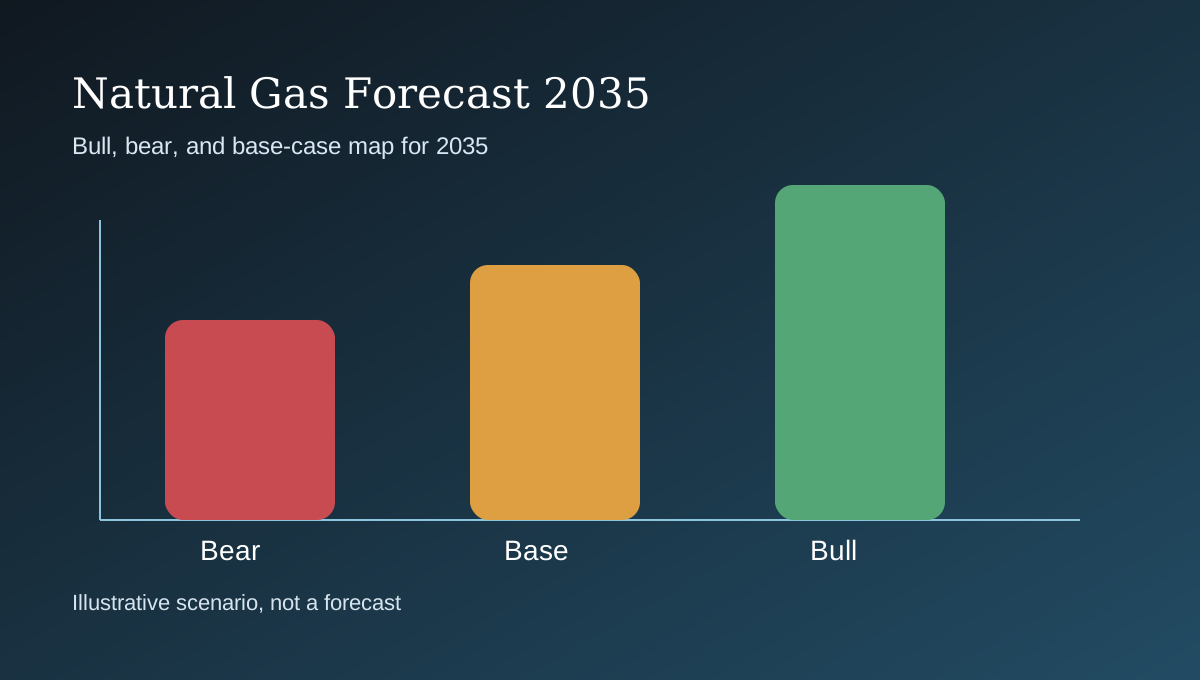
The 2035 framework below starts from EIA's long-run baseline and then widens around it using three questions: Will LNG demand outrun dependable new supply? Will associated gas keep U.S. supply loose? Will AI-era power demand make gas-fired generation more durable than many transition models expect?
| Scenario | Price range | Conditions | Probability |
|---|---|---|---|
| Bear | $2.75-$4.25/MMBtu | Associated gas stays abundant, LNG supply additions arrive broadly on time, efficiency and renewables limit gas burn. | 25% |
| Base | $4.75-$6.25/MMBtu | Exports stay strong, demand grows steadily, and supply expands but not enough to collapse price. | 45% |
| Bull | $6.50-$9.00/MMBtu | LNG remains structurally tight, weather volatility rises, AI-linked power demand sticks, and supply growth underdelivers. | 30% |
| Direction | Probability | Comment |
|---|---|---|
| Probability of rising from today's level | 60% | The long-term institutional baseline already sits above current futures. |
| Probability of falling from today's level | 15% | A lower-than-today 2035 outcome requires lasting oversupply and weak demand. |
| Probability of moving sideways around a mid-cycle band | 25% | Possible if abundance and demand growth offset each other. |
| Investor type | Prudent approach | Main watchpoints |
|---|---|---|
| Investor already in profit | Hold a core position if the thesis still depends on LNG growth or higher structural demand, but trim into sharp weather-driven spikes. | Watch whether rallies are backed by storage draws and export strength or only by short-covering. |
| Investor currently at a loss | Re-underwrite the thesis before averaging. A commodity can be right long term and still punish poor entries. | Separate structural LNG demand from short-term weather trades. |
| Investor with no position | Avoid chasing vertical moves. Wait for pullbacks, scale in gradually, or stay out when risk-reward is asymmetric. | Natural gas often offers better entries after volatility rather than during it. |
| Trader | Use stop-losses, respect seasonality, and follow storage, weather, production, and LNG feedgas daily. | Fast price moves can reverse before a macro thesis has time to play out. |
| Long-term investor | Dollar-cost averaging can work only with small sizing and a clear tolerance for drawdowns. | A cyclical energy asset should not be sized like a stable compounder. |
| Risk-hedging investor | Use natural gas as part of a broader inflation or energy-security hedge basket, then rebalance when the hedge becomes a crowded directional bet. | Gas can diversify some macro risks while creating weather and policy risk of its own. |
| Invalidation trigger | Why it matters | Likely effect |
|---|---|---|
| A decade of subpar LNG demand growth | Would weaken the export-led support case. | Base and bull ranges would move lower. |
| A sustained technology-driven productivity boom in gas supply | Would keep marginal supply cheap for longer. | Bear case probability would rise. |
| A much larger gas role in firming AI-related load than current planning suggests | Would strengthen structural demand. | Bull case probability would rise materially. |
The balanced reading is that 2035 natural gas probably settles above today's futures but below the most extreme scarcity narratives. Disclaimer: This article is for research and informational purposes only and does not constitute personalized financial advice.
06. FAQ
Frequently asked questions
What is a reasonable 2035 nat gas base case?
Roughly $4.75 to $6.25/MMBtu is a reasonable editorial base case because it aligns with EIA's long-run framework without assuming a supercycle.
Can natural gas still trade below 4 dollars in 2035?
Yes. That would likely require abundant associated gas, smoother LNG supply growth, and weaker-than-expected power-sector demand.
What does the extreme bull case require?
It requires several conditions at once: durable LNG tightness, repeated weather stress, strong power demand, and weaker supply elasticity.
Why are probabilities necessary here?
Because long-dated commodity outcomes are path-dependent. A single target hides how much depends on infrastructure, geopolitics, and policy.
References
Sources
- Yahoo Finance chart API, NG=F 10-year monthly data
- Yahoo Finance chart API, NG=F 1-month daily data
- EIA, Short-Term Energy Outlook: Natural gas, May 12, 2026
- EIA, Domestic and international demand drive natural gas production growth, April 8, 2026
- EIA, Annual Energy Outlook 2026 narrative PDF
- EIA, Annual Energy Outlook 2026 year-by-year data workbook
- IEA, Gas Market Report Q1 2026 executive summary
- IEA, Gas Market Report Q2 2026 executive summary
- IEA, Energy and AI: Energy demand from AI
- World Bank, Commodity Markets Outlook, April 2026
- IMF, World Economic Outlook, April 2026
- Shell LNG Outlook 2025 press release
- TD Economics, Commodities Quick Take, May 2026