01. Quick Answer
A reasonable 2030 Nestle forecast is constructive, but it is still a range story rather than a heroic one-number target
A sober 2030 Nestle forecast starts with the stock near CHF 78.07, not far above where it traded a decade ago, and well below the roughly CHF 127.44 monthly peak reached in late 2021 according to Yahoo price history. That long stagnation matters because it shows investors have already moved from paying up for certainty to demanding proof of renewed volume growth and cleaner execution.
The latest official evidence is somewhat better. Nestle reported Q1 2026 organic growth of 3.5%, with 1.2% real internal growth and 2.3% pricing, while maintaining full-year guidance for organic growth of around 3% to 4% and improved margin performance in the second half of the year (Nestle, Apr. 23, 2026). That does not justify an aggressive call by itself, but available data suggests the base case has improved.
| Point | Why it matters |
|---|---|
| Nestle remains a defensive global compounder, not a high-beta growth stock | Scenario analysis should focus on moderate earnings and valuation changes, not extreme momentum assumptions. |
| Coffee, petcare, and nutrition are doing most of the heavy lifting | Those categories are central to the 2030 bull case because they offer better category economics than legacy packaged-food lines. |
| Food-sector conditions still matter | Private label pressure, consumer downtrading, and slower household budgets can cap valuation even if Nestle executes better. |
| 2030 is best framed as a scenario range | The evidence is mixed enough that a bull, base, and bear framework is more credible than a single point estimate. |
02. Historical Context
Nestle's long-run equity record looks steadier in operations than in price, which is exactly why the 2030 forecast must balance historical resilience with current skepticism
Yahoo's 10-year monthly series shows NESN.SW starting this period around CHF 75.15 in May 2016 and sitting near CHF 78.07 in mid-May 2026. That translates into a price-only CAGR of about 0.38%, with a wide range between the October 2016 trough around CHF 68.40 and the November 2021 high around CHF 127.44. The market has therefore treated Nestle as a safe but not especially rewarding compounding story.
Operationally, the record is better than the stock chart implies. Nestle's 2025 Annual Review showed group sales of CHF 89.5 billion, underlying trading operating profit of CHF 14.4 billion, operating cash flow of CHF 15.9 billion, and a business still spread across 185 countries (Annual Review 2025). The disconnect between stable operations and flat equity performance is the core reason many long-term investors still watch NESN closely.
| Metric | Latest sourced reading | Why it matters |
|---|---|---|
| Q1 2026 sales | CHF 21.3 billion | Reported sales were down by FX and recall effects, but the top line still showed positive organic momentum. |
| Q1 2026 organic growth | 3.5% | This is the cleanest near-term signal that Nestle's RIG-led growth push is starting to gain traction. |
| Q1 2026 real internal growth | 1.2% | Positive volume is important because staples investors no longer want pricing-only growth. |
| 2026 free cash flow guide | Above CHF 9 billion | Cash generation underpins dividend support, deleveraging, and patience during a slower rerating. |
| Data point | Reading | Interpretation |
|---|---|---|
| 10-year start price | CHF 75.15 | Nestle started this period as a premium staples name with high expectations already embedded. |
| Recent price | CHF 78.07 | The flat outcome suggests valuation compression offset much of the operating resilience. |
| 10-year peak | CHF 127.44 in November 2021 | That peak likely represented a richer quality multiple than today's market is willing to pay. |
| 10-year low | CHF 68.40 in October 2016 | The stock has not behaved like a structural loser, but it has spent years oscillating in a broad range. |
03. Main Drivers
The 2030 outlook will be shaped by category quality, food-sector pressure, and whether Nestle can turn strategic simplification into better market confidence
1. Coffee is still the clearest offensive growth engine
Nestle's own disclosures show coffee was the strongest category in Q1 2026, with broad-based acceleration that management highlighted repeatedly in the press release and the investor call transcript (Q1 2026 press release; Q1 2026 transcript). Coffee matters because it combines pricing power, innovation, and relatively strong global brand equity.
2. Petcare and nutrition remain strategic ballast
The 2025 product restatement shows petcare and nutrition remain important pieces of the portfolio, even if momentum has been uneven. Investors care because these categories typically offer more durable long-run demand than lower-growth pantry staples (Nestle restatements, 2026).
3. Margin recovery is still a live issue
At the 2024 Capital Markets Day, Nestle targeted a return to above 17% UTOP margin in the medium term and around 4% organic growth in normal market conditions (CMD 2024). That target is important because the stock likely needs both better growth and better margins to rerate materially by 2030.
4. Food-sector demand is becoming more fragmented
McKinsey's 2026 State of Food and Beverage research argues that legacy CPG growth formulas are weakening as consumers trade across private label, convenience, wellness, and smaller brands (McKinsey, 2026). That means even strong incumbents like Nestle have to work harder to convert scale into growth.
5. Strategy execution matters more than headline size
Nestle's investor strategy page now emphasizes four priorities, a focus on global platforms, and CHF 3.0 billion of cost savings by the end of 2027 (Nestle strategy overview). If those savings fund innovation and marketing without damaging brand health, the 2030 base case improves; if they simply mask slow demand, the market will stay skeptical.
| Lever | Latest evidence | Forecast impact |
|---|---|---|
| Coffee | 2025 organic growth of 6.2% and strong Q1 2026 acceleration | Supports the upside case because it is a scalable, branded, and globally relevant category. |
| Petcare | 2025 organic growth of 2.2% with Q1 2026 momentum improving | Adds defensive growth, but the category still needs cleaner volume consistency. |
| Nutrition | 2025 organic growth of 0.7%, then recall disruption in early 2026 | The category can help long term, but recent volatility keeps the base case from becoming too optimistic. |
| Fuel for Growth savings | CHF 3.0 billion targeted by end-2027 | Raises operating leverage if savings are reinvested intelligently rather than purely harvested. |
04. Institutional Forecasts and Analyst Views
The strongest institutional signals are Nestle's own guidance, management's medium-term targets, and analyst consensus around steady but not explosive improvement
Public long-range Nestle point targets from major banks are limited, so the most defensible institutional view comes from triangulating company guidance, company-compiled analyst consensus, and the company's own medium-term operating goals. The consensus document published before Q1 2026 showed analysts expecting about 3.0% organic growth for full-year 2026, roughly 1.3% RIG, around 1.7% pricing, and about CHF 14.3-14.4 billion of UTOP. That is constructive, but it is not a high-growth profile.
In other words, the market is not waiting for Nestle to become a different business. It is waiting for the current business to prove that higher-quality categories, disciplined cost takeout, and margin repair can gradually restore a better valuation. That is why the 2030 range below leans moderate rather than extreme.
| Source | What it says | Implication for NESN |
|---|---|---|
| Q1 2026 official guidance | Organic growth around 3% to 4%, better margin in H2, free cash flow above CHF 9 billion | Sets the near-term base from which a 2030 path can be extended. |
| Company-compiled analyst consensus | Analysts broadly expected low-single-digit organic growth and modest RIG improvement for 2026 | Suggests outside expectations are constructive but disciplined. |
| Capital Markets Day 2024 | Target of around 4% organic growth in normal conditions and above 17% medium-term UTOP margin | Provides the operational bridge for the base and bull cases. |
| McKinsey food-sector work | Consumer behavior is fragmenting across private label, health, convenience, and channel shifts | Explains why the bear case still deserves real probability even for a quality franchise. |
05. Scenarios
Bull, bear, and base-case ranges for Nestle through 2030
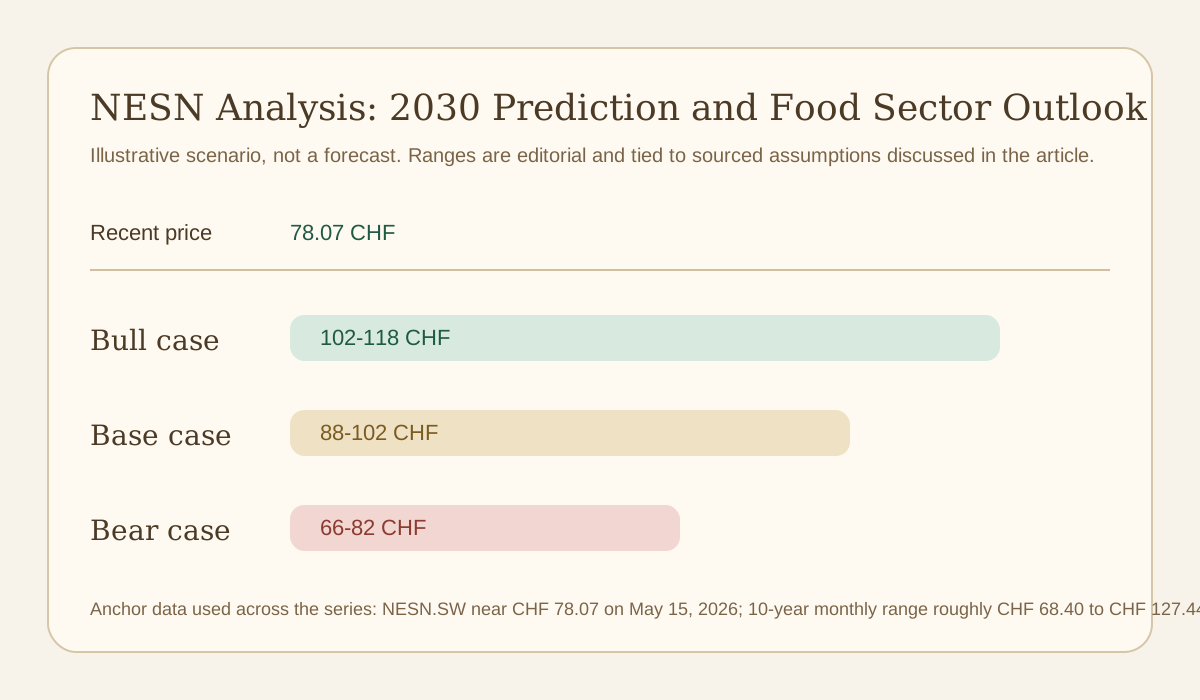
The forecast range here is built from three moving parts rather than a single spreadsheet output: current price near CHF 78, the fact that the stock's 10-year price CAGR has been barely positive, and the possibility that category mix plus margin repair can improve both earnings and valuation by 2030. That framework favors modest compounding in the base case, a clear rerating in the bull case, and range-bound or lower outcomes in the bear case.
The probability weights are editorial, but they are explicitly tied to publicly visible conditions. Rising odds go up if RIG remains positive, coffee and petcare stay strong, and cost savings convert into a higher UTOP margin. Falling odds rise if nutrition and water issues keep distracting management or if global food demand stays soft.
| Scenario | Range | What would likely drive it | Editorial probability |
|---|---|---|---|
| Bull | CHF 102-118 | Coffee keeps compounding, petcare improves, margin recovery approaches management's medium-term target, and investors pay a premium again for quality staples cash flow. | 25% |
| Base | CHF 88-102 | Nestle delivers steady low-single-digit growth, some margin repair, and ongoing dividends, but the valuation only partially recovers. | 50% |
| Bear | CHF 66-82 | Execution disappoints, category momentum fades, and the stock remains stuck near the lower half of its long-term range. | 25% |
| Outcome | Probability | Interpretation |
|---|---|---|
| Rising | 43% | Reasonable if the current improvement in RIG and category mix persists into 2027 and beyond. |
| Falling | 24% | Still meaningful because food-sector competition and operational setbacks can compress a staples multiple. |
| Moving sideways | 33% | Plausible because Nestle can execute decently and still remain range-bound if sentiment stays cautious. |
| Risk | Why it matters | What to monitor |
|---|---|---|
| Consumer downtrading | Private label and discount channels can dilute pricing power and mix quality. | Volume trends, channel commentary, and regional organic growth. |
| Nutrition execution risk | The infant formula recall shows how quickly a quality category can become a drag. | Recovery in offtake, shelf-space normalization, and further recall costs. |
| Water and regulatory overhang | Perrier and related water issues can absorb management attention and add reputational risk. | Official updates on partner discussions, production conditions, and litigation or regulatory changes. |
| Margin underdelivery | If savings do not reach the P&L, the stock may never recover a premium multiple. | UTOP margin progress, ad spend discipline, and free cash flow conversion. |
| Condition | Why it would change the view |
|---|---|
| Much stronger than expected volume growth across multiple categories | That would argue for a higher bull probability and a more generous 2030 rerating than assumed here. |
| A prolonged food-sector downturn or persistent recall fallout | That would push the base case lower because the current recovery assumptions would prove too optimistic. |
| Major portfolio reshaping beyond what management currently signals | Large divestitures, acquisitions, or a more radical strategic break could change the earnings mix enough to make this framework stale. |
06. Investor Positioning
How different investors might think about the 2030 NESN setup
No investor group should treat a Nestle forecast like a guarantee. The stock still looks more suitable for measured positioning, rebalancing, and patience than for aggressive chasing.
| Investor type | Prudent stance | Why |
|---|---|---|
| Investor already in profit | Hold core exposure and rebalance only if Nestle has become too large in a defensive sleeve | The base case still supports steady compounding, but upside is unlikely to be explosive. |
| Investor currently at a loss | Reassess the thesis around category quality and margin recovery rather than anchoring on the old high | The route back toward the 2021 peak depends on better execution, not just time. |
| Investor with no position | Wait for pullbacks or build slowly through dollar-cost averaging | The stock has a history of long trading ranges and may offer better entries during staples selloffs. |
| Trader | Avoid chasing defensive rallies and use stop-loss discipline around earnings and guidance revisions | Staples can still correct sharply when the market loses faith in organic growth. |
| Long-term investor | Focus on free cash flow, category mix, and the path toward above 17% UTOP margin | Those metrics matter more than quarter-to-quarter share-price noise. |
| Risk hedger | Use portfolio hedges elsewhere rather than assuming Nestle alone is a hedge | NESN is defensive, but it is not immune to bear markets, corrections, or company-specific shocks. |
07. Conclusion
Nestle still looks like a credible 2030 compounder, but only if operations keep improving faster than the market's skepticism
The evidence as of May 16, 2026 supports a constructive but restrained Nestle outlook. The company is showing better recent organic growth, it still has category strength in coffee and petcare, and management is trying to fund reinvestment through a measurable cost-savings program. Those are real positives.
At the same time, the last decade shows why investors should stay disciplined. A flat long-run stock chart, category disruptions, and a more fragmented food sector mean the forecast should remain range-based. For most investors, the base case is not that Nestle suddenly becomes a market darling. It is that the company slowly earns back some valuation credibility while continuing to behave like a high-quality global staples franchise.
Disclaimer: This article is an editorial scenario analysis based on public information available as of May 16, 2026. It is not personalized investment advice, and the ranges above should be read as conditional outcomes rather than promises.
08. FAQ
Frequently asked questions
What is the most realistic Nestle stock forecast for 2030?
A reasonable base case is roughly CHF 88 to CHF 102, assuming low-single-digit organic growth, some margin recovery, and a partial quality-multiple rebound. That is a scenario range, not a promise.
Why has NESN underperformed its own reputation over the last decade?
The business stayed resilient, but the valuation compressed after a richer multiple period. Flat price performance does not mean the operations collapsed; it means investors demanded more proof of growth.
What categories matter most for the Nestle outlook?
Coffee, petcare, nutrition, and food innovation matter most because they offer a better mix of brand power, pricing, and category relevance than slower legacy lines.
Could Nestle revisit its 2021 high by 2030?
Yes, but that would likely require sustained RIG improvement, cleaner execution in nutrition and water, and enough margin progress to justify a premium staples multiple again.
References
Sources
- Yahoo Finance chart API for NESN.SW 10-year monthly price history and recent price data
- Nestle annual report hub
- Nestle Annual Review 2025 PDF
- Nestle full-year results 2025 press release
- Nestle full-year results 2025 prepared remarks PDF
- Nestle full-year results 2025 transcript PDF
- Nestle three-month sales 2026 press release
- Nestle Q1 2026 investor call transcript PDF
- Company-compiled analyst consensus before Nestle Q1 2026 sales
- Nestle Capital Markets Day 2024
- Nestle investor strategy overview
- Nestle 2025 operating segment and product restatements PDF
- Nestle target to grow sales of nutritious products by 2030
- McKinsey State of Food and Beverage, 2026
- Nestle Nescafe Plan 2030 press release