01. Quick Answer
The most important 2027 Nestle call is whether today's early improvement is the start of a cleaner trend or just a temporary patch
A 2027 forecast depends less on distant structural change and more on whether the next 18 to 24 months confirm that Nestle's RIG-led growth strategy is working. That means catalysts matter more than abstract narratives.
The good news is that Nestle entered 2026 with a stronger Q1 than some investors feared. Organic growth reached 3.5%, coffee accelerated, food & snacks improved, and management maintained guidance despite greater geopolitical and macro uncertainty (Nestle, Apr. 23, 2026). The more difficult question is whether that momentum survives the recall and food-sector headwinds through 2027.
| Point | Why it matters |
|---|---|
| 2027 is an execution horizon | The main drivers are known already: category growth, recall normalization, cost savings, and margin delivery. |
| Coffee is the clearest positive catalyst | If coffee stays strong, it can offset weaker pockets elsewhere and support better sentiment. |
| Recall recovery is central to the base case | A slower normalization in nutrition would keep the stock from rerating much. |
| Investors should watch margin and free cash flow closely | Near-term price performance will likely depend on whether management turns strategic language into visible numbers. |
02. Historical Context
Nestle's 2027 outlook sits on top of a decade-long valuation reset, which makes near-term catalysts unusually important
Over the past 10 years, Nestle has delivered operational stability but poor price compounding. That backdrop matters because it lowers the market's trust threshold. Investors no longer reward the company for simply being large and defensive; they want visible evidence that growth quality is improving.
That is why the 2027 horizon matters. It is long enough for the Fuel for Growth program to show up in the P&L and short enough that current management priorities still dominate the thesis. Nestle's 2025 results and Q1 2026 update provide the immediate starting point for that assessment.
| Metric | Latest sourced reading | Why it matters |
|---|---|---|
| 2026 official organic growth guide | Around 3% to 4% | If Nestle meets this, the market will start thinking about 2027 follow-through instead of stabilization alone. |
| 2026 official margin guide | UTOP margin to improve versus 2025 | Key sign that cost savings are translating into economic value. |
| Q1 2026 coffee trend | Broad-based acceleration | Arguably the single most important positive business signal in the latest update. |
| Recall impact | About minus 90 bps on Q1 2026 OG and RIG | Shows how much room there could be for recovery if normalization continues. |
| Data point | Reading | Interpretation |
|---|---|---|
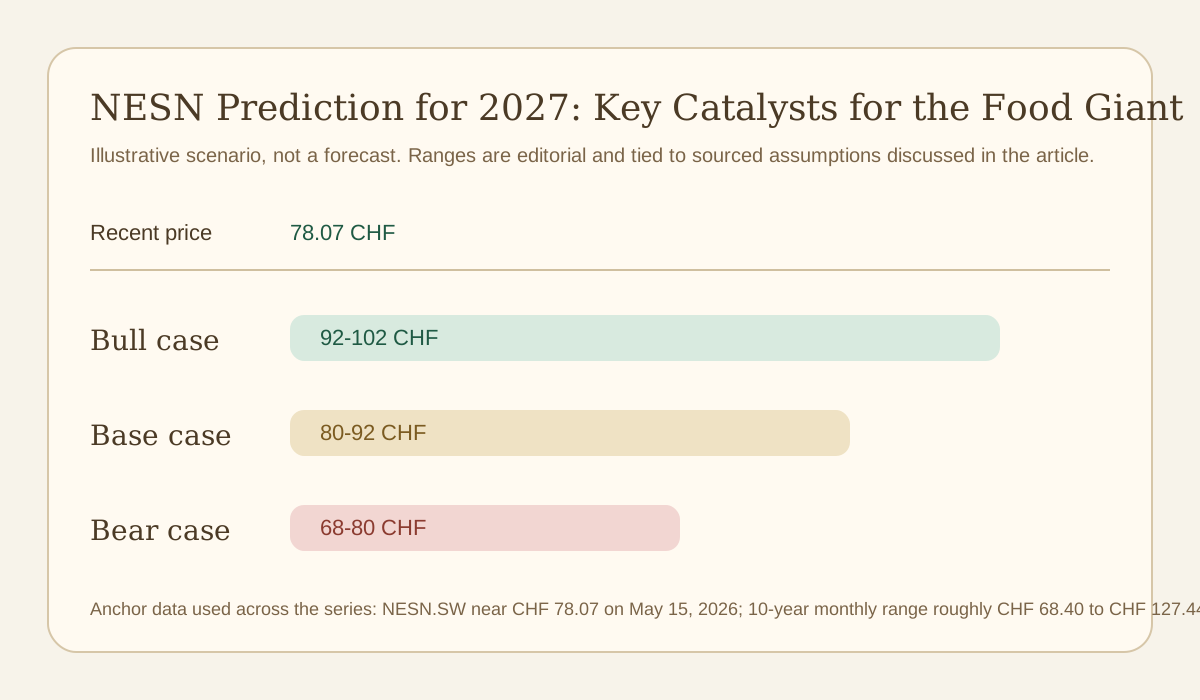
| Recent price | CHF 78.07 | Reasonable anchor for a 2027 range because it already reflects years of skepticism. |
| 2021 peak | CHF 127.44 | Too high to assume quickly, but useful as a reminder of what rerating can do. |
| 2025 sales base | CHF 89.5 billion | The company still has enough scale for modest operational gains to matter financially. |
| 2025 UTOP | CHF 14.4 billion | Reference point for judging whether 2026 and 2027 execution is improving or stalling. |
03. Main Drivers
Five catalysts should matter more than anything else for the 2027 NESN path
1. Coffee momentum must hold up
The Q1 2026 release highlighted coffee as the growth leader. If that remains true through the next several quarters, Nestle gets a cleaner mix and stronger pricing power narrative.
2. Nutrition needs a visible recall recovery
Nestle's infant formula advisory makes clear that the 2026 issue had a broad geographic footprint. A smoother recovery in availability, offtake, and consumer trust is one of the most important swing factors for 2027 (Nestle product advisory).
3. Cost savings need to show up in margins, not just slides
The strategy target of CHF 3.0 billion savings by end-2027 matters only if it funds growth and protects operating margins. Otherwise it risks looking like financial housekeeping rather than strategic acceleration.
4. Water-portfolio simplification can remove noise
Nestle said it began formal engagement with potential partners for Waters & Premium Beverages in Q1 2026 and expects deconsolidation from 2027. If handled well, that can simplify the story and improve focus on higher-priority categories.
5. Food-sector demand cannot deteriorate too much
Even strong execution can be overwhelmed by weak sector conditions. McKinsey's recent work on consumer packaged goods argues that incumbents need more precise innovation and channel execution than in the past, which means 2027 still carries macro sensitivity.
| Lever | Latest evidence | Forecast impact |
|---|---|---|
| Coffee acceleration | Management highlighted double-digit OG in Q1 2026 | Primary upside catalyst for the 2027 forecast. |
| Recall normalization | Q1 recall impact estimated around minus 90 bps on OG and RIG | Potential source of easier comparisons and sentiment repair. |
| Fuel for Growth program | CHF 3.0 billion savings by end-2027 | Can lift confidence if margin delivery becomes visible. |
| Water deconsolidation | Expected from 2027 | Could simplify the equity story and reduce overhang risk. |
04. Institutional Forecasts and Analyst Views
Analyst and company signals point to a measured 2027 improvement rather than an abrupt breakout
The official evidence base for 2027 begins with Nestle's 2026 guidance and the company's analyst consensus snapshot, both of which imply gradual rather than dramatic improvement. That usually argues for moderate price ranges unless either margins or category growth surprise strongly.
Because Nestle is a mature global staples company, the market typically rerates it when investors believe operating quality has improved on a durable basis. One or two strong quarters help, but 2027 probably requires a sequence of confirming evidence.
| Source | What it says | Implication for NESN |
|---|---|---|
| 2026 guidance | OG around 3% to 4%, improving margin, free cash flow above CHF 9 billion | Defines the near-term hurdle rate for the stock. |
| Pre-Q1 consensus | Analysts broadly expected around 3% organic growth and gradual RIG recovery for 2026 | Suggests the market remains cautious even after some improvement. |
| Annual Review and strategy updates | Management is prioritizing growth platforms, brand investment, and cost savings | Provides the operational roadmap for 2027. |
| Food-sector backdrop | Consumers continue to reallocate spend by value, wellness, and convenience | Keeps a ceiling on how aggressive a near-term valuation rerating can become. |
05. Scenarios
Bull, bear, and base-case ranges for 2027
The 2027 range is built around the idea that Nestle is already partway into a recovery narrative, but not far enough along to remove doubt. That means upside exists, yet the market may still demand evidence every quarter.
Editorial probabilities are tied to observable catalysts: coffee strength, recall repair, savings delivery, and whether management can hold growth in the 3% to 4% zone.
| Scenario | Range | What would likely drive it | Editorial probability |
|---|---|---|---|
| Bull | CHF 92-102 | Coffee stays strong, recall damage fades, and visible margin improvement convinces investors the strategic reset is working. | 28% |
| Base | CHF 80-92 | Nestle executes close to guidance, shows some mix improvement, and regains modest market confidence. | 47% |
| Bear | CHF 68-80 | Category momentum proves fragile, water and nutrition issues linger, or free cash flow disappoints. | 25% |
| Outcome | Probability | Interpretation |
|---|---|---|
| Rising | 45% | Supported if coffee, food & snacks, and margin improvement continue through 2026 and into 2027. |
| Falling | 26% | A still-material chance because the stock remains sensitive to execution misses. |
| Moving sideways | 29% | Plausible if results improve but never enough to materially change the valuation narrative. |
| Risk | Why it matters | What to monitor |
|---|---|---|
| Recall drag lasts longer than expected | Would pressure nutrition, trust, and near-term growth comparisons. | Management comments on product availability and sell-out trends. |
| Savings fail to widen margins | The market may decide the reset lacks operating substance. | UTOP margin progression and ad-spend discipline. |
| Water transition gets messy | Could preserve an overhang rather than removing one. | Partnering timeline, deconsolidation mechanics, and regulatory headlines. |
| Consumer slowdown | Would pressure volume across multiple categories. | RIG, market-share commentary, and geographic divergence in growth. |
| Condition | Why it would change the view |
|---|---|
| Strong multi-quarter RIG expansion | That would make the current base case too conservative and push the stock toward the bull range faster. |
| Fresh operational or regulatory setbacks | That would weaken the idea that 2027 is a clean recovery year. |
| A major portfolio deal | Large strategic changes could reset both earnings expectations and valuation assumptions. |
06. Investor Positioning
How different investors might think about a 2027 catalyst-driven setup
Because 2027 is close enough to be event-sensitive, investor positioning should be especially disciplined around earnings, guidance, and category disclosures.
| Investor type | Prudent stance | Why |
|---|---|---|
| Investor already in profit | Hold, but consider trimming into sharp post-earnings rallies | Near-term upside can be real, but Nestle is still not a stock to chase indiscriminately. |
| Investor currently at a loss | Watch for evidence that the original thesis is being repaired before averaging down aggressively | Recovery depends on execution, not on mean reversion alone. |
| Investor with no position | Wait for pullbacks or enter in stages | Event risk around recalls, water, and margins can create better entries. |
| Trader | Trade catalysts, use stop-losses, and distinguish between a correction and a new trend | NESN often moves modestly until a guidance or category surprise changes the tone. |
| Long-term investor | Use 2027 mainly to judge whether the medium-term thesis is getting stronger | A good 2027 would improve the 2030 and 2035 setup more than it guarantees immediate upside. |
| Risk hedger | Use hedges around broader portfolio risk rather than betting on Nestle as a standalone shield | Company-specific setbacks can still hurt a defensive stock. |
07. Conclusion
The 2027 Nestle outlook is really a test of whether management can convert early momentum into a credible medium-term trend
Nestle does not need extraordinary growth by 2027. It needs enough proof that coffee momentum, nutrition recovery, margin repair, and portfolio simplification are adding up to a better quality business mix.
If those catalysts line up, a move into the low 90s in CHF is credible. If they do not, the stock can remain range-bound. That is why 2027 looks like a catalyst year more than a destiny year.
Disclaimer: This article is an editorial scenario analysis based on public information available as of May 16, 2026. It is not personalized investment advice, and the ranges above should be read as conditional outcomes rather than promises.
08. FAQ
Frequently asked questions
What is the most important Nestle catalyst for 2027?
Coffee momentum is probably the clearest positive catalyst, but recall recovery and margin delivery may be just as important for valuation.
Why does 2027 matter more than 2035 for some investors?
Because 2027 is close enough for known catalysts to drive results, while 2035 carries much wider strategic and macro uncertainty.
Can Nestle outperform even if food-sector growth stays muted?
Yes, but it would likely need better mix, stronger margins, and cleaner execution than peers rather than depending on sector tailwinds.
What would make the 2027 forecast too optimistic?
A slower than expected normalization in nutrition, weak free cash flow, or failure to convert savings into visible margin progress would all weaken the thesis.
References
Sources
- Yahoo Finance chart API for NESN.SW 10-year monthly price history and recent price data
- Nestle annual report hub
- Nestle Annual Review 2025 PDF
- Nestle full-year results 2025 press release
- Nestle full-year results 2025 prepared remarks PDF
- Nestle full-year results 2025 transcript PDF
- Nestle three-month sales 2026 press release
- Nestle Q1 2026 investor call transcript PDF
- Company-compiled analyst consensus before Nestle Q1 2026 sales
- Nestle Capital Markets Day 2024
- Nestle investor strategy overview
- Nestle 2025 operating segment and product restatements PDF
- Nestle infant formula product advisory
- McKinsey State of Food and Beverage, 2026
- Nestle Nescafe Plan 2030