01. Quick Answer
The 2035 Nestle forecast should be driven by scenarios, because small changes in growth quality and valuation can produce very different long-run outcomes
A nine-year forecast for a large consumer staples company is mostly about conditions, not precision. Nestle does not need technology-style growth to justify a higher 2035 price, but it does need enough category momentum and margin recovery to escape the valuation trap that left the stock almost flat over the last decade.
The most useful way to think about 2035 is therefore through bull, base, and bear cases anchored to sourced facts: recent price around CHF 78.07, 2026 official growth guidance of around 3% to 4%, the above-17% medium-term UTOP margin ambition from Capital Markets Day 2024, and the company's CHF 3.0 billion cost-savings target by 2027 (Nestle strategy overview).
| Point | Why it matters |
|---|---|
| The 2035 case is mostly a compounding question | Long-range upside comes from steady earnings, dividends, and some rerating rather than dramatic revenue surges. |
| Valuation discipline matters | A quality franchise can still underdeliver if investors keep applying a muted multiple. |
| Scenario ranges are more honest than point targets | By 2035, management changes, category shifts, and macro cycles could materially alter the path. |
| Base and bull cases both require execution | Nestle must prove that higher-quality categories and cost savings can coexist with healthy brand investment. |
02. Historical Context
Nestle's long-run setup argues for patience, because a wide gap can emerge between durable operations and slow share-price performance
From a price-history perspective, Nestle has not looked like a classic long-term winner recently. The stock moved from about CHF 75.15 in May 2016 to CHF 78.07 in May 2026, despite spending time as high as CHF 127.44 in 2021. That tells investors that premium consumer staples are still vulnerable to multiple compression when growth disappoints or bond proxies fall out of favor.
Yet the operating franchise remains unusually broad. Nestle's 2025 Annual Review still shows a global network across 185 countries, CHF 89.5 billion in sales, and major positions in coffee, petcare, nutrition, and food & snacks. For a 2035 forecast, that scale is useful because it can support gradual reinvention even when a single category stumbles (Annual Review 2025).
| Metric | Latest sourced reading | Why it matters |
|---|---|---|
| FY 2025 sales | CHF 89.5 billion | Shows the size of the earnings base from which any 2035 compounding must begin. |
| FY 2025 UTOP | CHF 14.4 billion | Important benchmark for judging whether savings and mix shift produce real profit leverage. |
| FY 2025 dividend proposal | CHF 3.10 per share | Dividend continuity is a large part of why patient investors still own Nestle. |
| Q1 2026 organic growth | 3.5% | Evidence that the near-term trend is improving, though still not enough to remove all doubt. |
| Data point | Reading | Interpretation |
|---|---|---|
| 10-year price CAGR | About 0.38% | This low starting point actually gives the 2035 scenario range more upside leverage than a euphoric valuation would. |
| 2021 price peak | CHF 127.44 | A plausible bull-case reference point, but not an automatic destination. |
| Current business quality | High, but uneven by category | Nestle is not a turnaround disaster, yet it still needs cleaner growth quality. |
| Capital-return culture | Dividend maintained or increased for 66 years in CHF | Long-horizon investors can justify patience if cash flow stays robust. |
03. Main Drivers
The 2035 range depends on whether Nestle becomes a better growth compounder or remains a decent business stuck in a valuation box
1. The bull case needs a better category mix than the market currently assumes
Public disclosures already point to coffee, petcare, and nutrition as the most important growth categories. If those businesses grow faster than the rest of the portfolio over the next decade, Nestle's earnings mix should improve even without dramatic group-level revenue acceleration.
2. The base case leans heavily on margin repair
The Capital Markets Day framework matters because above-17% UTOP is enough to improve sentiment, especially if it is delivered alongside low-single-digit organic growth. A company this mature does not need hypergrowth; it needs credible operating discipline.
3. The bear case is mostly about chronic underdelivery
If Nestle spends years missing growth expectations, absorbing periodic recalls or regulatory distractions, and failing to show sustained RIG, the stock could remain trapped in a low-return band even if the business stays profitable.
4. Sector structure will matter more than many bulls admit
McKinsey's consumer-goods work shows large incumbents increasingly compete against private label, functionality-driven challengers, and channel shifts. That reduces the odds of a carefree rerating and is a key reason the base case stays measured (McKinsey, 2026).
5. Dividend durability still shapes the total-return case
Because Nestle is a mature staples name, the total-return story by 2035 will come from dividends plus moderate price appreciation. Investors who ignore the cash-return component risk underestimating the stock's long-horizon appeal.
| Lever | Latest evidence | Forecast impact |
|---|---|---|
| Category quality | Coffee and petcare remain central priorities | Supports the bull case if mix keeps improving. |
| Margin path | Above-17% UTOP is the medium-term target | Critical for the base case because valuation alone cannot do all the work. |
| Cost savings | CHF 3.0 billion by end-2027 | Can fund growth and defend margins if execution is disciplined. |
| Capital returns | Long dividend record in CHF | Improves the 2035 holding case even if share-price gains stay moderate. |
04. Institutional Forecasts and Analyst Views
The institutional evidence favors a moderate compounding story, with long-duration uncertainty doing most of the widening by 2035
There is no high-quality public consensus for Nestle in 2035, so extending current evidence requires caution. Analysts around the 2026 setup still look for low-single-digit organic growth and modest RIG improvement, while management's medium-term language points to normal-market growth of around 4% and an above-17% UTOP margin over time. That is enough to support upside, but not enough to justify fantasy assumptions.
The scenarios below therefore assume Nestle remains a large, cash-generative staples group with improving mix, rather than a structurally transformed growth company. The difference between the bull and bear cases is mainly whether management can sustain better growth quality for many years without fresh strategic drift.
| Source | What it says | Implication for NESN |
|---|---|---|
| Analyst consensus for 2026 | Low-single-digit organic growth with modest RIG and profit improvement | Good starting point for the base case, but not evidence of a major growth breakout. |
| Capital Markets Day 2024 | About 4% organic growth in normal conditions and above-17% UTOP margin | Acts as the operational ceiling for the base case and the floor for the bull case. |
| Annual Review 2025 | Large global scale, category breadth, and strong cash generation | Supports long-duration resilience even if macro conditions stay mixed. |
| Food-sector research | Growth increasingly depends on targeted innovation, wellness, and channel execution | Explains why management quality matters more than simple size by 2035. |
05. Scenarios
A 2035 Nestle forecast needs explicit bull, base, and bear cases
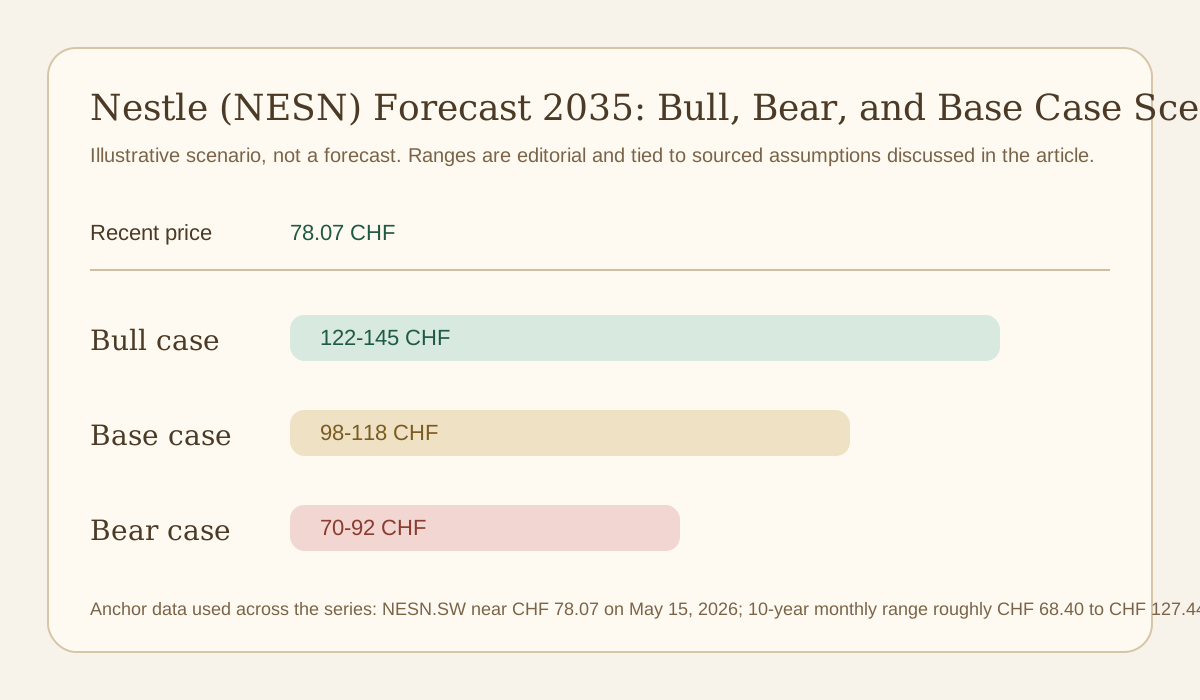
For a mature food company, nine years is enough time for moderate assumptions to compound into a wide range. The base case assumes Nestle grows and re-rates somewhat. The bull case assumes better category quality, cleaner execution, and a restored premium multiple. The bear case assumes the business remains solid but never truly exciting.
These ranges should not be read as mechanistic outputs. They are probability-weighted editorial scenarios tied to sourced current conditions and a realistic view of how staples equities usually move.
| Scenario | Range | What would likely drive it | Editorial probability |
|---|---|---|---|
| Bull | CHF 122-145 | RIG improves for several years, coffee and petcare lead mix upgrades, margins exceed 17%, and the market pays a stronger quality multiple again. | 22% |
| Base | CHF 98-118 | Nestle compounds gradually through cash flow, dividends, and modest earnings growth, with only partial rerating. | 53% |
| Bear | CHF 70-92 | Growth remains uneven, operational issues recur, and the stock continues behaving like a slow range-bound defensive name. | 25% |
| Outcome | Probability | Interpretation |
|---|---|---|
| Rising | 46% | Long enough horizon for moderate compounding to matter if execution improves. |
| Falling | 21% | Possible if Nestle keeps disappointing on growth quality or faces repeated category issues. |
| Moving sideways | 33% | Still realistic because premium staples can remain operationally fine but valuation-stuck for years. |
| Risk | Why it matters | What to monitor |
|---|---|---|
| Stagnant category mix | If faster categories do not gain enough weight, group growth may stay too low. | Category share of sales, RIG by product group, and brand investment intensity. |
| Valuation ceiling | Even better operations may not produce a rich multiple in a higher-rate world. | Relative staples valuation, bond yields, and market appetite for defensive franchises. |
| Execution fatigue | Long-duration forecasts fail when management loses consistency. | Repeated guidance resets, major restructuring changes, or weak market-share trends. |
| Regulatory and reputational shocks | Recalls and water issues can hurt quality perception and capital allocation focus. | Official updates on recall recovery, water-portfolio actions, and legal developments. |
| Condition | Why it would change the view |
|---|---|
| A sustained multi-year step-up in organic growth above current expectations | That would justify a higher 2035 range than modeled here because compounding from a stronger base becomes powerful. |
| Material strategic breakup or large acquisition strategy | That could change the business mix enough to make current scenario ranges obsolete. |
| A prolonged period of margin erosion despite cost savings | That would undercut both the base and bull cases because Nestle's quality premium would weaken further. |
06. Investor Positioning
Investor positioning for a long-range 2035 setup
The farther the forecast horizon, the more important it becomes to size positions prudently, focus on thesis quality, and avoid overreacting to one quarter.
| Investor type | Prudent stance | Why |
|---|---|---|
| Investor already in profit | Hold, rebalance, and collect the dividend rather than forcing a big directional call | The 2035 upside exists, but it likely arrives through patience. |
| Investor currently at a loss | Separate business quality from entry price and decide whether the slower-compounding thesis still fits | Nestle can be a valid long-term hold even if it has been frustrating. |
| Investor with no position | Accumulate gradually or wait for sector-wide defensive pullbacks | Long-horizon returns are usually better when staples are bought during periods of lower enthusiasm. |
| Trader | Treat NESN as a range or event-driven name, not a momentum vehicle | The stock's history argues against aggressive breakout chasing. |
| Long-term investor | Focus on capital discipline, category mix, and dividend durability | Those are the main drivers of 2035 total return. |
| Risk hedger | Use broader portfolio hedges, then let Nestle serve as a defensive cash-flow component | Nestle can soften volatility, but it is not a guaranteed hedge. |
07. Conclusion
The 2035 Nestle opportunity is real, but it is an exercise in disciplined compounding rather than bold prophecy
By 2035, Nestle could plausibly be worth materially more than today if management sustains category upgrades, better margins, and healthy dividends. That is the essence of the bull and base cases.
But the last decade is a warning against easy optimism. A premium food company can still spend years going nowhere in price if the market doubts its growth quality. That is why the most credible long-range NESN view remains scenario-based and probability-weighted.
Disclaimer: This article is an editorial scenario analysis based on public information available as of May 16, 2026. It is not personalized investment advice, and the ranges above should be read as conditional outcomes rather than promises.
08. FAQ
Frequently asked questions
What is a reasonable 2035 Nestle base case?
Roughly CHF 98 to CHF 118 looks reasonable if Nestle compounds steadily with some margin recovery and keeps its cash-return profile intact.
What would push Nestle toward the bull case by 2035?
Sustained RIG improvement, a stronger category mix in coffee and petcare, and a restored premium multiple would be the clearest drivers.
What is the biggest risk to the 2035 thesis?
The biggest risk is not collapse. It is years of respectable operations paired with mediocre equity returns because growth never becomes convincing enough.
Is the 2021 high relevant for 2035?
Yes. It is a useful reminder that the market once paid much more for Nestle's quality, but revisiting that level requires better evidence than management has shown so far.
References
Sources
- Yahoo Finance chart API for NESN.SW 10-year monthly price history and recent price data
- Nestle annual report hub
- Nestle Annual Review 2025 PDF
- Nestle full-year results 2025 press release
- Nestle full-year results 2025 prepared remarks PDF
- Nestle full-year results 2025 transcript PDF
- Nestle three-month sales 2026 press release
- Nestle Q1 2026 investor call transcript PDF
- Company-compiled analyst consensus before Nestle Q1 2026 sales
- Nestle Capital Markets Day 2024
- Nestle investor strategy overview
- Nestle 2025 operating segment and product restatements PDF
- Nestle nutritious-products 2030 target
- Nestle balanced diet and nutrition-health overview
- McKinsey State of Food and Beverage, 2026