01. Quick Answer
A 2030 Nifty forecast works better as a range than as a single number
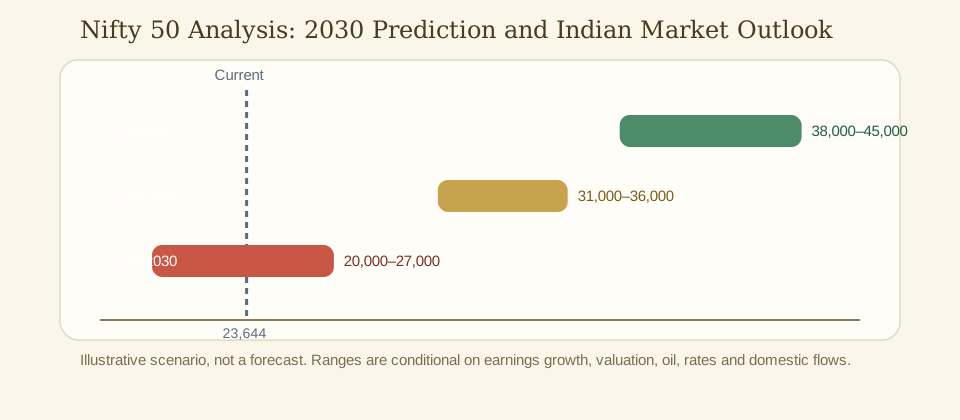
Available data suggests the Nifty 50 still has a credible long-term upside path into 2030, but the most defensible framework is a conditional range. A reasonable base case sits around 31,000 to 36,000 by 2030 if India sustains real growth near current expectations, large-cap earnings compound at a low-double-digit pace, and the market avoids major valuation excess. The evidence is mixed on a much more aggressive target because the starting valuation is not cheap and India remains exposed to imported energy shocks, global risk appetite, and periodic earnings downgrades.
- Historical data supports long-run optimism, but it does not justify assuming a straight-line rally.
- Current market conditions still show solid domestic liquidity, yet valuation is no longer obviously discounted.
- Institutional forecasts are concentrated in the 12-month window, so 2030 targets must be scenario-based.
- The biggest upside driver is sustained earnings compounding; the biggest downside driver is oil-led macro stress.
02. Current Market Snapshot
The benchmark is off its peak, but not cheap enough to ignore macro risk
As of May 15, 2026, the Nifty 50 closed near 23,643.50, according to Yahoo Finance chart data[1]. That puts the benchmark well above its 10-year monthly low of 8,185.80 but still below the 1-year high of 26,328.55 reached on January 02, 2026[1]. In other words, this is not a washed-out index, but it is no longer trading at the peak optimism seen in early 2026.
The official April 30, 2026 Nifty factsheet adds useful context: the index still showed a negative 1-year price return of 1.38%, a 5-year price CAGR of 10.40%, a P/E of 20.94, a P/B of 3.29, and a dividend yield of 1.3%[2]. Those figures matter because most long-range Nifty forecasts ultimately come down to three variables: earnings growth, starting valuation, and how much domestic liquidity continues to cushion external shocks.
| Metric | Value | Why it matters |
|---|---|---|
| Recent close | 23,643.50 on May 15, 2026 | Starting point for all scenario work |
| 10-year range | 8,185.80 to 26,202.95 | Shows how much repricing India large caps have already delivered |
| 10-year CAGR | 11.11% | Useful reality check against aggressive long-term projections |
| 1-year high / low | 26,328.55 / 22,331.40 | Captures the early-2026 correction and rebound window |
| Deepest 10-year drawdown | -38.44% | Distinguishes normal volatility from a true crisis phase |
| Official valuation snapshot | P/E 20.94, P/B 3.29, yield 1.3% | Valuation discipline is central to any Nifty forecast |
That combination argues against both extremes. The benchmark is not trading as if India's long-term story is broken, but neither is it priced like a deep-value market. For a 2030 investor, that usually means returns are more likely to come from earnings and time than from a sudden valuation rerating.
03. Historical Context And Main Drivers
The 2030 outlook depends on five persistent, measurable drivers
Over the past decade, the Nifty 50 compounded at roughly 11.11% annually from 8,287.75 to 23,643.50[1]. That record supports a constructive long-run view on Indian large caps, but it also reminds investors that heroic forecasts should be tested against what the index has historically delivered. Even strong structural stories rarely move in straight lines.
The most severe drawdown in the 10-year daily series was about -38.44%, from 26,328.55 on January 02, 2026 to 7,610.25 on March 23, 2020[1]. That distinction matters. A correction can be uncomfortable; a bear market involves deeper multiple compression and earnings stress; a crash usually requires forced liquidation or a macro shock. Readers searching for a Nifty forecast should be explicit about which regime they are actually discussing.
| Driver | Current evidence | Bullish implication | Bearish implication |
|---|---|---|---|
| Nominal GDP and domestic demand | IMF and World Bank still see India as a fast-growing major economy | Supports revenue growth across banks, autos, industrials, telecom and consumption | A sharp slowdown would hit breadth, not just cyclical pockets |
| Domestic fund flows | AMFI reported Rs 31,115 crore of SIP inflows in April 2026 | Steady local inflows can cushion FPI volatility | If flows cool while valuations stay high, corrections can deepen |
| Oil and imported inflation | World Bank flags Middle East conflict and energy risk | Benign oil would help margins, inflation and rates | Higher oil can squeeze earnings and the external balance |
| Rates and liquidity | RBI retained 6.5% growth outlook and cut inflation view to 3.1% | Lower inflation can create room for easier financial conditions | Policy room narrows if food or energy inflation returns |
| Index composition | Financials remain 35%+ of the benchmark by weight | Healthy credit and asset quality can lift index earnings | Sector concentration raises sensitivity to credit-cycle disappointment |
The bullish argument for 2030 begins with macro persistence. The World Bank's April 2026 India Development Update still described India as the fastest-growing major economy, while the IMF's 2025 Article IV kept the medium-term tone constructive even as it highlighted fragmentation and tariff risks. That does not guarantee equity upside, but it does keep the earnings denominator moving in the right direction, which is the single most important long-run support for the Nifty 50.
The more subtle driver is domestic liquidity. Monthly SIP contributions remained above Rs 31,000 crore in April 2026, and equity fund inflows remained positive, which helps explain why Indian equities often correct less violently than peers when global capital turns cautious. Still, the evidence is mixed on whether domestic inflows can offset every external shock. They are a stabilizer, not a magic shield.
04. Institutional Forecasts And Analyst Views
Institutional calls are useful near-term anchors, not precise 2030 predictions
There is a practical limit to what institutional forecasts can tell investors beyond one or two years. Banks publish abundant 12-month targets, but very few publish formal 2030 or 2035 Nifty targets. That means any long-range projection should be treated as a scenario framework built on current earnings expectations, macro assumptions, and plausible valuation bands, not as a precise institutional consensus number[9] [10] [11].
| Source | Target / stance | Core thesis | What it signals |
|---|---|---|---|
| J.P.Morgan | 27,000 base / 30,000 bull / 20,500 bear for 2026 | Valuation is elevated versus peers and oil can hurt earnings | Even constructive houses now attach a real downside case |
| BofA | 29,000 for 2026 | Returns should track earnings more than multiple expansion | A moderate bull case, not a euphoric one |
| Nomura / Citi | Targets cut as oil and earnings risks rose | Middle East stress darkened the macro picture | Risk regime can change quickly |
| Morgan Stanley | Bull market view on India; Sensex 95,000 base case | Macro stability plus private investment can restart leadership | Constructive long-run stance if India keeps reform momentum |
For a 2030 article, the practical takeaway from these notes is not the exact 2026 target. It is that major houses are still debating the same variables that will matter in 2030: earnings breadth, oil sensitivity, valuation discipline, and whether domestic capital formation can outlast global turbulence. In that sense, short-horizon broker notes are still informative because they reveal what the market is paying for today.
My 2030 range is built on that framework. If Nifty earnings can compound around 10% to 12% annually and the market trades in a roughly 19x to 21.5x band, the base path gets to about 31,000 to 36,000. A more aggressive bull case requires both stronger earnings and valuation support. A true bear case likely needs either a sustained oil shock, broader earnings misses, or both.
05. Bullish Scenario
What could push the Nifty toward 38,000 to 45,000 by 2030
A credible bull case starts with policy and profit durability rather than momentum alone. If India keeps public capex high enough to crowd in private investment, if banks preserve healthy balance sheets, and if manufacturing incentives continue to attract incremental capacity, index earnings could compound faster than current consensus assumes. A softer inflation backdrop would reinforce that view by lowering discount rates and supporting consumer demand.
The upside case also improves if leadership broadens beyond financials and a handful of mega caps. India's telecom, industrial, capital goods, and digital infrastructure plays could widen participation, while IT services could stabilize if global tech budgets recover. Under that combination, the Nifty could trade in the upper half of its historical valuation range and produce a higher 2030 outcome than the base case.
06. Bearish Scenario
What could pull the Nifty back to 20,000 to 27,000 instead
The most obvious bear trigger is a sustained energy shock. The World Bank explicitly warned that prolonged Middle East disruption could pressure India through higher import costs and supply-chain stress. If crude stays high long enough to lift inflation, compress margins and weaken real incomes, the index could see simultaneous earnings downgrades and multiple compression.
A second bearish path is slower earnings without a macro crisis. J.P.Morgan and HSBC both turned more cautious in April 2026 partly because valuations already embedded a lot of good news. If the market pays more than 20 times earnings while earnings only grow in the mid-single digits, the math becomes awkward. That is how a flat or lower five-year outcome can happen even without a recession.
07. Base Case
Why 31,000 to 36,000 remains the most defensible 2030 range
The base case assumes India remains a structurally above-average grower, but not an exception to valuation gravity. RBI, IMF and World Bank materials still point to resilient growth, improving inflation dynamics, and manageable external balances, even with clear downside risks. Under that backdrop, available data suggests low-double-digit earnings compounding is more plausible than a dramatic acceleration or collapse.
That translates into a constructive but measured outcome. From about 23,600 today, a 31,000 to 36,000 range by 2030 would imply respectable returns without assuming a speculative rerating. It also aligns better with the 10-year CAGR history than the more aggressive calls that implicitly require India to compound far above its already impressive long-run trend.
08. Probability Framework And Investor Positioning
Probability table and positioning by investor type
The probabilities below are judgment calls, not objective odds. They combine starting valuation, India's macro resilience, oil sensitivity, current institutional notes, and the index's sector concentration. The point is to show how a forecast range is constructed rather than to pretend precision where none exists.
| Path | Probability | Conditions |
|---|---|---|
| Rising toward 31k-45k by 2030 | 55% | Requires sustained earnings growth, stable domestic inflows, and no prolonged oil shock |
| Falling toward 20k-27k | 20% | Would likely need persistent earnings downgrades and deeper multiple compression |
| Mostly sideways / range-bound | 25% | Possible if earnings grow but valuations normalize at the same time |
| Investor profile | Prudent approach | Why that stance fits |
|---|---|---|
| Investor already in profit | Hold core, trim weak positions, rebalance on strength | Protect gains without fully exiting a structurally strong market |
| Investor currently at a loss | Avoid panic selling; review thesis, stagger exits or adds | Losses caused by valuation entry points should be treated differently from broken fundamentals |
| Investor with no position | Wait for pullbacks or use staged dollar-cost averaging | A full-size entry at non-cheap valuation increases regret risk |
| Trader | Use stop-loss rules and respect oil, rupee, and earnings catalysts | Short-term outcomes can diverge sharply from the 2030 thesis |
| Long-term investor | Accumulate selectively and rebalance sector concentration | Time horizon can absorb volatility if position sizing is disciplined |
| Hedger / risk-only investor | Use partial hedge, avoid overpaying for tail risk | Macro risk exists, but India is not in obvious crisis conditions |
For most readers, the practical implication is simple: do not confuse a structurally bullish India narrative with permission to chase every rally. The long-run outlook can stay constructive while the short-run path remains volatile and valuation-sensitive.
09. Risks To Watch And What Could Invalidate The Forecast
Oil, valuations, and earnings breadth matter more than slogans
The risks to watch are unusually concrete. Energy prices, inflation reacceleration, a cooling of domestic fund flows, and a more visible slowdown in large-cap earnings breadth would all argue for lowering the upper end of the 2030 range. None of those risks require an India-specific crisis; they only require the market to stop assuming perfect execution.
What would invalidate this article's base case? Either direction can do it. A more durable productivity and investment surge could make 31,000 to 36,000 too conservative. On the other hand, a long oil shock combined with weaker bank earnings and valuation compression could make it too optimistic. That is why range-based forecasting is more honest than a single target.
| Signal | Why it matters | Implication for the thesis |
|---|---|---|
| Oil remains benign and earnings accelerate above expectations | Would improve margins, inflation, and sentiment together | The base case would likely prove too low |
| Domestic SIP flows slow materially while FPI selling rises | A thinner local bid would expose valuation risk | The bear case would gain probability |
| Financials lose earnings leadership | The index is heavily dependent on banks and lenders | A sector-specific problem could hit the full benchmark |
Disclaimer: This article is an editorial scenario analysis, not personalized investment advice. Forecast ranges are conditional and can fail if earnings, policy, energy prices, or global liquidity move materially away from current assumptions.
10. Conclusion
The 2030 Nifty outlook is constructive, but only in a disciplined framework
A realistic Nifty 50 prediction for 2030 is neither a crash call nor a fairy tale. Historical data, official macro assessments, and persistent domestic inflows all support a constructive long-run outlook for Indian equities. But the evidence is mixed on any single heroic number because the starting valuation is not distressed and India remains sensitive to oil, rates, and earnings breadth. For most investors, the best use of a 2030 forecast is to guide position sizing, rebalancing, and expectations rather than to justify certainty.
FAQ
Frequently asked questions
Is the Nifty 50 likely to double by 2030?
It could, but that would require earnings to grow strongly and valuation to stay supportive. Available data suggests a doubling is possible only in the upper-end bull case, not in the base case.
What is the biggest risk to a bullish Nifty 2030 forecast?
A prolonged oil shock is the clearest macro risk because it can pressure inflation, margins, rates, and external balances at the same time.
Why not use a single exact Nifty target for 2030?
Because institutions themselves mostly publish shorter-horizon targets. Beyond one or two years, scenario ranges are more defensible than false precision.
Does domestic SIP money eliminate downside risk?
No. It reduces fragility, but it does not eliminate valuation resets or earnings disappointments.
References
Sources
- Yahoo Finance chart data for ^NSEI - 10-year monthly and 1-year daily history
- NSE Indices, Nifty 50 Factsheet, April 30, 2026
- NSE Indices, Methodology Document for Equity Indices
- Reserve Bank of India monetary policy press release - GDP growth 6.5% and CPI 3.1% outlook
- IMF Executive Board Concludes 2025 Article IV Consultation with India
- IMF Staff Country Report: India 2025 Article IV Consultation
- World Bank India Development Update, April 2026
- AMFI Monthly Note, April 2026 - SIP contributions and equity flows
- Reuters via MarketScreener - J.P.Morgan downgrades India to neutral and cuts Nifty target to 27,000
- Business Standard - BofA sees Nifty at 29,000 in 2026 as earnings drive returns
- Reuters via MarketScreener - Citi and Nomura cut India Nifty targets on oil and earnings risks
- Moneycontrol - Morgan Stanley sees a bull market ahead for Indian equities with Sensex at 95,000
- Reuters via MarketScreener - HSBC downgrades India to underweight as oil shock clouds earnings recovery