01. Quick Answer
2027 is mostly a question of earnings recovery versus valuation compression
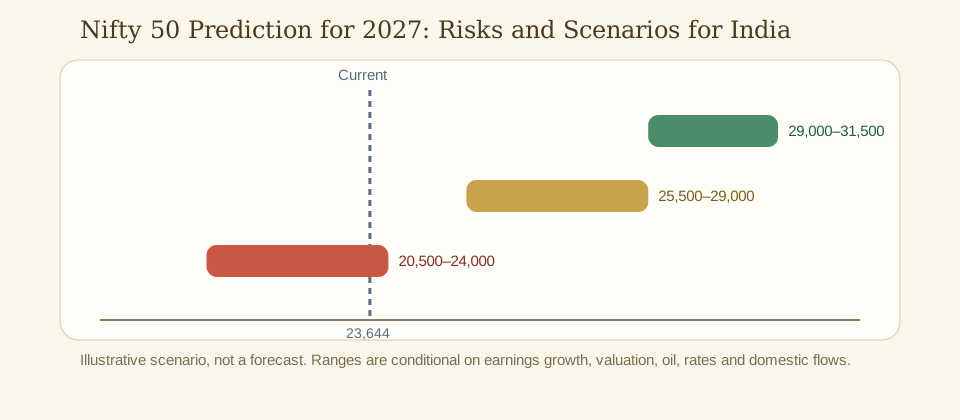
Based on current market conditions and the latest institutional notes, a prudent 2027 Nifty range is 25,500 to 29,000 in the base case. That range is close to the middle of what major houses are already publishing for the next 12 to 18 months. The evidence is mixed on a sharper upside extension because early-2026 volatility exposed how sensitive the benchmark still is to oil, earnings downgrades, and changes in foreign risk appetite.
- J.P.Morgan, BofA, Nomura and Citi all provide usable near-term anchors for 2027 thinking.
- The main bullish argument is resumed earnings delivery into a lower-inflation backdrop.
- The main bearish argument is that valuations remain demanding if earnings fail to catch up.
- A sideways 2027 outcome is plausible if earnings grow but multiples contract.
02. Current Market Snapshot
The index has already shown how quickly the near-term narrative can change
As of May 15, 2026, the Nifty 50 closed near 23,643.50, according to Yahoo Finance chart data[1]. That puts the benchmark well above its 10-year monthly low of 8,185.80 but still below the 1-year high of 26,328.55 reached on January 02, 2026[1]. In other words, this is not a washed-out index, but it is no longer trading at the peak optimism seen in early 2026.
The official April 30, 2026 Nifty factsheet adds useful context: the index still showed a negative 1-year price return of 1.38%, a 5-year price CAGR of 10.40%, a P/E of 20.94, a P/B of 3.29, and a dividend yield of 1.3%[2]. Those figures matter because most long-range Nifty forecasts ultimately come down to three variables: earnings growth, starting valuation, and how much domestic liquidity continues to cushion external shocks.
| Metric | Value | Why it matters |
|---|---|---|
| Recent close | 23,643.50 on May 15, 2026 | Starting point for all scenario work |
| 10-year range | 8,185.80 to 26,202.95 | Shows how much repricing India large caps have already delivered |
| 10-year CAGR | 11.11% | Useful reality check against aggressive long-term projections |
| 1-year high / low | 26,328.55 / 22,331.40 | Captures the early-2026 correction and rebound window |
| Deepest 10-year drawdown | -38.44% | Distinguishes normal volatility from a true crisis phase |
| Official valuation snapshot | P/E 20.94, P/B 3.29, yield 1.3% | Valuation discipline is central to any Nifty forecast |
For a 2027 forecast, the 1-year trading range matters almost as much as the 10-year history. The market already proved in early 2026 that it can move quickly from record highs into a material correction when macro risk and valuation concerns overlap.
03. Historical Context And Main Drivers
The 2027 call is driven by revisions, liquidity, and external shocks
Over the past decade, the Nifty 50 compounded at roughly 11.11% annually from 8,287.75 to 23,643.50[1]. That record supports a constructive long-run view on Indian large caps, but it also reminds investors that heroic forecasts should be tested against what the index has historically delivered. Even strong structural stories rarely move in straight lines.
The most severe drawdown in the 10-year daily series was about -38.44%, from 26,328.55 on January 02, 2026 to 7,610.25 on March 23, 2020[1]. That distinction matters. A correction can be uncomfortable; a bear market involves deeper multiple compression and earnings stress; a crash usually requires forced liquidation or a macro shock. Readers searching for a Nifty forecast should be explicit about which regime they are actually discussing.
| Driver | Current evidence | Bullish implication | Bearish implication |
|---|---|---|---|
| Earnings revisions | Brokerages cut expectations after early-2026 volatility | Upgrades would justify higher targets | Further cuts would make even flat prices look expensive |
| Oil prices | Reuters-linked notes cite Middle East energy risk repeatedly | Lower oil helps inflation and margins | Higher oil hurts macro and stock-specific earnings |
| Domestic mutual fund inflows | AMFI still shows robust SIP support | Can absorb part of FPI selling | A slowdown would expose the market to gap-down risk |
| RBI inflation backdrop | CPI outlook improved to 3.1% | Helps rates and sentiment if it holds | Upside inflation surprise would tighten the setup |
| Sector concentration | Financials still dominate the index | Credit resilience helps the whole benchmark | Any banking disappointment hits index-level earnings fast |
The near-term forecast process is more mechanical than a decade view. First, assess earnings expectations. Second, decide whether current valuation is justified by that earnings path. Third, overlay the external shock map, especially oil and global liquidity. That is essentially the same framework large brokerages are using right now.
It is also why 2027 can produce a wide range without changing the long-term India thesis. Near-term Nifty moves are heavily shaped by revisions, positioning, and macro headlines. Structural strengths matter, but they often work through the market more slowly than search traffic implies.
04. Institutional Forecasts And Analyst Views
Current institutional targets provide a real-world band for 2027
There is a practical limit to what institutional forecasts can tell investors beyond one or two years. Banks publish abundant 12-month targets, but very few publish formal 2030 or 2035 Nifty targets. That means any long-range projection should be treated as a scenario framework built on current earnings expectations, macro assumptions, and plausible valuation bands, not as a precise institutional consensus number[7] [8] [9].
| Source | Target / stance | Core thesis | What it signals |
|---|---|---|---|
| J.P.Morgan | 27,000 base / 30,000 bull / 20,500 bear | Valuation premium and oil-led earnings risks justify a wider range | Best single scenario matrix currently in the market |
| BofA | 29,000 | Returns likely follow earnings growth more than multiple expansion | Constructive but measured |
| Nomura | 24,900 after target cut | Growth and earnings risks rose as energy stress worsened | Shows the downside sensitivity of the consensus |
| Citi | 27,000 after cuts | Macro and earnings risks from the regional conflict | Reinforces the idea that 2027 depends on stabilization, not hype |
These targets are not predictions for the exact end of 2027, but they are close enough to anchor a scenario band. The overlap is telling: a lot of institutional thinking clusters around the mid-to-high 20,000s, with upside toward 29,000 to 30,000 only if earnings and macro conditions normalize.
That is why my base case stops short of exuberance. A 25,500 to 29,000 range allows for recovery without assuming that every source of 2026 stress disappears immediately. It also respects the fact that the market was already near 26,300 earlier this year, so the upside case has to be earned through fundamentals rather than mere rebound math.
05. Bullish Scenario
A better 2027 outcome needs earnings to reaccelerate and oil risk to cool
The cleanest bullish setup for 2027 is lower energy stress, steady domestic inflows, and a visible pickup in earnings revisions. If CPI stays benign and the RBI maintains a supportive backdrop, large financials, industrials, telecom and selected consumption names could regain leadership. That would likely push the Nifty toward the upper end of current sell-side targets or modestly above them.
A second positive factor would be better breadth. If the market stops relying on only a few heavyweight names and earnings upgrades become broader, the risk of valuation compression falls. In that environment, 29,000 to 31,500 becomes plausible, though still not guaranteed.
06. Bearish Scenario
The 2027 downside case is close enough to current prices to take seriously
Unlike long-range bear cases, the 2027 downside case does not need a dramatic story. J.P.Morgan's 20,500 bear case already shows that a 15% to 20% drawdown from current levels can be justified by valuation stress, weaker earnings, and macro pressure. That is a meaningful risk, not a tail fantasy.
If oil remains elevated, if export-linked sectors do not recover, or if domestic liquidity softens even slightly, a 20,500 to 24,000 zone would become much more credible. Investors should be careful not to confuse a long-term bullish India narrative with short-term immunity.
07. Base Case
Why a mid-20,000s to high-20,000s range still fits the evidence best
The base case is essentially a recovery-with-friction story. India still has growth support from domestic demand, financial stability and capital spending, but external risks are not trivial. That combination usually produces positive but uneven equity returns rather than a straight-line surge.
As a result, the most defensible 2027 Nifty forecast is one that keeps the market above current correction lows but does not assume a major rerating. That is how the 25,500 to 29,000 band was built, and it is consistent with where several institutional calls currently cluster.
08. Probability Framework And Investor Positioning
Probabilities and tactical positioning into 2027
Because the horizon is shorter, the probability table leans more heavily on current institutional targets and less on theoretical long-run assumptions.
| Path | Probability | Conditions |
|---|---|---|
| Rising toward 25.5k-31.5k | 50% | Needs earnings stabilization and a less hostile oil backdrop |
| Falling toward 20.5k-24k | 25% | Could happen if earnings cuts deepen or energy prices remain high |
| Mostly sideways | 25% | Likely if profits improve only enough to offset valuation drag |
| Investor profile | Prudent approach | Why that stance fits |
|---|---|---|
| Investor already in profit | Trail stops on tactical positions, hold core selectively | 2027 still contains event risk |
| Investor currently at a loss | Average only where the thesis still holds; avoid blind averaging | Near-term markets punish weak balance sheets and expensive narratives |
| Investor with no position | Wait for pullbacks or scale in across quarters | Institutional targets do not support urgent chasing |
| Trader | Trade levels, earnings dates, and oil headlines | This horizon is especially sensitive to catalysts |
| Long-term investor | Use 2027 volatility to build, not to overtrade | The horizon is short, but the structural story is longer |
| Hedger / risk-only investor | Use partial hedges near major macro event clusters | Protection is most valuable when valuation is not cheap |
The most important practical distinction is between tactical and strategic capital. Tactical money should respect range risk. Strategic money can tolerate the noise as long as the broader thesis stays intact.
09. Risks To Watch And What Could Invalidate The Forecast
The forecast fails if either revisions or liquidity move harder than expected
The clearest 2027 risks are fresh earnings downgrades, a renewed oil spike, and any meaningful slowing in domestic flow support. All three are observable. Investors do not need to guess; they need to monitor revisions, inflation, energy, and fund flow data with discipline.
The base case would be invalidated upward if earnings breadth improves faster than current broker notes imply. It would be invalidated downward if valuation compresses before profits recover. That is why 2027 is best approached as a probabilistic range rather than a directional certainty.
| Signal | Why it matters | Implication for the thesis |
|---|---|---|
| Consensus earnings upgrades return | Would justify a higher year-end multiple or target band | Bull odds rise |
| Oil shock persists into the next fiscal year | Would pressure inflation, CAD, and margins | Bear odds rise |
| Domestic inflows weaken from current strong levels | Would remove a key market buffer | Sideways-to-down outcomes become more likely |
Disclaimer: This article is an editorial scenario analysis, not personalized investment advice. Forecast ranges are conditional and can fail if earnings, policy, energy prices, or global liquidity move materially away from current assumptions.
10. Conclusion
A sensible 2027 Nifty forecast is constructive, but not complacent
For 2027, the Nifty 50 looks more like a valuation-and-revisions story than a pure macro bet. Institutional targets already sketch a credible band: upside exists, but it depends on earnings delivery and a calmer energy backdrop. The base case remains positive, yet the downside is close enough to current prices that risk management matters as much as conviction.
FAQ
Frequently asked questions
What is a realistic Nifty 50 target for 2027?
A prudent base case is around 25,500 to 29,000, with higher levels needing better earnings and lower oil stress.
Why do institutional targets differ so much?
Because analysts are making different assumptions about oil, earnings revisions, and how much valuation premium India deserves.
Could the Nifty fall even if India's economy stays strong?
Yes. Equity markets can correct if valuations compress faster than earnings grow.
Is 20,500 a crash scenario?
Not necessarily. It would be a serious correction or bear-market-like drawdown, but not a systemic collapse by itself.
References
Sources
- Yahoo Finance chart data for ^NSEI - 10-year monthly and 1-year daily history
- NSE Indices, Nifty 50 Factsheet, April 30, 2026
- Reserve Bank of India monetary policy press release - GDP growth 6.5% and CPI 3.1% outlook
- IMF Executive Board Concludes 2025 Article IV Consultation with India
- World Bank India Development Update, April 2026
- AMFI Monthly Note, April 2026 - SIP contributions and equity flows
- Reuters via MarketScreener - J.P.Morgan downgrades India to neutral and cuts Nifty target to 27,000
- Business Standard - BofA sees Nifty at 29,000 in 2026 as earnings drive returns
- Reuters via MarketScreener - Citi and Nomura cut India Nifty targets on oil and earnings risks
- Reuters via MarketScreener - HSBC downgrades India to underweight as oil shock clouds earnings recovery