01. Quick Answer
The best 2035 Nikkei 225 forecast is higher than today, but likely at a slower slope than the last decade
The Nikkei 225 already compounded from 15,575.92 on 2016-05-31 to 61,409.29 on 2026-05-15, a 10-year price CAGR of roughly 14.78% (Yahoo Finance chart API for ^N225, 10-year monthly history; Yahoo Finance chart API for ^N225, recent daily closes). Available data suggests that pace is too aggressive to use as a base-case assumption for 2035. The market is simply starting from a much higher base.
A credible 2035 framework therefore has to lean on structural, not just cyclical, drivers. OECD work and the IMF 2026 mission statement both highlight the same tension: Japan has a chance to operate in a healthier nominal-growth environment, yet still faces aging, labor scarcity, and very high public debt. The long-run Nikkei path depends on whether corporate Japan turns those pressures into productivity gains instead of margin erosion.
| Point | Why it matters |
|---|---|
| The next decade is about productivity | Without better productivity, demographics become a ceiling on earnings breadth. |
| Governance reform still matters | Higher payouts and capital efficiency can keep returns above GDP growth. |
| AI is a real structural force | Semiconductor equipment, testing, telecom infrastructure, and industrial automation all feed into the Nikkei story. |
| Debt and energy remain the main brakes | Japan cannot escape imported energy risk and public-finance pressure. |
02. Historical Context
A 2035 call needs to separate permanent change from the one-time rerating already achieved
By the numbers, the Nikkei's last decade was extraordinary. The index moved from 15,575.92 to 61,409.29, and the observed 10-year range ran from 15,575.92 to 61,409.29 (Yahoo Finance chart API for ^N225, 10-year monthly history). Some of that reflects genuine structural repair in Japan. Some reflects a period of unusually favorable translation from a weak yen, global liquidity, and the first big phase of governance rerating.
The index guidebook matters for long-run forecasting because it shows the benchmark is periodically reconstituted to reflect liquidity and sector balance. In practice, that means the 2035 Nikkei should not be analyzed as a frozen old-economy Japan basket. It can gradually become more technology, automation, healthcare, and services oriented if those sectors remain investable and liquid.
That dynamic supports the long-term bull case. But it also raises a harder question: if the benchmark keeps refreshing into stronger sectors, where do the next decade's leaders come from? The answer likely sits in AI infrastructure, semiconductor tools, automation, advanced manufacturing, financials benefiting from normalized rates, and global consumer franchises that can still use Japan as an earnings base rather than only a domestic story.
| Anchor | Reading | Why it matters for 2035 |
|---|---|---|
| Current index level | 61,409.29 | Prevents the forecast from ignoring how much upside has already been realized. |
| 10-year CAGR | 14.78% | Useful as historical evidence, but too optimistic as a base-case decade assumption. |
| 10-year low to high | 15,575.92 to 61,409.29 | Shows how dramatic the rerating already has been. |
| Editorial base case | 80,000-100,000 | Implies slower compounding than 2016-2026, but still a constructive long-run path. |
| Question | Bullish answer | Bearish answer |
|---|---|---|
| Can productivity rise despite demographics? | Automation and AI offset labor shortages. | Wages rise without enough efficiency gains. |
| Can governance reform keep compounding? | Buybacks, ROE discipline, and better communication remain widespread. | The rerating theme matures and stops expanding. |
| Can Japan stay strategically relevant in semis and AI? | Equipment, testing, sensors, and telecom cloud deepen the ecosystem. | Leadership narrows to too few names. |
| Can the macro regime stay stable? | Inflation and rates normalize without destabilizing debt or demand. | Policy errors and imported energy shocks dominate. |
03. Main Drivers
Five structural forces matter more than near-term noise in a 2035 forecast
1. Productivity against demographics. OECD analysis is direct that Japan needs better productivity and labor supply to strengthen growth. That is the central long-run question. If automation, software, and AI make corporate Japan more productive, demographics become manageable. If not, they eventually constrain earnings breadth.
2. Capital discipline and shareholder returns. The TSE campaign around cost of capital and stock price is one of the few reform stories with visible implementation pressure (TSE action to implement management conscious of cost of capital and stock price; TSE draft revisions to the Corporate Governance Code, April 10 2026). Long-run returns do not need explosive GDP if boards keep using excess cash better.
3. Industrial policy around semiconductors and digital infrastructure. METI semiconductor policy and GENIAC show the government is willing to back semiconductors, AI, and adjacent digital capability. That matters because the Nikkei's 2035 leadership set could be far more shaped by these programs than by old textbook export narratives.
4. A healthier financial sector. The end of ultra-low rates is not purely an equity headwind. S&P Global expects Japanese megabanks to benefit from normalization, which can broaden the earnings base beyond technology. A healthier banking system is a meaningful long-run support if credit quality stays contained.
5. Energy, debt, and geopolitical exposure. The long-term bear case is less about one recession and more about structural drag. The IMF still stresses Japan's very high debt burden, while the OECD flagged energy-price sensitivity. Those are the main reasons a 2035 forecast still needs meaningful downside room.
04. Institutional Forecasts and Analyst Views
Institutional evidence supports Japan, but long-run upside depends on breadth rather than a few superstars
Invesco, Goldman Sachs, and UBS all stayed constructive on Japan into 2026. The common thread is notable: reform, profitability, and domestic normalization. None of those sources argue that the Nikkei can rise for another decade without interruption. They argue that Japan still deserves strategic relevance in global portfolios.
That distinction matters for 2035. The evidence is mixed. Official institutions such as the IMF and the OECD remain guarded on trend growth. Market institutions are more positive because governance and earnings quality can let equities beat GDP. The long-run base case therefore should assume positive returns, but also lower annualized gains than the last ten years.
| Source | Main message | 2035 implication |
|---|---|---|
| OECD / IMF | Japan is more stable, but potential growth is still modest | Long-run upside needs productivity and reform, not macro optimism alone. |
| UBS / Goldman / Invesco | Japan still deserves an overweight or constructive stance | Supports a positive long-term return framework. |
| JPX / TSE reforms | Governance and disclosure changes remain active | Helps justify equity returns that exceed domestic GDP growth. |
| METI AI and semiconductor policy | Japan is trying to remain strategically relevant in critical technologies | Could refresh index leadership into 2035. |
05. Scenarios, Risks, and Invalidation
A 2035 forecast should be scenario-based because the drivers are structural and uneven
Bullish scenario
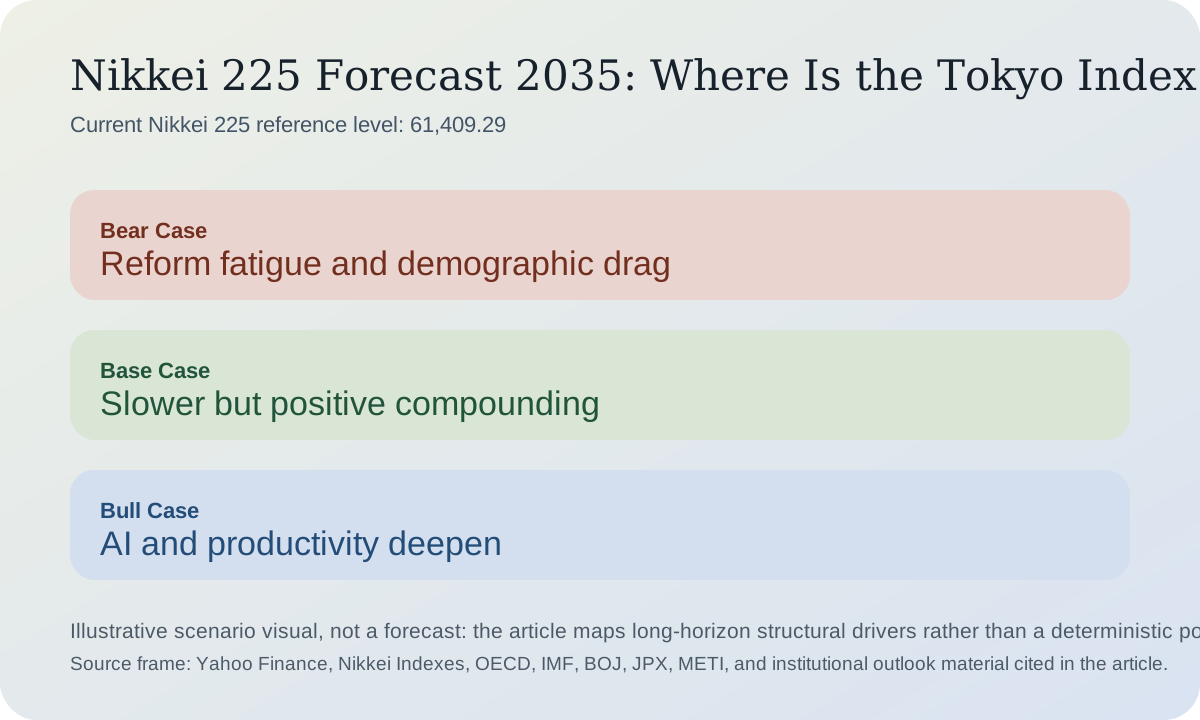
The bull case is 110,000 to 130,000 by 2035. This path requires successful productivity gains from AI and automation, continued capital-discipline reforms, strong semiconductor and testing demand, and no major debt or energy crisis that forces a regime reset.
Bearish scenario
The bear case is 50,000 to 65,000. That still does not require a collapse. It only requires modest macro growth, fading reform intensity, and a market that decides a few technology leaders cannot carry the entire benchmark forever.
Base-case scenario
The base case is 80,000 to 100,000. This scenario depends on reform staying alive, financials and industrials broadening the earnings stack, and Japan translating demographic pressure into productivity spending rather than stagnation.
Risks to watch
Watch labor-productivity data, capital-expenditure trends in semiconductors and automation, public-finance discipline, energy-import vulnerability, and whether the governance campaign continues to change boardroom behavior.
What could invalidate the forecast
The base range would be too high if demographics overwhelm productivity and if governance reform turns into a completed story rather than a compounding one. It would be too low if Japan becomes a bigger-than-expected beneficiary of AI infrastructure, digital sovereignty, and reshoring in strategic supply chains.
Conclusion
The 2035 Nikkei case is still positive, but it is fundamentally about quality of change, not momentum. Investors should think in terms of productivity, governance, and sector refresh rather than simple repetition of the last cycle.
Disclaimer: This article is for research and informational purposes only. Long-term scenario ranges are conditional estimates based on public information, not promises of future returns.
| Scenario | Range | Key conditions | Probability |
|---|---|---|---|
| Bull | 110,000-130,000 | Broad AI diffusion, stronger productivity, and durable reform | 20% |
| Base | 80,000-100,000 | Moderate long-run compounding with better capital discipline | 55% |
| Bear | 50,000-65,000 | Reform fatigue, demographic drag, and cyclical technology weakness | 25% |
| Path | Estimated probability | Why |
|---|---|---|
| Rising from current levels by 2035 | 55% | Japan still has structural reform and technology relevance working in its favor. |
| Falling below current levels by 2035 | 15% | A lower level after nine years likely needs structural policy and earnings disappointment. |
| Moving broadly sideways | 30% | Valuation digestion and uneven sector leadership could limit net progress. |
06. Investor Positioning
Long-horizon investors and traders should not use the same playbook
| Investor type | Cautious approach | What to watch |
|---|---|---|
| Investor already in profit | Let structural winners run, but rebalance if Japan has become a concentrated technology proxy. | Check whether gains still rest on the same two or three sectors. |
| Investor currently at a loss | Review whether the loss is cyclical or whether the structural thesis has weakened. | Do not average down only because the market is labeled a reform story. |
| Investor with no position | Build exposure over time instead of anchoring on a single 2035 target. | Long-run Japan works better as a staged allocation than a chase entry. |
| Trader | Treat the 2035 thesis as background, not as a substitute for risk control. | Near-term BOJ, yen, and semiconductor headlines still dominate shorter windows. |
| Long-term investor | Dollar-cost averaging and regular rebalancing remain the most defensible approach. | Monitor productivity, governance, and breadth rather than daily index noise. |
| Risk-hedging investor | Use currency and equity hedges if Japan is meant to be a strategic rather than tactical holding. | Imported energy shocks and abrupt yen moves are the key external risks. |
07. FAQ
Frequently asked questions about the 2035 Nikkei outlook
Is it realistic for the Nikkei to be above 100,000 by 2035?
Yes, but only in the more optimistic scenarios. It would likely require continued reform, strong productivity gains, and broader sector leadership than the market has today.
Why is the base case below the past 10-year CAGR?
Because the last decade started from a much lower base and benefited from a large initial rerating. Repeating that pace would be an aggressive assumption.
What is the biggest long-term threat to the Nikkei story?
The biggest threat is not one recession. It is a combination of demographic drag, energy vulnerability, and reform momentum fading before productivity fully improves.
References
Sources
- Yahoo Finance chart API for ^N225, 10-year monthly history
- Yahoo Finance chart API for ^N225, recent daily closes
- Nikkei Stock Average guidebook, July 2025 edition
- Nikkei Stock Average factsheet
- OECD economic snapshot for Japan
- OECD Economic Survey of Japan press release, May 13 2026
- IMF 2025 Article IV consultation with Japan
- IMF 2026 staff concluding statement for Japan
- Bank of Japan Outlook for Economic Activity and Prices, April 2026
- TSE draft revisions to the Corporate Governance Code, April 10 2026
- TSE action to implement management conscious of cost of capital and stock price
- METI GENIAC program overview
- METI outline of semiconductor revitalization
- Invesco 2026 investment outlook for Japan equities
- Goldman Sachs 2026 outlooks
- UBS House View with Japan rated Attractive
- S&P Global on Japanese megabanks and policy normalization