01. Quick Answer
The most defensible Nikkei 2027 view is a wide range because policy and global tech are pulling in opposite directions
The index closed at 61,409.29 on 2026-05-15, within a 52-week range of 36,855.83 to 63,799.32 (Yahoo Finance chart API for ^N225, recent daily closes; Yahoo Finance chart API for ^N225, 10-year monthly history). That alone argues against overconfidence. The market has huge momentum behind it, but it also sits far above where it traded only a year earlier.
For 2027, the evidence is mixed. BOJ materials and Tankan suggest underlying activity remains resilient. Yet OECD and the IMF are both careful about external shocks, energy costs, and fiscal or policy uncertainty. In practical terms, that makes 58,000 to 68,000 the most reasonable base-case range, with materially wider tails in both directions.
| Point | Why it matters |
|---|---|
| 2027 is mainly a policy-and-earnings debate | The next move depends more on BOJ execution and corporate earnings than on broad historical narratives. |
| AI still supports the index | Advantest and Tokyo Electron keep the Nikkei tied to global chip capex. |
| Energy and yen risk remain real | Japan is still exposed to imported inflation and FX volatility. |
| Probabilities are not one-sided | Analysts remain divided because the evidence supports both momentum and mean-reversion arguments. |
02. Historical Context
The near-term setup starts from an index that already did a lot of work
A short-horizon 2027 forecast still needs long-horizon discipline. The Nikkei entered May 2026 after already compounding from 15,575.92 in 2016 to 61,409.29 today (Yahoo Finance chart API for ^N225, 10-year monthly history). That means even a healthy 2027 outcome may look less dramatic than the last two years felt in real time.
The guidebook also matters for a 2027 call because price weighting increases the impact of a few stocks. A retailer like Fast Retailing (latest results) and semiconductor-linked names such as Advantest and Tokyo Electron can change the headline tone quickly, even if the broader Japanese equity market is behaving more calmly.
| Metric | Latest reading | Why it matters |
|---|---|---|
| Current index level | 61,409.29 | Sets the starting point for all 2027 scenarios. |
| 52-week low to high | 36,855.83 to 63,799.32 | Shows near-term upside and downside are both still plausible. |
| 10-year price CAGR | 14.78% | Reminds investors the benchmark may need a digestion period. |
| Editorial base range | 58,000-68,000 | Reflects a balanced near-term rather than euphoric framework. |
| Near-term variable | Why it matters now | Forecast effect |
|---|---|---|
| BOJ path | Markets are still adjusting to normalization | Can move both banks and growth multiples quickly. |
| Yen swings | FX volatility still changes earnings translation and import costs | Creates broader market sentiment shifts. |
| AI capex orders | Semiconductor equipment and testing remain headline sectors | Supports or weakens the index faster than GDP data does. |
| Energy shock risk | Japan remains exposed to imported energy costs | Can hit margins, inflation, and policy expectations at once. |
03. Main Drivers
Five near-term drivers are likely to dominate the 2027 path
1. BOJ communication and timing risk. The market can probably handle gradual normalization better than abrupt messaging shifts. BOJ and IMF both imply policy credibility matters as much as the level of rates themselves.
2. AI-linked capital spending. Advantest and Tokyo Electron remain among the clearest public-market channels into AI infrastructure demand. If global capex stays strong, 2027 upside remains plausible even without heroic domestic growth.
3. Domestic wage and consumption trends. OECD still sees growth moderating, which means wages must help domestic demand without becoming only a margin headwind. Retail and services names are a key check on whether normalization is broadening.
4. Financial-sector breadth. S&P Global expects the megabanks to keep benefiting from normalization. That matters because 2027 upside is healthier if it does not depend only on semiconductors.
5. Imported inflation and geopolitics. Energy costs and external conflict remain the cleanest path to a short-term downside scenario. That is why the probability table below gives meaningful weight to a falling or sideways market, not just another melt-up.
04. Institutional Forecasts and Analyst Views
Institutional views are positive on Japan, but far less certain on the exact 2027 trading range
Goldman and Invesco both remain constructive on Japanese equities because of domestic demand, corporate reform, and foreign-investor relevance. UBS also remains positive on Japan. But these are broad allocation views, not precise Nikkei 225 price targets.
That distinction matters because short-horizon index forecasting is more fragile. The evidence is mixed: the macro regime is better than in the old deflation era, but the market already priced much of that improvement. The near-term base case is therefore not a straight continuation of recent gains, but a market that can still rise modestly while absorbing volatility.
| Source | Main signal | 2027 implication |
|---|---|---|
| BOJ / Tankan | Activity remains resilient, but policy signaling matters | Supports moderate upside if normalization stays orderly. |
| OECD / IMF | Growth continues, though at a measured pace with clear external risks | Argues against extreme confidence in either direction. |
| Goldman / UBS / Invesco | Japan remains attractive as an equity allocation | Helps the bullish and base cases more than the bearish one. |
| Company disclosures | Semiconductor and bank earnings remain the clearest tactical proof points | Near-term rallies or pullbacks likely come through these groups first. |
05. Scenarios, Risks, and Invalidation
The 2027 setup deserves wide scenario bands because near-term catalysts can move quickly
Bullish scenario
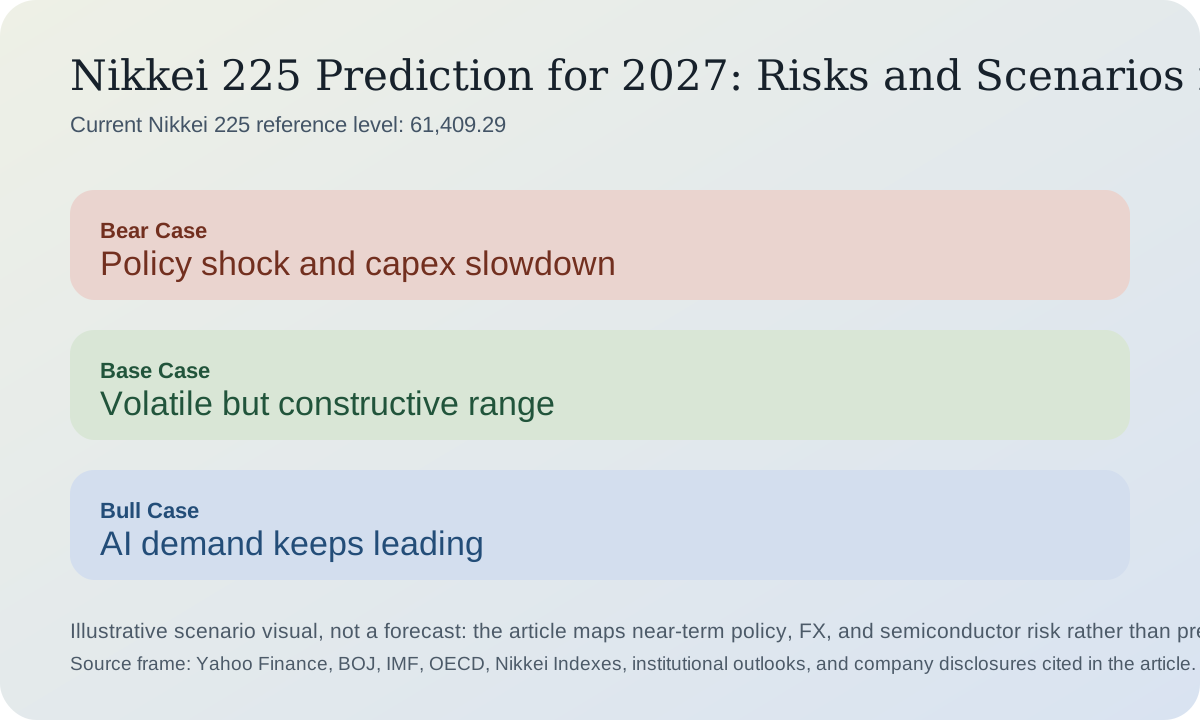
The bull case is 72,000 to 78,000. It requires strong AI-capex follow-through, a stable or only gently firmer yen, continued governance support, and no disruptive policy error from the BOJ.
Bearish scenario
The bear case is 42,000 to 52,000. That path would likely require a policy or energy shock, a deeper global technology slowdown, and a market rotation away from the most influential Nikkei names.
Base-case scenario
The base case is 58,000 to 68,000. It assumes Japan keeps enough earnings momentum to stay above current levels in parts of 2027, but not enough to justify another unchecked rerating.
Risks to watch
Watch BOJ meetings, wage data, oil prices, USD/JPY, semiconductor order commentary, and foreign-investor flow behavior.
What could invalidate the forecast
This range would be too conservative if Japan's reform story broadens into a genuinely wider earnings recovery and if AI demand keeps surprising to the upside. It would be too optimistic if imported inflation or policy volatility quickly tightens financial conditions.
Conclusion
The best Nikkei 2027 forecast is a disciplined range, not a slogan. Near-term Japan is investable, but it is also vulnerable to macro cross-currents that can overwhelm the narrative for months at a time.
Disclaimer: This article is for research and informational purposes only. Near-term scenarios and positioning ideas are conditional estimates, not personalized financial advice.
| Scenario | Range | Key conditions | Probability |
|---|---|---|---|
| Bull | 72,000-78,000 | AI-capex strength and smooth policy normalization | 25% |
| Base | 58,000-68,000 | Moderate earnings growth with volatility | 45% |
| Bear | 42,000-52,000 | Energy or policy shock plus tech weakness | 30% |
| Path | Estimated probability | Why |
|---|---|---|
| Rising from current levels by 2027 | 45% | Japan still has supportive structural factors, but much of the easy rerating is behind it. |
| Falling below current levels by 2027 | 25% | Downside remains meaningful because the starting point is high and macro shocks still matter. |
| Moving broadly sideways | 30% | Valuation digestion could offset continuing but uneven earnings growth. |
06. Investor Positioning
Near-term positioning should be more tactical than the long-run 2035 framework
| Investor type | Cautious approach | What to watch |
|---|---|---|
| Investor already in profit | Consider trimming into strength if the position has become too dependent on a handful of AI beneficiaries. | Use rebalancing rather than trying to call the exact top. |
| Investor currently at a loss | Do not average down automatically; reassess whether the near-term thesis still holds. | 2027 is especially sensitive to macro and policy shifts. |
| Investor with no position | Wait for pullbacks or scale in across several months. | Avoid chasing after sharp moves above the 52-week range. |
| Trader | Use stop-losses and clear time horizons. | BOJ headlines, USD/JPY, and semiconductor earnings are the key tactical catalysts. |
| Long-term investor | Keep some dry powder for volatility and use dollar-cost averaging. | Do not confuse a 2027 shakeout with a broken decade thesis. |
| Risk-hedging investor | Pair Japan exposure with currency or index hedges if downside volatility matters. | Energy shocks and sharp yen moves remain the main short-term threats. |
07. FAQ
Frequently asked questions about the Nikkei 2027 outlook
Why is the 2027 range so wide?
Because the Nikkei is starting from a high level and remains very exposed to policy messaging, yen moves, and a few large technology-linked leaders.
What matters more for 2027 than for 2035?
BOJ timing, energy shocks, and short-cycle semiconductor orders matter more over the next 12 to 18 months than broader demographic themes.
Can the Nikkei still rise if Japan's GDP growth is modest?
Yes. Governance reform, bank profitability, and technology earnings can support equities even if macro growth is only moderate.
References
Sources
- Yahoo Finance chart API for ^N225, 10-year monthly history
- Yahoo Finance chart API for ^N225, recent daily closes
- Nikkei Stock Average guidebook, July 2025 edition
- Bank of Japan Outlook for Economic Activity and Prices, April 2026
- Bank of Japan Tankan, March 2026 survey
- OECD Economic Survey of Japan press release, May 13 2026
- IMF 2026 staff concluding statement for Japan
- IMF 2025 Article IV consultation with Japan
- Goldman Sachs Japan Economic Outlook 2026
- Invesco 2026 investment outlook for Japan equities
- UBS House View with Japan rated Attractive
- S&P Global on Japanese megabanks and policy normalization
- Advantest financial review for fiscal year ended March 2026
- Tokyo Electron investor relations and FY2026 earnings release
- Fast Retailing FY2026 first-half results summary