01. Quick Answer
The 2035 Novartis forecast is less about one medicine and more about whether the company keeps proving it can industrialize innovation
Nine years is a long time in pharma. Any 2035 forecast for Novartis therefore has to be built on business model quality, not just on current products. The core question is whether Novartis can keep replacing patent losses with enough high-value launches to sustain superior cash flow and a premium valuation.
The evidence base is respectable. Novartis already targets 5% to 6% annual sales growth through 2030, says it has more than 30 potential high-value medicines in the pipeline, and continues to scale advanced platforms such as radioligand therapy and xRNA. That does not make 2035 easy to predict, but it does make range-based forecasting defensible.
| Point | Why it matters |
|---|---|
| The 2035 story is about platform durability | Long-range upside depends on whether Novartis remains a repeatable innovation engine, not just a beneficiary of one cycle. |
| Pipeline breadth lowers concentration risk | More than 30 potential high-value medicines provide more paths to success than a narrow franchise would. |
| Margin discipline still matters | Long-term total return requires both revenue replacement and operating control. |
| 2035 ranges should stay wide | Clinical, regulatory, pricing, and M&A uncertainty naturally widen long-duration outcomes. |
02. Historical Context
Novartis already behaves more like a quality compounder than many big-pharma peers, which is why the long-range case deserves attention
Over the last decade, Novartis produced a healthier price trajectory than many defensive European large caps, climbing from about CHF 67 to more than CHF 116 on a price-only basis. That is not proof of future success, but it does show the market has rewarded the company’s sharper post-Sandoz, pure-play innovative-medicines identity.
Operationally, 2025 was also strong: sales grew 8%, core operating income rose 14% in constant currencies, and free cash flow reached USD 17.6 billion. The Annual Report also reiterated long-term confidence in the company’s 5% to 6% sales growth outlook through the end of the decade, which is the most reasonable starting point for extending the story toward 2035.
| Metric | Latest sourced reading | Why it matters |
|---|---|---|
| 2025 free cash flow | USD 17.6 billion | Supports investment in R&D, bolt-on deals, buybacks, and dividends. |
| Dividend proposal for FY 2025 | CHF 3.70 per share | Important for long-duration total-return assumptions. |
| Growth pipeline | 30+ potential high-value medicines | Suggests broad replacement power if execution holds. |
| Readout cadence | 15+ potentially submission-enabling readouts in two years | Creates frequent opportunities for the 2035 thesis to improve or weaken. |
| Data point | Reading | Interpretation |
|---|---|---|
| 10-year start price | CHF 67.15 | Novartis started this period from a much lower multiple and different business mix. |
| Recent price | CHF 116.68 | Shows the market already recognizes a better-quality Novartis than in the mid-2010s. |
| Peak to date in period | CHF 130.50 | Indicates where current optimism has topped out so far. |
| Long-run business identity | Pure-play innovative medicines | Improves visibility for 2035 compared with a more diversified but less focused structure. |
03. Main Drivers
Five forces are most likely to define the 2035 outcome
1. Can Novartis keep renewing its revenue base?
This is the main long-range question. Pharma winners into 2035 will be the companies that replace patent losses repeatedly without destroying returns through excessive M&A or weak capital allocation.
2. Advanced platforms may matter more than single assets
Radioligand therapy, gene and cell therapy, and xRNA create optionality beyond today’s blockbuster lineup. That matters because platform strength can extend growth beyond one product cycle.
3. Commercial execution remains a moat
Novartis’ ability to scale launches such as Kisqali, Leqvio, and Pluvicto is critical. Strong science alone does not justify a premium 2035 valuation if commercialization underdelivers.
4. R&D economics across the sector remain relevant
Deloitte’s 2025 Switzerland pharma ROI work showed returns on R&D for the leading groups, including Novartis and Roche, rose to 5.9% in 2024 after a long slump. That suggests large-pharma innovation economics improved, but they remain far from guaranteed (Deloitte, 2025).
5. AI may gradually reshape the R&D engine
The 2035 horizon is long enough that AI-enabled discovery, development, and operations may matter materially. That does not replace biology or regulation, but it can improve throughput and portfolio quality at the margin.
| Lever | Latest evidence | Forecast impact |
|---|---|---|
| Pipeline replacement | 30+ potential high-value medicines | Core determinant of the long-term bull versus bear split. |
| Technology platforms | RLT, gene & cell therapy, xRNA prioritized for scale | Adds optionality beyond current blockbusters. |
| Capital allocation | Strong free cash flow and buyback capacity | Can enhance total return if used with discipline. |
| R&D productivity | Large-pharma innovation returns improved in recent studies | Supports a constructive, but not blind, long-duration outlook. |
04. Institutional Forecasts and Analyst Views
The strongest long-range evidence is business-model quality, not a narrow collection of short-term analyst targets
There are few credible public 2035 point targets for Novartis, and that is appropriate. A useful long-range forecast should instead extend from what is visible today: a published 2030 sales framework, platform scale, strong cash generation, and the company’s stated belief that its pipeline can support growth beyond 2030.
The biggest caveat is that pharma forecasts decay in precision quickly. Clinical outcomes, payer behavior, and new competitors can change the shape of the story. That is why the ranges below are intentionally broad and explicitly scenario-based.
| Source | What it says | Implication for NOVN |
|---|---|---|
| Novartis medium-term guidance | 5%-6% cc sales CAGR through 2030 | Provides the cleanest bridge into a long-range 2035 base case. |
| Annual Report 2025 | Confidence in growth beyond 2030 supported by 30+ high-value medicines | Supports a longer-duration compounding narrative. |
| Deloitte pharma ROI study | R&D returns improved in 2024 for the leading groups | Suggests sector innovation economics are healthier than in the late 2010s. |
| Reuters on Entresto erosion | 2026 shows how sharply patent loss can hit even a strong company | Justifies keeping a meaningful bear case in a 2035 framework. |
05. Scenarios
Bull, bear, and base-case ranges for 2035
The range below assumes Novartis remains a large-cap innovative medicines company with recurring patent cliffs but also recurring opportunities to replace them. The key question is whether execution stays above the industry average.
Editorial probabilities are intentionally moderate. Even very good pharma companies can spend years trapped between strong science and payer, regulatory, or clinical uncertainty.
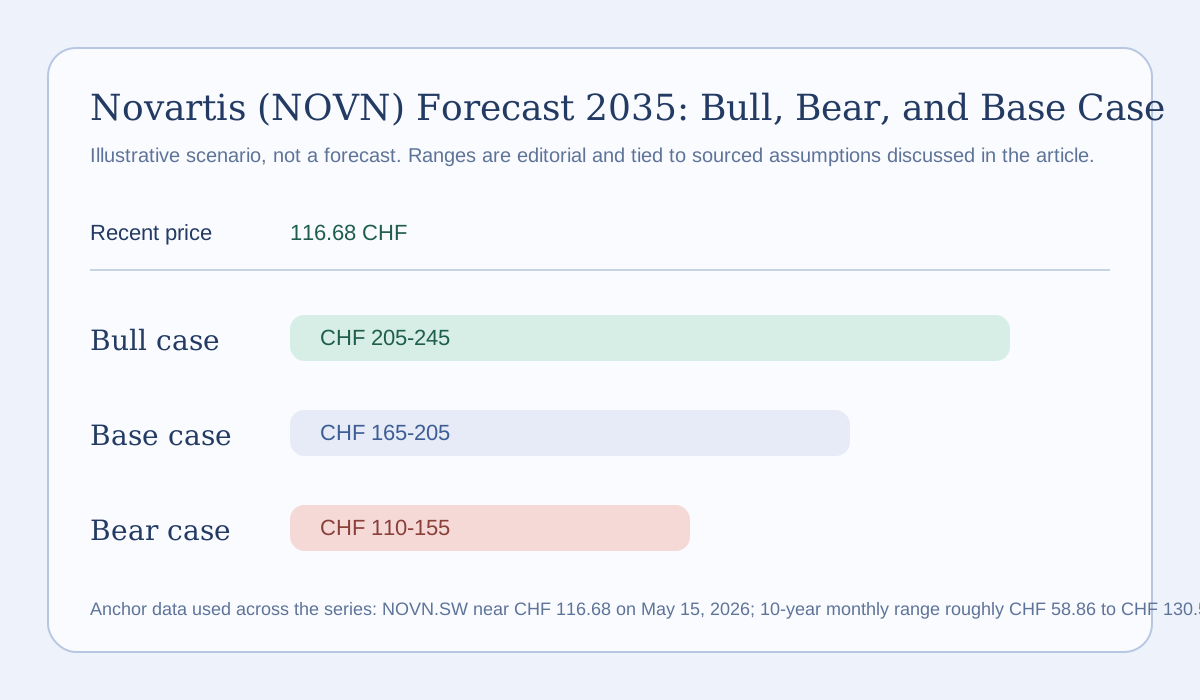
| Scenario | Range | What would likely drive it | Editorial probability |
|---|---|---|---|
| Bull | CHF 205-245 | Novartis repeatedly converts pipeline depth into durable franchises, scales advanced platforms, and sustains premium margins and shareholder returns. | 24% |
| Base | CHF 165-205 | The company compounds through steady innovation replacement, disciplined bolt-on deals, and healthy cash returns, but without a runaway rerating. | 51% |
| Bear | CHF 110-155 | Pipeline quality stays respectable but underwhelming, or the market discounts the company more heavily because of pricing, competition, or execution slippage. | 25% |
| Outcome | Probability | Interpretation |
|---|---|---|
| Rising | 49% | Long enough horizon for repeated innovation cycles to compound if Novartis keeps executing. |
| Falling | 20% | Possible if multiple pipeline cycles disappoint or pricing pressure intensifies. |
| Moving sideways | 31% | Still plausible because a mature pharma stock can deliver value mostly through dividends and moderate gains. |
| Risk | Why it matters | What to monitor |
|---|---|---|
| Clinical failure risk | Even broad pipelines can disappoint on pivotal readouts. | Late-stage trial outcomes and regulator commentary. |
| Payer and pricing pressure | Could cap the value of otherwise successful launches. | Reimbursement trends, U.S. policy, and net-price behavior. |
| M&A execution risk | Long horizons often include deals that can help or hurt. | Return profile of bolt-on acquisitions and integration outcomes. |
| Platform-scale risk | Manufacturing and delivery complexity can restrain advanced therapies. | RLT capacity, supply reliability, and commercialization execution. |
| Condition | Why it would change the view |
|---|---|
| Sustained above-plan growth beyond 2030 | That would justify a higher bull-range framework than modeled here. |
| Weak replacement after current launches mature | That would make the base case too optimistic because the compounding engine would be weaker than assumed. |
| Major structural changes to healthcare pricing | Those could materially alter long-range profitability assumptions for the entire pharma sector. |
06. Investor Positioning
How different investors might think about a 2035 Novartis horizon
A 2035 thesis favors patience, scenario thinking, and position sizing over excitement. The stock can still be attractive without behaving like a high-beta biotech.
| Investor type | Prudent stance | Why |
|---|---|---|
| Investor already in profit | Hold or rebalance, letting dividends and pipeline execution work over time | The 2035 case is strongest for patient capital. |
| Investor currently at a loss | Reevaluate the innovation thesis rather than anchoring on price alone | Long-range pharma investing works only if the scientific and commercial case still makes sense. |
| Investor with no position | Build slowly, especially around readout-driven weakness | Pharma volatility often creates better entries than steady uptrends suggest. |
| Trader | Treat NOVN as an event-driven compounder, not a pure momentum stock | Long-duration upside does not eliminate short-term readout risk. |
| Long-term investor | Watch free cash flow, pipeline replacement, and capital allocation discipline | Those three factors do most of the work in a 2035 model. |
| Risk hedger | Use diversified hedges, then let Novartis serve as part of a quality-healthcare sleeve | Even good pharma names can suffer product-specific drawdowns. |
07. Conclusion
The 2035 Novartis case is strongest when treated as a disciplined innovation-compounding story
Novartis has a better long-range foundation than many global healthcare majors: a focused business model, clear therapy priorities, strong cash generation, advanced platforms, and a published sales-growth ambition through 2030.
What keeps the forecast balanced is the nature of pharma itself. Patent cliffs, pricing risk, and clinical uncertainty never disappear. That is why the 2035 story still looks attractive through scenarios rather than through certainty.
Disclaimer: This article is an editorial scenario analysis based on public information available as of May 16, 2026. It is not personalized investment advice, and the ranges above should be read as conditional outcomes rather than promises.
08. FAQ
Frequently asked questions
What is a realistic 2035 base case for Novartis?
A reasonable base case is roughly CHF 165 to CHF 205, assuming Novartis continues replacing patent losses with enough new launches and supports total return with cash generation and dividends.
Why is the 2035 range so wide?
Because long-duration pharma outcomes depend on many variables, including clinical success, payer behavior, competition, manufacturing scale, and capital allocation.
What would push Novartis toward the bull case?
Repeated pipeline conversion, stronger platform scale in areas like radioligand therapy, and sustained premium margins would all improve the odds.
What is the biggest bear risk over such a long horizon?
The biggest risk is not one failed asset. It is a pattern of under-replacement in which patent losses outpace innovation gains for several years.
References
Sources
- Yahoo Finance chart API for NOVN.SW 10-year monthly price history and recent price data
- Novartis annual results hub
- Novartis Annual Report 2025 landing page
- Novartis Annual Report 2025 PDF
- Novartis quarterly results hub
- Novartis Q1 2026 press release
- Novartis Q1 2026 interim financial report PDF
- Novartis mid-term outlook update, November 20, 2025
- Novartis San Diego research center press release
- Novartis Carlsbad radioligand therapy manufacturing press release
- Novartis remibrutinib positive CHMP opinion press release
- Novartis ianalumab FDA Breakthrough Therapy designation press release
- Deloitte Switzerland pharma R&D return study, 2025
- Interpharma Annual Report 2025
- Reuters coverage of Novartis Q1 2026 generic erosion