01. Quick Answer
A realistic 2030 Novartis forecast is constructive because the company already has visible replacement power, but it still needs execution
Unlike many mature European defensives, Novartis is not trying to sell investors on stability alone. The company is explicitly arguing that a strong in-market portfolio, 30-plus potential high-value pipeline medicines, and more than 15 potentially submission-enabling readouts over two years can support 5% to 6% constant-currency annual sales growth through 2030 (Novartis, Nov. 20, 2025).
That is a stronger starting point than many large pharma peers can claim. The caution is that 2026 is still a transition year: Q1 sales fell 5% at constant currencies because U.S. generic erosion, especially Entresto, more than offset growth elsewhere. Available data suggests the 2030 thesis remains credible, but it depends heavily on launches and pipeline conversion, not on defensive reputation alone.
| Point | Why it matters |
|---|---|
| Novartis has one of the clearer 2030 growth frameworks in large-cap pharma | The company has published a 2025-2030 sales outlook and tied it to named growth brands and a broad pipeline. |
| The patent cliff is real, but so is replacement power | Entresto erosion is hurting 2026, yet Kisqali, Pluvicto, Scemblix, Leqvio, and pipeline assets offer a measurable offset path. |
| Swiss pharma conditions still matter | Switzerland remains a leading pharma hub, but cost-pressure debates and investment competition remain part of the backdrop. |
| 2030 should be framed as a range, not a single target | Pipeline readouts, reimbursement dynamics, and launch uptake can shift valuation materially over four years. |
02. Historical Context
Novartis has already delivered better long-run share performance than many European defensives, but its next phase will be judged on innovation replacement
NOVN.SW moved from about CHF 67.15 in May 2016 to roughly CHF 116.68 in mid-May 2026 based on Yahoo monthly data, with a 10-year price CAGR of about 5.71%. The monthly range ran from a low near CHF 58.86 in October 2016 to a high around CHF 130.50 in January 2026. That is a much stronger equity record than many defensive European names, but it also means the market already prices in meaningful confidence.
The operating backdrop is similarly robust. Novartis reported 2025 net sales of USD 54.5 billion, core operating income of USD 21.9 billion, and free cash flow of USD 17.6 billion, while the Annual Report emphasized more than 300 million patients reached and a pipeline with more than 30 potential high-value medicines (Annual Report 2025).
| Metric | Latest sourced reading | Why it matters |
|---|---|---|
| FY 2025 net sales | USD 54.5 billion | Shows the size of the earnings base that supports the 2030 forecast. |
| FY 2025 core operating income | USD 21.9 billion | Supports the argument that Novartis enters the patent-loss cycle from a position of strength. |
| Q1 2026 net sales | USD 13.1 billion, down 5% cc | Highlights the near-term hit from U.S. generic erosion. |
| Q1 2026 free cash flow | USD 3.3 billion | Even in a pressured quarter, cash generation remained solid. |
| Data point | Reading | Interpretation |
|---|---|---|
| 10-year start price | CHF 67.15 | Novartis began this period from a lower base before its pure-play innovative medicines rerating. |
| Recent price | CHF 116.68 | The market is already rewarding quality and pipeline credibility to some extent. |
| 10-year peak | CHF 130.50 in January 2026 | A useful marker for how much optimism the market can price before new data arrive. |
| 10-year CAGR | About 5.71% | Suggests reasonable long-run compounding power, though not immunity from clinical or patent risk. |
03. Main Drivers
The 2030 path will be shaped by launch execution, patent replacement, Swiss pharma competitiveness, and Novartis’ technology platforms
1. Growth drivers are already visible in-market
Novartis is not relying only on future pipeline hope. Q1 2026 showed continued strong growth from Kisqali, Pluvicto, Kesimpta, Scemblix, and Leqvio, even as group sales declined because of U.S. generics. That matters because it gives investors tangible proof of replacement power.
2. Pipeline depth is unusually important now
The company’s 2025-2030 outlook explicitly leans on 15-plus potentially submission-enabling readouts in two years and more than 30 potential high-value medicines. For a pharma stock, that is the core bridge between current valuation and 2030 expectations.
3. Radioligand therapy is a differentiated platform
Novartis continues to describe itself as the only pharmaceutical company with a dedicated commercial radioligand therapy portfolio, supported by an expanding U.S. manufacturing footprint. That gives the oncology franchise both strategic depth and supply-chain relevance.
4. Swiss pharma remains strong, but policy competition matters
Interpharma’s 2025 annual report still frames Switzerland as the leading pharma hub in Europe by 2030, but it also warns that investment conditions are no longer guaranteed. For Novartis, that means Swiss quality remains an asset, while regulatory and policy competitiveness still need to be watched (Interpharma, 2025).
5. Pharma demand still has structural support into 2030
IQVIA’s 2026 medicine-use outlook expects global medicine spending to keep growing through 2030, driven by innovative launches in oncology, immunology, neurology, and other specialty areas. That does not guarantee Novartis-specific success, but it strengthens the sector backdrop for high-value launches (IQVIA, 2026).
| Lever | Latest evidence | Forecast impact |
|---|---|---|
| In-market growth brands | Kisqali, Pluvicto, Kesimpta, Scemblix and Leqvio all posted strong Q1 2026 constant-currency growth | Supports the 2030 bull and base cases if the trajectory holds. |
| Pipeline depth | 30+ potential high-value medicines and 15+ readouts in two years | Provides replacement power against losses of exclusivity. |
| RLT platform | Dedicated commercial portfolio with expanding U.S. manufacturing network | Can support durable oncology growth and strategic differentiation. |
| Swiss pharma environment | Strong innovation hub, but increasing debate over competitiveness and access | Mostly affects longer-term valuation confidence and capital-allocation flexibility. |
04. Institutional Forecasts and Analyst Views
The institutional evidence supports a constructive 2030 range, but the quality of that range depends on launch conversion and patent management
The best institutional anchor for 2030 is not a scatter of unofficial price targets. It is Novartis’ own medium-term framework, which calls for 5% to 6% constant-currency annual sales growth from 2025 to 2030 and expects a return to 40%-plus core operating margins by 2029 after acquisition dilution. That framework is stronger than a generic “defensive pharma” narrative because it names both the growth engines and the risks.
The market is still testing that framework. Reuters reported that the Q1 2026 sales miss reflected fiercer-than-expected U.S. generic erosion for Entresto, and Vontobel analysts reportedly viewed the sales shortfall through that lens. That makes a 2030 range more credible than a precise target: the evidence is constructive, but it is not risk-free.
| Source | What it says | Implication for NOVN |
|---|---|---|
| Novartis 2025-2030 outlook | 5%-6% cc sales CAGR and return to 40%+ margins by 2029 | Strongest official base for long-term scenario construction. |
| Annual Report 2025 | 30+ potential high-value medicines and 15 submission-enabling readouts over two years | Supports the view that replacement power is not just marketing language. |
| Reuters on Q1 2026 | Generic erosion in the U.S. was fiercer than expected | Explains why near-term volatility still deserves material probability. |
| IQVIA and Interpharma | Sector innovation remains supportive, while Swiss competitiveness still needs protection | Helps frame the broader pharma and Swiss-market backdrop into 2030. |
05. Scenarios
Bull, base, and bear-case ranges for Novartis through 2030
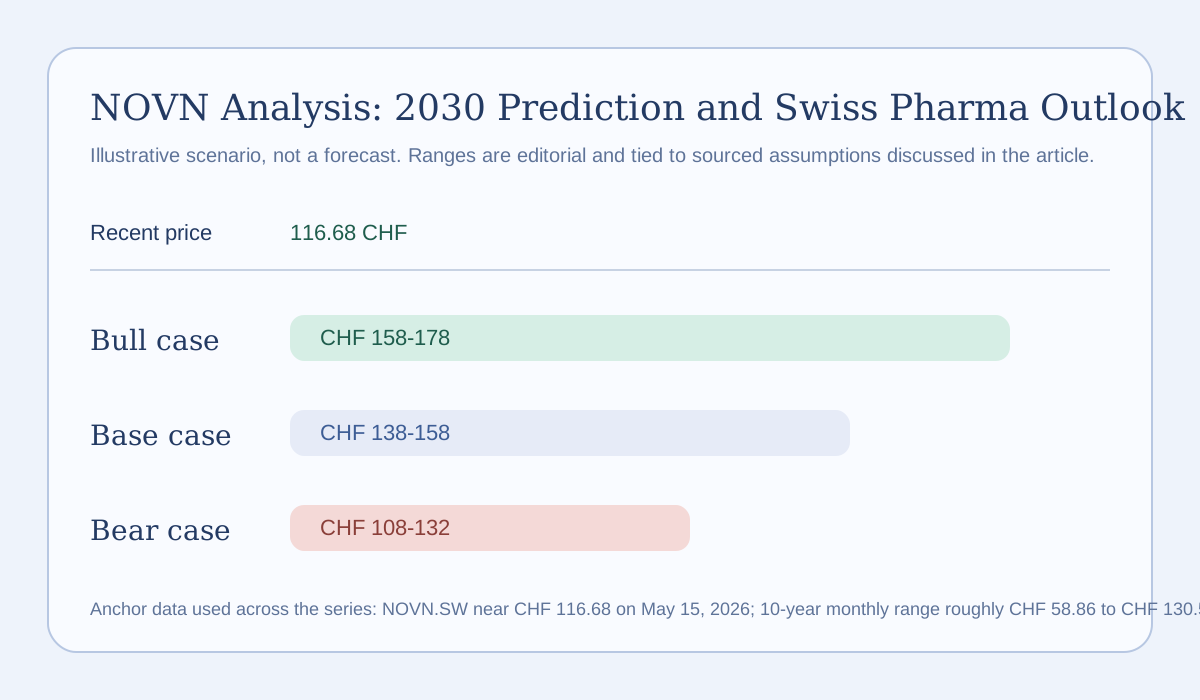
The range below is based on three layers of evidence: the actual 10-year price and operating history, the company’s published 2025-2030 growth framework, and the fact that 2026 is proving how disruptive large U.S. losses of exclusivity can be even for a strong pipeline company. The result is a constructive but not carefree forecast.
Editorial probabilities reflect how often a large pharma stock with visible launches, real cash flow, and a patent headwind tends to trade between execution proof points. Rising odds improve if growth brands and pipeline approvals consistently offset Entresto. Falling odds increase if launches or reimbursement underdeliver.
| Scenario | Range | What would likely drive it | Editorial probability |
|---|---|---|---|
| Bull | CHF 158-178 | Growth brands exceed expectations, remibrutinib and other pipeline assets land well, RLT manufacturing supports scale, and Novartis sustains a premium quality multiple. | 27% |
| Base | CHF 138-158 | Novartis broadly meets its sales-CAGR framework, absorbs patent losses, and compounds steadily on pipeline execution and capital returns. | 49% |
| Bear | CHF 108-132 | Generic drag lingers longer, pipeline conversion disappoints, or the market pays less for large-cap pharma quality. | 24% |
| Outcome | Probability | Interpretation |
|---|---|---|
| Rising | 47% | Supported by named growth brands, pipeline depth, and an official 2030 sales framework. |
| Falling | 22% | Still meaningful because patent cliffs and clinical setbacks can reset pharma valuations quickly. |
| Moving sideways | 31% | Plausible if the market waits for more readouts before extending the rerating. |
| Risk | Why it matters | What to monitor |
|---|---|---|
| Entresto and other patent erosion | Can overwhelm good launch momentum in specific years. | U.S. prescription trends, legal developments, and management commentary on erosion pace. |
| Pipeline disappointments | Long-range pharma forecasts depend on approvals and label expansions actually landing. | Phase III readouts, regulatory filings, and launch uptake. |
| Manufacturing and supply risk | RLT and biologics platforms need dependable supply to capture demand. | Network expansion, service levels, and any FDA or quality issues. |
| Pricing and reimbursement pressure | Affects both current brands and future launch economics. | U.S. policy moves, payer behavior, and Swiss or EU access debates. |
| Condition | Why it would change the view |
|---|---|
| Faster-than-expected approval and launch conversion across the pipeline | That would make the base case too conservative and justify a higher bull probability. |
| More severe-than-expected patent erosion or pricing pressure | That would lower the expected earnings bridge into 2030 and compress the range. |
| Major strategic or capital-allocation changes | A much larger M&A shift or portfolio restructuring could make this framework stale. |
06. Investor Positioning
How different investors might think about the 2030 NOVN setup
Novartis looks more like a disciplined long-horizon compounder than a pure momentum stock. That supports cautious positioning rather than aggressive one-way bets.
| Investor type | Prudent stance | Why |
|---|---|---|
| Investor already in profit | Hold or rebalance, but avoid assuming the 2025 rerating guarantees a straight line higher | 2030 upside exists, yet patent and pipeline volatility remain part of the journey. |
| Investor currently at a loss | Reassess the thesis around launches and pipeline replacement rather than anchoring on an old price | Novartis can still be a valid hold if the innovation case remains intact. |
| Investor with no position | Accumulate gradually or wait for readout-driven pullbacks | Pharma volatility often creates better entries than defensive headlines suggest. |
| Trader | Use stop-losses and distinguish between event-driven corrections and broader bear trends | Clinical and earnings catalysts can move the stock quickly in both directions. |
| Long-term investor | Focus on launch trajectories, free cash flow, and whether the 5%-6% sales framework remains credible | Those are the real 2030 drivers. |
| Risk hedger | Use broader hedges instead of assuming Novartis alone is defensive protection | Drug-specific events can still hit even high-quality pharma names. |
07. Conclusion
Novartis has one of the cleaner large-cap pharma stories into 2030, but the stock still has to earn each step of the next rerating
The evidence as of May 16, 2026 is favorable. Novartis has visible growth brands, strong cash flow, a broad pipeline, and a published medium-term outlook that appears more specific than many peers’ narratives.
The limiting factor is execution. Patent erosion, pricing pressure, and clinical uncertainty mean the stock should still be analyzed through scenarios. On that basis, the base case remains constructive, but not unconditional.
Disclaimer: This article is an editorial scenario analysis based on public information available as of May 16, 2026. It is not personalized investment advice, and the ranges above should be read as conditional outcomes rather than promises.
08. FAQ
Frequently asked questions
What is a realistic 2030 Novartis base case?
A reasonable 2030 base case is roughly CHF 138 to CHF 158 if Novartis broadly delivers on its 5% to 6% constant-currency sales framework and keeps margins resilient.
Why does the Swiss pharma outlook matter for NOVN?
Because Switzerland remains a major pharma innovation and manufacturing hub, but policy competitiveness and patient-access frameworks still influence long-term confidence and investment quality.
What is the biggest risk to the Novartis 2030 thesis?
The biggest risk is not one weak quarter. It is a combination of stronger-than-expected generic erosion and weaker-than-expected pipeline conversion.
Does Novartis have enough pipeline to offset Entresto?
Available data suggests it may, but that depends heavily on launches, approvals, and sustained uptake in products such as Kisqali, Pluvicto, Leqvio, and late-stage pipeline assets.
References
Sources
- Yahoo Finance chart API for NOVN.SW 10-year monthly price history and recent price data
- Novartis annual results hub
- Novartis Annual Report 2025 landing page
- Novartis Annual Report 2025 PDF
- Novartis quarterly results hub
- Novartis Q1 2026 press release
- Novartis Q1 2026 interim financial report PDF
- Novartis mid-term outlook update, November 20, 2025
- Novartis San Diego research center press release
- Novartis Carlsbad radioligand therapy manufacturing press release
- Novartis remibrutinib positive CHMP opinion press release
- Novartis ianalumab FDA Breakthrough Therapy designation press release
- Interpharma Annual Report 2025
- IQVIA U.S. Medicine Use Trends 2026
- Reuters coverage of Novartis Q1 2026 generic erosion