01. Quick Answer
The 2027 Novartis call will be driven by a handful of identifiable catalysts rather than distant strategic abstractions
The most important thing about a 2027 Novartis forecast is that the market already knows the main debate: can the company move past the Entresto shock quickly enough for launches and pipeline wins to dominate the narrative again?
The early evidence is mixed but workable. Q1 2026 showed a clear hit from U.S. generics, yet growth drivers were still up 34% at constant currencies and management reaffirmed full-year guidance. That makes 2027 a catalyst year, not a blank-page year.
| Point | Why it matters |
|---|---|
| 2027 is a transition-to-proof horizon | Investors will want confirmation that launch strength is not just masking temporary erosion elsewhere. |
| Kisqali and Pluvicto are central | Those franchises do a large share of the work in the medium-term growth story. |
| Pipeline readouts still matter materially | 2027 valuation can improve or weaken quickly based on regulatory and clinical milestones. |
| Entresto remains the main negative anchor | The faster the market sees the erosion normalize, the stronger the 2027 upside case becomes. |
02. Historical Context
Novartis enters the 2027 window with a stronger strategic identity but a very visible near-term headwind
The stock’s 10-year climb into the CHF 116 area shows that the market believes Novartis is better positioned than many large pharma peers. But 2026 also demonstrates how quickly that confidence can be tested when a blockbuster loses exclusivity.
That is why 2027 matters more than a generic “long term” label. It is the first period in which investors should be able to judge whether current launches, new approvals, and manufacturing scale are truly replacing the U.S. generic drag rather than just cushioning it.
| Metric | Latest sourced reading | Why it matters |
|---|---|---|
| Q1 2026 priority-brand performance | Kisqali +55%, Pluvicto +70%, Scemblix +79%, Leqvio +69% cc | These are the clearest positive operating catalysts for 2027. |
| Q1 2026 net sales guidance | Low single-digit sales growth for FY 2026 reaffirmed | Gives the market a baseline expectation from which 2027 can be judged. |
| Innovation milestones | Remibrutinib, ianalumab, Fabhalta, Itvisma progress | Pipeline data can alter the medium-term narrative quickly. |
| Buyback capacity | USD 10 billion program announced in July 2025, with USD 6.1 billion still to execute after Q1 2026 | Supports capital-return sentiment if execution remains solid. |
| Data point | Reading | Interpretation |
|---|---|---|
| Recent share anchor | CHF 116.68 | Useful base for 2027 because it already reflects both quality and transition risk. |
| 52-week range | CHF 91.06-131.00 | Shows that even a strong pharma name can move widely around results and patent events. |
| Q1 2026 pressure point | Entresto-led U.S. generic erosion | Main reason some investors remain cautious despite pipeline strength. |
| Growth-driver foundation | 34% cc growth in Q1 2026 | Main reason others think the stock can work through the overhang. |
03. Main Drivers
Five catalysts should dominate the 2027 NOVN setup
1. Entresto erosion has to become better understood
The bear case remains strongest if U.S. generic erosion keeps surprising negatively. Reuters highlighted the Q1 2026 miss as sharper-than-expected pressure from Entresto, so investors need evidence that the drag is becoming more forecastable.
2. Kisqali’s trajectory is one of the biggest upside levers
Novartis raised its peak-sales view for Kisqali to more than USD 10 billion in late 2025. That makes continued commercial execution in breast cancer one of the clearest reasons the 2027 stock could rerate.
3. Pluvicto and radioligand scaling matter strategically and financially
RLT capacity expansion in California, Florida, Texas, and Indianapolis is not just infrastructure theater. It directly affects whether Novartis can keep serving growing oncology demand and reinforce its platform moat.
4. Remibrutinib and immunology data can widen the story
Positive CHMP opinion in CSU and encouraging additional data expand the addressable medium-term opportunity. If launched well, remibrutinib could improve how investors value Novartis’ immunology pipeline.
5. Capital allocation and buybacks can support downside control
Strong free cash flow and an active buyback do not replace growth, but they do matter for how the stock trades through transition periods.
| Lever | Latest evidence | Forecast impact |
|---|---|---|
| Entresto normalization | Main source of 2026 pressure | Could materially change sentiment if the drag becomes easier to absorb by 2027. |
| Kisqali | Peak-sales guidance upgraded to USD 10 billion+ | Major positive driver for the bull case. |
| Pluvicto / RLT | 70% cc growth in Q1 2026 and manufacturing expansion underway | Supports both revenue growth and strategic differentiation. |
| Remibrutinib and immunology | Positive regulatory and clinical progress in 2026 | Adds incremental upside if approvals and launch execution follow. |
04. Institutional Forecasts and Analyst Views
The clearest 2027 evidence comes from known launch math and near-term pipeline events rather than distant valuation theory
For 2027, investors do not need to guess the whole future. They need to judge whether current launches, new approvals, and platform investments are overtaking the generic drag quickly enough.
That makes 2027 unusually measurable for a pharma stock. If growth drivers remain strong and the patent headwind becomes less dominant, the shares can justify a better range. If not, the stock may spend longer digesting its own optimism.
| Source | What it says | Implication for NOVN |
|---|---|---|
| Q1 2026 report | Growth drivers up 34% cc while group sales fell 5% cc | Defines the current tension at the heart of the 2027 thesis. |
| November 2025 outlook update | Higher peak-sales guidance for Kisqali and Scemblix plus 15+ readouts ahead | Gives the market concrete reasons to stay constructive into 2027. |
| Reuters Q1 coverage | Entresto erosion was fiercer than expected | Keeps a healthy level of caution in the base case. |
| Regulatory milestones | Remibrutinib, ianalumab, Itvisma, Fabhalta developments in 2026 | Could improve the medium-term narrative if momentum continues. |
05. Scenarios
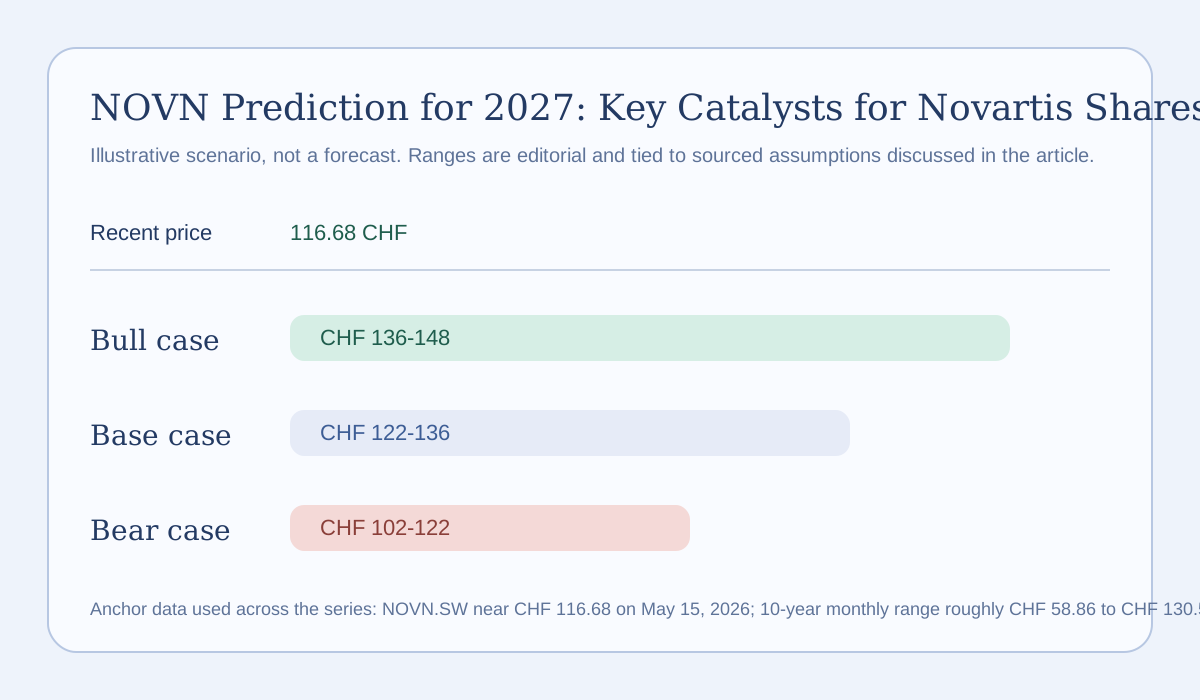
Bull, base, and bear-case ranges for 2027
The scenario construction here starts with today’s stock price and then asks how much of the current patent-loss fear should still matter by 2027. The answer depends on execution more than on macro.
Editorial probabilities are tied to whether launch growth remains strong, whether new approvals arrive on schedule, and whether the market sees 2026 as a temporary transition rather than a longer reset.
| Scenario | Range | What would likely drive it | Editorial probability |
|---|---|---|---|
| Bull | CHF 136-148 | Growth brands stay hot, remibrutinib and other launches add confidence, and Entresto drag becomes easier to model. | 29% |
| Base | CHF 122-136 | Novartis works through the patent hit with strong launches and decent capital returns, but the market stays selective. | 46% |
| Bear | CHF 102-122 | Generic erosion lingers or readouts fail to improve confidence fast enough. | 25% |
| Outcome | Probability | Interpretation |
|---|---|---|
| Rising | 46% | Medium-term upside is plausible because the launch portfolio is already visible and strong. |
| Falling | 24% | Still meaningful because U.S. patent loss can stay painful longer than bulls want. |
| Moving sideways | 30% | Possible if good and bad catalysts offset each other. |
| Risk | Why it matters | What to monitor |
|---|---|---|
| Steeper generic erosion | Would weigh on sales and confidence longer than expected. | U.S. market share, script trends, and management commentary. |
| Launch uptake disappoints | Would weaken the replacement-power argument. | Kisqali, Leqvio, Pluvicto, and remibrutinib uptake markers. |
| Clinical or regulatory delays | Would delay the valuation uplift from pipeline assets. | Regulatory calendars, CHMP/FDA milestones, and trial timing. |
| Pricing pressure | Could cap the commercial upside of otherwise successful medicines. | Net pricing, reimbursement wins, and payer restrictions. |
| Condition | Why it would change the view |
|---|---|
| Much faster than expected launch conversion | That would push the stock toward the bull range sooner than modeled here. |
| Multiple readout disappointments or new supply issues | That would make the current base case too optimistic for 2027. |
| Major portfolio change or larger M&A pivot | That could reset earnings expectations enough to invalidate the current framework. |
06. Investor Positioning
How different investors might respond to the 2027 catalyst setup
Because 2027 is catalyst-heavy, investor behavior should be driven by scenario discipline rather than conviction alone.
| Investor type | Prudent stance | Why |
|---|---|---|
| Investor already in profit | Hold or trim selectively into sharp rerating spikes | Medium-term upside exists, but catalyst-driven stocks can overshoot. |
| Investor currently at a loss | Wait for stronger evidence that launch math is outrunning the patent drag before averaging down heavily | 2027 depends on proof, not just patience. |
| Investor with no position | Build in stages or wait for event-driven weakness | Clinical and earnings volatility can create better entries. |
| Trader | Trade around defined catalysts and use stop-loss discipline | Readouts and earnings can produce abrupt repricings. |
| Long-term investor | Use 2027 as a checkpoint for the 2030 and 2035 thesis | Strong 2027 execution meaningfully improves longer-term confidence. |
| Risk hedger | Hedge broader market exposure separately and focus on company-specific event risk | Novartis risk is not purely macro. |
07. Conclusion
The 2027 Novartis forecast is fundamentally a verdict on replacement power
If investors see 2026 as the trough year for the Entresto shock and 2027 as the period when launches clearly take over, the stock can work well from here.
If that handoff remains messy, the stock may need more time. That is why the best 2027 framework focuses on a small set of measurable catalysts rather than broad pharma generalizations.
Disclaimer: This article is an editorial scenario analysis based on public information available as of May 16, 2026. It is not personalized investment advice, and the ranges above should be read as conditional outcomes rather than promises.
08. FAQ
Frequently asked questions
What is the biggest catalyst for Novartis shares into 2027?
The biggest catalyst is whether launch growth, especially from Kisqali and Pluvicto, overtakes the remaining drag from Entresto generics.
Why is 2027 such an important horizon?
Because it is close enough for today’s known launches and readouts to matter, yet far enough away for the current patent hit to be better absorbed if the strategy is working.
Could Novartis still do well if Entresto erosion remains painful?
Yes, but the stock would likely need stronger launch execution and pipeline wins to offset the headwind convincingly.
What would make the 2027 prediction too bullish?
Persistent erosion, weaker commercial uptake, or delayed readouts would all make the current base and bull cases too optimistic.
References
Sources
- Yahoo Finance chart API for NOVN.SW 10-year monthly price history and recent price data
- Novartis annual results hub
- Novartis Annual Report 2025 landing page
- Novartis Annual Report 2025 PDF
- Novartis quarterly results hub
- Novartis Q1 2026 press release
- Novartis Q1 2026 interim financial report PDF
- Novartis mid-term outlook update, November 20, 2025
- Novartis San Diego research center press release
- Novartis Carlsbad radioligand therapy manufacturing press release
- Novartis remibrutinib positive CHMP opinion press release
- Novartis ianalumab FDA Breakthrough Therapy designation press release
- Novartis Itvisma positive CHMP opinion press release
- Reuters coverage of Novartis Q1 2026 generic erosion and expectations
- Novartis AAD 2026 immunology data release