01. Quick Answer
The clearest 2027 Nvidia framework is a catalyst map, not a one-sentence AI narrative
By 2027, Nvidia’s stock will probably be judged on a compact set of variables: how smoothly Blackwell ramps, how convincingly Rubin bookings appear, whether hyperscaler and sovereign spending stays elevated, whether China contributes meaningful revenue, and whether inference economics reinforce or dilute Nvidia’s moat. That makes 2027 close enough for catalyst timing to matter, but still far enough away that one quarter cannot settle the debate.
| Category | Evidence-based read | Implication |
|---|---|---|
| Historical data | Nvidia has moved from a GPU supplier to a full AI infrastructure platform | Supports a structurally larger addressable market than in past cycles |
| Current market conditions | Demand remains unusually strong, but expectations remain unusually high | Forecast ranges should stay wide and scenario-based |
| Institutional signals | Reuters and S&P both show strong demand with visible debate on competition and capex sustainability | Analysts remain constructive, but not unanimous |
| Most important watchpoints | Blackwell and Rubin ramps, margin quality, customer concentration, China, and inference economics | These variables will likely shape the stock range more than headline excitement alone |
02. Historical Context
Nvidia’s long-run story is no longer a normal semiconductor cycle, but it is still exposed to cycle logic
Nvidia has become the clearest public-market proxy for large-scale AI infrastructure, yet that does not mean the stock has escaped cyclical risk. Its fiscal 2026 results showed revenue of $215.9 billion and Data Center growth of 68% for the full year, numbers that would have seemed implausible only a few years ago. But history matters precisely because the market often forgets that even category-defining chip companies can face pauses, digestion phases, and valuation resets when customers over-order, supply chains rebalance, or new competition changes the economics of the stack.
| Metric | Latest official reading | Why it matters |
|---|---|---|
| Quarterly revenue | $68.1 billion in Q4 FY2026 | Shows demand remains extraordinary into the Blackwell transition |
| Data Center revenue | $62.3 billion in Q4 FY2026 | Confirms AI infrastructure is carrying the entire story |
| Gross margin | 75.0% GAAP in Q4 FY2026 | Reinforces pricing power, but also invites scrutiny around durability |
| Capital return | $41.1 billion returned in fiscal 2026 | Shows balance-sheet strength even while investment needs stay high |
03. Main Drivers
Five forces are most likely to shape Nvidia’s stock path over the next several years
1. Hyperscaler and sovereign AI capex remains the core demand engine
Reuters described Nvidia’s results as a scoreboard for whether hundreds of billions of dollars of data-center spending are still converting into real demand. As long as hyperscalers, sovereign clouds, and AI factories continue ordering at scale, Nvidia remains the primary beneficiary.
2. The Blackwell-to-Rubin roadmap matters more than one quarter of Hopper digestion
Official Nvidia commentary keeps emphasizing a multi-generation product cycle rather than a one-chip story. That matters because the market is increasingly pricing Nvidia as a systems platform, not only as a GPU vendor.
3. Inference economics and software stickiness can widen the moat
Dynamo, NVLink, CUDA, networking, and full-rack systems all point to the same strategy: turn raw silicon demand into platform dependence. That is one of the strongest arguments for why Nvidia’s leadership may last longer than prior semiconductor peaks.
4. China and export controls remain a live swing factor
Reuters reporting in March and May 2026 showed how quickly the China opportunity can move from constrained to partially reopened and back into uncertainty. Even limited H200 approvals matter because China is both a revenue lever and a strategic risk variable.
5. Competition, custom silicon, and memory constraints still matter even in a bull market
Available data suggests Nvidia’s dominance remains intact, but not uncontested. AMD, hyperscaler custom chips, Google TPUs, and supply bottlenecks all remain part of the bear case investors should monitor carefully.
04. Institutional Forecasts and Analyst Views
The market still believes in Nvidia’s leadership, but the valuation now demands continued proof
Recent reporting gives a strong but incomplete baseline. Official results remain exceptional, and Reuters’ March reporting suggests management still sees huge commercial opportunity in Blackwell and Rubin. At the same time, export-control uncertainty and customer-specific capex questions mean the evidence is strong, but not one-directional. A sober 2027 forecast therefore needs explicit scenarios rather than a single heroic target.
| Source | Message | Interpretation |
|---|---|---|
| NVIDIA official reporting | Fiscal 2026 revenue and Data Center results remained extraordinary | Operational momentum is still very strong |
| S&P Global | Visible Alpha research still points to continued AI infrastructure support and upward revenue revisions | Supports the base-to-bull case |
| Reuters | Demand remains robust, but competition, supply constraints, and China policy remain live risks | Keeps bullish consensus from becoming certainty |
| Roadmap commentary | Blackwell, Vera, Rubin, and Dynamo expand the thesis beyond a one-chip cycle | Strengthens the quality of the long-run platform case |
05. Bull, Bear, and Base Case
How the forecast range and probability table are built
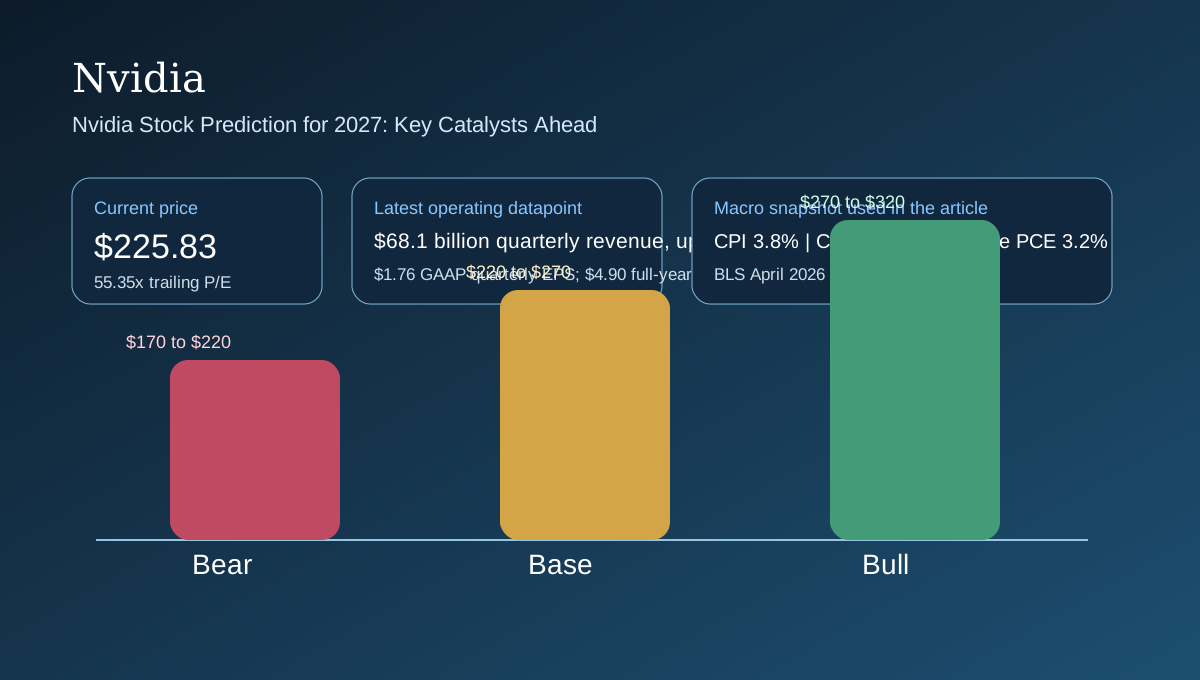
The ranges in this article are not point targets. They are editorial scenario matrices built from demand durability, margin quality, roadmap execution, customer concentration, policy risk, and valuation sensitivity. In practical terms, the probability weights ask how much of Nvidia’s current AI leadership is likely to remain both operationally dominant and financially rewarding over the horizon in question.
| Scenario | 2027 range | Conditions | Probability |
|---|---|---|---|
| Bull | $330-$410 | Blackwell remains supply-constrained for the right reasons, Rubin demand firms up, and AI capex stays robust | 30% |
| Base | $280-$350 | Growth remains strong, though the stock digests a higher base and more realistic expectations | 45% |
| Bear | $210-$280 | Demand remains healthy but not healthy enough for current expectations, or China and competition weigh more heavily | 25% |
| Direction | Probability | Comment |
|---|---|---|
| Higher | 45% | Still credible if execution remains excellent and capex commitments continue flowing through orders |
| Lower | 20% | Would likely require a broader reset in spending expectations or a clear competitive shock |
| Sideways | 35% | Plausible if fundamentals remain strong but valuation stops expanding |
| Investor type | Prudent approach | Main watchpoints |
|---|---|---|
| Investor already in profit | Hold a core stake, but trim or hedge if position size now depends on flawless execution | Gross margins, roadmap timing, and position concentration |
| Investor currently at a loss | Reassess whether the thesis is long-run platform dominance or short-run momentum and avoid averaging blindly | Data Center growth and valuation reset risk |
| Investor with no position | Prefer staged entries or wait for pullbacks instead of chasing euphoric AI rallies | China policy, hyperscaler capex, and pricing |
| Trader | Use stop-loss rules and trade around earnings, GTC, export-control headlines, and margin guidance | Volatility, options pricing, and supplier commentary |
| Long-term investor | Dollar-cost average only if convinced Nvidia can sustain full-stack monetization beyond Blackwell | Rubin adoption, CUDA moat, and customer diversification |
| Risk-hedging investor | Rebalance if Nvidia has become an outsized portfolio weight because of momentum alone | Portfolio concentration and semiconductor-cycle risk |
Conclusion: Nvidia’s 2027 path likely turns on a short list of powerful catalysts, with Blackwell and Rubin execution, China policy, and AI capex durability carrying more weight than simplistic “AI boom” slogans. Disclaimer: This article is for informational and research purposes only and does not constitute personalized financial advice.
06. FAQ
Frequently asked questions
Is Nvidia still the AI leader?
Available data suggests Nvidia remains the leading AI infrastructure platform, but leadership does not remove competition, policy risk, or valuation sensitivity.
What matters most for the next forecast revision?
Blackwell and Rubin execution, gross margins, hyperscaler capex, China policy, and evidence on inference economics are the most important inputs.
Is the main risk competition or valuation?
They are linked. Competition matters more when a stock already embeds very strong assumptions about revenue growth and margin durability.
What would invalidate the optimistic case?
A faster-than-expected slowdown in AI infrastructure demand, meaningful share loss, or margin normalization beyond what the market expects would all weaken the optimistic case materially.
Methodology and Invalidation
How to interpret this Nvidia framework and what would change it
Nvidia should not be analyzed with the same template used for mature mega-cap software or consumer-platform stocks. The company sits at the center of an unusually concentrated infrastructure buildout where product transitions, hyperscaler spending, memory and packaging capacity, export policy, and software ecosystem control all interact at once. That makes simple extrapolation dangerous. A single strong quarter may confirm demand without proving that the current pace can persist for five or ten more years. A single pullback may reflect valuation digestion rather than a structural break. The correct approach is to use scenario ranges grounded in official results, platform roadmaps, supply-chain constraints, and customer concentration risk.
The evidence base for these articles comes first from Nvidia’s own reporting. The fiscal 2026 release showed $215.9 billion of annual revenue, $62.3 billion of quarterly Data Center revenue, 75% Q4 gross margin, and a continued ramp around Blackwell and Rubin. The 2026 Form 10-K also adds important context: one direct customer represented 22% of revenue and another 14%, gross margins were affected by a $4.5 billion H20-related charge, and the company explicitly discusses foundry dependence, component availability, and geopolitical exposure. Those details are critical because they show that even a dominant AI supplier remains exposed to concentration, manufacturing, and policy risks.
External sources then help frame what the market is debating right now. Reuters and S&P Global both emphasized two simultaneous realities: AI infrastructure demand remains extremely strong, but expectations are also extremely high. Reuters highlighted a possible revenue opportunity above $1 trillion for Blackwell and Rubin by the end of 2027, while also noting concerns about custom silicon competition, supply bottlenecks, and whether hyperscaler capex can keep accelerating forever. S&P Global’s AI monitor similarly showed how much consensus expectations for Nvidia’s AI-exposed revenues have already been revised upward. That is why a sensible forecast must distinguish between business strength and stock sensitivity. A great company can still experience sideways returns or sharp corrections if expectations outrun the next wave of evidence.
Investor positioning should therefore be horizon-specific. A trader may care most about Blackwell shipments, packaging capacity, gross margin guidance, and China headlines. A long-term allocator should care more about CUDA stickiness, networking and full-rack monetization, the sustainability of AI factory spending, and whether Rubin-era systems deepen or dilute Nvidia’s returns on capital. Someone already in profit may rationally trim if the position has become too large relative to portfolio risk. Someone with no position may prefer staged exposure instead of chasing euphoric rallies. These are not conflicting views. They are different ways of expressing caution under the same scenario range.
What would invalidate a constructive Nvidia outlook? Clear evidence that hyperscaler capex is rolling over faster than expected, that custom silicon is materially displacing Nvidia in core workloads, that China restrictions or policy changes remove a meaningful revenue leg, or that margin structure is normalizing much faster than expected would all weaken the bull case. What would invalidate a more bearish Nvidia view? Continued full-stack monetization, sustained Blackwell and Rubin demand, stronger inference economics, and proof that customers are still prioritizing Nvidia even when alternatives exist would all weaken that downside thesis. The key discipline is to update the range as evidence changes, not to turn the current AI leader into a permanent certainty trade.
Inline evidence anchors that discipline. Nvidia’s own release, SEC filings, and GTC-era announcements establish the factual baseline (NVIDIA fiscal 2026 results; NVIDIA 2026 Form 10-K; Vera CPU launch). External research and reporting then explain where the market’s optimism and skepticism are currently concentrated (S&P Global review; Reuters on the Blackwell and Rubin opportunity; Reuters on H200 and China). That is the basis for the probabilities used here.
References
Sources
- NVIDIA, fourth-quarter and fiscal 2026 results
- NVIDIA, Form 10-K for fiscal year ended January 25, 2026
- NVIDIA investor relations, annual reports and proxies
- NVIDIA, Vera CPU launch for agentic AI
- NVIDIA, Dynamo 1.0 inference operating system announcement
- S&P Global, Nvidia post-earnings review Q4 2026 and outlook
- S&P Global, Nvidia earnings preview Q4 2026
- S&P Global, Visible Alpha AI Monitor January 2026 update
- Reuters, Nvidia beats estimates and forecasts Q1 above estimates, February 25, 2026
- Reuters, Nvidia results are AI market’s biggest test amid competitive worries, February 24, 2026
- Reuters, Blackwell and Rubin revenue opportunity above $1 trillion by 2027, March 17, 2026
- Reuters, U.S. cleared some Chinese firms to buy H200 chips, May 14, 2026