01. Quick Answer
The most defensible 2030 platinum outlook is constructive, but only if structural tightness survives the next few years of demand rotation and macro volatility
NYMEX platinum futures (PL=F on Yahoo Finance) were trading around $1,983.5/oz on 2026-05-18. The same 10-year monthly series started near $1,021.5/oz on 2016-06-01 and most recently showed $1,983.5/oz, with a 10-year monthly range of roughly $785.9 to $2,102.8 and a price-only CAGR near 8.04% (10-year monthly data).
The latest fundamental picture is still tight. WPIC's May 18, 2026 update says the platinum market is still expected to run a 297 koz deficit in 2026, with above-ground stocks falling to just under three months of demand cover by year-end. That is a stronger physical backdrop than platinum had for most of the last decade.
Still, 2030 is far enough away that investors should resist turning one good balance year into a deterministic forecast. WPIC's January 2026 five-year outlook expects deficits averaging roughly 348 koz a year from 2027 to 2030, but it also expects some demand softness as higher prices pressure jewellery consumption and encourage palladium-for-platinum substitution in autocatalysts. In other words, the evidence is constructive, but not one-directional.
| Point | Why it matters |
|---|---|
| Historical data | Platinum spent much of the last decade trapped well below gold, so the 2025-2026 rerating starts from a low-expectation base rather than from years of euphoric pricing. |
| Current market conditions | The market still looks physically tight because supply growth is modest and above-ground stocks remain thin. |
| Institutional forecasts | Bank and analyst views point to elevated pricing, but published medium-term targets still vary widely. |
| Base-case logic | A 2030 range in the mid-$2,000s assumes deficits persist without another speculative blow-off. |
02. Historical Context
Platinum's long-term setup only makes sense when current tightness is compared with a decade of false starts, sharp drawdowns, and renewed scarcity
Platinum's current regime is unusual because the market finally has both supply strain and visible investor attention at the same time. WPIC's Q4 2025 report said the 2025 deficit reached 1,082 koz, the largest shortfall in its time series, while the price more than doubled in response to tight stocks and favorable precious-metals sentiment.
That said, the longer history is far less linear. The Yahoo monthly series shows platinum trading as low as about $785.9/oz during the last 10 years and only recently reaching a monthly closing high near $2,102.8/oz, even though the 52-week range captured a much sharper intrayear spike to $2,852.4/oz. This is a reminder that platinum can overshoot both up and down because it is a small, liquidity-sensitive market.
The macro overlay matters as well. The IMF's April 2026 World Economic Outlook still projects global growth of 3.1% in 2026 and 3.2% in 2027, while the World Bank's April 2026 commodity outlook says platinum prices are likely to moderate after the early-2026 surge. That combination argues for constructive but volatile long-range expectations rather than a straight-line moonshot.
| Metric | Latest reading | Why it matters |
|---|---|---|
| Current platinum price | $1,983.5/oz | Every forecast range needs a live anchor because platinum already repriced sharply in 2025 and early 2026. |
| 52-week range | $1,004.5 to $2,852.4 | This range shows how quickly platinum can move when physical tightness meets speculative demand. |
| 10-year monthly range | $785.9 to $2,102.8 | Useful for separating a normal correction from a full regime shift. |
| 10-year price CAGR | 8.04% | Long-run compounding has been positive, but still uneven enough to punish lazy extrapolation. |
| Latest WPIC 2026 deficit | 297 koz | The latest published WPIC update still points to undersupply despite softer investment demand than in 2025. |
| Editorial base range | $2.2k-$2.8k | Scenario ranges are more honest than pretending platinum has one inevitable destination. |
| Line item | Latest official reading | Interpretation |
|---|---|---|
| 2025 deficit | 1,082 koz | A very large deficit depleted buffers and explains why platinum stopped behaving like a chronically ignored metal. |
| 2026 deficit forecast | 297 koz | Smaller than 2025, but still a deficit, which matters for how much inventory can rebuild before 2030. |
| 2027-2030 average balance | about 348 koz deficit per year | WPIC's medium-term balance path supports a higher floor than the pre-2023 regime. |
| Mine supply trend | Flat to only modestly higher | Supply growth still looks slow because the South African system has not suddenly become abundant. |
| Demand mix risk | Auto + industrial remain decisive | 2030 prices depend heavily on whether automotive declines are offset by industrial, jewellery, and investment demand. |
| Macro sensitivity | Still high | Platinum remains exposed to real-world growth disappointment in a way gold is not. |
03. Main Drivers
Five drivers will decide whether platinum in 2030 looks like a structurally rerated metal or just another short-lived scarcity trade
1. Persistent physical deficits still underpin the long-run case
WPIC's latest update keeps the market in deficit for a fourth straight year in 2026, and its January 2026 medium-term framework still projects average deficits through 2030. That does not guarantee higher prices, but it does mean any selloff has to fight a market that is not obviously oversupplied.
2. Mine concentration keeps the supply story fragile
Platinum remains heavily reliant on South Africa and, to a lesser extent, Zimbabwe and Russia. Johnson Matthey and USGS both reinforce the point that primary supply is not growing fast enough to create comfort. In platinum, flat supply can still be bullish if demand only has to stay decent rather than exceptional.
3. Automotive demand is shrinking slowly, not disappearing overnight
Auto demand remains platinum's largest end use, so battery-electric penetration matters. But WPIC still expects only a 2% decline in automotive demand for 2026, and its 2030 outlook suggests ICE and hybrid vehicles remain relevant long enough to keep autocatalyst demand meaningful.
4. Industrial demand is becoming more important to the floor
WPIC expects industrial demand to rise 9% in 2026 to 2,238 koz, while Johnson Matthey calls industrial use robust and specifically notes support from electronics, data-centre-linked demand, and broader industrial applications. That diversification makes platinum less dependent on a single demand channel.
5. Investor flows can still dominate the short run
LBMA analyst commentary and the Reuters poll both show how wide platinum price expectations remain. In a small market with thin stocks, ETF positioning, Chinese exchange participation, and tariff-related inventory movements can create moves that fundamentals alone would not forecast cleanly.
04. Institutional Forecasts and Analyst Views
Institutional evidence supports a tighter platinum market, but the range of fair-value assumptions is still unusually wide
The institutional message is not that platinum is risk-free. It is that the market remains tighter than casual observers assume. Johnson Matthey says platinum demand should again exceed supply in 2026, while WPIC says above-ground stocks could fall below three months of cover by the end of the year.
Published price anchors still diverge sharply. A Reuters poll put the median 2026 average at $1,550/oz, which now looks conservative relative to current spot behavior, while BofA lifted its 2026 average forecast to $2,450/oz. LBMA analysts cluster around the low-$2,000s on average, but with wide high-low ranges that implicitly admit how unstable platinum can be when speculative flows collide with tight physical balances.
For a 2030 article, the most useful institutional input is not a single point target. It is the combination of medium-term deficit expectations, price-sensitive demand warnings, and macro moderation assumptions. That is why the base case below sits above today's price, but below the most aggressive squeeze narratives.
| Source | Published view | Why it matters |
|---|---|---|
| WPIC Q1 2026 update | 2026 deficit revised to 297 koz | The latest fundamental update still says the market is undersupplied despite price volatility. |
| WPIC January 2026 five-year outlook | Average deficits of about 348 koz a year from 2027 to 2030 | This is one of the few published medium-term platinum balance frameworks. |
| LBMA 2026 analyst panel | Analyst averages shown around $2.1k-$2.3k with wide ranges | The range matters because platinum is still a small market where flows can overwhelm smooth modeling. |
| Reuters poll | $1,550 average for 2026 | Useful as a conservative institutional baseline captured before the latest rerating ran further. |
| BofA | $2,450 average for 2026 | Represents one of the stronger bank views tied to deficits, tariff risk, and Chinese demand. |
| Johnson Matthey 2026 PGM report | Platinum demand should again exceed supply in 2026 | Adds an industry operator's view, not just a macro strategist's opinion. |
| World Bank April 2026 outlook | Platinum prices projected up about 53% in 2026, then down 13% in 2027 | A macro commodity house case that explicitly assumes moderation after the spike. |
| Deutsche Bank | Tariff outcomes could either trigger a rally or soften prices via inventory unwind | Useful because it frames policy uncertainty as a genuine swing factor rather than background noise. |
05. Bull, Bear, and Base Case
A credible 2030 forecast for platinum needs conditions, probabilities, and clear failure points
Bullish scenario
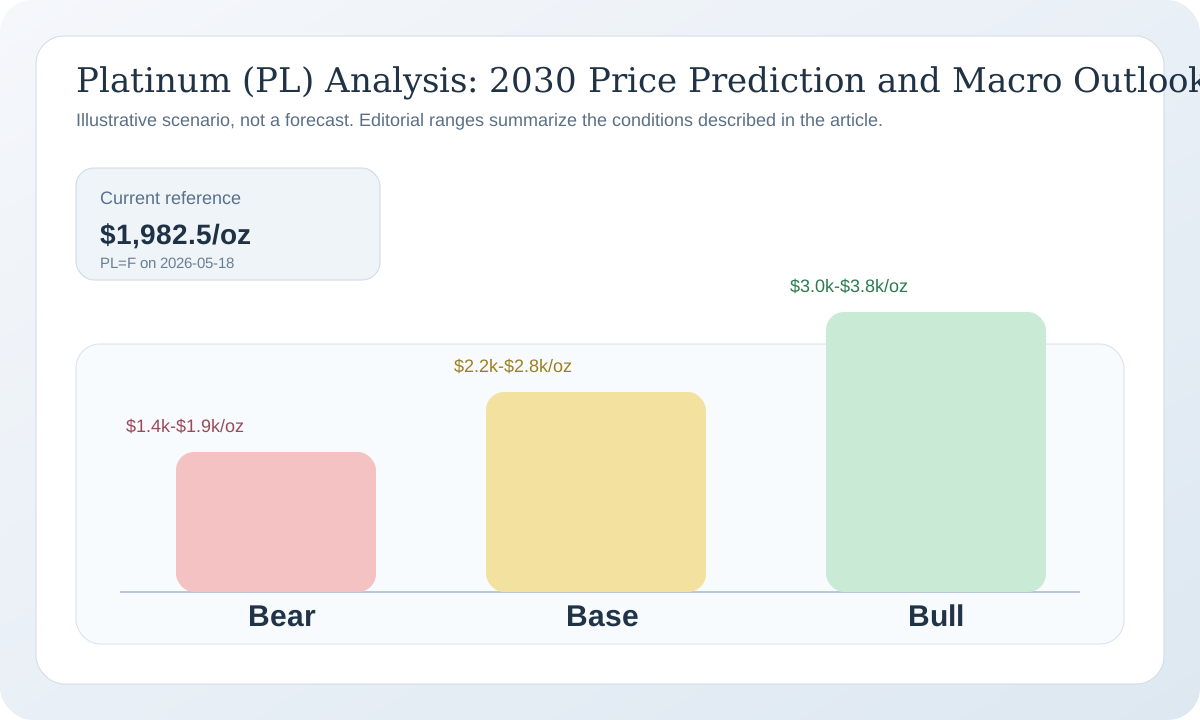
The bull case is $3,000 to $3,800 by 2030. It requires annual deficits to persist near the levels implied by WPIC's medium-term outlook, above-ground stocks to stay thin, industrial demand to expand beyond just glass rebound, and investor participation to remain stronger than in the pre-2025 regime.
Base-case scenario
The base case is $2,200 to $2,800. That range assumes deficits persist but do not worsen dramatically, supply inches higher through recycling, automotive demand erodes only gradually, and platinum retains part of its 2025-2026 rerating without repeating the blow-off conditions that created the January 2026 spike.
Bearish scenario
The bear case is $1,400 to $1,900 by 2030. This becomes more plausible if higher prices accelerate palladium substitution, jewellery demand stays weak, industrial demand underwhelms, and the market finally rebuilds enough inventory that scarcity no longer commands a premium.
Risks to watch
The main risks are faster BEV penetration, aggressive recycled-supply recovery, a sharp unwind in investor positioning, a policy outcome that releases warehouse metal back into the market, and a global growth slowdown that hits industrial uses at the same time.
What could invalidate the forecast
The constructive base case would be too optimistic if the latest deficit cycle proves temporary and 2027-2030 balances move toward surplus instead of the deficits projected by WPIC. It would be too conservative if demand from industry, jewellery substitution, and investment all hold up at once while mine supply remains essentially flat.
Conclusion
Platinum's 2030 outlook is still better framed as a probability distribution than as one precise price. Available data suggests the long-run floor has improved, but analysts remain divided on how much of the recent price regime should be treated as structural rather than cyclical.
The probability table below is an editorial framework built from the live price anchor, the latest WPIC balance data, the World Bank macro path, and the dispersion in LBMA and bank forecasts. It is not a statistical guarantee.
| Scenario | Illustrative range | Conditions | Probability |
|---|---|---|---|
| Bull | $3,000-$3,800 | Deficits persist, inventories stay thin, and industrial plus investor demand remain supportive. | 30% |
| Base | $2,200-$2,800 | Tightness persists without another extreme squeeze. | 45% |
| Bear | $1,400-$1,900 | Inventory rebuild, softer industry, and demand substitution weigh on the rerating. | 25% |
| Path | Estimated probability | Comment |
|---|---|---|
| Probability of rising | 55% | The structural case still leans upward because the market remains undersupplied. |
| Probability of falling | 20% | A lower 2030 price would likely require both demand disappointment and easier physical conditions. |
| Probability of moving sideways | 25% | Sideways but volatile is plausible if the floor improves while speculative enthusiasm fades. |
06. Investor Implications
A platinum forecast is only useful if it changes how different investors manage risk, timing, and position size
Platinum is not a simple buy-and-forget metal. It is small enough that being broadly right about the five-year thesis can still produce painful timing errors. That is why investor positioning matters as much as directional conviction.
For readers already exposed, the key distinction is between owning platinum because of a structural supply thesis and owning it because of a short-term squeeze story. The first can justify patience. The second usually needs tighter risk management.
| Investor type | Cautious approach | What to watch |
|---|---|---|
| Investor already in profit | Hold part of the core position if the deficit thesis still fits, but trim or rebalance if platinum has become too large a portfolio weight. | Lease-rate tightness, exchange inventories, and whether the market keeps rejecting rallies above the current zone. |
| Investor currently at a loss | Separate a broken thesis from a poor entry. Add only gradually if deficits, stock depletion, and industrial demand still support the long-run case. | Whether downside comes from looser physical balances or only from macro de-risking. |
| Investor with no position | Avoid chasing vertical rebounds. Prefer staged buying, wait-for-pullback plans, or dollar-cost averaging. | Chinese jewellery substitution, ETF flows, and whether recycled supply starts responding more aggressively. |
| Trader | Use stop-losses and respect headline risk. Platinum is too thin a market for oversized conviction when tariffs and positioning can move price quickly. | Dollar moves, exchange-for-physical stress, South African supply headlines, and auto-sector news. |
| Long-term investor | Focus on scenario ranges, rebalance bands, and the structural supply story instead of one exact price target. | Whether 2027-2030 deficits persist and whether hydrogen and industrial uses become material rather than symbolic. |
| Reader seeking a hedge | Treat platinum as a specialist hedge with industrial sensitivity, not as a pure crisis hedge like gold. | Correlation behavior during equity selloffs and whether platinum trades as a precious metal or an industrial metal in the next shock. |
Disclaimer: This analysis is for research and informational purposes only. It is not personalized investment advice, and no 2030 range here should be read as a guaranteed outcome.
07. FAQ
Frequently asked questions about the platinum 2030 outlook
Is platinum more attractive than gold for 2030?
Only for investors who want higher upside and higher cyclical risk. Platinum has a tighter physical story than gold, but it is also more exposed to industrial demand disappointment.
Why not use one exact 2030 target?
Because platinum is driven by a mix of physical deficits, macro positioning, and auto-industry shifts that can change materially over several years.
What matters most between now and 2030?
Inventory cover, South African mine supply, automotive substitution trends, industrial demand resilience, and whether investor interest stays broader than a one-quarter squeeze.
References
Sources
- Yahoo Finance PL=F recent daily chart
- Yahoo Finance PL=F 10-year monthly chart
- WPIC Platinum Quarterly Q1 2026
- WPIC Q1 2026 summary press release
- WPIC Platinum Quarterly Q4 2025
- WPIC Platinum Essentials January 2026
- Johnson Matthey 2026 PGM Market Report release
- LBMA 2026 analysts forecasts
- Reuters poll on platinum forecasts
- BofA platinum forecast summary
- World Bank Commodity Markets Outlook April 2026
- IMF World Economic Outlook April 2026
- USGS Mineral Commodity Summaries 2026
- Deutsche Bank metals and strategic materials note