01. Quick Answer
RUT has a real 2027 upside path, but only if financing and earnings cooperate
The Russell 2000 can still perform well in 2027, but the benchmark is likely to stay more sensitive to macro and credit conditions than large-cap U.S. indices. That is the central point investors need to keep in mind. Small caps can stage strong catch-up rallies, yet they also tend to suffer more when domestic growth cools, rates stay high, or earnings breadth weakens (FTSE Russell chartbook, March 31, 2026).
| Issue | Current read | Why it matters |
|---|---|---|
| Current market snapshot | Positive returns, but still highly cyclical | Recovery exists, but resilience is not guaranteed |
| Main catalyst | Improving financing conditions and domestic breadth | Those are the cleanest drivers of a small-cap rally |
| Main risk | Rates and earnings survivability | Smaller companies remain more vulnerable in tougher cycles |
02. Historical Risk Context
2027 should be framed through correction-versus-bear-market logic
A correction is not the same thing as a bear market, and a bear market is not the same thing as a crash. That distinction matters even more in a small-cap benchmark than in a large-cap benchmark. Because smaller companies are more economically sensitive, they can reprice sharply without implying systemic collapse. Available data from the Conference Board and the New York Fed suggests macro risk is real, but not automatically a crash thesis.
| Regime | Typical driver | What it would mean for RUT |
|---|---|---|
| Correction | Valuation reset or softer growth | Likely and manageable if financing stays available |
| Bear market | Deeper earnings and refinancing stress | Would require more persistent balance-sheet pressure |
| Crash | Systemic shock | Tail risk, not the base-case scenario implied by current evidence |
03. Risks and Catalysts
Five variables will likely determine the 2027 outcome
1. Rate relief
Perhaps the single biggest catalyst for small caps is a friendlier financing backdrop.
2. Domestic earnings breadth
Small-cap rallies become more durable when domestic cyclicals, services, and industrials all participate.
3. Balance-sheet quality
The benchmark's smaller median size means refinancing and debt-service burdens matter a great deal.
4. Relative valuation
RUT can look inexpensive for long periods if earnings quality remains in doubt, so valuation alone is not enough.
5. Market breadth rotation
If investors rotate away from overcrowded mega-cap leadership, small caps could benefit, but only if fundamentals cooperate.
04. Institutional Forecasts and Analyst Views
The evidence supports upside, but only with clear conditions
Institutional sources do not provide a simple Russell 2000 2027 target, but they do provide the framework. Vanguard's small-cap work argues for caution on old premium assumptions, BlackRock acknowledges near-term headwinds, and broader capital-market assumptions remain positive on equities over time. That supports a balanced 2027 outlook: opportunity is real, but it depends on rates, breadth, and balance sheets.
| Source | Message | 2027 implication |
|---|---|---|
| FTSE Russell | Returns improved, but volatility remains high | Supports opportunity with caution |
| Vanguard | Small-cap premium is less automatic | Supports selectivity and patience |
| BlackRock | Headwinds remain real | Keeps downside and sideways scenarios relevant |
05. Bull, Bear, and Base Case
How the 2027 RUT range is built
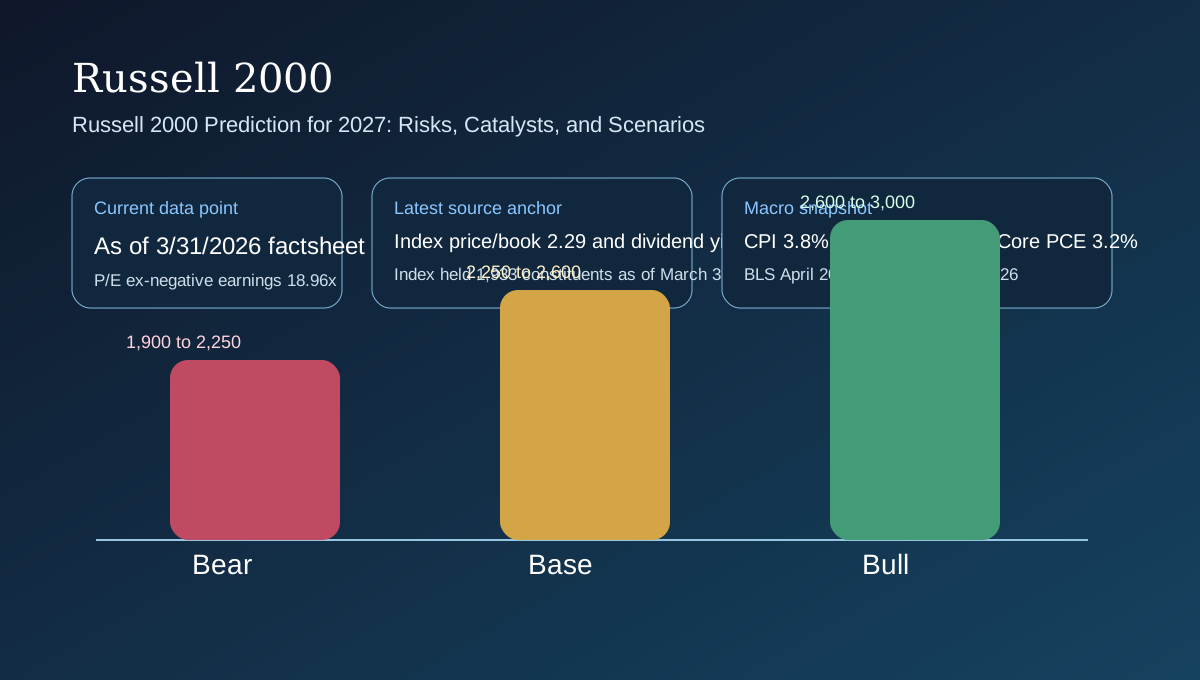
| Scenario | 2027 range | Conditions | Probability |
|---|---|---|---|
| Bull | 3,600-4,200 | Rates ease, financing improves, and domestic earnings broaden | 30% |
| Base | 2,900-3,600 | Recovery remains positive but uneven | 45% |
| Bear | 2,200-2,900 | Balance-sheet pressure and weaker macro data limit upside | 25% |
| Direction | Probability | Comment |
|---|---|---|
| Higher | 45% | Most likely if financing pressure eases |
| Lower | 20% | Would likely require weaker growth and tighter credit |
| Sideways but volatile | 35% | Plausible if valuation looks better than earnings quality |
06. Investor Positioning
How investors can think about a 2027 small-cap setup
| Investor type | Prudent approach | Watchpoints |
|---|---|---|
| Investor already in profit | Hold core exposure, but rebalance if macro sensitivity has grown too high | Credit and breadth |
| Investor currently at a loss | Review whether financing conditions still support the original thesis | Debt burden and revisions |
| Investor with no position | Use staged entries and wait for cleaner evidence if needed | Rates and LEI |
| Trader | Respect macro volatility and liquidity conditions | Economic data and breadth |
| Long-term investor | Use small caps as one sleeve inside broader U.S. equity diversification | Domestic earnings and financing conditions |
| Risk-hedging investor | Hedge selectively if spreads and revisions deteriorate together | Credit stress and macro trend |
What could invalidate this forecast? Sharper rate relief and stronger domestic growth would push the balance toward the bullish path, while renewed financing stress would weaken it. Conclusion: Russell 2000 has a credible 2027 upside path, but it remains a benchmark where macro and balance-sheet discipline matter more than simple relative-value slogans.
Disclaimer: This article is for informational and research purposes only and is not personalized investment advice.
Methodology and Invalidation
How to interpret this Russell 2000 framework and what would change it
A serious Russell 2000 article should not be read as a simple style rotation argument or as a promise that small caps must outperform because they look optically cheaper than mega-caps. It should be read as a scenario framework built from financing conditions, domestic breadth, balance-sheet quality, reconstitution dynamics, and the durability of small-cap earnings. FTSE Russell's own data makes clear why this matters. The benchmark's median company is much smaller and more economically sensitive than a constituent in most large-cap indices. That means the path of rates, credit spreads, refinancing costs, labor conditions, and domestic demand all matter more here than they do in benchmarks dominated by large global franchises. The right way to use a Russell 2000 forecast is therefore to ask not simply whether small caps are cheap, but whether the economic and financing backdrop is becoming supportive enough for those smaller companies to turn that cheaper profile into durable shareholder returns.
This is also why scenario ranges are more honest than point targets. A bullish Russell 2000 outcome usually requires more than optimism. It requires cleaner financing conditions, improving earnings breadth, and better confidence that smaller firms can survive and invest at the same time. A bearish outcome does not require systemic collapse. It only requires tighter financing, weaker domestic demand, or renewed evidence that a large share of the benchmark still struggles to convert revenue into resilient free cash flow. In many periods, the most realistic outcome is not a dramatic boom or bust, but a volatile sideways regime where valuation looks tempting while the quality of the earnings cycle remains too mixed to justify a full rerating. That is why the probability tables in these articles keep meaningful weight on sideways or mixed outcomes rather than forcing every path into an extreme bullish or bearish bucket.
The benchmark's structure adds another layer of nuance. Annual reconstitution, evolving IPO pipelines, and the relationship between public and private capital all influence the quality of the small-cap opportunity set over time. This is one reason Vanguard's work on the fading small-cap premium is so important. The old assumption that small caps automatically deserve a structural return edge has become less reliable. That does not make the asset class unattractive. It means investors should demand more evidence from breadth, quality, and balance sheets before assuming that apparent relative-value opportunities will close quickly. Small caps can still generate powerful rallies, especially when rates ease and breadth improves. But those rallies are healthier when they are supported by wider earnings participation rather than by short-lived macro relief alone.
Positioning therefore needs to be matched to investor type. A trader in Russell 2000 is usually trading macro sensitivity, sentiment, and liquidity as much as fundamentals. A long-term investor is making a different judgment: whether a diversified sleeve of domestic smaller companies can compound acceptably through the cycle despite sharper drawdowns and less predictable balance-sheet quality. Investors already in profit may have reason to rebalance without abandoning the asset class. Investors currently at a loss may need to ask whether their thesis was based on true small-cap quality or simply on the idea that "cheaper than large caps" was enough. Investors without a position may decide that staged entries are more rational than aggressive timing attempts, especially when the rate path is uncertain. Risk-hedging investors should recognize that small-cap drawdowns can deepen quickly when credit conditions tighten, even without a full recession or market crash.
What would most clearly invalidate a constructive Russell 2000 outlook? The most obvious risks are persistent higher-for-longer rates, worsening refinancing stress, weak domestic demand, and narrower earnings breadth. A meaningful deterioration in those variables would justify moving probability weight away from the bullish and base cases. What would invalidate a stronger bearish interpretation? Clearer rate relief, stronger domestic order and spending data, improving revisions, and more evidence that balance-sheet fragility is easing would all weaken the downside case. This kind of explicit invalidation logic is important because small-cap investing is often vulnerable to lazy narratives. A real thesis should tell investors what evidence would make that thesis stronger and what evidence would make it weaker.
The practical conclusion is that Russell 2000 remains one of the cleanest listed expressions of domestic U.S. breadth and small-cap risk appetite, but that also means investors should evaluate it with more care than broad-index headlines usually receive. Available data suggests the opportunity remains real, especially if the financing regime improves. The evidence is mixed enough, however, that patience, diversification, and scenario-based thinking remain more useful than confident single-number predictions. That is the lens through which the scenarios in these articles are built, and it is also the most defensible way to update those scenarios as new macro and earnings data arrive.
07. FAQ
Frequently asked questions
Can Russell 2000 outperform in 2027?
Yes, especially if financing conditions improve and domestic breadth broadens.
What is the biggest catalyst?
Rate relief combined with healthier small-cap earnings breadth is the biggest catalyst.
What is the biggest downside risk?
Balance-sheet stress and weaker domestic growth are the clearest downside risks.
Why distinguish correction, bear market, and crash?
Because they imply different levels of macro stress and different investor responses.
References
Sources
- LSEG FTSE Russell, Russell US Indexes overview
- LSEG FTSE Russell, Russell 2000 Index overview
- FTSE Russell, Russell US Indexes Spotlight
- FTSE Russell, Russell 2000 Index Quarterly Chartbook, Q1 2026
- FTSE Russell, 2026 Russell US Indexes Reconstitution Schedule
- BlackRock, Investment Directions, Spring 2026
- Vanguard, The fading U.S. small-cap premium
- Vanguard, 2026 outlook: Economic upside, stock market downside
- BlackRock, capital market assumptions
- J.P. Morgan AM, 2026 Long-Term Capital Market Assumptions
- The Conference Board, U.S. Leading Economic Index
- New York Fed, DSGE Model Forecast, March 2026
- FactSet, Earnings Insight, May 8, 2026