01. Historical Context
How Sanofi's last decade shapes a 2030 SAN forecast
Sanofi is one of those large-cap pharma names that can look underwhelming on a long price chart and yet become strategically interesting when the business mix changes. A 2030 forecast for SAN.PA is not really about whether Sanofi remains relevant. It is about whether its transition toward an R&D-driven, AI-powered biopharma model can produce stronger growth, better pipeline conversion, and a higher-quality earnings mix than the market currently gives it credit for (Sanofi corporate profile; FY 2025 results).
| Point | Why it matters |
|---|---|
| Sanofi is no longer just a mature pharma income stock | Pipeline, launches, and immunology exposure increasingly shape the equity story. |
| Dupixent still anchors the thesis | Its durability remains central to both valuation and capital allocation flexibility. |
| 2030 should be modeled as scenarios | Pipeline and pricing outcomes are too uncertain for single-point certainty. |
| AI and R&D productivity matter indirectly | The market may reward better quality of growth more than buzzwords alone. |
Historical context keeps the 2030 debate honest. SAN.PA traded around EUR 74.51 in May 2016 and around EUR 73.96 in May 2026, meaning the 10-year price-only CAGR was roughly -0.07%. That flat long-run chart is not proof of weakness by itself. It is evidence that investors have repeatedly discounted pipeline uncertainty, patent cliffs, and execution risk even when Sanofi remained a large and profitable global pharma company (10-year Yahoo Finance history).
| Metric | Latest public reading | Why it matters for 2030 |
|---|---|---|
| FY 2025 net sales | EUR 43.6 billion, up 9.9% at CER | Shows the company already re-accelerated growth before the next wave of pipeline decisions. |
| Q1 2026 sales | EUR 10.5 billion, up 13.6% at CER | Confirms strong near-term momentum. |
| Q1 2026 business EPS | EUR 1.88, up 14.0% at CER | Supports the view that profitability is improving alongside sales. |
| 2026 guidance | High single-digit sales growth; business EPS to grow slightly faster than sales | Gives investors a measurable near-term operating benchmark. |
| Recent price zone | Roughly EUR 73-EUR 82 in the past month | Shows the stock is still repricing growth credibility in real time. |
Available data suggests the current Sanofi story is more nuanced than the last decade's price chart implies. Dupixent remains an extraordinary engine, but management is also trying to broaden the story through new launches, immunology depth, rare disease development, vaccines, and targeted acquisitions such as Dynavax (Dynavax acquisition).
The 2030 question is therefore not simply whether Dupixent can keep growing. It is whether Sanofi can create a more diversified and resilient growth architecture around it before concentration risk starts to dominate the discussion.
That makes 2030 a scenario question about quality of growth, not just quantity of sales.
In practical terms, investors should think of Sanofi as a company trying to change how the market categorizes it. That is harder than simply posting one strong year, because large-cap pharma reratings usually require repeated proof across science, commercial execution, and capital discipline.
02. Key Drivers
What will move Sanofi shares over the long term
1. Dupixent durability remains the biggest single driver
Dupixent sales rose 30.8% in Q1 2026 to EUR 4.2 billion, a reminder that Sanofi still owns one of the most powerful assets in global biopharma (Q1 2026 results). If Dupixent remains dominant across expanding indications, the base and bull cases both strengthen.
2. Launch execution has become much more important
Sanofi highlighted that pharma launches rose nearly 50% in Q1 2026, driven primarily by Ayvakit, ALTUVIIIO, and Sarclisa. That matters because it shows the company is trying to make the next generation of growth visible, not theoretical.
3. Pipeline conversion will determine whether the market pays more
Positive data from assets such as venglustat and duvakitug help, but investors will ultimately care about approvals, commercial uptake, and how broad the pipeline contribution becomes over time (venglustat phase 3 data; duvakitug data).
4. Capital allocation has shifted toward growth
Sanofi's buyback and acquisition choices indicate a willingness to redeploy capital into differentiated science with attractive returns. That can help long-term value creation if discipline remains high.
5. The sector backdrop remains supportive but demanding
IQVIA still expects medicine use and spending to remain strong into 2030, while Deloitte describes a life-sciences industry that is optimistic but focused on resilience, AI, and pricing pressure (IQVIA medicine-use outlook; Deloitte 2026 life-sciences outlook). That is constructive for Sanofi, but not an excuse for sloppy execution.
03. Institutional View
What company results and sector research imply for 2030
A serious 2030 SAN forecast should start from what is already public. Sanofi delivered strong sales and EPS growth in 2025, opened 2026 with double-digit top-line and business-EPS growth, and reiterated guidance for high single-digit sales growth with business EPS growing slightly faster than sales (FY 2025 results; Q1 2026 guidance).
| Input | Current signal | Forecast implication |
|---|---|---|
| FY 2025 and Q1 2026 results | Growth and profitability both improving | Supports a constructive medium-term starting point. |
| Dupixent trajectory | Still very strong | Keeps the core earnings engine intact. |
| Launch portfolio | Meaningful acceleration | Raises the chance that Sanofi's growth broadens over time. |
| IQVIA and Deloitte sector view | Medicine demand resilient, but pricing and execution remain critical | Supports scenarios rather than certainty. |
The evidence is mixed less on Sanofi's strategic direction than on valuation confidence. The market can still worry that too much of the story rests on Dupixent, that late-stage pipeline wins may not all translate into durable revenue, or that a large pharma multiple should remain restrained until diversification is clearer.
That is why this article uses scenario ranges rather than a single target. Sanofi's 2030 outlook depends on a chain of scientific, commercial, and capital-allocation decisions, not on one macro variable.
Another reason to stay probabilistic is that healthcare valuations often move in steps rather than smooth lines. A few approvals or strong launches can materially improve sentiment, but one disappointing readout can also remind investors why they were cautious to begin with.
04. Scenarios
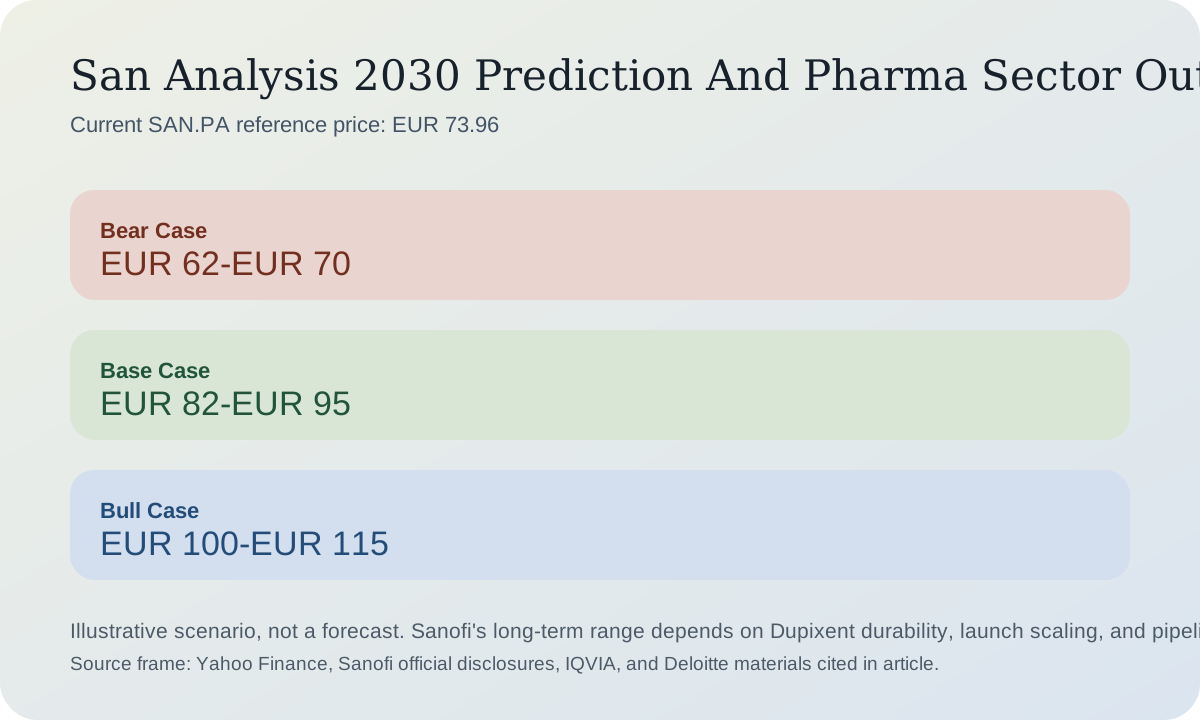
Bull, bear, and base cases for SAN.PA into 2030
Bullish scenario
The bull case points to roughly EUR 100 to EUR 115 by 2030. That would likely require Dupixent to remain powerful, the launch portfolio to scale meaningfully, and new pipeline assets to prove that Sanofi deserves to be seen as a higher-growth biopharma rather than a mature large-cap defensive name.
Bearish scenario
The bear case points to roughly EUR 62 to EUR 70. That would fit a world where Dupixent concentration becomes more concerning, launch momentum cools, pipeline conversion disappoints, or pricing and competitive pressure reduce confidence in the growth transition.
Base-case scenario
The base case is EUR 82 to EUR 95. That assumes Sanofi grows responsibly, diversifies somewhat beyond Dupixent, and earns a somewhat better valuation without turning into a biotech-style momentum stock.
| Path | Editorial probability | Reasoning |
|---|---|---|
| Rising meaningfully by 2030 | 44% | Supported by current momentum and a healthier innovation profile than the old Sanofi stereotype suggests. |
| Moving broadly sideways | 30% | Possible if the business improves but the market remains skeptical about concentration and pipeline depth. |
| Falling meaningfully | 26% | Still possible if commercial or clinical disappointments weaken the growth story. |
| Investor type | Prudent approach | What to watch |
|---|---|---|
| Investor already in profit | Hold core exposure, but trim if the Sanofi position is mainly a Dupixent concentration bet. | Launch execution and pipeline diversity. |
| Investor currently at a loss | Reassess whether the original thesis was yield-driven or growth-transition driven. | Business EPS quality and pipeline milestones. |
| Investor with no position | Wait for either a pullback or more evidence that diversification beyond Dupixent is broadening. | Readouts, approvals, and commercial uptake. |
| Trader | Respect event risk around trial data and quarterly guidance. | Pipeline catalysts and earnings days. |
| Long-term investor | Dollar-cost averaging can make sense if expectations remain scenario-based rather than heroic. | Dupixent durability and second-engine emergence. |
| Risk-hedging investor | Do not treat Sanofi as a hedge; it is still an equity story with clinical risk. | Pricing, competition, and regulatory outcomes. |
How this forecast range was built: the range combines Sanofi's current price, its flat 10-year share path, the rebound in 2025-2026 operating results, Dupixent concentration, pipeline optionality, and the typical valuation behavior of large-cap pharma transitioning toward faster growth.
Risks to watch: concentration in Dupixent, late-stage trial disappointments, competitive pressure, pricing policy, integration of acquisitions, and the possibility that AI and digital investment improve process quality without becoming visible in economics fast enough.
What would invalidate the forecast: a major acquisition, a sharply stronger pipeline conversion cycle than expected, or conversely a meaningful break in Dupixent's growth durability that changes how the entire Sanofi story is valued.
Disclaimer: This article is for informational and research purposes only. Scenario ranges are editorial judgments based on public sources, not guarantees or personal investment advice.
On balance, Sanofi looks more interesting as a transition story than its decade-long chart suggests. The opportunity is real, but so is the need for proof that growth can become broader and more durable.
The better that proof arrives, the easier it becomes to argue that the old flat-chart narrative is no longer the right anchor.
05. FAQ
Frequently asked questions about Sanofi and a 2030 forecast
Is Sanofi mainly a value stock or a growth stock now?
It sits somewhere in between. The market still treats it as a large-cap pharma name, but the business mix is becoming more growth-oriented.
Why does Dupixent matter so much?
Because it remains Sanofi's most important growth and confidence engine, and it influences how patient investors can be with the rest of the pipeline.
What matters most for a 2030 SAN forecast?
The most important variable is whether Sanofi can build credible second and third growth engines around Dupixent.
Could Sanofi outperform if the sector stays mixed?
Yes, if launch execution and pipeline conversion remain stronger than the market expects.
06. Sources
Reference list
- Yahoo Finance chart API for SAN.PA, 10-year monthly history
- Yahoo Finance chart API for SAN.PA, recent daily closes
- Sanofi Full Year 2025 results release
- Sanofi First Quarter 2026 results release
- Sanofi 2025 Form 20-F / annual report
- Sanofi acquisition of Dynavax press release
- Dupixent US approval press release
- Dupixent EU approval press release
- Venglustat phase 3 readout
- Duvakitug phase 2b data release
- IQVIA Global Medicine Use Trends 2026
- Deloitte 2026 Life Sciences Outlook