01. Long-Term Setup
What matters most in a Sanofi 2035 forecast
A 2035 forecast for Sanofi is really a judgment about whether the company can complete a multi-year transition from a dependable but often discounted large-cap pharma company into a higher-quality growth biopharma franchise. By then, investors will care less about the current quarter's Dupixent strength and more about whether Sanofi built a broader engine across immunology, rare disease, vaccines, and next-generation pipeline assets.
| Topic | 2035 relevance |
|---|---|
| Pipeline breadth | A long-run rerating requires growth to extend well beyond one flagship asset. |
| Capital allocation | Buybacks, M&A, and R&D intensity all shape long-term value creation. |
| AI-enabled R&D productivity | Could improve the quality and speed of pipeline decisions over time. |
| Large-cap pharma valuation logic | Sanofi needs repeatable proof, not just one or two good years, to earn a better multiple. |
The 10-year market record gives Sanofi an unusual starting point. A share-price move from EUR 74.51 to EUR 73.96 over the last decade is essentially flat, which means the market has not yet been willing to treat Sanofi as a long-duration growth compounder (Yahoo 10-year monthly chart). Yet the operating picture entering 2026 looks stronger than that stale chart suggests.
| Anchor | Current evidence | Why it matters |
|---|---|---|
| Current operating momentum | Strong FY 2025 and Q1 2026 growth | A better starting base than the old valuation stereotype implies. |
| Dupixent leadership | Still compounding rapidly across indications | Supports cash generation and strategic flexibility. |
| Pipeline readouts | Positive 2026 milestones in rare disease and immunology | Keeps optionality alive for broader growth. |
| R&D and AI posture | Explicitly framed as AI-powered biopharma | Suggests management is pushing for a different type of operating model. |
The evidence suggests Sanofi can remain a long-term winner, but only if investors stay realistic about what kind of winner it would be. This is not a pure biotech moonshot. It is a scaled biopharma transformation story where value will likely be built through repeated pipeline and commercial execution over many years.
That makes scenario work especially important for 2035. By then, multiple readout cycles, patent and competition dynamics, and several capital-allocation decisions could have changed how the entire franchise is viewed.
Another long-range nuance is that management must balance three things at once: defending current cash engines, reinvesting in future science, and maintaining enough shareholder discipline to keep investors patient. Over nine years, those trade-offs can influence total returns almost as much as any single asset does.
Investors should therefore think of 2035 as a test of disciplined reinvention rather than a simple extrapolation of today's strongest franchise.
That distinction matters because large-cap pharma companies rarely earn premium valuations from ambition alone. They earn them when reinvention starts to look repeatable, financially productive, and less dependent on one product family.
02. Core Drivers
The variables that can extend or weaken Sanofi's compounding story
1. Can Sanofi diversify beyond Dupixent?
This is still the most important strategic question. If launches and pipeline assets become meaningful enough, the 2035 bull case gets much easier to defend. If not, valuation may remain constrained by concentration concerns.
2. Will immunology and rare disease become a deeper moat?
Recent approvals and clinical updates suggest Sanofi is trying to reinforce exactly those areas. If that strategy works, the quality of growth improves materially.
3. Can capital allocation stay growth-focused without becoming reckless?
Sanofi's use of buybacks, acquisitions, and internal R&D spend will shape whether long-run returns look disciplined or merely expensive.
4. Does the sector backdrop remain supportive?
IQVIA still sees strong medicine use trends through 2030, while Deloitte emphasizes resilience, AI, pricing pressure, and regulatory complexity. That means the sector is promising, but not easy (IQVIA outlook; Deloitte 2026 life-sciences outlook).
5. AI and data science may gradually raise the ceiling
Sanofi's AI positioning matters because better discovery, portfolio decision-making, and manufacturing and supply execution could create a more efficient biopharma organization over a decade (Sanofi AI in R&D; digital transformation and AI).
03. Institutional Signals
How results and sector research shape the 2035 range
The strongest institutional input into a 2035 Sanofi forecast comes from the company's public financial trajectory and the strategic language around becoming an AI-powered, R&D-driven biopharma company. FY 2025 and Q1 2026 already show meaningful profitable growth, and the next question is whether that momentum can survive as the product mix evolves (FY 2025 results; Q1 2026 results).
| Source | Message | 2035 reading |
|---|---|---|
| Sanofi FY 2025 and Q1 2026 | Growth is stronger and broader than many legacy assumptions | Supports a constructive base case. |
| IQVIA | Medicine demand stays strong globally into 2030 | Helps the macro demand backdrop for innovative therapies. |
| Deloitte | Biopharma leaders remain optimistic but alert to pricing and AI execution | Suggests Sanofi can win, but only with discipline. |
| Sanofi AI and OpenAI positioning | Management wants AI embedded in drug development and operations | Could improve long-run productivity if execution is real. |
Analysts remain divided mainly on how much rerating Sanofi deserves if it keeps executing. That is the central tension in the 2035 forecast. A long-run bull case does not require Sanofi to become a small-cap biotech. It requires the market to trust that growth is broadening, pipeline quality is real, and capital allocation is supporting rather than diluting value.
That trust would likely be built through repetition rather than surprise: more than one launch that scales, more than one readout that converts, and more than one year in which Sanofi looks like a company with multiple growth pillars instead of a single dominant engine.
For a decade-long forecast, that type of repetition matters more than any one dramatic phase 3 headline, because it changes the market's model of what Sanofi actually is.
04. Scenario Matrix
Bull, base, and bear cases for SAN.PA into 2035
Bull case
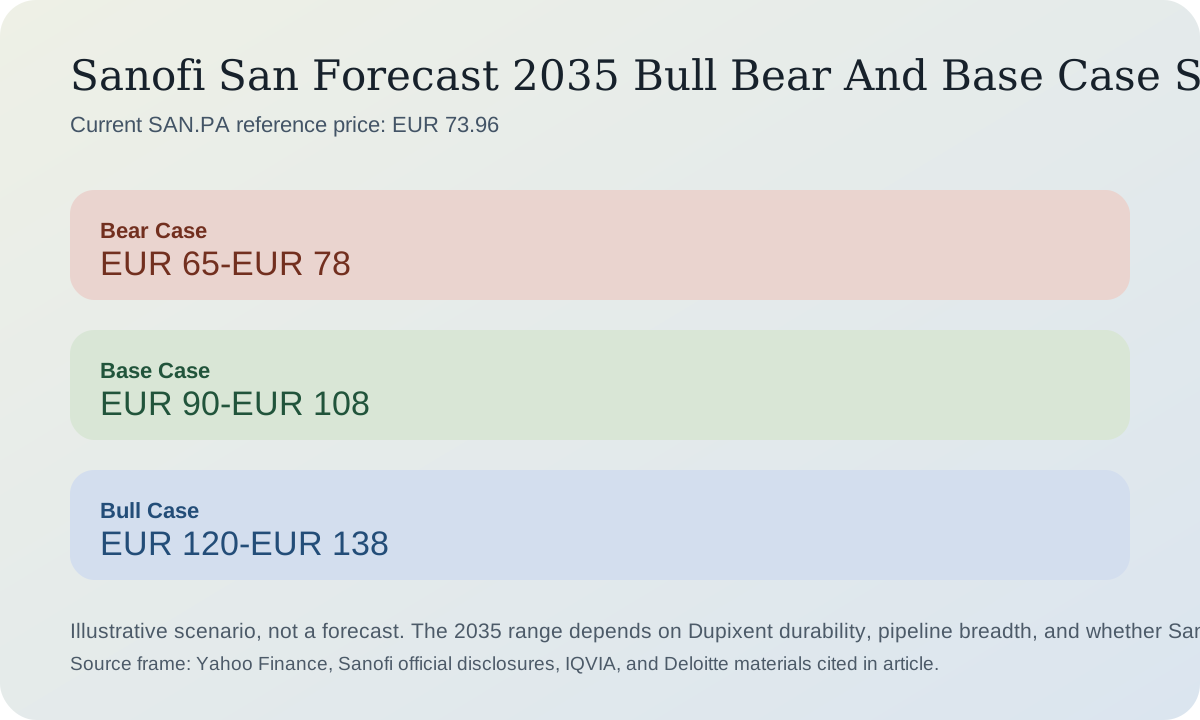
The bull case is EUR 120 to EUR 138 by 2035. That would likely require Dupixent to remain durable for longer than feared, multiple launch and pipeline assets to scale meaningfully, and Sanofi to earn a better valuation as a higher-quality biopharma compounder.
Bear case
The bear case is EUR 65 to EUR 78. That would fit a decade where concentration remains too high, clinical disappointments reduce confidence, or pricing and competition prevent Sanofi from turning better science into better valuation.
Base case
The base case is EUR 90 to EUR 108. That assumes Sanofi improves meaningfully but continues to trade with some discount versus faster-growth or more obviously diversified peers.
| Path | Editorial probability | Logic |
|---|---|---|
| Rising materially into 2035 | 42% | Sanofi starts from a better growth position than its long-term chart implies, but execution must persist. |
| Broadly sideways to modestly higher | 32% | A realistic outcome if business improves but concentration concerns linger. |
| Meaningful downside | 26% | Would likely require weaker-than-expected pipeline and commercial follow-through. |
| Investor type | Prudent stance | 2035-specific focus |
|---|---|---|
| Investor already in profit | Rebalance if SAN has become a concentrated healthcare bet around one thesis. | Breadth of growth beyond Dupixent. |
| Investor currently at a loss | Separate past chart frustration from current business-quality improvement. | Pipeline credibility and capital allocation. |
| Investor with no position | Phase in rather than chase, especially after short bursts of pipeline optimism. | Readouts, approvals, and launch trajectories. |
| Trader | Treat Sanofi as a catalyst-driven healthcare stock first, not a smooth defensive line. | Clinical events and quarterly guidance. |
| Long-term investor | Focus on whether Sanofi is becoming a stronger growth franchise, not just a safer large-cap pharma. | Commercial diversification and business EPS quality. |
| Risk-hedging investor | Do not use Sanofi as a hedge; clinical and sector risks remain real. | Pricing pressure and competitive data. |
How probability and range were set: the framework blends Sanofi's flat decade-long share behavior, current earnings acceleration, Dupixent concentration, pipeline optionality, and the market's habit of demanding repeated proof before rerating large-cap pharma.
Risks to watch: concentration in Dupixent, pipeline setbacks, pricing pressure, M&A integration, competition, and failure to convert AI and digital investment into measurable productivity.
What would invalidate the forecast: a major acquisition, a more powerful pipeline conversion cycle than expected, or a material break in the commercial trajectory of key assets.
Disclaimer: This article is for informational purposes only and does not constitute personalized investment advice. Long-term scenario ranges are conditional and not guaranteed.
The long-run Sanofi thesis is credible because it is transitioning from stable scale toward better science-led growth. The challenge is that the market will likely demand repeated evidence before paying much more for that transition.
If Sanofi can keep showing that capital redeployment, science, and commercial execution are all reinforcing each other, the upper half of the 2035 range becomes much easier to defend.
The long-run bet is therefore not simply on medicine demand. It is on Sanofi proving that a better scientific strategy can finally translate into a better valuation regime.
05. FAQ
Frequently asked questions about Sanofi's long-term outlook
Could Sanofi double by 2035?
It is possible, but it would likely require several years of convincing pipeline and commercial diversification rather than a single breakthrough.
What matters more for 2035: Dupixent or the broader pipeline?
Both matter, but over a full decade the broader pipeline probably matters more because it determines whether Sanofi remains too concentrated.
Is Sanofi safer than biotech?
Yes in balance-sheet and scale terms, but the stock still carries real clinical, competitive, and pricing risk.
Why not use a single 2035 target price?
Because too many scientific and commercial variables can change over nine years for point precision to be credible.
06. Sources
Reference list
- Yahoo Finance chart API for SAN.PA, 10-year monthly history
- Yahoo Finance chart API for SAN.PA, recent daily closes
- Sanofi Full Year 2025 results release
- Sanofi First Quarter 2026 results release
- Sanofi 2025 Form 20-F / annual report
- Sanofi acquisition of Dynavax press release
- Dupixent US approval press release
- Dupixent EU approval press release
- Venglustat phase 3 readout
- Duvakitug phase 2b data release
- IQVIA Global Medicine Use Trends 2026
- Deloitte 2026 Life Sciences Outlook
- Sanofi AI in R&D page
- Sanofi digital and data science page
- Sanofi, Formation Bio, and OpenAI collaboration