01. Quick Answer
The most reasonable 2030 SAP forecast is constructive, but still execution-sensitive
A rational 2030 view on SAP starts with the stock near $164.18 and a 10-year CAGR around 8.15%. That gives SAP a credible compounding base, but the next phase depends on whether cloud backlog, Cloud ERP growth, and AI conversion stay strong enough to support premium software economics. Available data suggests a base case around $210 to $260 by 2030 is defensible.
| Point | Why it matters |
|---|---|
| SAP is increasingly a cloud-backlog story | SAP's long-run equity story is now driven more by cloud and backlog than by legacy-license optics. |
| AI matters because it can deepen the suite, not just market the stock | Cloud ERP and AI are central to whether SAP can keep compounding at a premium multiple. |
| Revenue mix can still create near-term volatility | Revenue mix still matters, even when the strategic story is intact. |
| 2030 should be framed as a range, not a promise | Scenario ranges are more credible than one-number targets for a large enterprise software platform. |
02. Historical Context
SAP remains a mission-critical enterprise software platform, but the modern thesis increasingly depends on cloud migration, backlog quality, and AI monetization
SAP moved from roughly $75.02 to about $164.18 over the last 10 years based on Yahoo Finance monthly data, implying a 10-year CAGR of about 8.15%. That is a respectable long-run rate, especially for a mature enterprise software vendor whose business model has been undergoing a difficult but strategically necessary shift from on-premise licenses and support toward cloud subscriptions, Cloud ERP, and increasingly AI-enabled workflow automation. The current SAP case is not about whether the company matters. It clearly does. The real question is whether cloud, backlog, margin discipline, and AI can support another decade of compounding without the stock becoming too expensive relative to execution risk.
| Metric | Latest official reading | Why it matters |
|---|---|---|
| Q1 2026 current cloud backlog | €21.9 billion | Backlog is one of the clearest indicators of future revenue visibility in SAP's cloud-transition story |
| Q1 2026 cloud revenue growth | +27% constant currency | Shows SAP's core cloud engine is still accelerating faster than many mature software peers |
| Q1 2026 Cloud ERP Suite growth | +30% constant currency | Cloud ERP is central because it carries strategic stickiness and cross-sell potential |
| Q1 2026 non-IFRS operating margin | 30.0% | Margin discipline matters because SAP must keep funding AI, cloud migration, and profitability at the same time |
| Feature | SAP implication | Forecast effect |
|---|---|---|
| Mission-critical enterprise stack | ERP, finance, procurement, HR, and supply chain make SAP deeply embedded in customer operations | Supports defensibility and recurring revenue, but also slows abrupt growth accelerations |
| Cloud transition still underway | License/support declines can weigh on reported revenue even when the cloud story is strong | Explains why the market may react harshly to revenue mix shifts despite solid long-run trends |
| Backlog-heavy visibility | Current cloud backlog and total cloud backlog matter almost as much as reported revenue | Scenario ranges should be grounded in backlog quality, not just near-term EPS |
| AI integrated into workflows | Joule, Business Data Cloud, and agentic automation may improve customer retention and upsell economics | AI can strengthen the bull case, but monetization needs to be proven over time |
03. Main Drivers
Five forces are most likely to shape SAP stock over the next several years
1. Current cloud backlog remains the clearest scorecard for future compounding
SAP's Q1 2026 release showed current cloud backlog of €21.9 billion, up 25% at constant currencies. That matters because the stock is increasingly valued on cloud visibility and migration progress rather than on legacy license dynamics.
2. Cloud ERP Suite growth is central to the entire bull case
Cloud ERP Suite revenue grew 30% at constant currencies in Q1 2026. If customers keep standardizing on SAP's suite, the company can keep deepening switching costs, cross-sell opportunities, and AI adoption across finance, HR, procurement, and supply chain.
3. Revenue mix transition still creates tension in the near term
Reuters and market recap coverage both highlighted that strong cloud growth can still be accompanied by investor frustration if total revenue misses estimates or if legacy software support declines accelerate. That makes SAP a stock where the strategic story may be right even when the quarter still disappoints traders.
4. AI could become an important monetization and retention layer
Joule, Business AI, agentic workflows, and SAP's AI-focused acquisitions all strengthen the argument that SAP can capture more value from the business processes it already sits inside. The key question is not whether SAP has AI products. It does. The key question is whether AI drives more suite adoption, more backlog, and better economics.
5. Margin discipline still matters because SAP is funding transformation at scale
SAP has to keep balancing cloud growth, operating profit expansion, and platform investment. If the company keeps lifting non-IFRS profit while growing cloud at a high rate, the market can justify a premium valuation. If margins wobble, the multiple can compress quickly.
04. Institutional Forecasts and Analyst Views
The strongest evidence base comes from official SAP backlog, cloud, and margin disclosures rather than from one-line price targets
There are plenty of analyst targets in the market, but the more durable way to frame SAP is to combine live price, 10-year CAGR, cloud backlog growth, cloud revenue momentum, 2026 guidance, and the role of AI in the suite. That creates a more defensible range-based framework than simply repeating an external price target without context.
| Source | What it says | Implication for SAP |
|---|---|---|
| Q1 2026 results | Current cloud backlog grew 25% at constant currencies, while cloud revenue rose 27% at constant currencies | Supports the argument that SAP's cloud engine remains strong despite maturity and macro complexity |
| 2026 financial outlook | SAP continues to expect €25.8 billion to €26.2 billion in cloud revenue and approximately €10 billion in free cash flow | Provides a useful base case for medium-term scenario work |
| Integrated Report 2025 | Total cloud backlog reached €77 billion in 2025 | Shows the scale of embedded future revenue and supports the long-run compounding thesis |
| Reuters, April 2026 | SAP beat first-quarter profit estimates on cloud demand, but the market remained sensitive to the pace of revenue transition | Confirms that investors still care about execution quality, not just strategic narrative |
| SAP AI releases and Sapphire 2026 | Joule agents, Business AI, and partnerships across cloud, models, and data platforms keep expanding | AI can reinforce SAP's suite value proposition if adoption and economics translate into backlog and retention |
05. Scenarios
Bull, bear, and base-case scenarios for SAP
| Scenario | Range | What would likely drive it | Editorial probability |
|---|---|---|---|
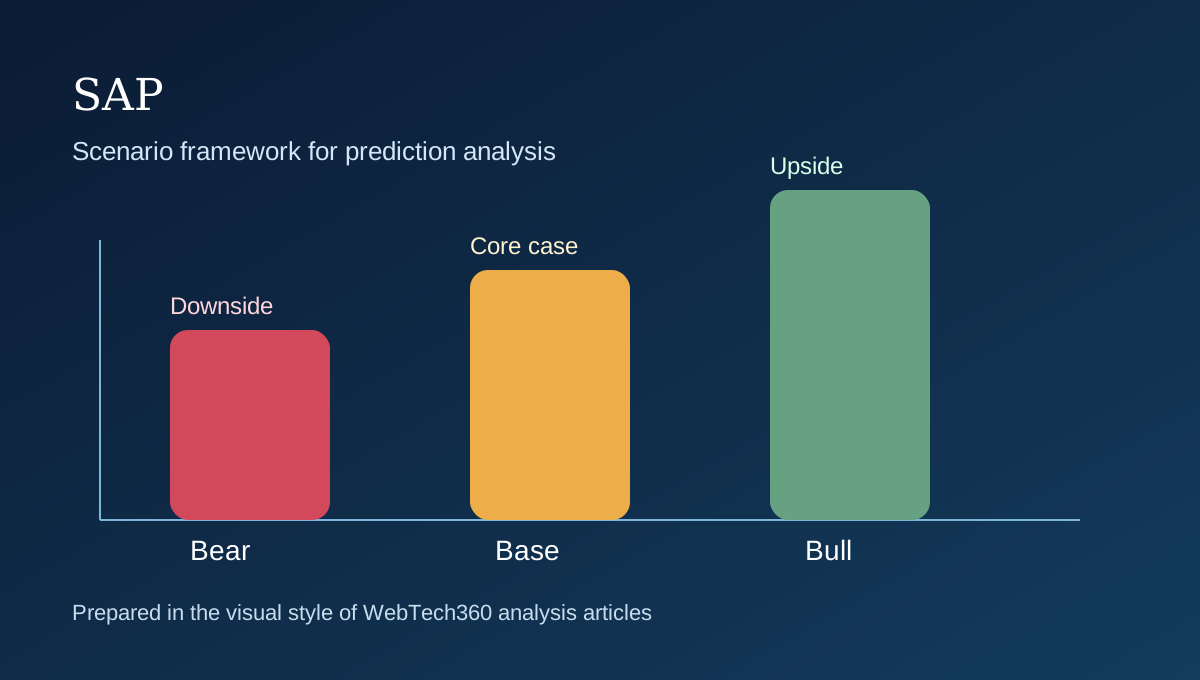
| Bull | $260-$330 | Backlog, Cloud ERP, and AI all sustain premium enterprise-software economics with strong margin discipline | 25% |
| Base | $210-$260 | SAP compounds steadily through cloud migration, free-cash-flow growth, and better suite monetization | 50% |
| Bear | $150-$210 | Cloud momentum slows, valuation compresses, or AI monetization proves more incremental than expected | 25% |
| Outcome | Probability | Interpretation |
|---|---|---|
| Rising | 44% | Plausible if cloud backlog and ERP migration continue to support premium recurring growth |
| Falling | 22% | Still meaningful because software multiples can compress quickly when growth quality is questioned |
| Moving sideways | 34% | A realistic path if execution remains good but valuation already reflects much of the cloud-transition upside |
06. Investor Positioning
How different investors might respond
| Investor type | Prudent stance | Why |
|---|---|---|
| Investor already in profit | Hold core, trim only if software concentration or valuation risk has become excessive | SAP remains a high-quality enterprise platform, but the multiple still depends on sustained cloud execution |
| Investor currently at a loss | Reassess the thesis around backlog, cloud ERP, and AI rather than around one volatile quarter | The long-run case depends on transformation progress, not on one revenue miss or one rally |
| Investor with no position | Use staggered entries and avoid chasing after AI headlines or post-earnings spikes | SAP can still be a strong long-run compounder, but software valuation resets can create better entry points |
| Trader | Use stop-losses and watch cloud backlog, cloud revenue, margin trends, and revenue-mix commentary | Short-term moves can turn on guidance or mix changes faster than on the deeper platform story |
| Long-term investor | Focus on cloud backlog, ERP migration, Joule adoption, and cash-flow conversion; consider dollar-cost averaging | SAP is most compelling for patient investors who understand the enterprise-transition cycle |
| Hedging-focused investor | Use SAP as part of a diversified software or Europe-quality sleeve rather than as a pure defensive hedge | It has durable enterprise qualities, but it is still a growth and valuation-sensitive stock |
07. Risks to Watch
What could change the outlook quickly
The main risks are not about relevance. SAP is relevant. They are about the pace of cloud migration, how much AI actually expands deal size and retention, and whether margins can keep improving while legacy support declines faster.
| Potential invalidation | Why it matters |
|---|---|
| Backlog and cloud growth stay well above expectations | Would strengthen the bull case by proving SAP's cloud engine can support longer-duration growth than skeptics assume |
| AI drives larger suite expansion and retention | Would justify a stronger long-run multiple if customers buy more of the suite because of Joule and Business AI |
| Margins keep expanding alongside cloud growth | Would demonstrate that transformation and profitability are reinforcing rather than conflicting |
| Large-enterprise migrations accelerate into 2027 and beyond | Would support the base and bull cases by making backlog and free-cash-flow assumptions more durable |
08. Conclusion
Bottom line
By 2030, SAP most likely looks like a stronger cloud-and-AI enterprise platform than it does today. The constructive case is credible, but it still depends on execution rather than on inevitability.
FAQ
Frequently asked questions
Why is cloud backlog so important for SAP?
Because it gives one of the clearest views into future revenue visibility. SAP's cloud transition is not just about current sales. It is about the amount and quality of future contracted business.
Why can SAP stock fall even when cloud growth looks strong?
Because investors still react to reported revenue mix, valuation, support-revenue decline, and whether profit growth matches the strategic narrative. In other words, the cloud story can be right while the stock still corrects.
How were the forecast ranges built?
The ranges combine the current SAP price, the 10-year CAGR, Q1 2026 cloud and backlog growth, official 2026 guidance, and scenario analysis around AI adoption, ERP migration, margins, and valuation.
Can AI materially change SAP's economics?
Potentially yes, if Joule and related AI offerings improve adoption, retention, upsell, and workflow automation across SAP's installed base. The likely impact builds over time rather than all at once.
Methodology and Invalidation
How these SAP ranges were built and what would change them
These scenario ranges are editorial frameworks, not guarantees or institutional targets. They start with the live SAP price near $164.18` in mid-May 2026, then layer on the stock's 10-year CAGR of roughly 8.15%, Q1 2026 cloud and backlog growth, SAP's 2026 cloud-revenue and free-cash-flow guidance, and the strategic role of AI inside the suite. A purely mechanical projection of the last decade would ignore changes in cloud mix, AI monetization, ERP migration, and valuation sensitivity.
For downside language, a correction usually means around 10% down from a recent high, a bear market closer to 20%, and a crash something sharper tied to macro shock, valuation reset, or strategic disappointment. SAP is less speculative than many software names, but it can still re-rate lower if backlog growth slows or margins wobble.
The evidence base here is intentionally current. SAP reported Q1 2026 current cloud backlog of €21.9 billion, cloud revenue growth of 27% at constant currencies, Cloud ERP Suite growth of 30% at constant currencies, and non-IFRS operating profit growth of 24% at constant currencies. SAP's 2026 outlook still calls for €25.8 billion to €26.2 billion of cloud revenue, €36.3 billion to €36.8 billion of cloud and software revenue, €11.9 billion to €12.3 billion of non-IFRS operating profit, and around €10 billion of free cash flow. Reuters reporting added the important nuance that total revenue growth in 2026 is now expected to stay at similar levels to 2025 and accelerate in 2027, rather than accelerate continuously through 2027.
What would invalidate the constructive case? Slower backlog growth, weaker cloud ERP momentum, slower AI monetization, or a more painful legacy-revenue decline would all matter. What would invalidate the bearish case? Continued strong backlog growth, expanding margins, successful AI integration into core workflows, and sustained large-enterprise cloud migrations would weaken it. Investors should treat these articles as conditional research tools that need updating as backlog, margins, and AI economics evolve.
Disclaimer: This material is for research and editorial purposes only, does not constitute investment advice, and should not be treated as a recommendation to buy, sell, or hold SAP SE or any related security.
References
Sources
- Yahoo Finance chart API, SAP 10-year monthly history and current price
- SAP Investor Relations, recent results and 2026 outlook
- SAP announces Q1 2026 results
- SAP releases Integrated Report 2025 and files Annual Report 2025 on Form 20-F
- SAP Business AI release highlights Q1 2026
- SAP Sapphire 2026: SAP unveils the autonomous enterprise
- SAP to acquire Prior Labs to establish a frontier AI lab in Europe
- SAP Joule Studio overview
- SAP Customer Experience: What's new in Q1 2026
- SAP GROW Fast: With AI, companies compete on innovation
- Reuters via Investing.com, SAP beats first-quarter profit estimates on cloud demand, April 23, 2026
- Investing.com recap of SAP Q1 2026 slides and market reaction, April 23, 2026
- Reuters via MarketScreener, SAP reports rise in quarterly profit as cloud demand holds up, April 23, 2026
- SAP press room media coverage, including Reuters and external coverage