01. Quick Answer
A 2035 forecast is mostly about structure, not next-quarter noise
The evidence supports a constructive long-term Sensex outlook into 2035, but only if forecasts are framed as conditional scenarios. Because very few banks publish formal 2035 targets, the most credible method is to combine current valuation, the benchmark's decade compounding history, official macro assessments, and assumptions about earnings growth and maturity.
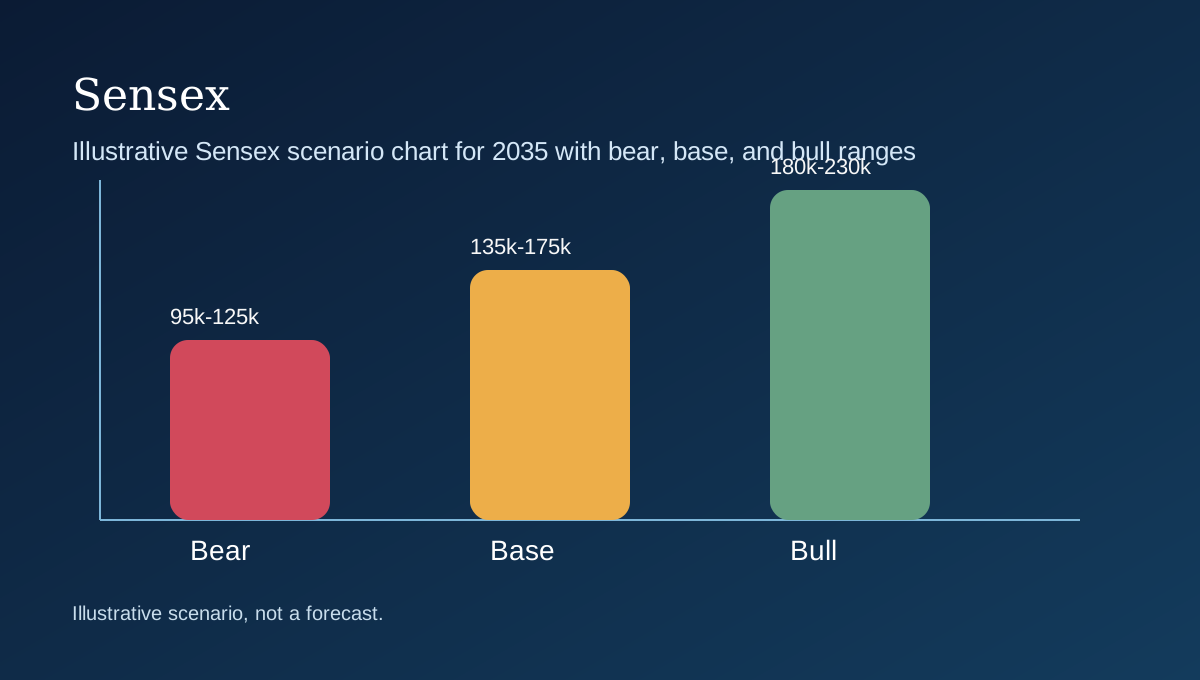
That approach points to a broad base-case range of roughly 135,000 to 175,000 by 2035. A higher bull case becomes possible if India converts its growth potential into sustained productivity and profit expansion. A lower bear case can happen even without an economic collapse if the market matures into lower multiples while earnings compound more slowly than today's optimists expect.
- Historical data supports a constructive long-run view, but not a straight-line rally.
- Current market conditions show resilience, yet Sensex concentration makes breadth important.
- Institutional forecasts are strongest over 12 to 24 months, so longer targets should stay scenario-based.
- Bull, bear, and base cases depend on earnings growth, domestic flows, oil, and valuation discipline.
02. Current Market Snapshot
A Sensex outlook needs a current anchor before it can become a forecast
As of May 15, 2026, the Sensex closed near 75,237.99, according to Yahoo Finance chart data[1]. That leaves the benchmark below its 52-week high of 86,159.02 but above the 52-week low of 71,545.81[2]. The market is therefore not washed out, but neither is it trading at the euphoric high reached in late 2025.
History also matters here. Over the past decade, monthly closes moved from about 26,999.72 in late May 2016 to 75,237.99 in mid-May 2026, a roughly 10.79% annualized gain[1]. The BSE's 40-year paper adds a longer lens: it notes about 13.4% annualized Sensex growth over 39 years, in line with nominal GDP growth, while also emphasizing that sector leadership has changed materially over time[5].
| Metric | Value | Why it matters |
|---|---|---|
| Recent close | 75,237.99 on May 15, 2026 | Starting point for all scenario work |
| 10-year range | 26,626.46 to 85,706.67 | Shows how much India's large-cap benchmark has already repriced |
| 10-year CAGR | 10.79% | Useful reality check against aggressive long-run projections |
| 1-year high / low | 86,159.02 / 71,545.81 | Captures the 2025 peak and the 2026 stress window |
| Deepest 10-year drawdown | -38.07% | Helps separate a correction from a true bear market |
| Structural concentration | Top 10 names about 65% of index weight | Leadership breadth matters more than headline GDP alone |
The other reason current structure matters is concentration. According to the BSE Sensex at 40 paper, financial-services weight nearly doubled from about 22% in 2005 to roughly 39.5% in 2025, and the top 10 names represent about 65% of the benchmark's weight[5]. That means the headline market story can look healthy even when leadership is narrower than many investors assume.
03. Historical Context And Main Drivers
The 2035 path depends on productivity, breadth, and the maturity of India's capital markets
Sensex behavior over the last decade already shows why forecast language has to stay disciplined. The daily series implies a maximum drawdown of roughly -38.07%, from 41,952.63 on January 14, 2020 to 25,981.24 on March 23, 2020[2]. That was a genuine crisis drawdown, not a routine correction. Distinguishing correction, bear market, and crash is not semantics; it changes how investors should interpret risk.
| Driver | Current evidence | Bullish implication | Bearish implication |
|---|---|---|---|
| Potential growth | IMF and World Bank still project India as a leading growth engine | Supports a long runway for revenue expansion | Potential growth can fall if reform momentum weakens |
| Productivity and innovation | IMF says stronger innovation could lift productivity materially | Could support much stronger profit compounding by 2035 | If productivity disappoints, the market may rerate less than bulls expect |
| Household financialization | AMFI data still show very large SIP flows | Creates a persistent domestic equity bid | Flows can plateau if returns disappoint or savings shift |
| Index concentration | Top 10 names remain about 65% of weight | Leaders can compound hard if they keep market share | Long-run concentration can cap upside if new winners stay outside the benchmark |
| Energy dependence | World Bank still flags external energy risk | Lower oil would support longer cycles | High oil can repeatedly interrupt compounding |
A 2035 projection should start with what India can become, not only what it is now. IMF work argues that stronger innovation, business dynamism, and AI-linked efficiency can materially lift India's productivity trend[15]. That matters for the Sensex because long-range returns are still mostly a function of how quickly earnings compound and whether profit growth broadens beyond a handful of sectors and mega-cap names.
But there is an important caveat. The current Sensex is not a perfect proxy for every future Indian growth engine. BSE research shows that the benchmark has become more concentrated in financials and top holdings over time[5]. So a strong India story does not automatically translate one-for-one into effortless Sensex outperformance unless sector leadership also widens.
04. Institutional Forecasts And Analyst Views
Institutional material can anchor assumptions even when it stops far short of 2035
There is a practical limit to what institutional forecasts can tell investors beyond one or two years. Most sell-side houses publish 12-month targets, not clean 2030 or 2035 endpoints. That means any longer-horizon Sensex estimate should be treated as a scenario framework built from current valuation, earnings assumptions, macro conditions, and credible institutional anchors rather than as a precise consensus number[10][11][12][13].
| Source | Target / stance | Core thesis | What it signals |
|---|---|---|---|
| Morgan Stanley | 95,000 base case and 107,000 bull case for 2026 | Macro stability, valuation improvement, and private investment could revive leadership | Useful medium-term anchor for a later-cycle 2030s model |
| HSBC | 94,000 by end-2026 | Improved valuations and domestic policy support can still attract capital | Shows that even cautious houses can turn constructive when the setup improves |
| J.P.Morgan | Neutral on India due to oil-led earnings and valuation risks | Premium markets can still disappoint tactically | Good reminder that long-run bulls must respect entry price |
| IMF / World Bank | No index target, but constructive medium-term macro tone | India remains a major contributor to global growth | Macro support exists, yet it is not a stock-market guarantee |
Because formal 2035 sell-side targets are scarce, the right framework is simple: start with current valuation, assume earnings-growth bands rather than exact numbers, and then apply a valuation range that reflects both optimism and the possibility of a more mature market by the 2030s.
Under that framework, 135,000 to 175,000 by 2035 is a reasonable base case if earnings growth stays in the high-single-digit to low-double-digit range and valuation remains around the broad neighborhood of today's large-cap norms. The upper bull case requires a better productivity story and broader sector leadership. The lower bear case mostly reflects weaker valuation support rather than a broken India economy.
05. Bullish Scenario
A strong 2035 bull case requires India to widen, not just extend, its growth model
A durable bull case into 2035 would likely require more than healthy banks and consumption. It would require productivity-enhancing reforms, rising private capex, stronger manufacturing depth, and a more innovation-heavy profit pool. Even a modest uplift in trend productivity can compound into a meaningfully larger earnings base over a decade.
If that happens while domestic capital keeps flowing into listed equities, the Sensex could earn both stronger profits and a sustained valuation premium versus many emerging-market peers. In that scenario, 180,000 to 230,000 becomes plausible by 2035. It should still be described as an upper-end scenario rather than a baseline expectation.
06. Bearish Scenario
A long-run bear case does not need economic collapse to be credible
The simplest long-run bear case is that India keeps growing but the stock market becomes less willing to pay a premium. That could happen if productivity gains are narrower than hoped, if financials dominate too much of the benchmark, or if repeated energy shocks keep interrupting corporate margins and policy flexibility.
Under that type of outcome, the Sensex can still make new highs by 2035 and yet deliver underwhelming real returns versus the current enthusiasm embedded in many bullish narratives. A 95,000 to 125,000 range would still reflect growth, just not the kind of growth that justifies today's more optimistic projections.
07. Base Case
Why 135,000 to 175,000 is the more defensible long-run range
The base case assumes India remains a structural outperformer among major economies, but not a market that escapes all valuation gravity. Official macro material still supports that stance, and the long history of Sensex compounding gives it credibility. At the same time, maturity often lowers future returns unless earnings breadth improves enough to compensate.
That is why the 135,000 to 175,000 range is a useful middle path. It recognizes the power of compounding and financialization without assuming every part of the India thesis gets monetized perfectly through the listed large-cap benchmark.
08. Probability Framework And Investor Positioning
Probability table and positioning by investor type
The probabilities below are judgment calls, not objective odds. They combine the starting valuation, the Sensex's concentration, official macro material, domestic flow data, and current institutional notes. The point is to show how a forecast range is built rather than to pretend precision where none exists.
| Path | Probability | Conditions |
|---|---|---|
| Rising toward 135k-230k by 2035 | 52% | Requires sustained earnings growth, better productivity, and continued household participation |
| Falling toward 95k-125k | 18% | Would likely reflect weaker multiples, recurring energy shocks, and narrower profit growth |
| Mostly sideways / lower-real-return compounding | 30% | Possible if profits rise but valuation support fades as the market matures |
| Investor profile | Prudent approach | Why that stance fits |
|---|---|---|
| Investor already in profit | Hold core, trim weak positions, rebalance on strength | Protect gains without treating every rally as permanent |
| Investor currently at a loss | Avoid panic selling; review thesis, stagger exits or adds | Entry price risk is different from broken market structure |
| Investor with no position | Wait for pullbacks or use staged dollar-cost averaging | A full-size entry into a premium market raises regret risk |
| Trader | Use stop-loss rules and respect oil, rupee, and earnings catalysts | Short-term price action can diverge sharply from the macro story |
| Long-term investor | Accumulate selectively and rebalance sector concentration | Time horizon helps only if sizing stays disciplined |
| Hedger / risk-only investor | Use partial hedges, avoid overpaying for tail risk | India has macro risk, but not every risk deserves an extreme hedge |
For most readers, the practical implication is the same across themes: avoid treating a structural India story as a license to chase price. The benchmark can remain attractive over the long run while still being vulnerable to valuation resets, oil shocks, and leadership rotations.
09. Risks To Watch And What Could Invalidate The Forecast
The 2035 debate is really about productivity, concentration, and valuation maturity
The biggest risks to a strong 2035 outcome are not one-off headlines. They are structural: a slower productivity path, weaker breadth beyond financials, repeated energy shocks, and the possibility that India's premium eventually compresses as the market deepens and matures.
What would invalidate this forecast? A stronger-than-expected productivity and innovation cycle could make the base range too low. A more mature market with decent earnings but lower multiples could make it too high. Either way, the key variable is not just growth. It is how that growth is translated into public-market profits.
| Signal | Why it matters | Implication for the thesis |
|---|---|---|
| Innovation and productivity improve much faster than expected | Would support stronger margins, capex, and profit breadth | The base case would likely prove too low |
| Domestic financialization plateaus and valuation premium compresses | A lower structural bid can cap future multiples | The lower-end bear case gains credibility |
| Index concentration deepens further | A narrow benchmark becomes more vulnerable to leadership failure | 2035 upside becomes harder to sustain |
Disclaimer: This article is editorial scenario analysis, not personalized financial advice. Forecast ranges are conditional and can fail if earnings, policy, liquidity, inflation, or geopolitics move materially away from current assumptions.
10. Conclusion
The 2035 Sensex outlook is promising, but maturity changes the math
A disciplined Sensex 2035 forecast can still be constructive without becoming promotional. India has a credible long-run growth story, household financialization remains powerful, and productivity upside is real. But the best long-run forecasts also respect concentration, valuation, and the possibility that a maturing market compounds less spectacularly than its strongest believers assume.
FAQ
Frequently asked questions
Could the Sensex double by 2035?
Yes, a doubling from current levels is plausible and fits inside the base-to-bull range. It is not automatic, because valuation and earnings breadth still matter.
What matters more for 2035: GDP growth or valuations?
Both matter, but at a nine-year horizon the interaction between earnings growth and valuation discipline is usually more important than a single year's GDP print.
Why does concentration matter so much for the Sensex?
Because a narrow benchmark can lag even when the broader economy does well if leadership remains too dependent on a few sectors or stocks.
What is the main reason the bear case still rises over time?
A long-run bear case for a growth market often means lower-than-hoped returns, not permanent decline.
References
Sources
- Yahoo Finance chart data for ^BSESN - 10-year monthly history
- Yahoo Finance chart data for ^BSESN - daily history for drawdowns and 52-week range
- BSE SENSEX official index page
- BSE Indices Methodology
- BSE Sensex at 40 research paper, January 2026
- IMF Executive Board Concludes 2025 Article IV Consultation with India
- IMF Staff Country Report: India 2025 Article IV Consultation
- World Bank India Development Update, April 2026
- AMFI Monthly Note, April 2026
- Reuters via TradingView - HSBC upgrades Indian equities to overweight, sees Sensex at 94,000 by 2026-end
- Reuters via MarketScreener - J.P.Morgan downgrades India equities to neutral on oil-led earnings risks
- Business Standard - Morgan Stanley sees Sensex at 95,000 base case and 107,000 bull case
- IMF note: Business Growth and Innovation Can Boost India's Productivity