01. Quick Answer
A 2027 Sensex forecast is mostly about regime, catalysts, and valuation discipline
Available data suggests the Sensex has a credible path higher into 2027, but the case is much more conditional than many broad India narratives imply. A reasonable base range sits around 82,000 to 92,000 if earnings stabilize, domestic flows remain solid, and oil does not create another inflation shock.
The evidence is mixed on a much stronger outcome because starting valuation is not distressed and some major houses have explicitly highlighted oil-led earnings risk. For 2027, catalysts matter almost as much as structure: bank earnings, crude, the rupee, foreign positioning, and whether broader leadership emerges beyond the heaviest weights.
- Historical data supports a constructive long-run view, but not a straight-line rally.
- Current market conditions show resilience, yet Sensex concentration makes breadth important.
- Institutional forecasts are strongest over 12 to 24 months, so longer targets should stay scenario-based.
- Bull, bear, and base cases depend on earnings growth, domestic flows, oil, and valuation discipline.
02. Current Market Snapshot
A Sensex outlook needs a current anchor before it can become a forecast
As of May 15, 2026, the Sensex closed near 75,237.99, according to Yahoo Finance chart data[1]. That leaves the benchmark below its 52-week high of 86,159.02 but above the 52-week low of 71,545.81[2]. The market is therefore not washed out, but neither is it trading at the euphoric high reached in late 2025.
History also matters here. Over the past decade, monthly closes moved from about 26,999.72 in late May 2016 to 75,237.99 in mid-May 2026, a roughly 10.79% annualized gain[1]. The BSE's 40-year paper adds a longer lens: it notes about 13.4% annualized Sensex growth over 39 years, in line with nominal GDP growth, while also emphasizing that sector leadership has changed materially over time[5].
| Metric | Value | Why it matters |
|---|---|---|
| Recent close | 75,237.99 on May 15, 2026 | Starting point for all scenario work |
| 10-year range | 26,626.46 to 85,706.67 | Shows how much India's large-cap benchmark has already repriced |
| 10-year CAGR | 10.79% | Useful reality check against aggressive long-run projections |
| 1-year high / low | 86,159.02 / 71,545.81 | Captures the 2025 peak and the 2026 stress window |
| Deepest 10-year drawdown | -38.07% | Helps separate a correction from a true bear market |
| Structural concentration | Top 10 names about 65% of index weight | Leadership breadth matters more than headline GDP alone |
The other reason current structure matters is concentration. According to the BSE Sensex at 40 paper, financial-services weight nearly doubled from about 22% in 2005 to roughly 39.5% in 2025, and the top 10 names represent about 65% of the benchmark's weight[5]. That means the headline market story can look healthy even when leadership is narrower than many investors assume.
03. Historical Context And Main Drivers
The 2027 outlook depends on catalysts the market can actually react to now
Sensex behavior over the last decade already shows why forecast language has to stay disciplined. The daily series implies a maximum drawdown of roughly -38.07%, from 41,952.63 on January 14, 2020 to 25,981.24 on March 23, 2020[2]. That was a genuine crisis drawdown, not a routine correction. Distinguishing correction, bear market, and crash is not semantics; it changes how investors should interpret risk.
| Driver | Current evidence | Bullish implication | Bearish implication |
|---|---|---|---|
| Oil shock or relief | Current institutional notes still flag crude as a key swing factor | If oil cools, margins and inflation both improve | If oil stays high, earnings and rates both get pressured |
| Earnings revisions | J.P.Morgan and Citi both referenced earnings risk | Stabilization can drive a cleaner rerating | Further cuts can hurt even without recession |
| Domestic SIP flows | AMFI still shows strong monthly household participation | A strong local bid can cushion foreign volatility | If flows cool, valuation fragility rises |
| Financials leadership | Banks remain the largest part of the benchmark | Healthy credit can pull the index higher quickly | A banking wobble weakens the full benchmark |
| Valuation premium | India still trades at a premium to many EM peers | A premium can persist if growth delivery is strong | If growth disappoints, that premium can unwind fast |
Over a short horizon, the same large macro themes still matter, but transmission is faster. World Bank materials continue to warn that energy disruptions and higher import costs can soften activity[8]. Recent inflation prints also show why markets stay sensitive to commodity moves: March 2026 CPI was 3.40%, while April 2026 WPI jumped to 8.3% because of fuel and commodity pressures[18][19].
At the same time, domestic liquidity remains a serious stabilizer. AMFI's April 2026 note still showed more than Rs 31,000 crore in SIP inflows[9]. That does not guarantee upside, but it helps explain why India can stay relatively resilient even when global risk appetite becomes less friendly.
04. Institutional Forecasts And Analyst Views
Current broker targets are useful because 2027 still sits close to the institutional horizon
There is a practical limit to what institutional forecasts can tell investors beyond one or two years. Most sell-side houses publish 12-month targets, not clean 2030 or 2035 endpoints. That means any longer-horizon Sensex estimate should be treated as a scenario framework built from current valuation, earnings assumptions, macro conditions, and credible institutional anchors rather than as a precise consensus number[10][11][12][13].
| Source | Target / stance | Core thesis | What it signals |
|---|---|---|---|
| HSBC | 94,000 by end-2026 | Valuations improved and foreign positioning looked light | A bullish anchor for the next 12 to 18 months |
| Morgan Stanley | 95,000 base and 107,000 bull for 2026 | Improving valuations and macro stability can restart leadership | Supports a constructive 2027 follow-through if execution holds |
| J.P.Morgan | Neutral on India | Oil-led earnings risks and premium valuation still matter | Short-horizon caution remains credible |
| Citi / Nomura | Targets cut amid Iran-war-linked macro stress | Oil and earnings can alter the setup quickly | Good reminder that the 2027 path is event-sensitive |
For a 2027 article, near-term broker targets matter more than they do in a 2035 piece. HSBC's 94,000 2026-end target and Morgan Stanley's 95,000 base case / 107,000 bull case create plausible launch points for a 2027 framework. At the same time, J.P.Morgan's neutral stance and Citi's target cuts show that the downside case is not theoretical.
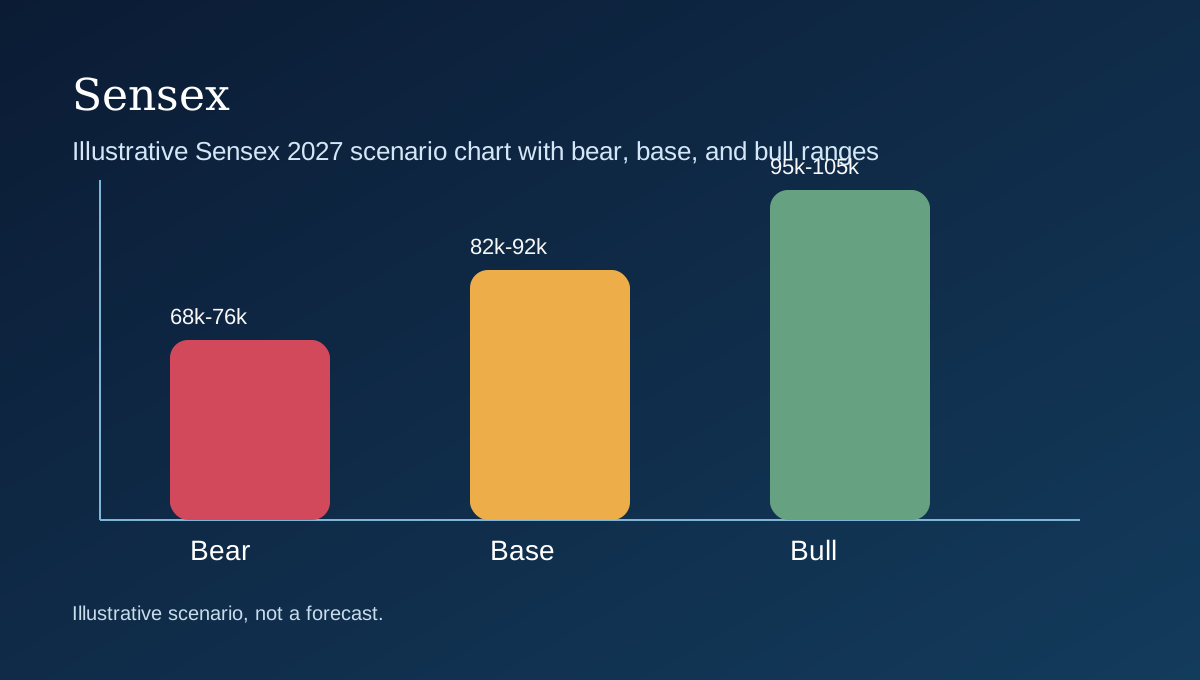
That mix leads to a cleaner range-based approach. The benchmark does not need a euphoric rerating to reach 82,000 to 92,000 by 2027. It needs decent earnings execution and a less hostile oil backdrop. To reach 95,000 plus in a durable way, the market likely also needs better breadth and less skepticism around valuations.
05. Bullish Scenario
What could push the Sensex toward 95,000 to 105,000 by 2027
A credible 2027 bull case begins with softer oil and cleaner earnings. If imported inflation stays manageable, if banks keep delivering, and if telecom, industrials, or consumer leaders contribute more to index-level profits, the market can rise without needing a reckless multiple expansion.
The upside case also improves if foreign investors stop treating India as just a premium macro trade and start leaning back into it as an earnings story. In that kind of environment, the Sensex could challenge or exceed the upper end of current 2026 broker targets and extend into a 95,000 to 105,000 zone during 2027.
06. Bearish Scenario
What could keep the benchmark closer to 68,000 to 76,000 instead
The bear case does not require an Indian recession. It mainly requires persistent pressure from crude, weaker-than-expected earnings revisions, or a market that decides the valuation premium is no longer justified. When a premium market loses narrative confidence, price damage can arrive faster than the macro data alone would suggest.
The other bearish path is narrow leadership fatigue. If the biggest financial and conglomerate names stop carrying the tape while broader participation fails to improve, the Sensex can stall or slip even if the broader economic story remains intact.
07. Base Case
Why 82,000 to 92,000 is still the cleaner 2027 range
The base case assumes India stays resilient but not euphoric. Domestic liquidity remains supportive, growth avoids a major interruption, and earnings recover enough to offset some of the pressure from premium valuations. That is a solid environment for gains, but not necessarily for an explosive melt-up.
From about 75,000 today, an 82,000 to 92,000 range by 2027 would still be a respectable result and would fit much better with the institutional debate now on the table than a much more aggressive target based purely on demographics or hope.
08. Probability Framework And Investor Positioning
Probability table and positioning by investor type
The probabilities below are judgment calls, not objective odds. They combine the starting valuation, the Sensex's concentration, official macro material, domestic flow data, and current institutional notes. The point is to show how a forecast range is built rather than to pretend precision where none exists.
| Path | Probability | Conditions |
|---|---|---|
| Rising toward 82k-105k by 2027 | 45% | Requires decent earnings, supportive domestic flows, and a manageable oil backdrop |
| Falling toward 68k-76k | 25% | Would likely need oil stress, weaker revisions, and valuation compression |
| Mostly sideways / choppy | 30% | Possible if profits improve only enough to offset multiple normalization |
| Investor profile | Prudent approach | Why that stance fits |
|---|---|---|
| Investor already in profit | Hold core, trim weak positions, rebalance on strength | Protect gains without treating every rally as permanent |
| Investor currently at a loss | Avoid panic selling; review thesis, stagger exits or adds | Entry price risk is different from broken market structure |
| Investor with no position | Wait for pullbacks or use staged dollar-cost averaging | A full-size entry into a premium market raises regret risk |
| Trader | Use stop-loss rules and respect oil, rupee, and earnings catalysts | Short-term price action can diverge sharply from the macro story |
| Long-term investor | Accumulate selectively and rebalance sector concentration | Time horizon helps only if sizing stays disciplined |
| Hedger / risk-only investor | Use partial hedges, avoid overpaying for tail risk | India has macro risk, but not every risk deserves an extreme hedge |
For most readers, the practical implication is the same across themes: avoid treating a structural India story as a license to chase price. The benchmark can remain attractive over the long run while still being vulnerable to valuation resets, oil shocks, and leadership rotations.
09. Risks To Watch And What Could Invalidate The Forecast
Near-term Sensex risk is mostly about catalysts, not abstract theory
The key risks for a 2027 forecast are visible and monitorable: crude, the rupee, inflation prints, earnings revisions, and the durability of domestic equity inflows. Short-horizon analysis should stay grounded in those catalysts rather than in decade-long narratives that may be true but not decisive over the next 18 months.
What would invalidate this article? A clear improvement in breadth and a better-than-expected earnings cycle could make the base case too conservative. A prolonged oil shock or deeper de-rating could make it too optimistic. The important point is that 2027 outcomes can move quickly once a catalyst breaks the current balance.
| Signal | Why it matters | Implication for the thesis |
|---|---|---|
| Oil falls and earnings breadth improves together | Would support margins, sentiment, and sector participation | The base case would likely prove too low |
| Inflation and fuel pressure intensify | Would tighten financial conditions and hurt margins | The bear case probability rises |
| Domestic fund flows lose momentum | A weaker local bid would expose premium valuation risk | Sideways or lower scenarios become more likely |
Disclaimer: This article is editorial scenario analysis, not personalized financial advice. Forecast ranges are conditional and can fail if earnings, policy, liquidity, inflation, or geopolitics move materially away from current assumptions.
10. Conclusion
The 2027 Sensex call should stay conditional and catalyst-aware
A serious Sensex prediction for 2027 should be more disciplined than the usual growth-story shorthand. India still has a resilient macro backdrop and a powerful domestic savings bid, but the near-term path depends heavily on oil, earnings delivery, and whether the market keeps awarding the benchmark a premium. Range-based thinking is the more honest way to frame that setup.
FAQ
Frequently asked questions
Is 100,000 on the Sensex possible by 2027?
Yes, but it fits the upper-end bull case rather than the base case. The market would likely need softer oil, better breadth, and stronger earnings execution.
What is the most important catalyst for a 2027 Sensex rally?
Oil is arguably the biggest swing factor because it affects inflation, margins, the rupee, and sentiment simultaneously.
Why do broker targets matter more in a 2027 article?
Because 2027 still sits close enough to the normal sell-side forecast window that current targets provide useful anchors.
Could the Sensex go sideways even if India grows well?
Yes. A premium market can still go sideways if earnings only grow enough to offset valuation compression.
References
Sources
- Yahoo Finance chart data for ^BSESN - 10-year monthly history
- Yahoo Finance chart data for ^BSESN - daily history for drawdowns and 52-week range
- BSE Sensex at 40 research paper, January 2026
- World Bank India Development Update, April 2026
- AMFI Monthly Note, April 2026
- Reuters via TradingView - HSBC upgrades Indian equities to overweight, sees Sensex at 94,000 by 2026-end
- Reuters via MarketScreener - J.P.Morgan downgrades India equities to neutral on oil-led earnings risks
- Business Standard - Morgan Stanley sees Sensex at 95,000 base case and 107,000 bull case
- Reuters via MarketScreener - Citi cuts India's Nifty target on earnings and macro risks from the Iran war
- MoSPI CPI release for March 2026, published April 13, 2026
- PIB WPI release for April 2026, published May 14, 2026