01. Quick Answer
A higher 2035 range is plausible, but Shenzhen still has to earn it
The long answer starts with a simple observation: Shenzhen already trades like a market that investors expect to carry a bigger share of China's future industries. SZSE own ChiNext material highlights the board's scale and high-tech concentration. Index-adjustment notes show strategic emerging industries dominate the exchange's most innovation-heavy benchmarks. Invesco, UBS, and J.P. Morgan AM all emphasize structural themes such as advanced manufacturing, AI, semiconductors, and new quality productive forces. The evidence therefore supports a constructive 2035 framework, but analysts remain divided on how much of that story can be monetized at the broad-index level rather than only within a subset of champions.
| Point | Why it matters |
|---|---|
| Historical data still matters | The Shenzhen Index has compounded at 4.04% over 10 years, but with a drawdown of roughly 45.8%. |
| Current market conditions are improved, not risk-free | China's macro data stabilized in early 2026, but property and consumption still cap conviction. |
| Institutional forecasts are mostly thematic, not point targets | Goldman, UBS, Invesco, and J.P. Morgan discuss China-growth, technology, and sector opportunities rather than explicit 2030 SZSE levels. |
| Forecast ranges should separate bull, bear, and base cases | The evidence is mixed enough that scenario probabilities are more defensible than one exact target. |
02. Historical Context
Shenzhen's history argues for scenario work, not single-number certainty
Yahoo Finance data for 399001.SZ, which labels the benchmark as the Shenzhen Index, show the market rising from 10,489.99 on 2016-05-31 to 15,561.37 on 2026-05-15. That works out to a 10-year price CAGR of 4.04% and a peak-to-trough monthly drawdown of about 45.8%. The long-run range of 7,239.79 to 15,561.37 matters because it reminds investors that Shenzhen can deliver long stretches of stagnation and then re-rate quickly when policy, manufacturing, and technology expectations line up.
| Metric | Latest reading | Why it matters |
|---|---|---|
| Recent close | 15,561.37 | Every scenario in this article starts from the latest Yahoo Finance close on 2026-05-15. |
| 10-year starting point | 10,489.99 | Anchors long-run range work to an observable base instead of a cherry-picked panic low. |
| 10-year range | 7,239.79 to 15,561.37 | Shows the benchmark is already testing the upper end of its long-run band. |
| 10-year price CAGR | 4.04% | Provides a sober compounding reference for base-case assumptions. |
| Max monthly drawdown | 45.8% | Explains why risk control still matters even in a constructive China-tech thesis. |
| 52-week range | 9,950.14 to 16,207.75 | Frames current momentum against the most recent policy and earnings cycle. |
| Fact | Public evidence | Interpretation |
|---|---|---|
| Listed companies | 2,852 at year-end 2024 | Shenzhen is a deep equity ecosystem, not a niche thematic basket. |
| Average P/E ratio | 24.00x at year-end 2024 | The market is growth-oriented, but not priced like an unchecked mania by official exchange data. |
| Annual stock turnover | RMB146.74 trillion in 2024 | Liquidity is large enough to amplify both risk-on and risk-off rotation. |
| ChiNext scale | 1,358 companies and over RMB12 trillion market value | Confirms Shenzhen's role as a public market for China's innovation complex. |
| Shenzhen Component manufacturing weight | 76% after the December 2025 refresh | The index is heavily tied to industrial technology, hardware, autos, and capital goods. |
| ChiNext strategic emerging-industry weight | 93% | AI, semiconductors, biotech, and new-energy themes have real benchmark relevance. |
The broader exchange statistics support that interpretation. SZSE Market Overview 2024 shows 2,852 listed companies, stock market value of RMB33.04 trillion, annual stock turnover of RMB146.74 trillion, and an average P/E ratio of 24.00x at year-end 2024. Meanwhile, SZSE ChiNext overview article said the ChiNext board had 1,358 listed companies with total market value above RMB12 trillion as of October 30, 2024, with roughly 90% of firms classified as high-tech and nearly 70% in strategic emerging industries. That is why the Shenzhen benchmark is not just a generic China index. It is one of the clearest public-market expressions of China's manufacturing, export, hardware, automation, EV, and innovation stack.
The composition has become even more explicit. SZSE December 2025 index refresh note says manufacturing carries 76% weight in the Shenzhen Component Index, while strategic emerging industries account for 93% of the ChiNext Index. Another SZSE index article said Shenzhen Component constituents distributed RMB387.6 billion in dividends since the start of 2024, equal to 77% of total SZSE dividends. Those details matter because they frame Shenzhen as a technology-and-industry benchmark, but not a speculative pure-software index.
03. Main Drivers
Five long-run questions decide where the index can be headed by 2035
1. Can Shenzhen keep acting as China's listed proxy for new quality productive forces-
Official policy framing now places advanced manufacturing, digitalization, and future industries at the center of the 2026-2030 development agenda. Shenzhen is unusually well aligned with that framework because of its exchange composition and its local industrial ecosystem.
2. Will hardware and manufacturing remain profit pools, not just capacity races-
The bullish case depends on margins, not just output volume. Goldman Sachs argues China will keep leaning into industrial competitiveness and technology self-reliance. That helps Shenzhen strategically, but it does not automatically protect shareholder returns if pricing pressure intensifies.
3. Can ChiNext keep producing investable leaders rather than only IPO supply-
ChiNext 2025 profile points to scale, high-tech density, and strategic-emerging-industry exposure. The 2035 bull case needs that pipeline to mature into larger cash-generative businesses, not just more listings.
4. Does China's macro mix become more supportive of valuation durability-
The IMF says medium-term rebalancing still needs a stronger consumption engine. For Shenzhen, that matters because a better domestic demand backdrop would reduce reliance on exports and policy sentiment as the main valuation supports.
5. Can AI, robotics, and automation become index-level earnings drivers-
Invesco robotics work and official AI policy both argue that China's AI and embodied-intelligence push is broadening. Over a decade, that can matter materially for Shenzhen, but the evidence is mixed on timing and breadth. That is why the 2035 outlook still needs a base case, not just a tech-hub slogan.
| Question | Why it matters | Current read |
|---|---|---|
| Industrial policy durability | Supports sector leadership and capital allocation | Constructive |
| Profitability of strategic sectors | Decides whether the tech story reaches shareholder returns | Mixed |
| ChiNext maturation | Determines quality of the growth pipeline | Constructive |
| Domestic-demand healing | Broadens valuation support beyond exports and policy | Still incomplete |
| AI and automation monetization | Could widen the long-run premium band | Promising but early |
04. Institutional Forecasts and Analyst Views
The available public research supports a thematic 2035 upside case, not a neat point target
There is no serious public-source consensus target for the Shenzhen Index in 2035, and pretending otherwise would be fabrication. What exists is a clustering of medium-term views that support the broad conditions needed for higher long-run levels. UBS emphasizes semiconductors, consumer-electronics components, and broader technology value-chain names. Invesco highlights AI, automation, EVs, and industrial upgrading. J.P. Morgan AM keeps pointing investors toward sectors aligned with policy priorities. The IMF is more cautious because of domestic-demand and property constraints. The evidence therefore supports a constructive long-run direction, but only with explicit scenario discipline.
| Source | Signal | 2035 implication |
|---|---|---|
| UBS | Prefers parts of China's technology value chain | Supports selective long-run upside. |
| Invesco | Constructive on AI, automation, EVs, and industrial upgrading | Supports Shenzhen's structural premium thesis. |
| J.P. Morgan AM | Favors policy-aligned sectors under high-quality growth | Supports a selective rather than indiscriminate rally. |
| Goldman Sachs | China remains focused on manufacturing and tech self-reliance | Supports long-run industrial leadership if profitability holds. |
| IMF | Warns that rebalancing and domestic demand still matter | Supports keeping downside and sideways scenarios alive. |
05. Bull, Bear, and Base Cases
A 2035 forecast should separate structural upside from valuation overreach
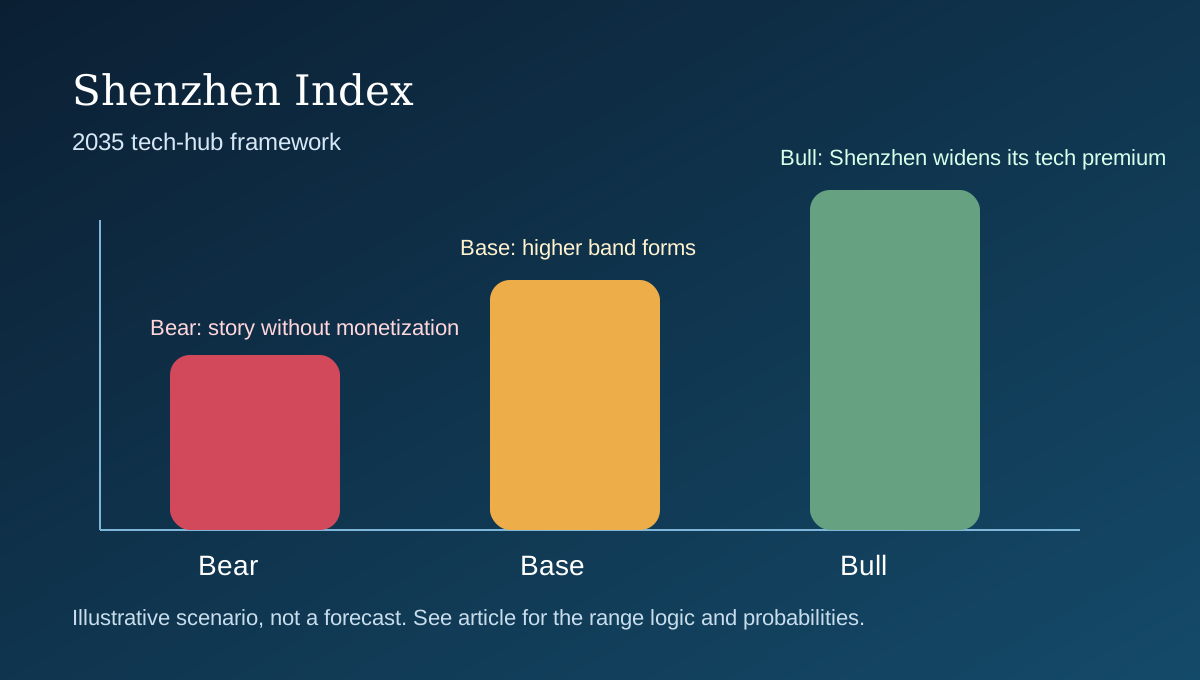
The ranges below extend the current price, the 10-year CAGR, and the current sector mix into a much longer horizon. Because the horizon is nine-plus years, the uncertainty band is wider than in the 2027 or 2030 articles. These are editorial ranges, not institutional targets.
Bullish scenario
The bull case is 24,000 to 29,000 by 2035. That requires Shenzhen to keep widening its premium as China's listed center for higher-value manufacturing, semiconductors, automation, robotics, and AI-related hardware, while domestic demand stabilizes enough to sustain multiples.
Base-case scenario
The base case is 18,500 to 22,500. This assumes the exchange compounds moderately above its long-run historical pace as industrial upgrading continues, but without a full regime shift in valuations.
Bearish scenario
The bear case is 12,500 to 16,500. That would likely mean the market's premium story remains too narrow, profitability disappoints, and the benchmark spends years behaving more like a cyclical exporter index than a durable innovation compounder.
| Scenario | Range | Key conditions | Probability |
|---|---|---|---|
| Bull | 24,000-29,000 | Durable technology premium with broad monetization | 25% |
| Base | 18,500-22,500 | Moderate compounding with selective winners | 50% |
| Bear | 12,500-16,500 | Structural story underdelivers at index level | 25% |
| Path | Estimated probability | Comment |
|---|---|---|
| Rising over the long run | 60% | Still the most plausible direction if Shenzhen remains central to China's innovation stack. |
| Falling from current levels by 2035 | 15% | Possible, but it would likely require a meaningful loss of growth credibility. |
| Moving sideways in a broad band | 25% | Also realistic because Chinese equity markets can spend years digesting prior optimism. |
Risks to watch
Watch margin durability in hardware and EV supply chains, policy execution, domestic-demand healing, AI monetization, and whether dividend discipline keeps improving.
What could invalidate this forecast
This framework would be too bullish if the tech-hub narrative stays too narrow to move the broad index. It would be too cautious if Shenzhen becomes a more credible long-run quality market and attracts a more durable valuation premium.
Conclusion
The long-run question is not whether Shenzhen has growth exposure. It does. The real question is how much of that exposure becomes durable index-level profitability by 2035.
Disclaimer: This article is for research and informational purposes only. Long-range scenarios are conditional judgments, not guaranteed outcomes or personalized recommendations.
06. Investor Positioning
Different readers should respond to the same Shenzhen outlook in different ways
| Investor profile | Cautious approach | What to monitor |
|---|---|---|
| Investor already in profit | Hold core exposure but consider trimming into sharp policy-driven spikes if price moves faster than earnings revisions. | Watch breadth, valuation expansion, and whether leadership remains in quality manufacturers rather than only in speculative pockets. |
| Investor currently at a loss | Avoid automatic averaging down. Reassess whether the thesis was China reform, industrial upgrading, AI adoption, or a short-term liquidity bounce. | Track property stress, export momentum, and whether fundamentals are improving or only headlines are changing. |
| Investor with no position | Wait for pullbacks or scale in gradually through dollar-cost averaging instead of chasing breakout candles. | Monitor valuation, policy follow-through, and whether domestic demand is broadening alongside tech strength. |
| Trader | Use stop-loss discipline and treat Shenzhen as a momentum-sensitive market where sentiment can reverse quickly. | Follow PMIs, policy meetings, sector rotation, and the index reaction to large-cap hardware and EV names. |
| Long-term investor | Rebalance slowly, favor patience over hero timing, and accept that even a good structural thesis can include long sideways phases. | Focus on dividend quality, R&D intensity, export competitiveness, and whether strategic sectors are converting growth into free cash flow. |
| Risk-hedging investor | Hedge or rebalance if Shenzhen exposure overlaps heavily with broader China, EM, or semiconductor risk elsewhere in the portfolio. | Watch RMB moves, global rate conditions, tariff headlines, and any deterioration in liquidity or foreign-risk appetite. |
07. FAQ
Common questions investors ask about this Shenzhen outlook
Why is the 2035 range wider than the 2030 range-
Because the longer the horizon, the more uncertainty compounds around policy, valuation, sector profitability, and macro rebalancing.
What makes Shenzhen different from a generic China benchmark-
Its heavier exposure to manufacturing, hardware, EV supply chains, semiconductors, biotech, and the ChiNext growth ecosystem.
What is the single most important long-run proof point to monitor-
Whether strategic sectors keep converting revenue growth and R&D intensity into durable profit and cash-flow improvement.
08. Sources
Primary and high-credibility references used in this article
- Yahoo Finance chart API for 399001.SZ, 10-year monthly history
- Yahoo Finance chart API for 399001.SZ, recent daily closes
- Shenzhen Stock Exchange overview page
- SZSE English home page with recent market bulletins
- SZSE Market Overview 2024
- Shenzhen Stock Exchange Fact Book 2024
- SZSE core indices article on dividends, manufacturing weight, and strategic emerging industries
- Adjustment of constituents for Shenzhen Component Index, ChiNext Index, and Shenzhen 100 Index
- Shenzhen market indices refresh to enhance roles as long-term value ballast
- ChiNext article on 1,358 listed companies and over RMB 12 trillion market value
- China GDP preliminary accounting results for Q1 2026
- National Economy Got off to a Good Start in the First Quarter
- Total Retail Sales of Consumer Goods from January to March 2026
- Industrial Production Operation in March 2026
- Investment in Fixed Assets from January to March 2026
- Investment in Real Estate Development from January to March 2026
- Purchasing Managers' Index for April 2026
- Consumer Price Index in April 2026
- Industrial Producer Price Indexes in April 2026
- IMF Executive Board concludes 2025 Article IV consultation with China
- IMF staff report on China 2025 Article IV consultation
- IMF commentary on how China can pivot to consumption-led growth
- Goldman Sachs on China's economy expected to grow in 2026 amid surging exports
- UBS China Outlook 2026-27: Resilience and Rebalancing
- UBS view on Chinese equities and the next era of growth
- Invesco 2026 investment outlook - Chinese equities
- Invesco The Big Picture Q2 2026
- J.P. Morgan AM on what China's 1Q 2026 GDP data tells investors
- J.P. Morgan AM on China's 2026 NPC annual session and high-quality growth