01. Quick Answer
Silver could remain structurally strong into 2030, but the industrial bull case is not linear
The short answer is yes: Wall Street may still be underestimating silver's long-run industrial relevance, but not for the simplistic reason often repeated on social media. The strongest evidence is not a single headline target. It is the combination of recurring market deficits, power-grid expansion, AI-related electronics demand, higher EV content, and continuing growth in solar capacity even while silver usage per panel falls.
That matters because the silver market is much smaller and less liquid than gold. When investment flows and physical tightness line up, price moves can overshoot fundamentals in both directions. Available data suggests silver's path to 2030 is likely to be more volatile than gold's, with stronger upside in a macro-risk environment and sharper downside if substitution accelerates faster than demand from new technologies.
| Question | Most supported answer | Why it matters |
|---|---|---|
| Is demand still structurally strong? | Yes, but composition is changing | PV thrifting hurts one segment, while AI, grid and automotive demand help offset it |
| Is supply solving the problem? | Not yet | The Silver Institute still expects another deficit in 2026 despite higher mine output and recycling |
| Could prices still correct hard? | Absolutely | Silver's liquidity profile makes sentiment and ETF flows extremely important |
| Is triple-digit silver guaranteed? | No | This scenario depends heavily on deficits staying tight while investor demand remains elevated |
02. Historical Context
Silver's history argues for wide ranges, not tidy straight-line targets
Silver's long history matters because it repeatedly alternates between long dormant periods and violent repricing phases. In 2025, according to the Silver Institute, the annual average price rose 42% year over year to just above $40, after beginning the year below $29 and eventually reaching record levels late in the year. In early 2026, silver extended the rally, but the same official sources also stressed the intensity of the subsequent pullback.
That pattern fits silver's basic market structure. It is partly a monetary metal, partly an industrial input, and partly a liquidity-sensitive trading vehicle. The result is a market that can rally on safe-haven buying even when industrial momentum is soft, then slump on real-yield pressure even while physical balances remain tight. Investors who treat silver as a cleaner version of copper or a higher-beta version of gold usually misread it.
| Metric | Recent reading | Interpretation |
|---|---|---|
| 2025 average silver price | Just above $40/oz | Silver re-rated materially higher before 2026 even began |
| 2025 total demand | 1.13Boz | Demand softened slightly but remained historically large |
| 2025 industrial demand | 657.4Moz | Lower than 2024, but still very elevated relative to pre-2021 norms |
| 2026 market balance | Deficit expected | The market still relies on above-ground inventories |
For a 2030 forecast, the biggest lesson is that silver usually overshoots both optimism and pessimism. That supports a scenario framework rather than a single anchor number.
03. Main Drivers
The 2030 case depends on three industrial drivers and three macro drivers
Industrial driver 1: electrification keeps expanding even if PV silver intensity falls
The Silver Institute's 2026 survey is the best starting point because it cuts through the easy narrative. Industrial silver demand fell 3% in 2025 and is projected to ease again in 2026, largely because photovoltaic manufacturers are aggressively reducing silver loadings per cell and substituting where possible. That is a real headwind, and any credible bull thesis has to admit it.
But the same survey also says AI infrastructure, automotive demand, and power-grid investment remain positive structural supports. The IEA's Electricity 2026 report projects global electricity demand to grow by an average 3.6% per year from 2026 through 2030, with solar PV generation alone adding more than 600TWh per year and total global electricity demand reaching 33,600TWh in 2030. In plain English, the electrical system silver serves is still expanding rapidly.
Industrial driver 2: EVs and electronics broaden the demand base
The Silver Institute's Oxford Economics-backed technology report says EVs use materially more silver than internal-combustion vehicles, with roughly 25-50 grams per EV and 67%-79% more silver than ICE models on average. The same report estimates automotive silver demand can grow at a 3.4% compound rate from 2025 to 2031. That matters because it spreads silver demand across transport, charging infrastructure, connectors, sensors, and power electronics rather than concentrating it only in solar.
Industrial driver 3: AI and data centers are helpful, but not a magic wand
Silver bulls sometimes overstate AI, yet dismissing it is also a mistake. The Silver Institute argues that AI infrastructure and data-center electronics are now incrementally supportive. The EIA likewise expects U.S. electricity demand to post its strongest four-year growth since 2000, with data centers a major driver. That does not mean AI alone justifies triple-digit silver. It means the industrial demand base is broadening into categories that may persist even if PV thrifting continues.
Macro driver 1: recurring deficits still matter
The Silver Institute expects a sixth consecutive annual deficit in 2026, even with total supply rising 1.5% to a decade high and recycling surpassing 200Moz. A market can operate with deficits for years if above-ground inventories are ample. But repeated deficits reduce that cushion and increase the chance that investment demand causes price spikes.
Macro driver 2: investor flows can overwhelm fabrication trends
J.P. Morgan's 2026 silver outlook is blunt: the bank sees silver averaging $81 in 2026, but warns that price volatility could rise because cost inflation and substitution can damage industrial demand over time. LBMA's 2026 survey also shows unusually wide silver ranges. The message is consistent: a physically tight market plus active ETF or futures buying can drive prices higher faster than industrial usage alone would justify, but the reverse is also true.
Macro driver 3: the dollar and real rates still set the temperature
Silver's industrial story does not make it immune to macro. If U.S. real yields stay elevated or the dollar strengthens sharply, silver can correct even in a deficit market. If growth slows, the Fed eases, and precious-metals allocations keep rising, silver typically benefits more than gold in percentage terms. That is why the 2030 outlook cannot be separated from the macro regime.
04. Institutional Views
Institutional forecasts are bullish on average, but they are also warning about overstretch
The institutional picture is constructive, but not uniform. LBMA's 2026 survey put the analysts' average silver forecast at $79.57. J.P. Morgan projected a 2026 average of $81 and $85.5 for 2027. HSBC's LBMA submission was more cautious at $68.25, while Capital Economics sat at $67.50. The World Bank's April 2026 outlook argued prices could average 76% higher in 2026 year over year and then fall about 7% in 2027.
| Source | Reference point | What it suggests |
|---|---|---|
| LBMA 2026 survey | $79.57 average for 2026 | Broadly bullish consensus, but with extreme forecast dispersion |
| J.P. Morgan Global Research | $81 in 2026; $85.5 in 2027 | Strong near-term upside, tied to macro and investor demand |
| HSBC via LBMA survey | $68.25 average; $58-$88 range | Constructive, but expects easing tightness later in 2026 |
| World Bank | 2026 up, 2027 down modestly | Higher 2026 average does not automatically imply a permanent step-up |
These are not 2030 forecasts, but they help. Institutions are effectively saying silver can remain elevated if tightness and flows persist, yet they are not treating current conditions as permanently self-sustaining. That is exactly why a 2030 framework needs bull, base, and bear cases.
05. Bull, Bear, and Base Case
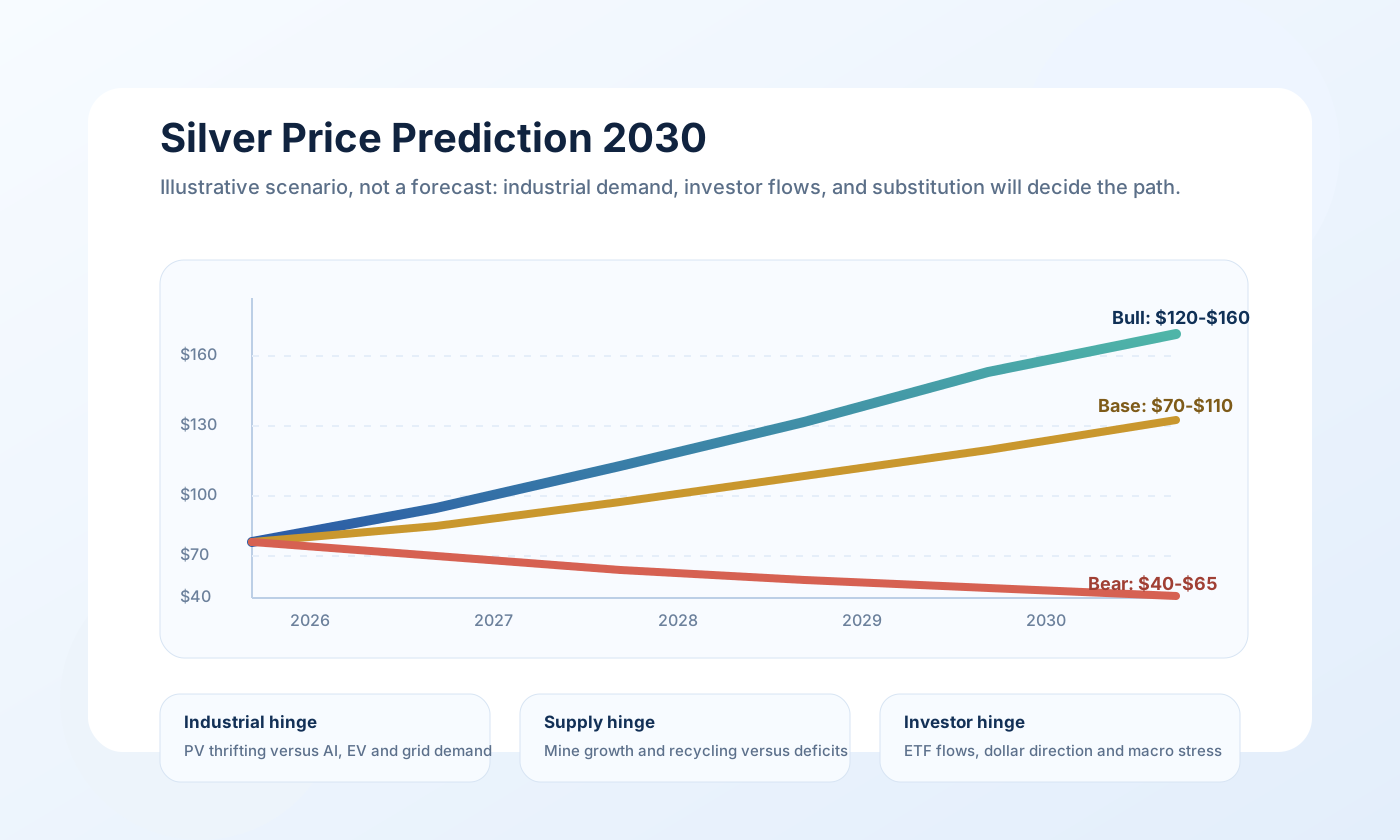
Three 2030 scenarios are more credible than one silver target
| Scenario | Illustrative 2030 range | Conditions required | Probability |
|---|---|---|---|
| Bull | $120-$160 | Deficits persist, ETF demand stays strong, EV and grid demand compounds, and PV thrifting slows versus expectations | 30% |
| Base | $70-$110 | Industrial growth remains positive overall, but substitution and recycling cap the rate of tightening | 45% |
| Bear | $40-$65 | Real yields stay high, macro risk fades, deficits narrow, and industrial users substitute aggressively | 25% |
The bull case is not impossible, especially because silver has a history of overshooting when a small market collides with genuine scarcity. But the evidence is mixed on one crucial point: solar capacity growth is clearly bullish for electrical demand, while solar silver intensity is clearly falling. The 2030 result depends on which side wins, and on whether investor demand adds fuel.
| Path | Probability | Reasoning |
|---|---|---|
| Higher than current structural regime | 55% | Deficits, electrification, and broader investor interest remain supportive |
| Lower after a cyclical unwind | 25% | High prices destroy demand faster than new uses replace it |
| Sideways but volatile | 20% | Physical balances stay tight but not tight enough to force a sustained repricing |
06. Investment Implications
Positioning should be scenario-based, not certainty-based
| Investor type | Prudent approach | What to watch |
|---|---|---|
| Investor already in profit | Consider hold or trim into strength; avoid assuming a straight line to triple digits | ETF inflows, lease rates, and signs of fabrication demand damage |
| Investor currently at a loss | Reassess thesis first; average only if the original deficit and industrial thesis still fits | World Silver Survey revisions and macro conditions |
| Investor with no position | Wait for pullbacks or scale in gradually; avoid chasing parabolic weeks | Real yields, dollar trend, and inventory tightness |
| Trader | Use stop-loss discipline and position sizing; silver can gap harder than gold | COMEX positioning and volatility spikes |
| Long-term investor | Dollar-cost averaging can make sense if used as a diversified satellite allocation | Industrial demand breadth beyond solar alone |
| Hedge-focused investor | Prefer measured exposure; silver is less stable than gold for pure hedging | Whether macro stress or industrial cyclicality is dominating |
Risks to watch are straightforward. PV substitution could outpace expectations. A strong dollar or higher real rates could crush investor appetite. Recycling could surprise on the upside if elevated prices persist. What would invalidate the bullish long-run thesis more decisively would be a combination of narrower deficits, slower power demand growth, and persistent evidence that silver is being designed out of key technologies faster than new uses emerge.
Conclusion: silver still has one of the more interesting 2030 setups in the commodity complex, but it is not a clean story. The evidence supports a constructive base case, not a certainty. A reasonable long-horizon framework is that silver remains structurally supported, experiences violent cyclical pullbacks, and can outperform consensus if electrification demand broadens faster than substitution.
Disclaimer: This article is for research and informational purposes only and does not constitute personalized investment advice or a recommendation to buy or sell any asset.
07. FAQ
Frequently asked questions
Can silver reach $100 by 2030?
Yes, available data suggests it is plausible, but it is not a base-case certainty. The market would likely need recurring deficits, healthy investor flows, and enough non-PV industrial demand to offset substitution.
Is silver mainly an industrial metal now?
No. It is more industrial than gold, but it still trades like a precious metal during macro shocks. That hybrid role is exactly why price swings can be so large.
What is the biggest bullish driver?
A persistent deficit combined with renewed ETF and bar-and-coin demand is the most powerful combination because the market is relatively small and inventory-sensitive.
What is the biggest bearish risk?
Faster-than-expected substitution in solar and other uses, especially if it arrives alongside a stronger dollar and firmer real yields.
References
Sources
- Silver Institute, World Silver Survey 2026
- Silver Institute, April 15 2026 press release on World Silver Survey 2026
- Silver Institute, February 10 2026 outlook for the silver market
- Silver Institute and Oxford Economics, Silver demand across technology sectors
- J.P. Morgan Global Research, How will silver prices fare in 2026?
- LBMA, 2026 Precious Metals Forecast Survey at a glance
- LBMA, 2026 Precious Metals Forecast Survey analyst forecasts
- IEA, Electricity 2026 executive summary
- U.S. EIA, January 2026 release on electricity demand growth and data centers
- World Bank, Commodity Markets Outlook April 2026