01. Quick Answer
The most reasonable SMI 2030 forecast is constructive, but it still depends on whether Swiss defensives can justify their premium from a mature starting point
The SMI closed at 13,220.17 on 2026-05-15, up from 8,020.15 at the start of its 10-year Yahoo Finance monthly series on 2016-06-01, for a price-only CAGR of about 5.12% (Yahoo Finance 10-year history; recent daily closes). That price-only compounding is respectable, but not euphoric, which fits the identity of the Swiss market.
A serious 2030 framework starts with two competing truths. The first is that the SMI still contains some of the most trusted franchises in Europe, led by Nestlé, Roche, and Novartis. The second is that the benchmark remains concentrated, defensive, and currency-sensitive enough that upside should be modeled as a range, not a certainty.
| Point | Why it matters |
|---|---|
| The SMI is safer in composition, not immune in price | Defensive sector mix reduces cyclicality, but valuation and concentration risk still matter. |
| Healthcare and staples still dominate | Roche, Novartis, and Nestlé shape the benchmark much more than Swiss GDP alone does. |
| Safe-haven status is a double-edged sword | Franc strength and capital inflows can support valuation while pressuring exporters' reported growth. |
| 2030 should be framed as scenarios | Available data suggests resilience, but not a one-way compounding story. |
02. Historical Context
The SMI has already delivered a long period of steady compounding, so the 2030 debate is about durability rather than recovery
The SMI closed at 13,220.17 on 2026-05-15, up from 8,020.15 at the start of its 10-year Yahoo Finance monthly series on 2016-06-01, for a price-only CAGR of about 5.12% (Yahoo Finance 10-year history; recent daily closes). The significance of that path is not explosive upside. It is resilience across cycles that included the pandemic, inflation shocks, and a volatile global rates regime.
SIX methodology and market material show that the SMI remains a concentrated benchmark shaped by 20 blue chips, with caps to avoid excessive dominance but still clear weight concentration in the largest names. That matters because the index is not a broad representation of all Swiss corporate activity. It is a curated concentration of multinational defensives, healthcare innovators, and financial franchises.
Historical returns also warn against simply extending the same path forward. A market that compounds through stability can still underperform for years if defensives derate or if the franc remains too strong. The realistic 2030 discussion is therefore about whether quality and safe-haven status continue to deserve a premium.
| Metric | Latest reading | Why it matters |
|---|---|---|
| Current index level | 13,220.17 | Anchors every forecast to the latest available close rather than an old safe-haven narrative. |
| 52-week range | 11,612.00 to 14,063.53 | Shows the SMI is already close to its upper historical zone and not simply a depressed value market. |
| 10-year start point | 8,020.15 | Provides discipline around long-run compounding assumptions. |
| Editorial base range | 14,300-15,600 | A scenario range is more credible than a one-number target in a concentrated defensive index. |
| Feature | Implication | Forecast effect |
|---|---|---|
| Heavy healthcare and staples exposure | Roche, Novartis, and Nestlé dominate the benchmark | Defensive quality can cushion drawdowns but can also cap upside during aggressive growth rallies. |
| Swiss franc safe-haven effects | Currency strength can help capital inflows while pressuring exporters' translation | The market can trade like a defensive shelter and an earnings headwind at the same time. |
| Concentration in a few large franchises | Top names drive more of the index than many casual observers assume | A small number of earnings stories can dominate the whole market path. |
| Insurance and financial resilience | UBS, Zurich, and Swiss Re add capital-markets and balance-sheet exposure | Rates, regulation, and safe-haven flows matter more than Swiss GDP alone. |
03. Main Drivers
Five structural drivers are most likely to shape the Swiss benchmark into 2030
1. The health of healthcare giants. Roche and Novartis matter because healthcare remains the cleanest structural growth and defensiveness channel in the index.
2. Nestlé's ability to restore steadier growth. Nestlé still shapes the staples side of the benchmark and influences whether the SMI behaves like a resilient compounding market or a slower-growth defensive trade.
3. Safe-haven capital flows and the Swiss franc. SNB material keeps reminding investors that currency conditions matter. Safe-haven inflows can help multiples while stronger CHF can hurt translation.
4. Insurance and banking execution. UBS, Zurich Insurance, and Swiss Re can support the index if balance-sheet strength and pricing discipline remain intact.
5. Industrial and electrification exposure still matters. ABB adds a more cyclical but strategically relevant automation and electrification channel to an otherwise defensive-heavy benchmark.
04. Institutional Forecasts and Analyst Views
Official Swiss macro projections are measured, so any 2030 upside still needs company execution more than domestic excitement
The institutional evidence base is constructive but modest. OECD, IMF, KOF, and SNB all support the idea of continued Swiss resilience, but not a domestic boom.
Analysts remain divided because the evidence is mixed. Switzerland still deserves some premium because of institutional stability and franchise quality, yet the market's concentration and defensive nature can limit upside in growth-led global tapes. The most defensible 2030 estimate is therefore a moderate range above current levels rather than an aggressive breakout target.
| Source | What it says | Implication for SMI |
|---|---|---|
| OECD | Swiss growth should recover progressively, but stay moderate | Supports resilience rather than euphoric market assumptions. |
| IMF | Switzerland remains strong but externally exposed | Confirms that safe-haven status does not eliminate global dependence. |
| SNB | Inflation remains low and policy conditions relatively contained | Helps justify defensive valuations, though CHF strength still matters. |
| Company updates | Healthcare, staples, finance, and industrial leaders remain operationally solid | Supports a constructive base case if valuation stays disciplined. |
05. Scenarios, Risks, and Invalidation
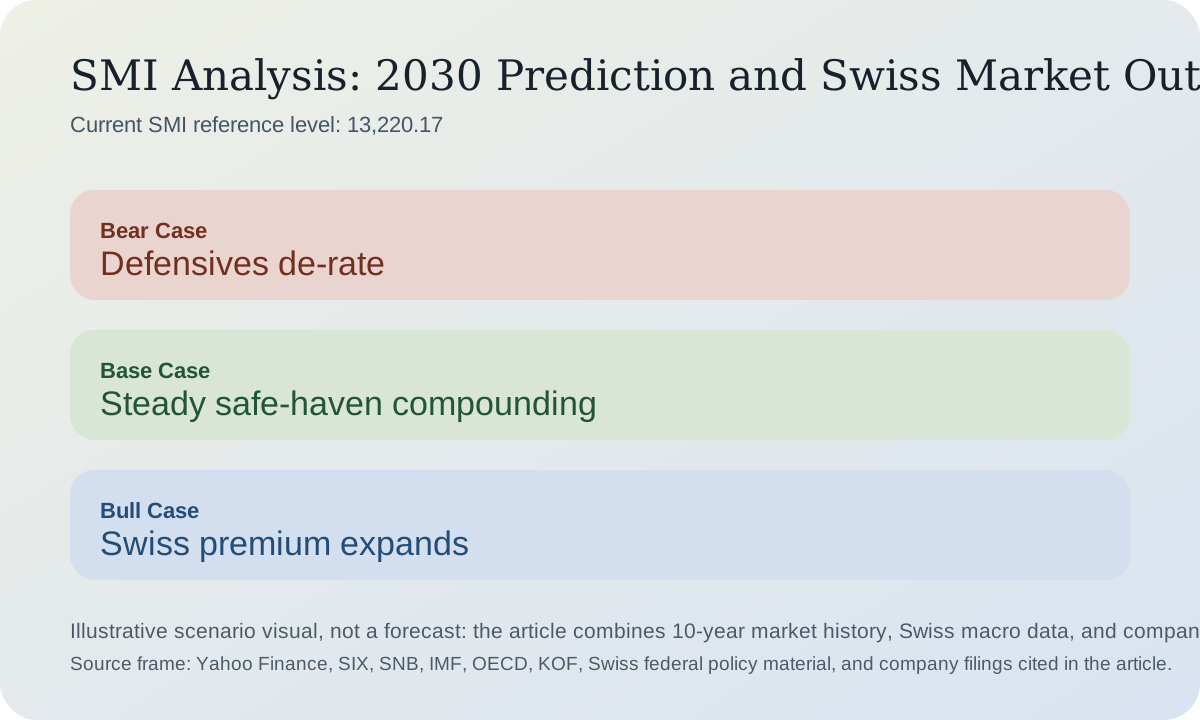
Bull, bear, and base cases imply a 2030 range because safety does not eliminate valuation risk
Bullish scenario
The bull case for 2030 is roughly 15,900 to 17,200. This scenario depends heavily on healthcare strength, more stable Nestlé growth, sustained safe-haven flows, and continued financial-sector resilience.
Bearish scenario
The bear case is 11,800 to 12,900. That path would likely require defensive de-rating, franc pressure on multinationals, and weaker growth from the largest healthcare and staples names.
Base-case scenario
The base case is 14,300 to 15,600. That assumes moderate earnings growth, continued premium quality, and no major macro or currency accident.
Risks to watch
Watch CHF strength, healthcare pricing pressure, Nestlé's volume and mix recovery, insurance pricing, and whether global investors continue to pay a premium for Swiss defensiveness.
What could invalidate the forecast
This range would be too optimistic if the SMI's largest franchises fail to grow through currency pressure and cost discipline challenges. It would be too conservative if safe-haven demand and healthcare execution both remain stronger than expected.
Conclusion
The most credible SMI 2030 outlook is constructive, but not flashy. Switzerland still offers an unusually defensive mix of global blue chips, yet the market's concentration and valuation profile argue for range-based forecasting rather than certainty.
Disclaimer: This article is for research and informational purposes only. Scenario ranges are editorial judgments based on public information, not guarantees or personalized investment advice.
| Scenario | Range | Key conditions | Probability |
|---|---|---|---|
| Bull | 15,900-17,200 | Healthcare and staples strength plus sustained safe-haven premium | 25% |
| Base | 14,300-15,600 | Moderate defensive compounding and stable CHF conditions | 50% |
| Bear | 11,800-12,900 | Defensive de-rating and weaker growth from the heaviest weights | 25% |
| Path | Estimated probability | Why |
|---|---|---|
| Rising from current levels by 2030 | 55% | The index still contains durable franchises and strong balance-sheet businesses. |
| Falling below current levels by 2030 | 20% | A lower 2030 level likely requires defensive de-rating plus slower healthcare-staples growth. |
| Moving broadly sideways | 25% | Possible if quality earnings are offset by a flatter valuation regime. |
06. Investor Positioning
Different investor profiles should treat the SMI differently into 2030
| Investor type | Cautious approach | What to watch |
|---|---|---|
| Investor already in profit | Hold core exposure but trim if defensive names have created too much concentration. | How much of the position depends on a few healthcare and staples leaders. |
| Investor currently at a loss | Separate timing error from thesis quality before averaging down. | If the thesis was safe-haven resilience, test whether that still holds at current valuations. |
| Investor with no position | Build exposure in stages or wait for pullbacks rather than paying any price for safety. | Franc strength, valuation, and earnings breadth. |
| Trader | Use stop-losses and trade around earnings, SNB headlines, and CHF swings. | The SMI moves less explosively than growth indices, but concentration still matters. |
| Long-term investor | Dollar-cost averaging is more defensible than all-in timing calls. | Total return, including dividends and defensive durability. |
| Risk-hedging investor | Use dedicated hedges and rebalance rather than assuming Swiss equities alone hedge all risk. | Currency exposure and sector concentration. |
07. FAQ
Frequently asked questions about the SMI outlook
Is the SMI mainly a safe-haven trade?
Partly, but not only. It is also a concentrated portfolio of healthcare, staples, and financial franchises with global earnings exposure.
Why use scenario ranges rather than one 2030 target?
Because a concentrated defensive index can be helped by safe-haven flows and hurt by valuation or currency at the same time.
What matters most right now for the SMI?
Healthcare execution, Nestlé's growth trajectory, Swiss franc strength, and whether investors keep paying for defensive quality.
References
Sources
- Yahoo Finance chart API for ^SSMI, 10-year monthly history
- Yahoo Finance chart API for ^SSMI, recent daily closes
- SIX SMI overview page
- SIX SMI methodology 2026
- SIX Exchanges Figures February 2026
- Swiss National Bank Quarterly Bulletin 1/2026
- IMF 2025 Article IV consultation for Switzerland
- OECD Switzerland economic snapshot
- KOF Spring 2026 economic forecast
- Federal Council adopts Digital Switzerland Strategy 2026
- Swiss AI regulation overview
- Nestlé three-month sales 2026
- Roche first quarter sales 2026
- Novartis Q1 2026 results
- UBS first-quarter 2026 results
- ABB Q1 2026 results
- Zurich Insurance May 2026 operating update
- Swiss Re Q1 2026 results