01. Quick Answer
The most realistic 2035 SMI forecast is higher than today, but the path depends on durable quality more than on broad economic acceleration
The SMI closed at 13,220.17 on 2026-05-15, up from 8,020.15 at the start of its 10-year Yahoo Finance monthly series on 2016-06-01, for a price-only CAGR of about 5.12% (Yahoo Finance 10-year history; recent daily closes). That performance looks almost modest next to more cyclical growth markets, but it is consistent with Switzerland's role as a quality-heavy safe-haven benchmark.
The long-range institutional backdrop is cautious but constructive. OECD, IMF, KOF, and SNB all support the idea of a stable but not explosive Swiss macro base. That combination argues for constructive long-run compounding inside a broad range.
| Point | Why it matters |
|---|---|
| 2035 is a regime question, not a one-year target | Safe-haven flows, healthcare execution, and valuation discipline matter more than one quarter of data. |
| The SMI's quality can still compound | Defensive blue chips often produce slower but steadier long-run outcomes than more cyclical benchmarks. |
| The bear case is still real | Currency strength and defensive de-rating can weigh on a concentrated benchmark for years. |
| Total return likely matters more than headline excitement | Dividends and stability remain an important part of the SMI case. |
02. Historical Context
The last decade proves the SMI can compound steadily, but a nine-year forecast needs a slower and more disciplined logic
The SMI closed at 13,220.17 on 2026-05-15, up from 8,020.15 at the start of its 10-year Yahoo Finance monthly series on 2016-06-01, for a price-only CAGR of about 5.12% (Yahoo Finance 10-year history; recent daily closes). The historical lesson is not that Switzerland suddenly becomes a high-beta market. It is that resilience can still compound when paired with high-quality global franchises.
SIX market material and company disclosures show why. The SMI is a concentrated mix of healthcare, staples, insurance, banking, and industrial automation. That means the benchmark often benefits when global investors want quality and balance-sheet strength, but it can also lag when the market pays more for cyclical or technology beta.
The more cautious lesson is that mature defensive markets rarely compound in a straight line. A credible 2035 framework must therefore allow for steady earnings quality alongside long stretches of valuation digestion and currency-related earnings pressure.
| Metric | Latest reading | Why it matters |
|---|---|---|
| Current index level | 13,220.17 | Anchors every forecast to the latest available close rather than an old safe-haven narrative. |
| 52-week range | 11,612.00 to 14,063.53 | Shows the SMI is already close to its upper historical zone and not simply a depressed value market. |
| 10-year start point | 8,020.15 | Provides discipline around long-run compounding assumptions. |
| Editorial base range | 16,000-18,800 | A scenario range is more credible than a one-number target in a concentrated defensive index. |
| Feature | Implication | Forecast effect |
|---|---|---|
| Heavy healthcare and staples exposure | Roche, Novartis, and Nestlé dominate the benchmark | Defensive quality can cushion drawdowns but can also cap upside during aggressive growth rallies. |
| Swiss franc safe-haven effects | Currency strength can help capital inflows while pressuring exporters' translation | The market can trade like a defensive shelter and an earnings headwind at the same time. |
| Concentration in a few large franchises | Top names drive more of the index than many casual observers assume | A small number of earnings stories can dominate the whole market path. |
| Insurance and financial resilience | UBS, Zurich, and Swiss Re add capital-markets and balance-sheet exposure | Rates, regulation, and safe-haven flows matter more than Swiss GDP alone. |
03. Main Drivers
Six long-range forces are likely to decide where the SMI stands by 2035
1. Healthcare innovation and execution. Roche and Novartis remain central because their earnings quality can support the whole benchmark over long horizons.
2. Whether Nestlé restores a cleaner growth profile. Staples leadership matters because Nestlé still carries heavyweight symbolic and practical importance for Swiss equities.
3. Safe-haven capital flows and the franc. Switzerland's reputation can keep supporting valuation, but CHF strength can also remain a long-run earnings headwind.
4. The future of Swiss financial champions. UBS, Zurich, and Swiss Re matter for whether the index remains merely defensive or also attractive on capital return.
5. Industrial digitalization and electrification. ABB gives the benchmark more cyclical and technology-adjacent optionality than many investors assume.
6. Policy and digital competitiveness. Swiss digital strategy and AI-regulation choices can matter more over a decade than in a single year.
04. Institutional Forecasts and Analyst Views
The best 2035 framework combines official Swiss stability with the unusual quality and concentration of the SMI
There are few credible long-dated institutional point targets for the SMI, which is normal. The more defensible approach is to combine OECD, IMF, KOF, and major constituent execution rather than forcing false precision.
Analysts remain divided because the evidence is mixed. Switzerland still offers one of Europe's cleanest quality profiles, yet the SMI remains concentrated enough that slower growth or a change in defensive valuations can matter for years. The long-range base case therefore assumes respectable compounding with multiple phases of consolidation.
| Source | What it implies | Why it matters |
|---|---|---|
| OECD and IMF | Swiss stability should persist, but growth stays moderate | Supports long-run resilience without promising aggressive upside. |
| SNB and KOF | Low inflation and steady macro conditions remain plausible | Helps the quality premium, though CHF strength still matters. |
| SIX methodology | The benchmark remains highly concentrated in 20 names | Long-run outcomes depend on a small set of franchises. |
| Company updates | Healthcare, staples, finance, and automation all provide identifiable drivers | Index performance can rest on several earnings channels rather than only one macro story. |
05. Scenarios, Risks, and Invalidation
A long-range bull case exists, but the base case still assumes years of defensive valuation digestion
Bullish scenario
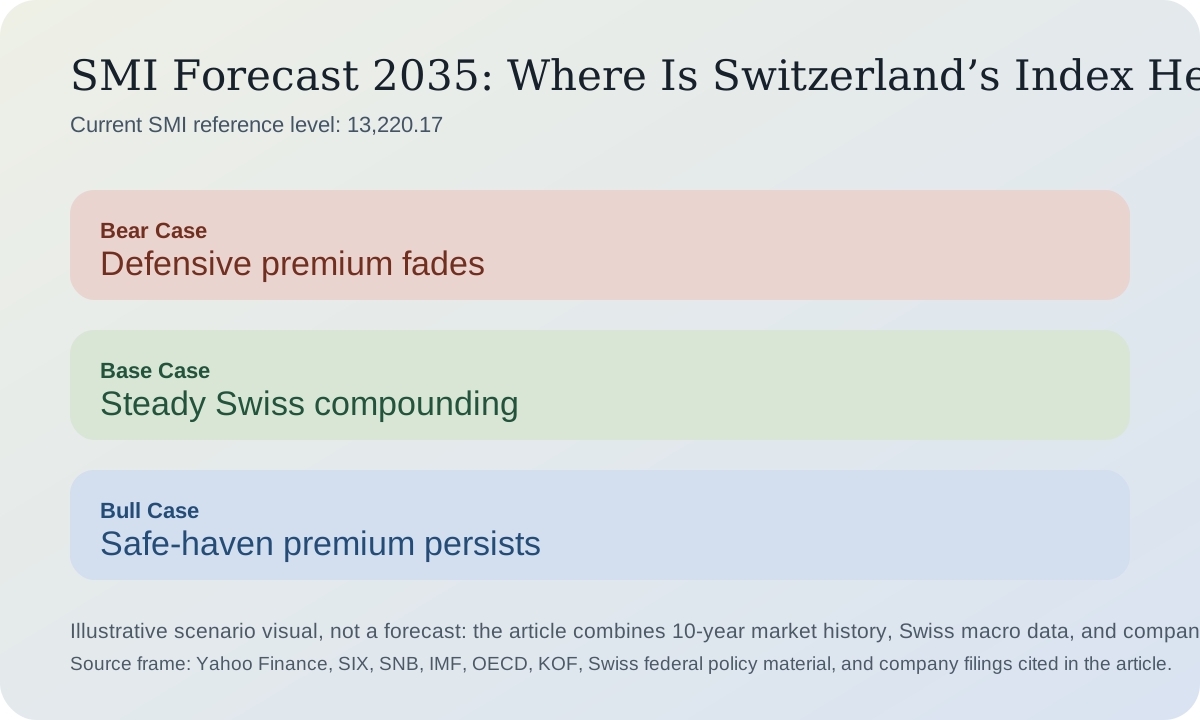
The long-range bull case is 19,000 to 21,500 by 2035. This would likely require sustained healthcare innovation, cleaner Nestlé growth, continued safe-haven inflows, and a supportive capital-return story from financials.
Bearish scenario
The bear case is 12,500 to 14,200. That would imply a prolonged defensive de-rating, stronger franc pressure on multinational earnings, and weaker-than-expected execution at the heaviest weights.
Base-case scenario
The base case is 16,000 to 18,800. That assumes slow but durable earnings growth, recurring dividends, and periodic valuation resets that do not break the thesis.
Risks to watch
Watch healthcare pipelines, consumer pricing power, franc strength, banking regulation, and whether global investors continue to treat Switzerland as a quality refuge.
What could invalidate the forecast
The range would be too optimistic if defensive valuation compression becomes a multiyear drag and earnings fail to compensate. It would be too conservative if healthcare, insurance, and capital-light compounders sustain stronger growth than current assumptions allow.
Conclusion
The most credible 2035 SMI view is constructive, but only inside a broad range. Switzerland can still deliver respectable long-run returns, yet concentration and currency effects make range-based analysis more honest than one precise number.
Disclaimer: This article is for research and informational purposes only. Long-range scenarios are conditional frameworks, not guarantees or individualized advice.
| Scenario | Range | Conditions | Probability |
|---|---|---|---|
| Bull | 19,000-21,500 | Healthcare leadership, stable CHF conditions, and sustained safe-haven premium | 20% |
| Base | 16,000-18,800 | Steady defensive compounding with valuation pauses | 50% |
| Bear | 12,500-14,200 | Defensive de-rating and slower growth from the dominant weights | 30% |
| Direction | Probability | Comment |
|---|---|---|
| Higher than today by 2035 | 60% | Nine years is enough time for Swiss quality and cash generation to matter. |
| Lower than today by 2035 | 15% | This likely requires persistent valuation compression and weaker healthcare-staples execution. |
| Sideways to moderate gains | 25% | Still plausible because safe-haven markets can digest gains for long periods. |
06. Investor Positioning
A long horizon changes how investors should think about the SMI
| Investor type | Cautious approach | What to watch |
|---|---|---|
| Investor already in profit | Rebalance concentration and let defensive quality keep a role without dominating the whole portfolio. | How much exposure sits in the top healthcare and staples names. |
| Investor currently at a loss | Check whether the thesis is long enough to justify holding through valuation resets. | Short-term underperformance does not always invalidate a 2035 case. |
| Investor with no position | Use staged entries instead of paying any price for safety. | Valuation and franc sensitivity matter over a nine-year horizon. |
| Trader | Do not confuse a decade scenario with a short-term setup. | The SMI can remain structurally attractive while still correcting over months. |
| Long-term investor | Dollar-cost averaging and periodic rebalancing remain the most defensible approach. | Total return, dividends, and concentration management. |
| Risk-hedging investor | Pair SMI exposure with explicit hedges if currency or healthcare concentration risk is uncomfortable. | CHF swings and sector concentration. |
07. FAQ
Frequently asked questions about the SMI outlook
Can the SMI still compound after a decade of steady gains?
Yes, but probably at a moderate pace. Swiss quality can still work without delivering high-beta returns.
What matters most over a nine-year horizon?
Healthcare execution, Nestlé's trajectory, safe-haven flows, financial-sector capital return, and the Swiss franc.
Why not give one exact 2035 target?
Because a concentrated defensive index can plausibly move through multiple valuation regimes before 2035.
References
Sources
- Yahoo Finance chart API for ^SSMI, 10-year monthly history
- Yahoo Finance chart API for ^SSMI, recent daily closes
- SIX SMI overview page
- SIX SMI methodology 2026
- SIX Exchanges Figures February 2026
- Swiss National Bank Quarterly Bulletin 1/2026
- IMF 2025 Article IV consultation for Switzerland
- OECD Switzerland economic snapshot
- KOF Spring 2026 economic forecast
- Federal Council adopts Digital Switzerland Strategy 2026
- Swiss AI regulation overview
- Nestlé three-month sales 2026
- Roche first quarter sales 2026
- Novartis Q1 2026 results
- UBS first-quarter 2026 results
- ABB Q1 2026 results
- Zurich Insurance May 2026 operating update
- Swiss Re Q1 2026 results